
1. Background
Adolescence is a significant period for brain development. The immaturity of parts of the frontal lobe leads to poor decision-making, increasing teenagers' tendency to exhibit risky behaviors. Behaviors such as smoking, drinking alcohol, and substance abuse are often initiated during adolescence and continue into adulthood. According to the United Nations Children’s Fund (UNICEF), around half of those who began smoking in adolescence continue to smoke until 15 years old (1).
In Indonesia, the estimated prevalence of smoking among youth aged 10 - 18 increased from 7.2% in 2013 to 9.1% in 2018 (2). The global youth tobacco survey (GYTS) in 2014 stated that out of 32.1% of students who used any smoked tobacco product, 20.3% are active tobacco users. The majority, over 43.2% of students, started smoking cigarettes at 12 - 13 years old, with boys being more likely than girls ever to use tobacco products (3).
There are no data on adolescent electronic cigarette users in Indonesia. However, Putra et al. found that 20.5% of high school students in Denpasar use e-cigarettes, of which 43.8% are male, and 6% are female (4). Factors that contribute to the increase in the use of e-cigarettes are related to the presence of friends or family members using e-cigarettes, variations in taste in e-cigarettes, and the perception that e-cigarettes are safer than other tobacco products (5).
Research done by the Columbia University National Centre on Addiction and Substance Abuse (CASA) in 2007 showed that smoking adolescents are twice as likely to experience a major depressive episode than non-smokers (6). Another study found that teenagers who fit the criteria for major depression had rates of daily cigarette intake between one and two times higher than those who did not (7). In Indonesia, the prevalence of depression among 15-year-olds is 6.1% (2).
Smoking, vaping, and depression are among the 26 health indicators used by the National Center for Health Statistics to determine a country's quality of life and health level (8). Knowing the prevalence of smoking, vaping, and depression among adolescents in Indonesia would make it possible to prevent the increase of such behaviors and be the foundation for decreasing the risk of this global burden disease in the future.
2. Objectives
This study aimed to describe the smoking and vaping behavior, and the experience of depressive symptoms among high school students in Jakarta.
3. Materials and Methods
3.1. Design and Setting
This descriptive-analytical research used a cross-sectional design and was conducted in two public and private high schools, two private vocational high schools, and one private Islamic high school from August to December 2017.
3.2. Sample and Data Collection Procedure
The population target of this research was teenagers aged between 10 and 19 in Indonesia. Three provinces were selected: Jakarta, West Java, and Banten. With a 95% confidence interval, the proportion of risky behavior according to previous studies was 41.7%, the margin of error was 3%, and the design effect was 2. Therefore, the sample size for this study based on the Lemeshow formula was 2080 (9). The population included 667 respondents, of whom 258 were eligible to participate in this study report, as the rest did not fit the inclusion criteria of having tried smoking or vaping.
3.2.1. Sampling Method Procedures
Firstly, sampling in this study was conducted randomly using the multistage sampling method. The procedure was as follows: The primary sampling unit was selected using stratified random sampling according to three provinces' level II regional strata (municipalities and districts). Two municipalities were chosen at random from the list of municipalities in DKI Jaya province. We selected six primary sample units as three municipalities and three regencies.
Secondly, we selected secondary sample units based on the list of sub-districts for each primary sample unit. A secondary sample unit was selected as one sub-district at random using the simple random sampling method.
Thirdly, tertiary sample units were chosen using stratified random sampling based on school strata, which included senior high school, vocational high school, and religious high school. Five schools were randomly selected based on the list obtained from the education office in each city. Based on the list of students (sampling frame) from each tertiary sample unit, 90 subjects were selected using the simple random sampling method.
Based on the inclusion criteria, students who tried smoking or vaping were selected. And those with a diagnosis of psychological disorders were excluded. Each respondent filled out the informed consent form, and consent was obtained from the subjects' parents or guardians.
3.3. Instruments
From 667 respondents, 258 (38.6%) met the inclusion criteria. A YRBS questionnaire developed by the Centers for Disease Control and Prevention (CDC) was used as the instrument of this study. The questionnaire contains questions on the characteristics of the respondents, youth-risk behaviors such as smoking and vaping, and the experience of depressive symptoms. Data collected from respondents was processed using SPSS version 24. A univariate analysis was used to describe the characteristics of the respondents, smoking and vaping behaviors, and depression. A bivariate analysis was also conducted to determine the correlation between smoking, vaping behaviors, and symptoms of depression.
4. Results
4.1. Characteristics of the Students
Characteristics of the students in this study are illustrated through their distribution by gender, age, type of school, grade in school, ethnicity, religion, place of residence, and household electrical power.
Table 1 shows that 258 of the chosen respondents were late adolescents, ranging in age from 15 to 19 years (98%), with the number of male students (72.8%) significantly higher than the number of female students (27.1%). Furthermore, most respondents were vocational school students (51.9%), and 37.9% were in grade 12.
Table 1.
Characteristics of the Respondents
| Variables and Categories | No. (%) |
|---|---|
| Age | |
| Early adolescent (10 - 14 years old) | 5 (1.9) |
| Late adolescent (15 - 19 years old) | 253 (98) |
| Gender | |
| Male | 188 (72.8) |
| Female | 70 (27.1) |
| Type of school | |
| High school | 107 (41.4) |
| Islamic high school | 17 (6.5) |
| Vocational school | 134 (51.9) |
| Grade in school | |
| 10 | 68 (26.3) |
| 11 | 92 (35.6) |
| 12 | 98 (37.9) |
| Ethnicity | |
| Javanese | 99 (38.3) |
| Sundanese | 38 (14.7) |
| Batavia | 69 (26.7) |
| Bataknese | 5 (1.9) |
| Minang | 22 (8.5) |
| Makassar/Bugis | 9 (3.4) |
| Chinese | 1 (0.3) |
| Malay | 1 (0.3) |
| Others | 14 (5.4) |
| Religion | |
| Islamic | 252 (97.6) |
| Catholic | 1 (0.3) |
| Christian | 5 (1.9) |
| Place of living | |
| With parents | 243 (94.1) |
| Without parents | 15 (5.8) |
| Household electricity power (Watt) | |
| No electricity | 2 (0.7) |
| 450 | 29 (11.2) |
| 900 | 53 (20.5) |
| 1300 | 79 (30.6) |
| 2200 | 37 (14.3) |
| > 2200 | 58 (22.4) |
Regarding social-economic background, the distribution of students based on ethnicity showed that most were of the Javanese race (38.5%), and based on religion, the majority were Muslims (97.6%). Moreover, most respondents lived with their parents (94.1%) and had household energy consumption of 1300 watts, suggesting a lower-middle-class family (30.6%).
4.2. Smoking Behavior Among Students
In terms of smoking behavior, the frequency of smoking was classified as “rarely smoking” when the respondent’s answer for the number of days smoked within the last 30 days was under 20 days and as “frequent smoking” when they smoked for 20 days or more (10).
Table 2 shows that 36.4% of the respondents tried smoking cigarettes for the first time at 13 - 14 or early adolescence. However, 27.5% finished one whole cigarette for the first time, and 22.8% smoked regularly at 15 - 16 years old or in late adolescence.
Table 2.
Smoking Behavior of the Respondents
| Categories | No. (%) |
|---|---|
| Have tried smoking even only one or two cigarettes | |
| Yes | 258 (100) |
| Age during the first time of trying cigarette even only one or two puffs (y) | |
| < 9 | 10 (3.8) |
| 9 - 10 | 34 (13.1) |
| 11 - 12 | 30 (11.6) |
| 13 - 14 | 94 (36.4) |
| 15 - 16 | 73 (28.2) |
| ≥ 17 | 9 (3.4) |
| Age during the first time of finishing one whole cigarette (y) | |
| < 9 | 3 (1.1) |
| 9 - 10 | 9 (3.4) |
| 11 - 12 | 32 (12.4) |
| 13 - 14 | 57 (22) |
| 15 - 16 | 71 (27.5) |
| ≥ 17 | 10 (3.8) |
| Age during the first time of smoking routinely (at least one cigarette a day for thirty days) (y) | |
| < 9 | 1 (0.3) |
| 9 - 10 | 2 (0.7) |
| 11 - 12 | 11 (4.2) |
| 13 - 14 | 35 (13.5) |
| 15 - 16 | 59 (22.8) |
| ≥ 17 | 17 (6.5) |
| Frequency of smoking within the last 30 days | |
| Rarely smoking | 203 (78.6) |
| Frequent smoking | 55 (21.5) |
| Source for obtaining cigarettes within the last 30 days | |
| Store | 114 (44.1) |
| Online | 1 (0.3) |
| Bought by others | 10 (10) |
| Borrowed | 9 (3.4) |
| Others | 2 (0.7) |
| Frequency of smoking in school area within the last 30 days | |
| Rarely smoking | 248 (96.1) |
| Frequent smoking | 10 (3.8) |
| Tried to stop smoking within the last 12 months | |
| Yes | 150 (58.1) |
| No | 108 (41.8) |
Within the last 30 days, 21.5% of the respondents smoked, and 3.8% smoked in the school area. The most frequent source of obtaining cigarettes was the store (44.1%), and within the last 12 months, 58.1% of them tried to stop smoking.
4.3. Vaping Behavior Among Students
In terms of vaping behavior, the frequency of vaping is classified as “rarely vaping” when the respondents' answer for the number of days they vaped within the last 30 days was under 20 days and as “frequent vaping” when they vaped for 20 days or more (10).
Table 3 shows that 70.5% of the respondents tried vaping before, and within the last 30 days, 8.1% vaped frequently, and the most frequent source for obtaining vape was through borrowing (29.4%).
Table 3.
Vaping Behavior of the Respondents
| Categories | No. (%) |
|---|---|
| Have tried vape | |
| Yes | 182 (70.5) |
| Frequency of vaping within the last 30 days | |
| Rarely vaping | 237 (91.8) |
| Frequently vaping | 21 (8.1) |
| Source for obtaining vape the last 30 days | |
| Store | 38 (14.7) |
| Online | 3 (1.1) |
| Bought by others | 1 (0.3) |
| Borrowed | 76 (29.4) |
| Given | 5 (1.9) |
4.4. Depressive Symptoms Among Students
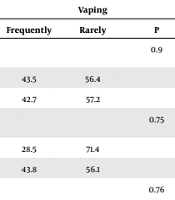
Based on Table 4, 32.9% of the students have felt sad or hopeless for two weeks in a row within the last 12 months. Guidelines for the Diagnostic and Statistical Manual of Mental Disorders, 5th Edition (DSM-5) lists this as one of the three most important signs of depression (11). The table also shows that within the last 12 months, 5.4% of students considered attempting suicide, 6.2% planned how they would attempt suicide, and 8.5% attempted suicide at least once.
Table 4.
The Depression Symptoms Experienced by Respondents Who Frequently Smoked and Vaped Within the Last 30 Days (n = 258) a
| Categories | Respondents | Smoking | Vaping | ||||
|---|---|---|---|---|---|---|---|
| Frequently | Rarely | P | Frequently | Rarely | P | ||
| Felt sad and hopeless every day for two weeks in a row within the last 12 months | 0.2 | 0.9 | |||||
| Yes | 32.9 | 54.1 | 45.8 | 43.5 | 56.4 | ||
| No | 67 | 47.9 | 52 | 42.7 | 57.2 | ||
| Considered attempting suicide within the last 12 months | 0.6 | 0.75 | |||||
| Yes | 5.4 | 35.7 | 64.2 | 28.5 | 71.4 | ||
| No | 94.5 | 50.8 | 49.1 | 43.8 | 56.1 | ||
| Made a plan of how they would attempt suicide within the last 12 months | 0.98 | 0.76 | |||||
| Yes | 6.2 | 37.5 | 62.5 | 18.75 | 81.2 | ||
| No | 93.7 | 50.8 | 49.1 | 44.6 | 55.3 | ||
| Attempted suicide within the last 12 months | 0.4 | 0.4 | |||||
| Yes | 8.5 | 45.4 | 54.5 | 40.9 | 59 | ||
| No | 91.4 | 50.4 | 49.5 | 43.2 | 56.7 | ||
a Values are expressed as %.
The students who experienced depressive symptoms were more likely to smoke than vape within the last 30 days. In particular, 54.1% of the frequent smokers experienced depressive symptoms of feeling sad or hopeless for two weeks, and 43.5% were active vapors. However, we found no significant correlation between smoking and vaping behaviors and the experience of depressive symptoms in this study (P > 0.05).
5. Discussion
This study found that most students aged 13 - 14 or in early adolescence tried smoking cigarettes, even for the first time. This study is consistent with the 2014 GYTS results, which found that the most frequent age for Indonesian teenagers first to try cigarettes was between 12 and 13 years old (3). The frontal lobe develops during early adolescence and is responsible for reasoning and making decisions, leading adolescents to be more inclined to act impulsively and not think rationally, making them more exposed to risky behaviors like smoking (1).
This study shows that 21.5% of students frequently smoked in the last 30 days. This proportion is higher than the study of Indonesian students aged between 13 and 15 years conducted by GYTS in 2014, which was 1.8% (6). In contrast to the GYTS study, where early adolescents made up the majority of the sample, the current study's sample consisted primarily of late adolescents (98%), showing that more pupils engaged in smoking behavior (12). In addition, the sample of this study was also dominated by men (72.8%), in following with the study by Harsanti and Wicaksono on Indonesian students, which found that smoking was more prevalent in males (13), indicating that the frontal lobe develops more slowly in males. Hence, men tend to act impulsively and not think critically compared to females (1).
Of the 258 respondents who had smoked, 70.5% tried vaping, which was lower than the research by Putra et al. in Denpasar, who found that 94.7% of Denpasar's teenagers had previously smoked electric cigarettes (4). This study also found that 8.1% of students frequently vaped within the last 30 days, which is higher than the results of research on American students conducted by YRBS (2017), which found that 3.3% of students frequently vaped (14). The high prevalence of vaping can be related to adolescent perceptions about e-cigarettes, specifically that e-cigarettes are safer than conventional cigarettes and can help conventional smokers quit smoking, persuading teens with good mental health to prefer e-cigarettes (4, 15, 16).
This study did not analyze the relationship between cigarette smoking, vaping, and depressive symptoms. However, animal studies have shown that in adolescent mice, the signaling receptor nicotinic acetylcholine (nAChR), which is involved in various neurobiological systems implicated in the pathophysiology of depression (17), is still changing actively. The functional activity of nAChR in these adolescent mice is higher compared to adult mice. So, nicotine is more likely to cause long-term changes in parts of the brain that are still developing in teenagers (16).
Long-term use of nicotine can cause decreased synthesis and release of serotonin in the hippocampus area and decreased serotonergic neuron firing in the midbrain raphe nucleus (18, 19). Serotonin is a neurotransmitter that regulates emotions; it indirectly affects mood through processing emotional information in the brain. In individuals with abnormal serotonin states, negative emotional processing can occur, so low serotonin levels are associated with depression and an increase in one's predisposition to suicide attempts (18, 20).
This study found that 32.9% of students had depressive symptoms, such as feeling sad or hopeless for two weeks, more than the 21.3% found in a 2007 study of Indonesian students by the global school-based student health survey (GSHS) (21). While the frequency of depressive symptoms in the form of suicide intents (5.4%) is nearly identical to the results of the 2015 GSHS study (5.14%), the prevalence of creating a suicide plan (6.2%), and attempting suicide (8.2%) is greater than the study results (5.54% and 2.39%) (22).
Students who smoked cigarettes reported experiencing more depressive symptoms than those who used electronic cigarettes. The proportion was higher for smoking because more respondents had tried smoking rather than vaping. One reason students start vaping is that they used to smoke cigarettes. Therefore, students who vape may have started smoking before or begun vaping while still smoking. In addition, the affordability of cigarettes is higher than that of vaping, and cigarettes are much cheaper. In Indonesia, people, even teenagers, can easily buy cigarettes and vape. The tobacco law is not strictly applied (23). Affordability, also accessibility affect smoking and vaping behaviors (24).
Most students who experienced feeling sad or hopeless for two weeks in the last 12 months were frequent smokers, which can be caused by self-medication, where unhappy individuals are encouraged to consume cigarettes to get the acute effects of nicotine. Acute nicotine consumption triggers dopamine release, giving smokers a sense of comfort and thereby eliminating the feeling of sadness until the effect disappears (7, 24). Murphy et al. state that the effect of removing feelings of dysphoria from nicotine is very strong, to the point that it could encourage someone to start or continue the behavior of smoking (25).
In this study, we only looked at the emergence of depressive symptoms expressed by students that were not confirmed by expert examination, so it is not yet a diagnosis of depression. However, the symptoms disclosed are the main symptoms of depression, ranging from sadness, and hopelessness to suicidal ideation, and suicide attempts.
Smokers or vapers might experience depressive symptoms. Fergusson et al. in New Zealand reported that depressive symptoms and smoking behavior could be attributed to risk factors such as sex, race, comorbidity with anxiety and alcohol use, association with certain peers, and the experience of bad events in life, especially in childhood. These factors, alone or together, can cause depression symptoms, smoking, and vaping behavior (26).
This research was conducted in an urban setting in Jakarta, the capital city and busiest area in Indonesia. Regarding social-economy background, the students are from lower middle-class families. As mentioned by Rahim et al., one of the significant predictors of smoking behaviors in urban areas is economic status, in which smokers predominantly come from middle- and low-income families (27). Further research needs to be done to ascertain the causes of experiencing depressive symptoms, smoking, and vaping behaviors in high school students in Jakarta.
5.1. Conclusions
In conclusion, most students in Jakarta tried smoking cigarettes for the first time during early adolescence (13 - 14 years old). They are more likely to become frequent smokers or vapers. Moreover, those who frequently smoked or vaped experienced more depression than those who rarely smoked. Smoking behavior at a very young age poses a risk to overall health. The findings of this study should serve as a wake-up call for those working to prevent diseases caused by smoking behavior. Factors such as youth characteristics, socioeconomic background, and urban setting may contribute to developing smoking and vaping behaviors or depressive symptoms.