
1. Background
Attention deficit hyperactivity disorder (ADHD) is one of the most common psychiatric problems in school - aged children (1). ADHD is a developmental disorder characterized by inattention, impulsivity and hyperactivity. The global prevalence of this disorder in school - age children is 4 - 8%. The symptoms continue into adolescence and adulthood in 50 - 80% of cases (2). According to Meysamie et al. of 1403 Iranian children aged 3 - 6 years, 362 (25.8%) were classified as having ADHD symptoms according to their parent evaluation and 239 17% according to their teacher’s evaluation (3). The prevalence of the disorder in Tabriz is estimated 9.7% among children and 3.8% in adults (4, 5). ADHD is a heterogeneous neurobehavioral disorder and symptoms are different in boys and girls. Many studies showed that girls had significantly lower scores in attention problems. Delinquent behavior, aggressive behavior, and externalizing problems were frequent in boys (6).
ADHD is a multifactorial disorder, including psychological, environmental and genetic factors (7). Several studies have shown that genetic factors contribute to 80% of this disorder’s phenotype (8-10). The data obtained from study of families and twins have shown that ADHD has a strong genetic predisposition, so that an amount of 60 - 90% have been reported by some authors (9, 11).
Several studies have shown that neural pathways of catecholamines are involved in the neurobiological basis of the disorder including dopamine and norepinephrine neurotransmitters that are involved in neurological function, concentration and awareness (12).
Polymorphism of DAT1, DBH, DRD4 and DRD5 genes has been reported as important genetic factors in the etiology of ADHD (7). DAT1 is one of the most studied genes located on chromosome 5 (13). It is one of the main regulators of dopamine transport in the synaptic space, its expression is limited to the central nervous system and is mainly expressed in the midbrain dopamine neurons. This major transporter performs its task by reuptaking dopamine and controlling its amount in synaptic space. Imbalance in the dopaminergic system creates other neurological disorders, including ADHD, schizophrenia, bipolar disorder and Parkinson disease (14).
Some studies have shown the increased density of DAT1 in the brain of ADHD patients compared with healthy people (15). But there is no definite result regarding the extent of penetration of this polymorphism in the disorder. However, numerous studies have shown a weak relationship or even the lack of relationship between DAT1 polymorphism and ADHD (16). But it is not yet clear whether the negative results are due to differences in groups and populations with different races, genetics and heterogeneity or because of weakness in performing and interpreting statistical tests or they really represent an actual difference between different communities. Therefore, the present study aimed to examine the relationship between DAT1 gene polymorphism in children with ADHD in Northwest Iran. Also we examined the association between 10 or 9 - repeat allele of a variable number tandem repeat (VNTR) polymorphism in the 3’ - untranslated region (UTR) of the DAT1 gene and ADHD.
2. Methods
2.1. Samples
A total of 130 children with ADHD from northwestern Iran, who were referred to the psychiatrc clinic and diagnosed according to the Diagnostic and Statistical Manual (DSM - 5) by the child and adolescent psychiatrists, were introduced as the experimental group. Also, 130 healthy children with a similar mean age were considered as the control group. The control group was selected from non - psychiatric patients who were referred to the Children’s Hospital affiliated to Tabriz University of Medical Sciences for adenotonsillectomy and required routine lab tests. The ADHD case selection was performed by the same child and adolescent psychiatrist.
The participants were selected through the convenience sampling method according to inclusion and exclusion criteria. Since all participants were children, written informed consents were obtained from their parents. This study was verified by the scientific and Ethics Committee of Tabriz University of Medical Sciences as a doctoral thesis.
2.2. Inclusion Criteria
- ADHD, diagnosed based on criteria specified in DSM - 5 through clinical interviews by child and adolescent psychiatrists and the semi - structured interview form SADS - K - PL.
- Age range 4 to 14 years.
2.3. Exclusion Criteria
1. History of head trauma. 2. Psychiatric comorbidity. 3. History of epilepsy. 4. Serious medical illness. 5. Mental retardation.
2.4. Gene Amplification via PCR - VNTR
First of all, 2 mL of peripheral blood was collected from the children in EDTA - containing tubes and stored at -20°C. DNA was extracted using the saturated salt extraction technique. The samples were electrophoresed on 1% agarose gel to be ensured of extraction (Figure 1).
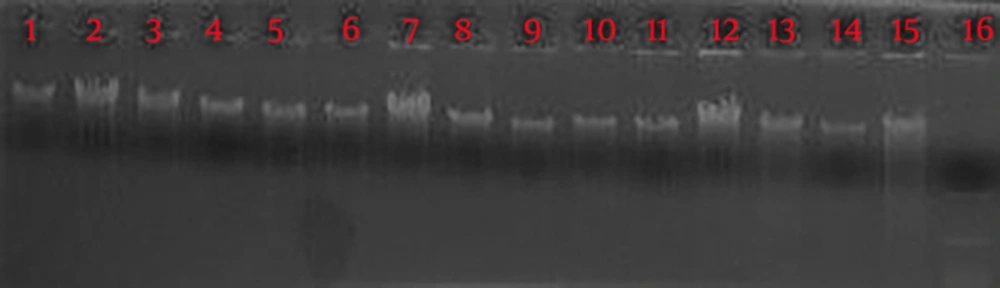
Figure 1.
Electrophoresis of the Extracted DNA Samples
Table 1 represents the pair of primers used for amplification of DAT1 gene at 3’ UTR region.
Table 1.
The Used Pair of Primers
| Primer | Sequence | Length (base) |
|---|---|---|
| Forward | GCACAAATGAGTGTTCGTGCATGTG | 25 |
| Reverse | AGCAGGAGGGGCTTCCAGGC | 20 |
DNA amplification was performed by polymerase chain reaction (PCR) in 20 µL solution containing 150 ng extracted genomic DNA in the Ampliqon master mix (Denmark) and 0.5 mL of each primer using the thermal program shown in Table 2.
Table 2.
The Thermal Program Used for Amplification
| Cycle No. | Step | Temperature | Time |
|---|---|---|---|
| 1 | Initial denaturation | 94°C | 5 min |
| 30 | Denaturation | 94°C | 45 sec |
| Annealing | 94°C | 45 sec | |
| Extension | 94°C | 45 sec | |
| 1 | Final extension | 72°C | 10 min |
After gene amplification, the PCR products repeats in 2% agarose gel were stained with ethidium bromide and observed under UV light.
2.5. Statistical Analysis
The results of the number of gene products in each sample were entered in SPSS - 21. The data were calculated based on the number and frequency, and the obtained means were analyzed using χ2 test. P values less than 0.05 were considered significant.
3. Results
A total of 260 children, including 130 children in the case group and 130 healthy children (control group) were investigated in this study. From 130 samples in the case group, 6 samples did not respond to PCR, so 124 samples were considered in the calculations. Similarly, of 130 healthy samples, one did not respond to PCR and hence 129 samples were entered into the calculations.
The mean age of children in the case and control group was 7.64 ± 2.35 and 7.52 ± 2.02 years, respectively (P = 0.66). Results of the samples amplified and digested by the restriction enzyme in the case and control groups are shown in Figure 2.
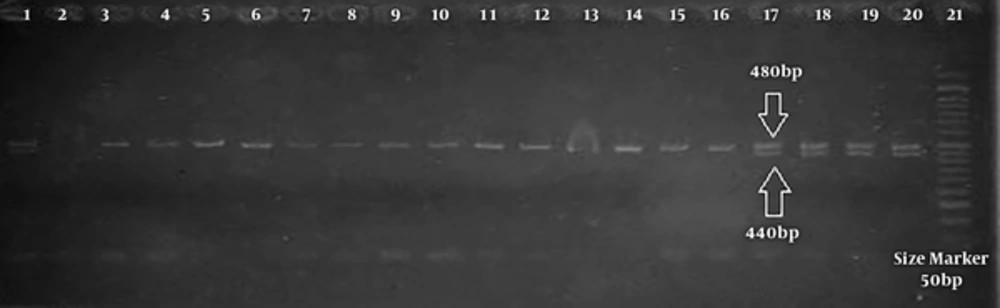
Figure 2.
Lane 2, No Response To PCR; Lanes 3 to 16, 9 - Fold Repeats; Lanes 1 and 17 - 20, 10 - Fold Repeats in the Control Group; Lane 21, 50 Bp Size Marker
The 9 - fold repeats with a length of 440 bp and the 10 - fold repeats with a length of 480 bp can be seen in this figure. The results show that genotypes 9/10 and 10/10 of DAT1 gene was significantly higher in children with ADHD than that in the healthy group (P = 0.002) (Table 3).
Table 3.
Genotypic Percentage and Frequency in Patients with ADHD and Controls
| Genotype | Case Group | Control Group | P Value | ||
|---|---|---|---|---|---|
| Frequency | Percent | Frequency | Percent | ||
| 9/9 | 108 | 87.1 | 127 | 98.4 | 0.002 |
| 9/10 | 13 | 10.5 | 2 | 1.6 | |
| 10/10 | 3 | 2.4 | 0 | 0 | |
Data analysis also showed that no significant relationship existed between the age and gender of children with ADHD and their genotype (Table 4).
Table 4.
Genotypic Percentage and Frequency in Patients with ADHD and Their Relationship with Age and Gender
| Variable | Genotype 9/9 | Genotype 9/10 | Genotype 10/10 | P Value | |||
|---|---|---|---|---|---|---|---|
| Frequency | Percent | Frequency | Percent | Frequency | Percent | ||
| Age range | 0.288 | ||||||
| 5 - 9 years | 83 | 76.9 | 12 | 92.3 | 3 | 100 | |
| 10 - 14 years | 25 | 23.1 | 1 | 7.7 | 0 | 0 | |
| Gender | 0.393 | ||||||
| Boy | 83 | 9.76 | 12 | 92.3 | 2 | 66.7 | |
| Girl | 25 | 23.1 | 1 | 7.7 | 1 | 3.7 | |
4. Discussion
ADHD is a neurobehavioral disorder in children (17). Any defect in the synthesis of dopamine inhibitory neurotransmitter or its receptor protein as well as its transporter can cause the disorder. Dopamine transporter is a plasma membrane protein which is responsible for rapid collection of dopamine through its reabsorption in the presynaptic space (14). It is observed that controlling the concentration and duration of dopamine neurotransmission is performed through its reabsorption in the synaptic space (18). Immuno - histochemical studies have shown that DAT1 gene mRNA is expressed in dopaminergic neurons in the brain substantia nigra and ventral tegmental area and the protein is active in areas of the brain with dopaminergic innervation, including ventral mesencephalon and dorsal and ventral parts of corpus striatum (19, 20).
Several studies have shown that the polymorphism of DAT1 gene located at 40 bp from VNTR in the untranslatable 3’ region (3’ UTR) is considered as a risk factor for ADHD and can increase dopamine transporter expression.
This study reports that genotypes 9/10 and 10/10 of DAT1 gene was significantly higher in children with ADHD in our study population. Our results are in agreement with many other studies.
The genotype of these individuals is determined by 40 bp repeats in each of the two alleles. The genotype includes 9 - fold and 10 - fold repeats. Sometimes 10/10 genotype is associated with ADHD, although these repeats were not associated with this genetic variant in all analytical studies. No definitive result has been achieved regarding the extent of penetration of this polymorphism to this disorder so far (7).
Nevertheless, many of the studies performed in the past were unable to achieve an association between DAT1 gene and ADHD. For example, in a study by Muglia et al. (2002), no significant association was found between the frequency of DAT1 allele and children with ADHD (21). In another similar study by Bruggemann et al. (2007) on 122 patients with ADHD and 174 healthy subjects, there was no association between the occurrence of dopamine transporter and the incidence of ADHD (22). Other studies such as that of da Silva et al. (23) and Muller et al. (24) found no association. There was also no significant relationship between ADHD and the incidence of dopamine transporter allele in the study of Yu et al. but a significant relationship was observed between this disease and the allele of dopamine receptor (25).
In contrast, some other studies the relationship of this gene with ADHD is suggest. In a study by Beth Brown et al. 91 persons were examined in terms of genotype of DAT1 gene, of them 53 were ADHD patients and 38 healthy controls; among them, 62% of ADHD patients and 32% of controls had 9/10 allele (genotype 9/10) and a significant relationship existed between allele 9 and the incidence of ADHD. However, they found no association with age, gender and IQ (26). In another study by Barkley et al. 9/10 heterozygous repeat in DAT1 gene was different in many respects with 10/10 allele; such as having severe ADHD, more symptoms, many behavioral problems in childhood and adolescence, weaker relationship with parents and even learning problems at school in adolescence (27). In the study by Franke et al. a significant association was found between DAT1 gene and ADHD and in this respect, the present study is consistent with the results of other researchers (28).
The lack of similar research in other parts of the country to compare the results is a limitation of this research, although in the works of Sharif et al. and Arabgol et al. various issues of ADHD children were contemplated (29, 30).
Understanding of relationship between the number of repetitions of DAT1 gene and ADHD disorder among children in our regions is one of the strengths of this study.
4.1. Conclusion
As can be seen, the existence of a relationship between DAT1 gene polymorphism and ADHD is confirmed in many studies and rejected in many others; these discrepancies are probably due to differences in phylogenetics of different populations and races. However, determining polymorphism of this gene in the population of north - west Iran can be a prognostic tool for diagnosis of ADHD in the studied area.