


1. Background
2. Objectives
3. Methods
3.1. Data Description
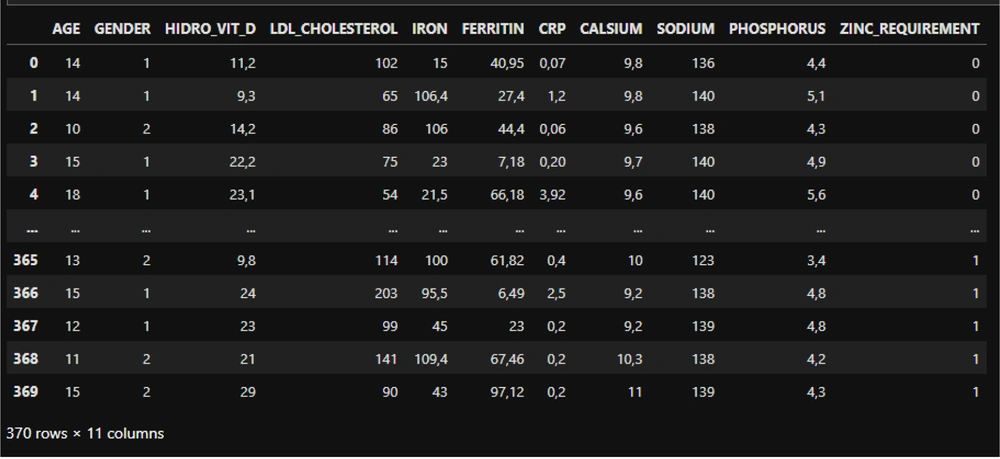
Database of zinc features
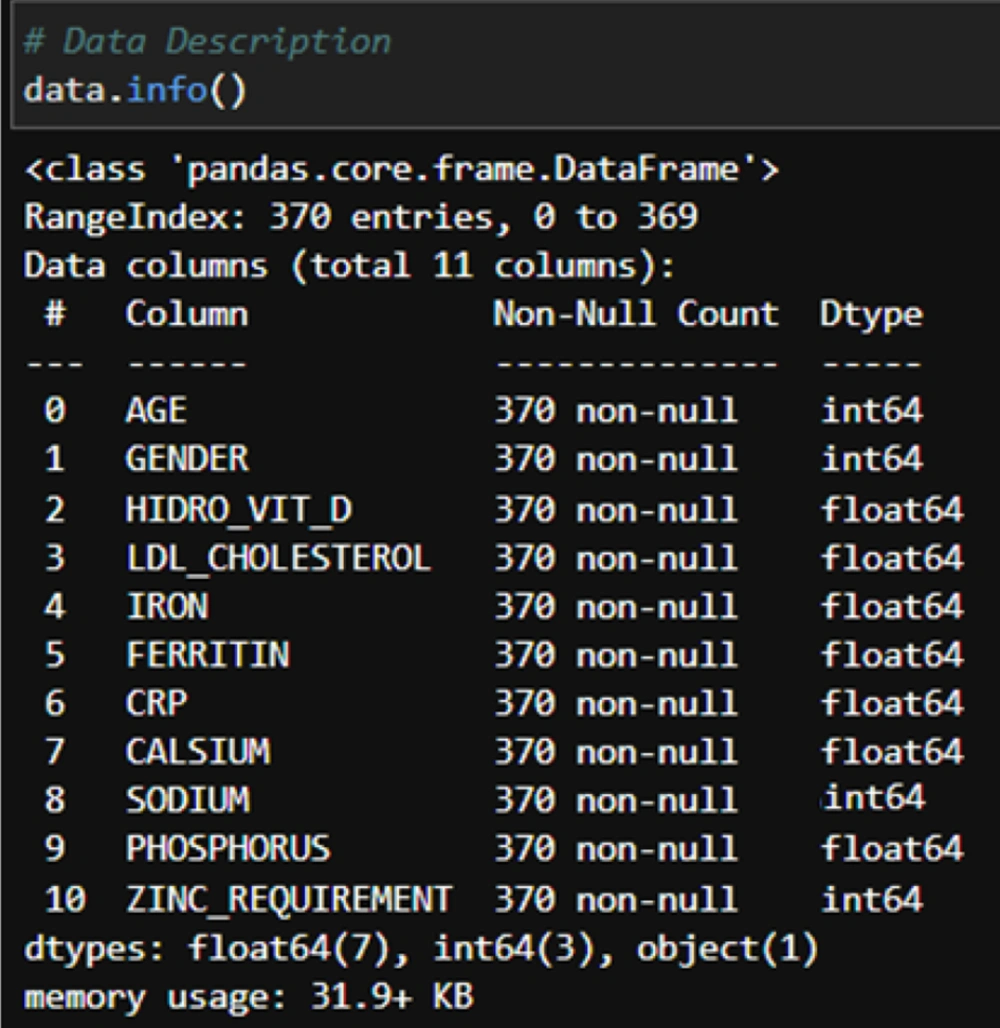
Data description of zinc requirement
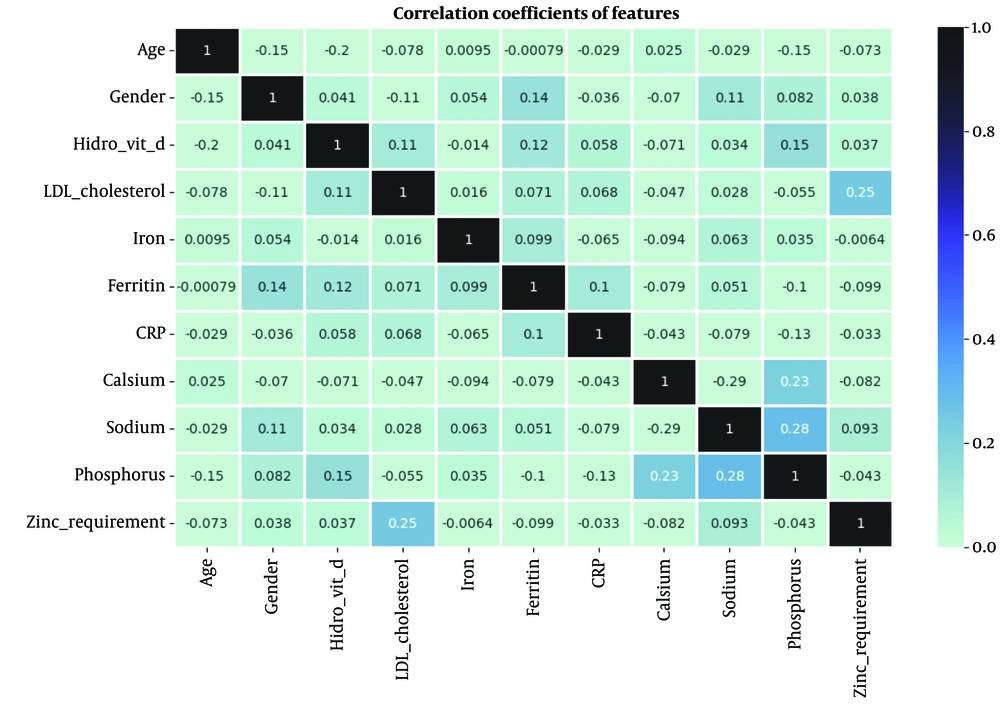
Correlation coefficients of features
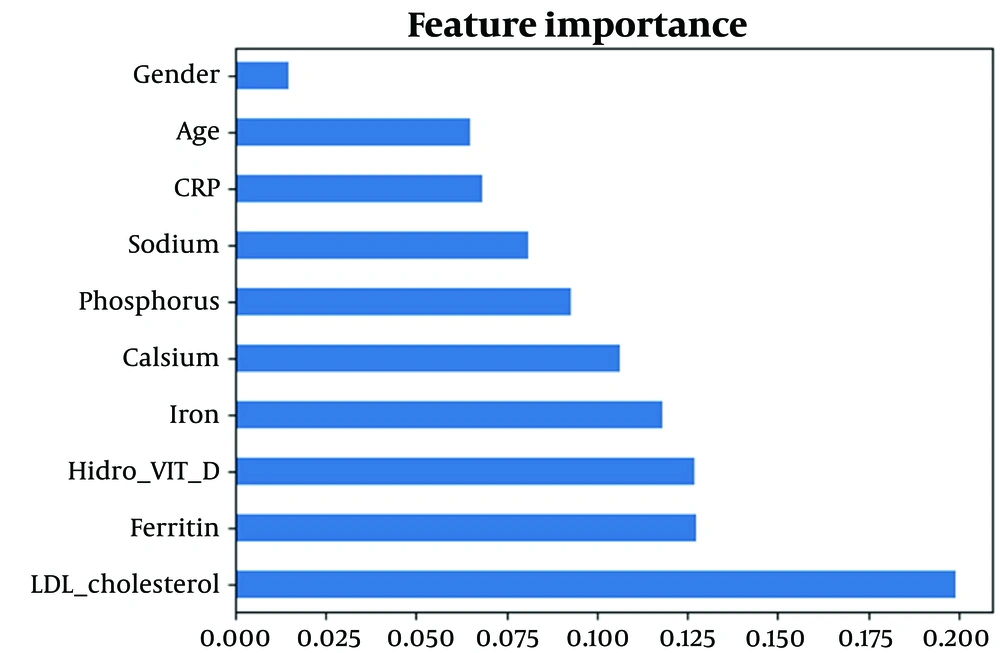
Random forest classifier feature importance.
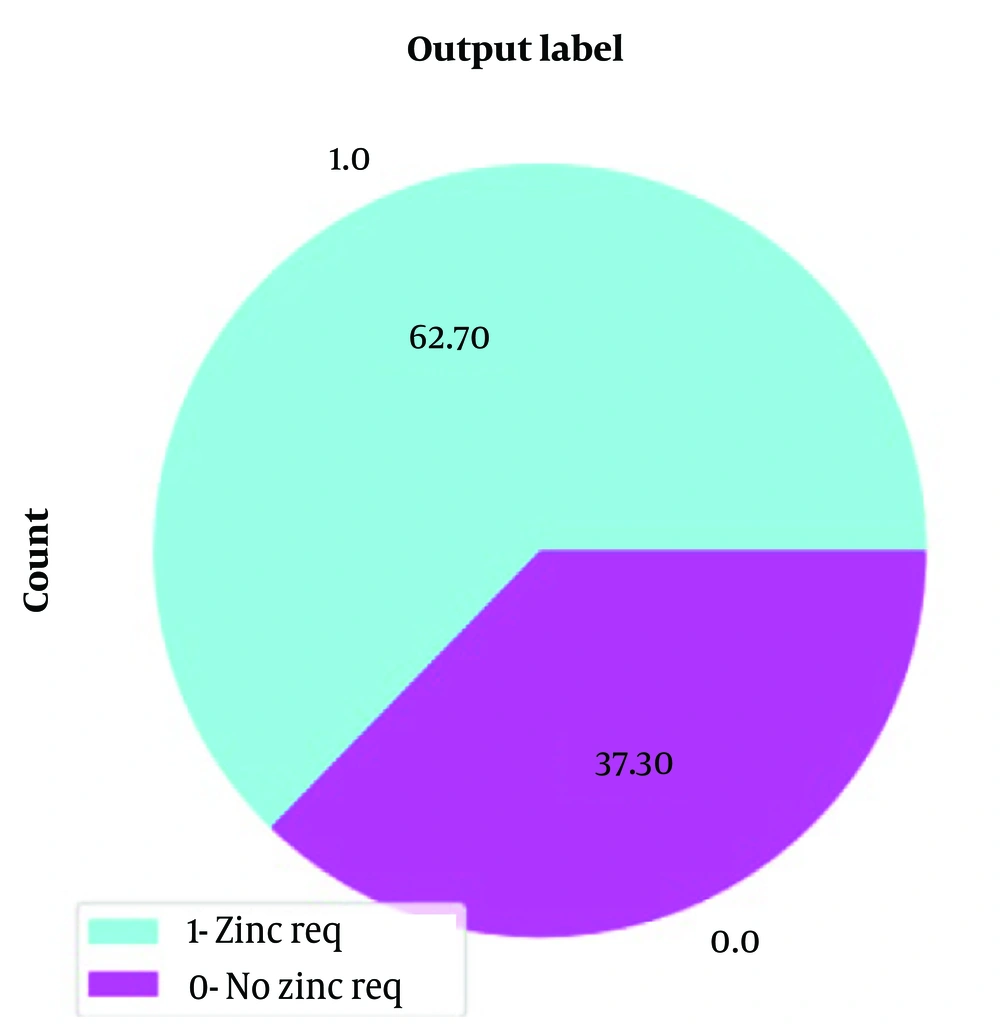
Distribution of data classes
3.2. Machine Learning Methods
| ID | Methods Name | Description | Parameters | Advantages | Disadvantages |
|---|---|---|---|---|---|
| 1. | K-NN | K-NN is used to classify or predict an instance by using the class labels of its nearest neighbors. | The number of neighbors (K) is an important parameter. | Simple and effective. | Computationally expensive for large datasets. |
| 2. | LR | Logistic regression is a linear model used for classification problems. | It can be controlled by parameters like regularization term. | Simple, interpretable, and fast. | Limited in handling complexity. |
| 3. | FOREST | Random Forest classifies by combining many decision trees. | Important parameters include the number of trees, feature selection, etc. | Strong, high generalization, and resistant to overfitting. | Complex internal structure. |
| 4. | SVM | SVM tries to find the best separating hyperplane between two classes. | Important parameters include kernel type, C (error tolerance), etc. | Effective in high-dimensional data, especially successful with limited datasets. | Long training time for large datasets. |
| 5. | TREE | Decision tree is used for classification or regression tasks using a tree structure. | Important parameters include tree depth, minimum sample split, etc. | Easy to understand structures, low data preprocessing requirement. | Prone to overfitting. |
| 6. | LDA | LDA finds axes that best express the difference between classes. | Few default parameters. | Emphasizes differences between classes, provides dimensionality reduction. | Assumes equal covariances between classes by default. |
| 7. | GNB | Probability-based classification algorithm based on Bayes' theorem, assuming independence between features | Few default parameters. | Simple, fast, often successful in tasks like text classification. | Independence assumption may not hold in the real world. |
| 8. | EXTRA | Similar to Random Forest, but selects split points in trees more randomly. | Important parameters include the number of trees, feature selection, etc. | Resistant to overfitting, low variance due to random feature selection. | Complex internal structure. |
| 9. | GRADIENT | A community learning algorithm that combines weak learners (often decision trees) to create a strong model. | Important parameters include learning rate, number of trees, etc. | High generalization ability, successful in many datasets. | May require more training time and tuning. |
| 10. | ADA | Combines weak classifiers to create a strong classifier by focusing on misclassified examples. | Important parameters include the type of weak learner, learning rate, etc. | Resistant to overfitting, high generalization ability. | Sensitive to tuning. |
| 11. | XGB | Tree-based learning algorithm using gradient boosting technique, known for its speed and performance. | Important parameters include learning rate, number of trees, etc. | Fast, high-performance, successful in many data science competitions. | May require more tuning and hyperparameter selection. |
| 12. | BGC | Bagging is a method of improving a model's performance by training on different subsamples. | Important parameters include the type of base learner, sampling strategy, etc. | Resistant to overfitting, low variance | Often depends on the type of base learner. |
| 13. | MLP | A type of artificial neural network with multiple layers that updates weights during the learning process. | Important parameters include the number of layers, number of hidden neurons, etc. | Ability to learn complex relationships, suitable for large datasets. | Long training time for large datasets, tendency for overfitting. |
Abbreviations: K-NN, K-nearest neighbors; LR, logistic regression; FOREST, random forest; SVM, support vector machine; TREE, decision tree; LDA, linear discriminant analysis; GNB, gaussian naive bayes; EXTRA, extra tree classifier; GRADIENT, gradient boosting classifier; ADA, AdaBoosting classifier; XGB, XGBoost classifier; BGC, bagging classifier; MLP, multilayer perceptron.
3.3. Performance Metrics
3.3.1. Confusion Matrix
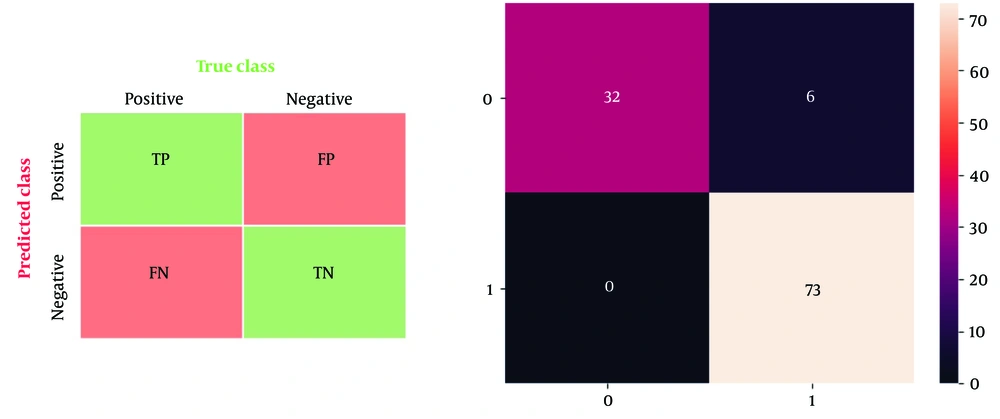
Confusion matrix of SVM algorithm
3.3.2. Accuracy
3.3.3. Precision
3.3.4. Recall (Sensitivity)
3.3.5. F1 Score
3.3.6. Confidence Interval
4. Results
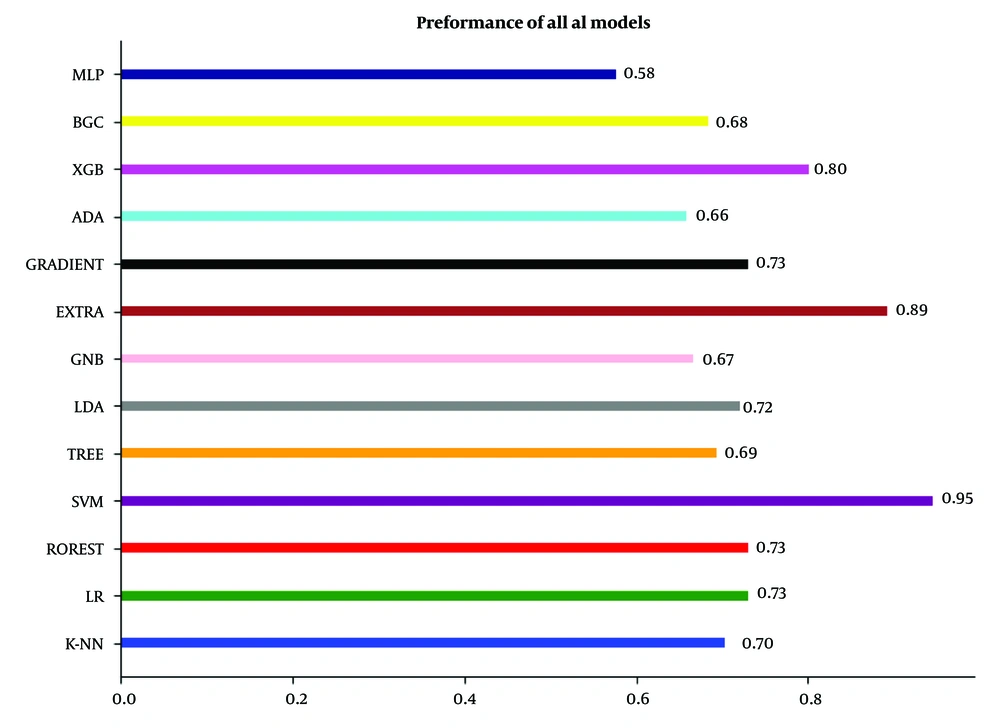
Accuracy performance of ML models
| Metrics (%) | K-NN | LR | RF | SVM | DTREE | LDA | GNB | EXTRA | GRA | ADA | XGB | BGC | MLP |
|---|---|---|---|---|---|---|---|---|---|---|---|---|---|
| Accuracy | 0.703 | 0.730 | 0.730 | 0.946 | 0.694 | 0.721 | 0.667 | 0.892 | 0.730 | 0.658 | 0.802 | 0.685 | 0.577 |
| Confusionmetrics | [27 - 11] | [18 - 20] | [13 - 25] | [32 - 6] | [33 - 5] | [17 - 21] | [7 - 31] | [34 - 4] | [20 - 18] | [5 - 33] | [34 - 4] | [10 - 28] | [32 - 6] |
| [22 - 51] | [10 - 63] | [5 - 68] | [0 - 73] | [29 - 44] | [10 - 63] | [6 - 67] | [8 - 65] | [12 - 61] | [5 - 68] | [18 - 55] | [7 - 66] | [41 - 32] | |
| Precision | 0.730 | 0.719 | 0.728 | 0.950 | 0.773 | 0.709 | 0.634 | 0.897 | 0.722 | 0.614 | 0.837 | 0.663 | 0.704 |
| Recall | 0.703 | 0.730 | 0.730 | 0.946 | 0.694 | 0.721 | 0.667 | 0.892 | 0.730 | 0.658 | 0.802 | 0.685 | 0.577 |
| F1 score | 0.709 | 0.718 | 0.698 | 0.945 | 0.700 | 0.707 | 0.609 | 0.893 | 0.723 | 0.585 | 0.807 | 0.644 | 0.577 |
| Confidence-up | 0.753 | 0.797 | 0.805 | 1.000 | 0.733 | 0.789 | 0.746 | 0.948 | 0.794 | 0.740 | 0.850 | 0.761 | 0.607 |
| Confidence-down | 0.652 | 0.662 | 0.654 | 0.882 | 0.654 | 0.652 | 0.587 | 0.836 | 0.666 | 0.576 | 0.754 | 0.608 | 0.546 |
Abbreviations: K-NN, K-nearest neighbors; LR, logistic regression; SVM, support vector machine; LDA, linear discriminant analysis; GNB, gaussian naive bayes; EXTRA, extra tree classifier; GRA, gradient; ADA, AdaBoosting classifier; XGB, XGBoost classifier; BGC, bagging classifier; MLP, multilayer perceptron.




