
1. Background
Collective violence is escalating due to urbanization, technological expansion, drought, and climate change (1-3). It encompasses aggressive actions carried out by numerous individuals aimed at harming others or damaging private or government properties (4, 5). Mass violence, occurring in demonstrations, riots, football matches, and other recreational events, is a common manifestation of collective violence (6, 7). Recent incidents include mass brawls in Ardabil city (6), clashes in Ahvaz city (7), conflicts among football fans (8), prison riots (9), and village clashes (10).
The consequences of collective violence are profound, leading to loss of life, disability, injury, property destruction, exacerbation of prejudices and hatred, erosion of social trust, weakening of solidarity and empathy, and hindrance to growth and development (11).
To elucidate this phenomenon, various scientific disciplines such as social psychology, sociology, political science, and criminology have proposed diverse theories. These theories, emphasizing individual, group, or structural factors, interpret collective violence as a product of either individual or environmental influences. Among these theories are the social identity theory, which underscores group behavior (individual); the relative deprivation theory, highlighting individuals' feelings of injustice and dissatisfaction (individual); the resource mobilization theory, focusing on weak groups' efforts to acquire resources and power (environmental); and the collective action theory, emphasizing cooperation and solidarity among opposing groups (environmental) (12).
These theories elucidate the factors influencing the development of social identity, the experience of disparities, the mobilization of resources, and participation in collective action. However, they also encounter limitations and challenges. Some of these include the lack of empirical evidence demonstrating their applicability and validity, overlooking contextual factors such as culture, history, geography, economy, and politics, which play significant roles in collective violence, and the difficulty in quantifying key concepts upon which the theories are based, such as social identity, relative deprivation, resources, and collective action (13). Therefore, more comprehensive and integrative perspectives are necessary to comprehend and prevent collective violence.
Several scales exist to assess specific aspects of group violence. These include the Cyberbullying Scale, comprising 10 questions on a four-point Likert Scale to evaluate online violence or cyberbullying across three dimensions: Social media, insulting, and threatening speech (14). The School Bullying Scale employs 15 questions on a five-point Likert Scale to gauge group violence within school settings, encompassing three dimensions: Physical, verbal, and psychological (15). The Aggression Motivation Scale comprises 12 open-ended questions to assess adolescents' personality traits and inclinations toward violence, categorizing motives into four dimensions: Power, control, influence, and preventive attacks (16). The Reactive-Proactive Aggression Questionnaire employs 20 questions on a three-point Likert Scale to distinguish and evaluate the two primary dimensions of behavioral violence: Reactive and proactive aggression (17). The Modern Violence Scale uses 15 open-ended questions to evaluate contemporary violent behaviors across three dimensions: Violence in communication, media, and cyberspace (18). Lastly, the Youth Violence Questionnaire (YVI ) comprises 10 open-ended questions to assess the type and severity of violence among adolescents across three dimensions: Physical, psychological, and sexual (19).
Assessing behavior and attitudes toward collective violence holds significant importance as it can play a crucial role in preventing and mitigating this phenomenon (20). However, existing tools for this purpose are inadequate and face several limitations. These tools primarily concentrate on the causes of collective violence (6, 8) and often lack sufficient validation, disregarding cultural biases and ethical concerns (21). For instance, some tools employ hypothetical scenarios that may not accurately reflect current realities, while others focus on specific types of violence or particular groups, failing to assess collective violence comprehensively across all environments and cultures. Additionally, certain tools involve direct observation or intervention, raising ethical and practical issues (1, 4, 22-24). Therefore, addressing these challenges necessitates the development of a more comprehensive and ethically sound measurement tool capable of thoroughly evaluating behavior and attitudes toward collective violence.
Despite these challenges, efforts have been made to assess collective violence, leading to the introduction of the Multidimensional Scale of Acceptance of Collective Violence (MSACV) in Poland in 2020 (21).
The MSACV is a self-report questionnaire designed to measure four dimensions of acceptance of collective violence: Justification, identification with perpetrators, emotional reactions, and behavioral intentions. Compared to other tools, the MSACV offers several advantages: It encompasses a broad spectrum of situations and types of collective violence, demonstrates high internal consistency and construct validity, is grounded in a theoretical framework that integrates social identity theory and moral disengagement theory, is easy to administer and score, and is suitable for both research and intervention purposes (21). The MSACV can aid in identifying individuals or groups more prone to engaging in or endorsing collective violence and can facilitate the design and evaluation of interventions aimed at reducing acceptance of collective violence.
On the other hand, a study indicated an increase in collective violence in Iran in recent years, causing significant economic and social damage in Iranian society (25). To plan and implement preventive actions, it is necessary to evaluate collective violence and identify the factors that affect it. Many studies have been conducted to identify these factors in Iran (26-28), but there is a lack of research in the field of evaluating collective violence.
Therefore, conducting studies in the field of collective violence assessment is needed to validate and develop a scale to help identify people and communities at risk of collective violence. One approach to developing scales is to adapt scales from other cultures, which requires their revalidation (29). Considering the increase in collective violence in Iran and the absence of validation for the MSACV in the country, this study aims to examine the factor structure and validity of the MSACV for assessing collective violence in Iranian teenagers. Thus, this study hypothesizes that the MSACV demonstrates an acceptable factor structure and validity in assessing collective violence in Iranian teenagers.
Therefore, conducting studies in the field of collective violence assessment is needed to validate and develop a scale to help identify people and communities at risk of collective violence.
One approach to developing scales is to use scales from other cultures, requiring their revalidation (29). In light of the increase in collective violence in Iran and the lack of validation for the MSACV in the country, this study hypothesises that the MSACV has acceptable factor structure and validity for assessing collective violence in Iranian teenagers. This study aims to determine the factor and validity of MSACV for assessing collective violence in teenagers.
2. Objectives
This study aimed to validate the MSACV.
3. Methods
In this cross-sectional study, the questionnaire underwent translation into Persian using the forward-backward method. The study adhered to the guidelines outlined by Fenn et al. for the development, validation, and translation of psychological tests, providing a comprehensive framework for validating new scales in the social sciences field. The validation process involved several steps, including translation, pilot testing (face validity), Cronbach's alpha (internal reliability), test-retest (stability reliability), content validity, exploratory factor analysis (EFA), and confirmatory factor analysis (CFA). Utilizing separate samples for each step was recommended to optimize resource utilization and achieve conclusive and reliable results (30).
3.1. Translation
The research questionnaire underwent translation by the researchers using the forward-backward method. Two proficient English translators were enlisted to translate the questionnaire into Persian and then back into English. The final questionnaire was derived after consensus was reached between the two translators.
3.2. Participants and Procedure
The target population for this study comprised all teenagers in Tehran in 2022. The study had four main objectives: Assessing concurrent validity, conducting EFA, performing CFA, and evaluating reliability (internal and stability) of the instrument. Different sample sizes were determined for each objective based on statistical methods and criteria. The total sample size for this study was 840 teenagers, selected through stratified random sampling. Details of the sample size calculation for each objective are as follows:
For concurrent validity, the sample size was calculated using the Cochran formula (n = Z2*p*q/d2), where ( Z = 1.96 ) is the statistical value for the desired confidence level, ( P = 0.5 ) is the expected probability for the characteristic of interest, and ( d = 0.1 ) is the permissible error. By substituting these values into the formula and rounding the result, the sample size for concurrent validity is obtained to be 100 individuals(31). For EFA, the sample size was calculated as 20 individuals per question (32), resulting in 420 individuals determined for EFA. To account for potential missing samples, 460 individuals were ultimately selected for EFA (33). Following EFA, 200 teenagers were chosen for CFA (34). Additionally, 80 teenagers (40 for each type of reliability) were selected to assess internal and stability reliability (35).
The authors of the study employed random cluster sampling to select participants from various districts of Tehran. They allocated distinct samples for concurrent validity, factor analysis, internal reliability, and stability reliability, respectively and independently. Utilizing separate samples for concurrent validity, CFA, EFA, internal reliability, and test-retest reliability is essential for the following reasons: First, each validation method has a distinct goal and approach. For instance, while factor analyses aim to uncover or confirm the structure, concurrent validity aims to assess the relationship with an external criterion. Second, utilizing separate samples enables each method to focus more accurately on the specific characteristics of its sample. Third, employing independent samples enhances the statistical power and robustness of the results. Fourth, this approach prevents interference between validation methods and minimizes the possibility of mutual influence. Therefore, employing independent samples leads to more valid results (36-39).
Official reports have revealed that among Tehran's 22 districts, districts 21, 22, 9, 15, 16, and 12 had the highest murder rates. For sampling, the first district (District 9) was randomly selected from these six districts. This selection was conducted by writing the names of the districts on six pieces of paper and placing them in a black bag, then randomly drawing one paper. This district was chosen for cluster sampling for concurrent validity and subsequently removed from the list of districts.
Using the same method, two other districts (Districts 22 and 15) were selected for EFA, one district (District 12) for CFA, and one district (District 16) for reliability assessment.
Subsequently, in each of these districts, three streets were randomly chosen. The number of samples required for each street was calculated by dividing the number of samples for each cluster by three. By visiting each street and employing systematic sampling, residential units were selected as sampling units.
The questionnaires were distributed with informed consent from both the parents and adolescents residing in these units, but 42 adolescents declined to participate in the research. Sampling was conducted from 4 pm to 7 pm on Saturdays through Wednesdays by a team of 30 undergraduate students from the Islamic Azad University, South Branch. This team volunteered for the task and received compensation for their assistance in collecting the questionnaires. They underwent an orientation session where they were briefed on the research objectives, ethical consent, data collection methods, and privacy protection.
A total of 798 completed electronic questionnaires were collected, capturing demographic characteristics such as gender, age, residence status, parental divorce status, and education level from the sample. The authors collected a total of 798 completed electronic questionnaires, encompassing demographic characteristics such as gender, age, residence status, parental divorce status, and education level from the sample. The study included participants aged 12 - 18 years residing in Tehran who were willing to participate and sign informed consent. Those who were unwilling to participate or withdrew from the study were excluded. Informed consent was obtained from both the participants and their parents, and the confidentiality of the questionnaire responses was ensured to encourage accurate answers. The article is based on the first author's PhD thesis and was approved by the Ethics Committee of Islamic Azad University, Semnan Branch, with the code IR.IAU.SEMNAN.REC.1401.039 .
3.3. Measures
The MSACV assesses how an individual behaves and thinks about a new group using 21 questions on a 5-point Likert Scale (ranging from strongly disagree = 1 to strongly agree = 5). The total score of the questionnaire is the sum of the scores of each question, ranging from 21 to 105. A higher score indicates a higher likelihood of collective violence in the person’s society. The scale comprises 6 factors: Physical violence (questions 1 - 3), verbal violence (questions 13 - 15), isolation (questions 10 - 12), indirect violence (questions 16 - 18), absorption (questions 4 - 6), neglect (questions 7 - 9), and positive reactions (questions 19 - 21). Factor analysis confirmed the validity of the questionnaire. The internal consistency for the entire scale was 0.83, and for the factors, it ranged between 0.52 and 0.88 (21).
Orpinas and Frankowski developed the Aggression Scale (AS) questionnaire, consisting of 11 questions rated on an 8-point scale (0 = never to 6 = six times and more) to assess physical behaviors in teenagers. The possible scores range from 0 to 66. Orpinas and Frankowski confirmed the scale's validity through factor analysis and reported a Cronbach's alpha of 0.88 (40). Akbari-Balootbangan and colleagues also validated the scale using factor analysis in Iran, reporting a Cronbach's alpha of 0.82 (41). In this study, we assessed reliability using Cronbach's alpha and split-half methods, resulting in scores of 0.81 and 0.89, respectively.
3.4. Statistical Analysis
The researchers employed four types of validity and two types of reliability to evaluate the questionnaire. For face validity, they implemented both qualitative and quantitative approaches. In the qualitative approach, they interviewed 10 individuals from the target community, examining the questionnaire for difficulties and ambiguities. They also gathered feedback on the questionnaire (42).
In the quantitative component, the researchers used a 5-point scale to assess the face validity of the questionnaire. They distributed it to 10 members of the target community and revised or removed questions with an impact score below 1.5. The impact factor was determined by calculating the average percentage of 4 and 5 responses to each question from all participants (42).
To evaluate the content validity of the questionnaire, the authors engaged 10 experts who assessed each question using both the content validity ratio (CVR) and Content Validity Index (CVI) methods. For the CVR evaluation, experts rated each question on a 3-point Likert Scale as "necessary," "useful but not necessary," or "unnecessary." According to the Lawshe table, a CVR value above 0.62 was deemed acceptable (43). For the CVI, experts rated each question on a 4-point Likert Scale regarding simplicity, specificity, and clarity. Following Lawshe's guidelines, a score above 0.79 was considered acceptable (44).
Correlation analysis was employed to assess the concurrent validity between the scores of the MSACV and the AS.
In this study, we applied the mean ± 3 standard deviations method to identify outliers. Data outside the range of 3 standard deviations were removed (31). To check the normal distribution of data, we utilized the Shapiro-Francia test (45).
After outlier removal, EFA was conducted on the refined data to confirm the questionnaire’s structure (46). This analysis used the principal axis factoring extraction method and Varimax rotation. Eigenvalues greater than 1 were identified as significant factors (considering the differences in historical, political, religious, and ethnic backgrounds in Iran and Poland, the structure of collective violence may vary. Thus, it is essential to assess the factor structure of MSACV in the Iranian sample through EFA and to check its consistency with the original sample (47)).
In this study, Varimax rotation facilitated a simple and interpretable factor structure in the EFA. Given the need for the extracted factors to serve as independent variables in further analyses, maintaining their orthogonal relationships was crucial. Varimax rotation was chosen as it was well-suited to the research objectives and data characteristics. The results indicated that the factors derived via Varimax rotation aligned with theoretical expectations and exhibited desirable reliability and validity (37).
In the next step, to evaluate the suitability of the data for factor analysis, two tests were employed. The first was the Kaiser-Meyer-Olkin (KMO) test, which required a value greater than 0.70, and the second was Bartlett's Test of Sphericity, which needed to be less than 0.05 (48). These tests ensured the appropriateness of the samples for factor analysis. Subsequently, to determine the number of factors to extract, the Scree plot method was utilized. This method involved examining the changes in variance explained by the factors as the number of extracted factors increased, selecting as final those factors where the decrease in variance was significant. In cases of missing data, the method of imputing missing data using the mean was employed (33), whereby missing values were replaced with the mean of the existing values for each variable (49).
For the dimensions extracted, the researchers applied CFA and assessed the overall model fit using several indices, including the standardized root mean square residual (SRMR), Goodness of Fit Index (GFI), Comparative Fit Index (CFI), Adjusted Goodness of Fit Index (AGFI), root mean square error of approximation (RMSEA), and chi-square/degrees of freedom (CMIN/DF). The following threshold values were set for these fit indices: SRMR less than 0.08, RMSEA less than 0.09, CFI and GFI higher than 0.90, AGFI above 0.80, and CMIN/DF less than 3. Factor loadings of 0.4 or higher were considered acceptable. If the model met these criteria, it was deemed to have a good fit (33).
The study employed Cronbach's alpha to ascertain the internal consistency of the scale, with a threshold of 0.70 or higher considered acceptable (33). The test-retest method was used to evaluate the temporal stability of the scale. Additionally, the split-half method was used to assess the internal reliability of the scale (50). This method complemented the Cronbach's alpha by providing an additional estimate of internal reliability that is less affected by the number of items in the scale (50).
Descriptive statistics were employed to calculate frequency and percentage. Data were analyzed using SPSS version 21 (SPSS Inc., Chicago, IL, USA) and LISREL 8.80 (Scientific Software International, Inc., Lincolnwood, IL, USA). The significance level for this study was set at 0.05.
4. Results
A total of 798 individuals participated in the study, of whom 389 (51.25%) were girls. Regarding housing, 401 participants (50.25%) resided in rented houses. Among the participants, 65 individuals (8.15%) had divorced parents. Additionally, 140 participants (17.54%) had dropped out of school, and 41 (5.14%) were married (Table 1).
Table 1.
Demographic Characteristics of the Study Participants by Validation Method (n = 798) a
| Variables | Concurrent Validity (n = 94) | Exploratory Factor Analysis (n = 435) | Confirmatory Factor Analysis (n = 193) | Reliability (Internal Consistency; n = 39) | Reliability (Stability; n = 37) | Total (n = 798) |
|---|---|---|---|---|---|---|
| Gender | ||||||
| Male | 41 ( 43.62 ) | 215 ( 49.43 ) | 101 ( 52.33 ) | 17 ( 43.59 ) | 15 ( 40.54 ) | 389 ( 48.75 ) |
| Female | 53 ( 56.38 ) | 220 ( 50.57 ) | 92 ( 47.67 ) | 22 ( 56.41 ) | 22 ( 59.46 ) | 409 ( 51.25 ) |
| Housing | ||||||
| Tenant | 50 ( 53.19 ) | 212 ( 48.74 ) | 98 ( 50.78 ) | 21 ( 53.85 ) | 20 ( 54.05 ) | 401 ( 50.25 ) |
| Owner | 20 ( 21.28 ) | 112 ( 25.75 ) | 46 ( 23.83 ) | 6 ( 15.38 ) | 9 ( 24.32 ) | 193 ( 24.19 ) |
| Others | 24 ( 25.53 ) | 111 ( 25.52 ) | 49 ( 25.39 ) | 12 ( 30.77 ) | 8 ( 21.62 ) | 204 ( 25.56 ) |
| Marital status of parents | ||||||
| Divorced | 10 ( 10.64 ) | 31 ( 7.13 ) | 17 ( 8.81 ) | 5 ( 12.82 ) | 2 ( 5.41 ) | 65 ( 8.15 ) |
| Married | 84 ( 89.36 ) | 404 ( 92.87 ) | 176 ( 91.19 ) | 34 ( 87.18 ) | 35 ( 94.59 ) | 733 ( 91.85 ) |
| Education status | ||||||
| Dropout | 21 ( 22.34 ) | 70 ( 16.09 ) | 34 ( 17.62 ) | 8 ( 20.51 ) | 7 ( 18.92 ) | 140 ( 17.54 ) |
| Student | 73 ( 77.66 ) | 365 ( 83.91 ) | 159 ( 82.38 ) | 31 ( 79.49 ) | 30 ( 81.08 ) | 658 ( 82.46 ) |
| Marital status | ||||||
| Married | 5 ( 5.32 ) | 20 ( 4.60 ) | 8 ( 4.15 ) | 3 ( 7.69 ) | 5 ( 13.51 ) | 41 ( 5.14 ) |
| Single | 89 ( 94.68 ) | 415 ( 95.40 ) | 185 ( 95.85 ) | 36 ( 92.31 ) | 32 ( 86.49 ) | 757 ( 94.86 ) |
a Values are expressed as No. (%).
The results indicated that the mean scores for the dimensions of collective violence, which include physical violence, absorption, neglect, isolation, verbal violence, indirect violence, and positive reactions, were 8.60, 8.41, 9.20, 8.45, 9.04, 8.89, and 9.34 respectively, with standard deviations of 3.75, 3.49, 3.23, 3.72, 3.62, 3.30, and 3.38. Additionally, the mean and standard deviation of the variables of collective violence and aggression were 61.94 (± 17.22) and 33.22 (± 6.51) respectively (Table 2).
Table 2.
Descriptive Statistics of Research Variables
| Variables | Mean | Std. Deviation | Minimum | Maximum |
|---|---|---|---|---|
| Physical violence | 8.60 | 3.75 | 3 | 15 |
| Absorption | 8.41 | 3.49 | 3 | 15 |
| Neglect | 9.20 | 3.23 | 3 | 15 |
| Isolation | 8.45 | 3.72 | 3 | 15 |
| Verbal violence | 9.04 | 3.62 | 3 | 15 |
| Indirect violence | 8.89 | 3.30 | 3 | 15 |
| Positive reactions | 9.34 | 3.38 | 3 | 15 |
| Collective Violence | 61.94 | 17.22 | 21 | 105 |
| Aggression | 33.22 | 6.51 | 19 | 49 |
4.1. Face Validity
To ensure face validity, the research team gathered feedback from the sample population regarding the simplicity, comprehensibility, and relevance of the items to the research topic. The scores for all items exceeded 1.5, indicating positive face validity.
4.2. Content Validity
Content validity assesses how comprehensively a test covers the relevant aspects of the construct it intends to measure. In this study, the construct of interest was the level of optimism among university students (47). To evaluate the content validity of the 21-item scale, a panel of 10 experts in psychology and education rated each item based on relevance, clarity, and simplicity (47). Relevance pertains to how well an item reflects the construct of optimism; clarity to how easily an item can be understood; and simplicity to the conciseness of an item (47). The experts used a three-point scale for relevance (necessary, useful but not necessary, or unnecessary) and a four-point scale for clarity and simplicity (not at all, somewhat, quite, or very). The CVR was calculated for each item by subtracting the number of experts who rated the item as somewhat or not at all relevant from those who rated it as quite or very relevant, then dividing by the total number of experts (47). The CVI for each item was calculated by dividing the number of experts who rated the item as quite or very clear or simple by the total number of experts (47). The results showed that all items had CVR values above 0.68 and CVI values above 0.70, which are considered acceptable thresholds for content validity (44). Consequently, the scale was deemed to have adequate content validity for measuring optimism among university students.
4.3. Concurrent Validity
The results indicated that all subscales of the MSACV were significantly positively correlated with the AS, suggesting that higher acceptance of collective violence was associated with increased levels of aggression. The strongest correlation was observed between collective violence and AS (r = 0.74, P < 0.001), followed by positive reactions and AS (r = 0.60, P < 0.001), isolation and AS (r = 0.58, P < 0.001), verbal violence and AS (r = 0.53, P < 0.001), indirect violence and AS (r = 0.51, P < 0.001), neglect and AS (r = 0.51, P < 0.001), absorption and AS (r = 0.46, P < 0.001), and physical violence and AS (r = 0.45, P < 0.001). These findings support the good concurrent validity of the MSACV with the AS as a criterion measure of violence and aggression.
4.4. Exploratory Factor Analysis
The KMO measure was 0.726, and Bartlett's test showed significance (approximate chi-square = 3384.381, df = 210, P < 0.001), indicating adequate sampling for performing exploratory factor analysis (EFA). Principal axis factoring extraction with Varimax rotation identified seven factors that explained 58.97% of the total variance. The first factor, related to positive reactions (questions 19 to 21), explained 8.78% of the total variance. The second factor, concerning absorption (questions 4 to 6), accounted for 8.60% of the variance. The third factor, associated with verbal violence (questions 13 to 15), explained 8.59% of the total variance. The fourth factor, linked to physical violence (questions 1 to 3), accounted for 8.58% of the variance. The fifth factor, involving indirect violence (questions 16 to 18), explained 8.31% of the variance. The sixth factor, related to neglect (questions 7 to 9), accounted for 8.07% of the variance. Finally, the seventh factor, associated with isolation (questions 10 to 12), explained 8.04% of the total variance (Table 3).
Table 3.
Rotated Component Matrix for the Study Items
| Items | Component | CVI | CVR | ||||||
|---|---|---|---|---|---|---|---|---|---|
| Verbal Abuse | Isolation | Indifference | Physical Violence | Positive Reactions | Indirect Violence | Absorption | |||
| i1 | 0.06 | 0.07 | 0.00 | 0.72 | 0.10 | 0.07 | 0.07 | 0.71 | 0.73 |
| i2 | 0.12 | 0.06 | 0.01 | 0.81 | 0.04 | 0.03 | 0.01 | 0.85 | 0.87 |
| i3 | 0.08 | 0.12 | 0.01 | 0.74 | 0.11 | 0.04 | 0.05 | 0.75 | 0.78 |
| i4 | 0.07 | 0.71 | 0.12 | 0.10 | 0.08 | 0.08 | 0.06 | 0.69 | 0.70 |
| i5 | 0.03 | 0.80 | 0.05 | 0.07 | 0.08 | 0.13 | 0.04 | 0.91 | 0.92 |
| i6 | 0.12 | 0.73 | 0.09 | 0.08 | 0.04 | 0.07 | 0.06 | 0.70 | 0.72 |
| i7 | 0.09 | 0.14 | 0.02 | 0.05 | 0.09 | 0.70 | 0.13 | 0.85 | 0.88 |
| i8 | 0.13 | 0.04 | 0.02 | 0.06 | 0.04 | 0.73 | 0.06 | 0.72 | 0.74 |
| i9 | 0.10 | 0.09 | 0.09 | 0.03 | 0.05 | 0.75 | 0.10 | 0.81 | 0.83 |
| i10 | 0.05 | 0.04 | 0.07 | 0.02 | 0.04 | 0.12 | 0.71 | 0.75 | 0.76 |
| i11 | 0.05 | 0.03 | 0.09 | 0.09 | 0.07 | 0.09 | 0.70 | 0.73 | 0.74 |
| i12 | 0.05 | 0.08 | 0.04 | 0.02 | 0.06 | 0.06 | 0.73 | 0.73 | 0.74 |
| i13 | 0.07 | 0.09 | 0.74 | 0.00 | 0.09 | 0.03 | 0.05 | 0.79 | 0.82 |
| i14 | 0.05 | 0.08 | 0.82 | 0.01 | 0.09 | 0.05 | 0.04 | 0.87 | 0.89 |
| i15 | 0.05 | 0.08 | 0.70 | 0.01 | 0.12 | 0.05 | 0.10 | 0.68 | 0.70 |
| i16 | 0.05 | 0.09 | 0.11 | 0.09 | 0.74 | 0.05 | 0.07 | 0.74 | 0.77 |
| i17 | 0.04 | 0.07 | 0.06 | 0.09 | 0.68 | 0.09 | 0.09 | 0.88 | 0.91 |
| i18 | 0.05 | 0.03 | 0.14 | 0.08 | 0.79 | 0.03 | 0.01 | 0.84 | 0.86 |
| i19 | 0.70 | 0.09 | 0.06 | 0.11 | 0.04 | 0.11 | 0.03 | 0.88 | 0.94 |
| i20 | 0.77 | 0.09 | 0.06 | 0.09 | 0.03 | 0.12 | 0.04 | 0.68 | 0.92 |
| i21 | 0.81 | 0.04 | 0.04 | 0.06 | 0.08 | 0.09 | 0.08 | 0.84 | 0.86 |
Abbreviations: EFA, exploratory factor analysis; CFA, confirmatory factor analysis.
4.5. Confirmatory Factor Analysis
The results of the confirmatory factor analysis (CFA) indicated that the 7-factor model exhibited a good fit with the data, as evidenced by the goodness-of-fit measures: SRMR = 0.073 (less than 0.10), RMSEA = 0.064 (less than 0.08), CFI = 0.94 (greater than 0.90), NFI = 0.91 (greater than 0.90), GFI = 0.91 (greater than 0.90), AGFI = 0.88 (greater than 0.80), and CMIN/DF = 1.76 (less than 3). Figure 1 further illustrates the congruence of the model with the data, indicating strong support for the 7-factor model.
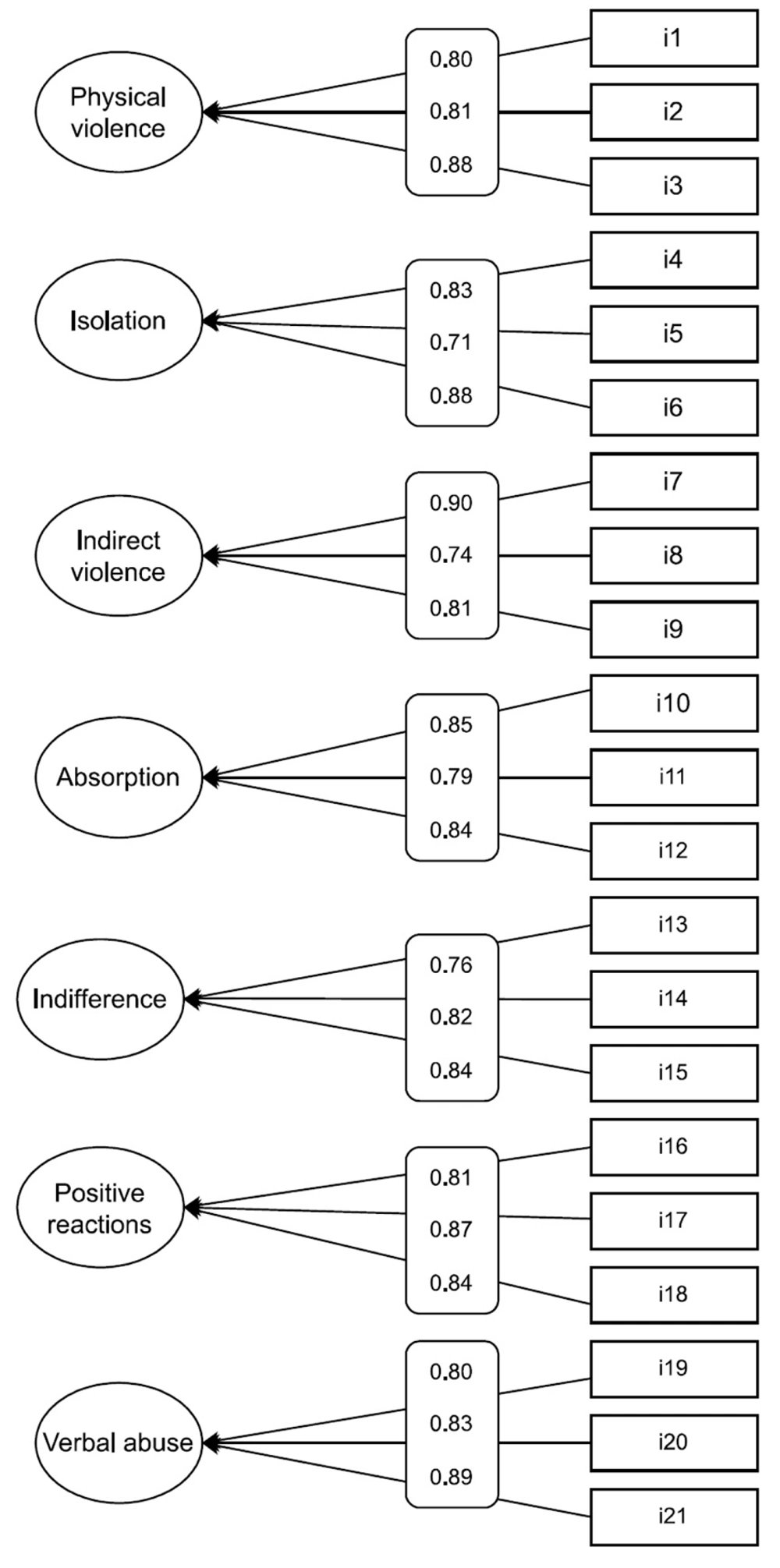
Figure 1.
Confirmatory factor analysis results
4.6. Reliability
The Cronbach's alpha coefficient for the overall scale was 0.91, and for its subscales—physical violence, absorption, neglect, isolation, verbal violence, indirect violence, and positive reactions—the coefficients were 0.87, 0.90, 0.89, 0.88, 0.94, 0.92, and 0.70, respectively. All items showed positive and significant correlations with the scale score, ranging from 0.335 to 0.753 (P < 0.01). The split-half reliability was 0.86 for the first half (11 questions) and 0.87 for the second half (10 questions) of the data, with a correlation coefficient of 0.74 (P < 0.01) between them. The Cronbach's alpha value remained unchanged with the removal of each item, indicating that no items should be deleted. The test-retest reliability results were 0.86 (P < 0.01).
5. Discussion
The MSACV is a novel scale developed by Winiewski and Bulska (21) based on the social identity theory and the stereotype content model. It aims to gauge how adolescents perceive and respond to collective violence within their social groups and intergroup relations. The scale comprises seven dimensions: Verbal violence, isolation, indifference, physical violence, positive reactions, indirect violence, and absorption. Apart from the original study by Winiewski and Bulska (21), this scale has not been utilized or validated in any prior research. Hence, this study represents the first endeavor to validate the MSACV in a distinct cultural context, specifically Iran.
The results of the face validity assessment revealed that the impact score of all items exceeded 1.5, with no items omitted. This outcome aligns with the findings of Winiewski and Bulska (21). Before the face validity assessment, the scale's questions underwent editing and localization by the research team and several members of the academic staff. Consequently, no items were removed at this stage, indicating a high level of clarity and relevance of the scale for Iranian adolescents, with the items being well-understood and acceptable to the target population.
This study conducted the first validity examination of the MSACV. The findings demonstrated that the MSACV exhibited acceptable content validity. Unfortunately, unlike other researchers' findings, the content validity of this scale has not been confirmed in the original study or other investigations. This suggests that the scale demonstrates a high degree of correspondence between its items and the construct of collective violence, comprehensively covering all relevant aspects of this construct.
The concurrent validity of the MSACV was assessed using the AS. The results indicated acceptable concurrent validity. However, unlike other researchers' findings, the content validity of this scale has not been validated in the original research or other studies. This suggests that the scale exhibits a high degree of correlation with another measure of the same construct, namely the AS, which is a widely used and validated instrument for assessing aggression among adolescents (48).
The EFA identified seven factors for the MSACV Scale, which comprises 21 questions. These factors include verbal violence, isolation, indifference, physical violence, positive reactions, indirect violence, and absorption. This factorial structure aligns with the original research (21). Moreover, since the factor loading values for each question exceed 0.4, the factor loading is deemed sufficient. Therefore, it can be inferred that all items are appropriately categorized under the sub-scale of adolescent aggression in the factorial structure, indicating the absence of incompatible or redundant items in the scale. This implies that the scale demonstrates a high degree of construct validity, indicating that it measures the underlying concept of collective violence, and that the scale items reflect the various dimensions of this concept.
The results of the CFA validated the structural integrity of the MSACV Scale. This finding is consistent with the original research by Winiewski and Bulska (21), demonstrating that the MSACV Scale encompasses seven independent dimensions: Verbal violence, isolation, indifference, physical violence, positive reactions, indirect violence, and absorption. These dimensions are congruent with the social identity theory and the stereotype content model, reflecting the diversity of behaviors and attitudes of adolescents towards collective violence in their groups and intergroup relations. Therefore, the MSACV scale proves to be a suitable instrument for measuring collective violence among Iranian adolescents.
One dimension of the questionnaire is verbal violence, which encompasses the use of inappropriate, insulting, and threatening language against minority groups, indicating a violation of the dignity and identity of such groups. This dimension corresponds with dimensions in the YVI and the Aggressive Behavior Questionnaire (AQ) (40, 51). Verbal violence can result in negative psychological consequences such as anger, hatred, fear, and low self-esteem among minority groups. Verbal violence aligns with the dimension of physical violence in other questionnaires, as both indicate aggressive behavior towards minority groups.
One of the dimensions of the questionnaire is separation. This dimension includes behaviours such as removal, ignoring and not accepting minority groups as members of society, which indicates a violation of their right to belong. This dimension is consistent with dimensions in the Social Prejudice Questionnaire (SAS) and the Social Isolation Scale (SIS) (52, 53). Separation can lead to negative social consequences such as isolation, deprivation and reduced welfare and educational opportunities in minority groups. Separation is consistent with the dimension of isolation in other questionnaires, as both indicate non-aligned and disconnected behaviour with minority groups.
One of the dimensions of the questionnaire is indifference. This dimension includes cold, careless and unfriendly behaviours with minority groups, which indicates ignoring their rights. This dimension is consistent with dimensions in the YVI and the Non-Intervention Questionnaire (BIQ) (40, 54). Indifference can lead to negative individual consequences such as dissatisfaction, poverty and a sense of humiliation in minority groups. Indifference is consistent with the dimension of neglect in other questionnaires, as both indicate insensitive and unresponsive behaviour towards minority groups.
One of the dimensions of the questionnaire is physical violence. This dimension includes harmful, beating and harassing behaviours against minority groups, which indicates a violation of their right to life and health. This dimension is consistent with dimensions in the YVI and the AQ (40, 51). Physical violence can have negative physical, psychological, social and economic consequences for minority groups. This dimension is consistent with the dimension of verbal violence in other questionnaires, as both indicate aggressive and dominant behaviour towards minority groups.
One of the dimensions of the questionnaire is positive reactions. This dimension includes kind, sympathetic and supportive behaviours towards minority groups, which indicates respect and appreciation for them. This dimension is consistent with dimensions in the Empathy Questionnaire (TEQ) and the Social Orientation Scale (SOS) (55, 56). Positive reactions can create positive psychological outcomes such as trust, hope and belonging in minority groups. This dimension is consistent with the dimension of absorption in other questionnaires, as both indicate aligned and communicative behaviour with minority groups.
One of the dimensions of the questionnaire is indirect violence. This dimension includes covert, deceptive and humiliating behaviours against minority groups, which indicates a violation of truth and honesty towards them. This dimension is consistent with dimensions in the SAS and the BIQ (52, 54). Indirect violence can lead to negative psychological consequences such as frustration, distrust and low self-esteem in minority groups. This dimension is consistent with the dimension of separation in other questionnaires, as both indicate non-aligned and disconnected behaviour with minority groups.
One of the dimensions of the questionnaire is absorption. This dimension includes active, conciliatory and influential behaviours toward minority groups, which indicates respect and attention to them. This dimension is consistent with dimensions in the TEQ and the SOS (55, 56). Absorption can lead to positive individual and social outcomes such as participation, development and progress in minority groups. This dimension is consistent with the dimension of positive reactions in other questionnaires, as both indicate aligned and communicative behaviour with minority groups.
The internal consistency of the adolescent MSACV Scale was examined for the overall scale and each dimension. The results showed that the adolescent MSACV Scale has sufficient reliability, which is in line with Winiewski and Bulska’s findings. However, some dimensions had lower Cronbach α values than those reported by Winiewski and Bulska, such as verbal violence (0.64 vs. 0.88) and indirect violence (0.56 vs. 0.86) (21). This could be due to the cultural differences between the Iranian and Polish samples, as well as the different wording and translation of some items. For example, item 13 in the verbal violence dimension ("I use swear words when talking to minority groups") might not reflect the common way of expressing verbal aggression in Iran, where other forms of insults or threats might be more prevalent. Similarly, item 19 in the indirect violence dimension ("I spread false rumours about minority groups") might not capture the subtle and covert ways of harming minority groups, such as excluding them from social activities or ignoring their opinions. Therefore, it is suggested that these items be revised or replaced with more culturally appropriate ones in future studies.
The stability of the adolescent MSACV Scale was also assessed by the test-retest correlation coefficient, which was 0.86 for the overall scale. This indicates that the scale has a high degree of temporal consistency and can measure the same construct over time. This result is consistent with Winiewski and Bulska’s result, which was 0.83 on the overall scale (21). This suggests that the adolescent MSACV Scale is a reliable instrument for assessing minority social attitudes among adolescents in different contexts and cultures.
Some of the strengths of this article are as follows: This article is the first study to validate the MSACV Scale for measuring minority social attitudes among Iranian adolescents. The article demonstrates that the MSACV scale has acceptable psychometric properties, such as face validity, content validity, concurrent validity, construct validity, and reliability. The article also confirms the 7-factor structure of the MSACV scale, which is consistent with the original research and the theoretical framework. The article provides a valid and reliable instrument for assessing minority social attitudes among adolescents, which can be used for research and intervention purposes in the field of prevention and treatment of collective violence.
Some of the limitations of this article are as follows: The article used a cross-sectional design to validate the MSACV Scale, which limits the ability to infer causal relationships between minority social attitudes and other variables. The article also used a self-report measure to assess minority social attitudes, which may be subject to social desirability bias or inaccurate recall. The article also did not examine the predictive validity of the MSACV Scale, which means that the scale's ability to predict future behaviours or outcomes related to collective violence is unknown. The article also did not explore the possible moderating or mediating effects of other factors, such as gender, age, ethnicity, religion, education, or socioeconomic status, on minority social attitudes. Future studies should use longitudinal or experimental designs to examine the causal effects of minority social attitudes on collective violence and its consequences. Future studies should also use multiple methods to assess minority social attitudes, such as behavioural observations, interviews, or physiological measures. Future studies should also test the predictive validity of the MSACV Scale by using relevant outcome measures, such as intergroup conflict, discrimination, victimization, or cooperation. Future studies should also investigate the role of other individual or contextual factors that may influence minority social attitudes and their relationship with collective violence.
5.1. Conclusions
Collective violence has increased with the development of information technology and the increase in marginalization; there is no acceptable scale for assessing it. Therefore, MSACV was validated in this study to assess aggression and collective violence in teenagers.