
1. Background
Patient-centered care is one of the major goals of rehabilitation (1). With population aging, rising patient expectations, emerging technologies, and new therapies, the healthcare industry is growing fast. Therefore, promotion of services and customer satisfaction is very necessary (2).
Patient satisfaction is a multidimensional concept and is affected by cultural, social, cognitive, and emotional factors (3). Scientific methods are available for measuring patient satisfaction. Patient satisfaction is a mental perception of the quality of health care. It is a comparison of the quality of health care with patient’s mental standards. It is neither in accordance with an objective criterion nor in accordance with the views of therapists and managers. Therefore, it is often assessed by subjective methods (4).
It is very common to use a questionnaire in many studies to assess patients’ satisfaction due to its easy management, cost-effectiveness, and reproducibility (5). Completion of the questionnaire is not time consuming, and in comparison with interviews it does not report a falsely high score, and bias does not occur. One of the drawbacks of patient satisfaction studies is the lack of methodological studies (6).
In comparison with a normal visit to a doctor’s office, patient-physiotherapist interactions are high and more collaboration with the patient in physiotherapy is needed. Therefore, patient satisfaction questionnaires in medical areas are not suitable for use in physiotherapy (7). Therefore, physical therapy requires a specific instrument (7).
Cultural adaptation results in the creation of a questionnaire tailored to the language and culture of the same population, based on the original questionnaire (8). On the other hand, economic and cultural contexts influence satisfaction. Therefore, it is logical that people in different countries have different priorities regarding satisfaction (9).
To date, numerous questionnaires have been used in patient satisfaction studies in the field of physiotherapy, including the 14-item tool to measure patient satisfaction with physical therapy. Since there is no Persian version of this questionnaire, it development provides the possibility of measuring the satisfaction of patients receiving physiotherapy services in various studies. These satisfaction questionnaires could be useful for assessing the quality of care, and physical therapists can predict patient behavior based on the level of satisfaction, which influence clinical outcomes and allows managers to improve strategies for the provision of health care (10).
The current researchers selected this questionnaire for translation to Persian because it contains all the relevant factors of physiotherapeutic activity and infrastructure (8). This questionnaire is a valid instrument for assessing satisfaction with physical therapy in both outpatients and inpatients (8). It is short questionnaire, thus it does not take much time to answer; also it is easy to be understood by all patients independently from their educational level (11). Moreover, many previous studies have used this questionnaire (8-11). The current researchers believed that this questionnaire would be appropriate for the Iranian social context.
1.1. Patient Satisfaction with Physical Therapy Questionnaire
The questionnaire on patient satisfaction with physical therapy provides self-assessment and is multidimensional. The original version is in French (12). It was developed in 1999 in an educational hospital in Geneva, Switzerland (8). This questionnaire, prepared by Monnin and Perneger was used on 528 outpatients and inpatients. Cronbach’s alpha coefficients ranged between 0.77 and 0.90, and its validity was supported. This questionnaire contains 14 questions. In the factor analysis, four factors emerged, including treatment (five items), admission (three items), logistics (four items), and global assessment (two items). The overall score ranged between 0 and 100. Each question has a five-point scale (1 = poor and 5 = excellent) (7). For each item, the following formula is used for scoring (score 0 - 100 = 25 × (score 1 - 5 - 1) (8).
This questionnaire is presented in Supplementary File.
2. Methods
This methodological research examined the psychometric properties of the 14-item tool to measure patient satisfaction with physical therapy.
This study was conducted in public physiotherapy centers in Kerman, Iran. All the patients had musculoskeletal disorders. Convenient sampling was carried out. The study was carried out in two steps. The first step was the translation and adaptation of the questionnaire to Persian and the second step was reviewing the psychometric properties.
2.1. Translation and Cultural Adaptation
1. After obtaining permission from the developer of the questionnaire, in order to examine the linguistic validation, the questionnaire was firstly translated by the forward translation method, which means a translation from English to Persian by two translators fluent in English and Persian, separately, who were not familiar with the original questionnaire.
2. The translation of these two translators was revised and approved in a group meeting of English professors and physiotherapists.
3. Backward translation means a translation from Persian to English, which was carried out by two individuals, who were fluent in English and Persian and were not familiar with the original questionnaire. These translations were presented in a group meeting of physiotherapists and English professors and the final translation was prepared after revision.
4. This translation was sent to the developer of the questionnaire, who was asked to comment on the translated version in term of the conceptual equivalence to the original version (13). His corrective suggestions were applied in the Persian version. Finally, in a group meeting of English professors and physiotherapists, the necessary corrections were made, and the translated version was matched in terms of the relevance of the questions and the consistency with the original questionnaire.
2.2. Investigation of Psychometric Properties
2.2.1. Face Validity
To assess face validity, 30 participants were included. These subjects were from different groups in terms of gender, social, and economic parameters, and were over 18 years of age.
2.2.2. Reliability
To assess the reliability of the test, 40 physiotherapy clients were selected to answer the questions on the questionnaire five to seven days round of the first completion of the questionnaire (14). To examine the relative reliability, the intra-class correlation coefficient (ICC) (coefficient < 0.4 low reliability, coefficient ranging from 0.4 to 0.75 medium reliability, coefficient ranging from 0.75 to 0.9, high reliability and coefficient > 0.9, excellent reliability). Additionally, the Cronbach’s alpha coefficients were used to examine the homogeneity of the items; alpha coefficient of 0.7 to 0.95 was acceptable (14).
2.2.3. Structural Validity
A sample of 300 Persian-speaking physiotherapy patients was selected. The Patients’ demographic data, such as age, gender, education, area involved, chief complaint, disease name, duration of illness, and occupation were recorded.
Patients also completed the visual analog score (VAS) and the global rating of change (GRC) scales for divergent validity. Their results were compared with the results of the Persian version of the Patient Satisfaction Questionnaire with Physical Therapy (15).
The VAS scale is based on a line 10 cm in length; score 0 ‘absence of pain’ and score 100 ‘unbearable pain’ (16).
The GRC evaluates the patient’s current health status compared to the patient’s status at the beginning of treatment. It is a nine-point Likert scale ranging from one (“very much better”) to nine (“very much worse”). The lower GRC score indicates that the patient is getting better and the higher score indicates that the patient’s condition has worsened (17).
To study the structural validity of this questionnaire, confirmatory factor analysis was performed using the Amos software. In this study, ceiling and floor effects were also evaluated by calculating the percentage of patients, who had the maximum (ceiling) and the minimum (floor) score in the questionnaire. If this percentage, at a maximum or minimum score, was > 15%, it was considered as a ceiling or floor effect, respectively (18).
To examine the convergent validity of this questionnaire, the correlation between this questionnaire and its subscales with another questionnaire that assessed the satisfaction of physiotherapy, “patients Physical Therapy Patient Satisfaction Questionnaire (PTPSQ)”, was calculated (10). A correlation coefficient of 0.81 to 1 was considered excellent, and a correlation coefficient 0.61 to 0.80 was considered very good, 0.41 to 0.60 was good, 0.21 to 0.40 was acceptable, and 0.00 to 0.20 was considered poor (8).
2.3. Physical Therapy Patient Satisfaction Questionnaire (PTPSQ)
The PTPSQ is a self-report tool based on domains cited by Nelson in 1990 (19). Goldenstein et al. investigated the validity and reliability of PTPSQ in 2000. Cronbach’s alpha was 0.82 and different types of validity were examined (10). This questionnaire consisted of 26 items. The first six items referred to patient’s demographic data and the second part included 20 items related to patient satisfaction (10).
The current researchers selected the PTPSQ for convergent validity because PTPSQ demonstrated strong psychometric properties for evaluating patients’ satisfaction with physiotherapy (10). This questionnaire has been used in many studies (9, 20-23). Bakhtiari translated this questionnaire to Persian. Intra-class correlation coefficient was 0.94 and validity obtained excellent results (24). It is brief and its content and dimensions are similar to the dimensions of Patient Satisfaction with Physical Therapy Questionnaire in the current study (9). Conceptually, these two questionnaires are very close to each other.
Since one of the exclusion criteria was cognitive problems, mini-mental state examination (MMSE) was used to investigate this case (25).
2.4. Participants
Of patients with musculoskeletal disorders referring to the public outpatient centers of physiotherapy in Kerman, Iran, 300 subjects were selected to participate in this study. The Persian version of the questionnaire was completed in two steps, with an interval of five to seven days by 40 patients receiving physiotherapy treatment. The subjects were > 18 years of age. The participants were able to write and read in the Persian language. At least their literacy was at the level of secondary school. Data were collected from July to November, 2017. Those, who had an MMSE test score of < 23 were excluded.
All the rights of participants in the study were observed. All the patients completed an informed consent form. The subjects were not required to write their name and identity information, and at each stage of the study, they could leave the study if they wished.
The entire process of this research was reviewed and approved by the Ethics Committee of the University of Social Welfare and Rehabilitation Sciences of Iran.
3. Results
The patient satisfaction questionnaire was translated to Persian and tested for measurement properties. The descriptive information has been reported in Tables 1 and 2. For face validity, the researchers did not deal with a question or a phrase that was not comprehensible by reviewing the responses of the respondents, and without changing the translation of the questions, the Persian translation of this questionnaire was prepared. Overall, 45.5% of patients had a score of > 70. The mean scores and standard deviations of this questionnaire in the test and re-test were 66.44 (22.3) and 62.15 (23.3), respectively.
Table 1.
Characteristics of the Study Participants (Qualitative Variables)
| Variable | No. (%) |
|---|---|
| Gender | |
| Male | 129 (44.5) |
| Female | 161 (54.2) |
| Employment status | |
| Employed | 137 (48.9) |
| Unemployed | 5 (1.8) |
| Housekeeper | 102 (36.4) |
| Student | 11 (3.9) |
| Retiered | 25 (8.9) |
| Education status | |
| Undergradguate | 102 (34.7) |
| Diploma | 105 (35.7) |
| University educated | 87 (29.6) |
| Location of symptoms | |
| Neck | 36 (12.8) |
| Back | 76 (27.0) |
| Arm | 16 (5.7) |
| Foot | 56 (19.9) |
| Ankle | 19 (6.7) |
| Hand/wrist | 23 (8.2) |
| Knee | 40 (14.2) |
| Other | 16 (5.7) |
Table 2.
Descriptive Information of Quantitative Variables
| Variable | Mean | Median | SD | Variance | Range | Skewness | Kurtosis |
|---|---|---|---|---|---|---|---|
| Age, y | 38.75 | 36.00 | 14.62 | 213.88 | 62 | 0.45 | -0.075 |
| Weight, kg | 73.66 | 72.00 | 15.74 | 247.98 | 135.00 | 1.99 | 10.20 |
| Duration of illness, mon | 27.98 | 4.00 | 60.89 | 3708.11 | 479 | 3.94 | 19.10 |
| VAS | 4.03 | 4.00 | 1.34 | 1.81 | 7 | -1.07 | 1.08 |
| MMSE | 29.39 | 30.00 | 2.10 | 4.43 | 36.0 | 10.12 | 151.40 |
| Score of questionnaire | 66.44 | 67.30 | 22.3 | 965.46 | 100 | -0.24 | -0.16 |
| GRC | 2.88 | 3.00 | 1.11 | 1.25 | 9 | 0.89 | 2.81 |
Abbreviations: GRC, global rating of change; MMSE, mini-mental state examination.
3.1. Reliability
The ICC for the total scores of the questionnaire was 0.88. Cronbach’s alpha coefficient for the total score of the questionnaire and subscales has been reported in Table 3. The results showed acceptable internal consistency.
Table 3.
Cronbach’s Alpha Coefficient for the Total Score of the Questionnaire and Subscales
| Variable | Cronbach’s Alpha |
|---|---|
| Total score | 0.95 |
| Subscales | |
| Admission | 0.83 |
| Treatment | 0.91 |
| Logistic | 0.86 |
| Global assessment | 0.77 |
3.2. Validity
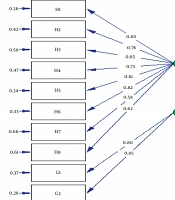
Structural validity of this questionnaire was based on confirmatory factor analysis, using the Amos software. In confirmatory factor analysis, the most probable method for pattern estimation and some other indicators were used to examine the pattern’s fitness. The fitting of the model was assessed using the following indices: Chi-square (CMIN), relative chi-square: Chi-square/degree of freedom (CMIN/DF), root mean square error of approximation (RMSEA), comparative fit index (CFI) and Bollen’s incremental fit index (IFI) (26).
Four-factor solution fitting indexes of the questionnaire are presented in Table 4 and factor loading value items are presented in Table 5. The fit indices for the model four-component solution represent an excellent data fit.
Table 4.
Fit Indices for Confirmatory Factor Analyses
| Fit Indices | CFI | IFI | RMSEA | CMIN | DF | CMIN/DF | P Value |
|---|---|---|---|---|---|---|---|
| 4 factor model | 0.91 | 0.91 | 0.12 | 316.83 | 59 | 5.37 | 0.0001 |
Abbreviations: CFI, comparative fit index; CMIN, chi-square fitting model; DF, degree of freedom; IFI, incremental fit index; RMSEA, root mean square of approximation;
Table 5.
Factor Loading Values of Patient Satisfaction with Physical Therapy Questionnaire Items Derived from a Confirmatory Principal Component Analysis
| Question Number | Factor 1 (Admission) | Factor 2 (Treatment) | Factor 3 (Logistics) | Factor 4 (Global Assessment) | Premerger Designation |
|---|---|---|---|---|---|
| 1 | 0.83 | Admission | |||
| 2 | 0.86 | Admission | |||
| 3 | 0.71 | Treatment | |||
| 4 | 0.85 | Treatment | |||
| 5 | 0.87 | Treatment | |||
| 6 | 0.84 | Treatment | |||
| 7 | 0.84 | Treatment | |||
| 8 | 0.79 | Logistics | |||
| 9 | 0.83 | Logistics | |||
| 10 | 0.72 | Logistics | |||
| 11 | 0.81 | Logistics | |||
| 12 | 0.79 | Global assessment | |||
| 13 | 0.80 | Global assessment |
Pearson’s correlations between the scores of the Persian version of the questionnaire and values of the VAS and GRC were -0.24 (P = 0.0001) and -0.32 (P = 0.0001), respectively. The results of this test showed a significant negative and rather weak correlation between the total score of the questionnaire with the VAS and GRC, meaning that if the score of the satisfaction scale increases, pain and GRC score decrease, and vice versa.
In examining the effect of ceiling and floor effects, the total score and subscales of this questionnaire showed that except the admission and treatment subscales, there was no ceiling and floor effects for all the subscales and the total score.
In order to examine the convergent validity, the correlations between the total score of this questionnaire and its subscales with PTPSQ score were good. The correlation between the results of the Patient Satisfaction Questionnaire with Physical Therapy with PTPSQ is presented in Table 6.
Table 6.
The Correlation Coefficient of the Total Score of the 14-Item Questionnaire and its Subscales with Physical Therapy Patient Satisfaction Questionnaire (PTPSQ) Score
| Admission | Treatment | Logistic | Global Assessment | Total Score | |
|---|---|---|---|---|---|
| PTPSQ, r (P value) | 0.53 (0.0001) | 0.66 (0.0001) | 0.54 (0.0001) | 0.56 (0.0001) | 0.60 (0.0001) |
4. Discussion
This study evaluated the psychometric properties of the Persian version of the questionnaire on patient satisfaction with physical therapy.
The process of forward and backward translation of this questionnaire was carried out, according to standard guidelines (27). A total of 45.5% of the subjects had a score of > 70. The high satisfaction rate indicates the ability to differentiate dissatisfied and satisfied patients. This result is consistent with many questionnaires on patient satisfaction (4, 14, 28).
Based on the results of the present study, considering the ICC, the Persian version of this questionnaire is reliable (ICC: 0.88). The results of this study are consistent with those reported by Scascighini et al. (ICC: 0.74 - 0.92) (8).
Cronbach’s alpha coefficient for the subscales exhibited a range of 0.77 to 0.91 and for total score, this was 0.95, which is similar to those reported by Scascighini et al. (Cronbach’s alpha: 0.85 to 0.96) (8) and Monnin and Perneger (Cronbach’s alpha: 0.77 to 0.90) (7). The results related to the internal consistency of this study showed that all the items measured the same construct and matched the original version.
In the present study, confirmatory factor analysis confirmed the four-factor solution of the original version (admission, treatment, logistics, and global assessment), presented by Monnin and Perneger (7). Scascighini et al. (8) also confirmed these dimensions of the patient satisfaction concept.
In the present study, researchers found a negative and significant rather weak correlation between the total score of the questionnaire with VAS and GRC, indicating the divergent validity of this questionnaire.
In de Fatima Costa Oliveira et al.'s study, this correlation between MedRisk Instrument for measuring patient satisfaction with physical therapy care (MRPS) and GRC was significant yet poor (r = -0.21) (14). In a study by Hush et al. on the comparison of satisfaction of musculoskeletal patients at an international level, the correlation between satisfaction and GRC was low (r = -0.22) (29). In a study by Beattie et al. a significant negative correlation was found between GRC and patient satisfaction, and the correlation with Med Risk’s factors was also poor to moderate (-0.18 to -0.30) (30).
It can be pointed out that satisfaction with care, measured by the patient satisfaction questionnaire, is different from satisfaction with the outcomes of treatment measured by the GRC and VAS due to the low magnitude of the correlation. These results are consistent with other studies. In fact, satisfaction with care is related to health care services and is provided for patients during treatment, while satisfaction with the treatment outcomes is related to the effects of treatment on the patient’s health. Although these two concepts are potentially linked to each other, they should be evaluated separately by appropriate tools (31).
In the present study, the admission and treatment subsets had the ceiling effect (more than 15%), and the total score and logistic and global assessment subscales had no ceiling and floor effect. In Scascighini et al.’s study, the total score did not have ceiling and floor effects, and items three, four, six, and seven had ceiling effects (more than 30%) (8) and in the Monnin and Perneger’s study, all the scores had a ceiling effect, and the floor effect was not reported (7). In this regard, the results of the present study are somewhat similar to other studies.
To assess the convergent validity, the correlation between this questionnaire and the subscales with the PTPSQ were calculated. The correlations were good. Scascighin (2008), in his study, examined the correlation between the subscales and the total score for assessing the structural validity, and reported moderate to good correlations (8).
Considering the correlation coefficients between the scores of this questionnaire and its subscales with PTPSQ, construct validity was confirmed regarding both the direction of the correlation and the magnitude. Overall, these were not strong correlations. It can be concluded that the current results about construct validity should be interpreted cautiously.
4.1. Conclusions
The results of this study showed that the Persian version of the physiotherapy satisfaction questionnaire has acceptable validity and reliability and it is equivalent to the original version and is suitable for assessing the level of satisfaction of physiotherapy in outpatients and inpatients.
4.2. Research Limitations
This study evaluated the satisfaction of outpatients; it is recommended to also evaluate the satisfaction of inpatients. In this study, patients with musculoskeletal disorders participated, therefore, the researchers suggest evaluation and a new validation with adaptations for patients with other disorders. This study was conducted at public centers, and since the expectations of patients referring to public and private centers are different (16), it is also necessary to assess the satisfaction of physiotherapy patients in private centers.