





1. Background
Attention-deficit/hyperactivity disorder (ADHD) is widely recognized as a highly prevalent neurodevelopmental disorder of childhood and adolescence, characterized by persistent difficulties in sustaining attention, regulating emotions, and exerting behavioral self-control (1). As one of the most common developmental conditions, ADHD has substantial clinical significance across early life stages. Evidence indicates that the disorder has a strong neurobiological foundation (2) and often persists into later developmental periods. Epidemiological studies estimate that its global prevalence among children and adolescents ranges from 4% to 7.6%, and longitudinal findings suggest that approximately 65% of affected individuals continue to exhibit symptoms into adulthood, when the prevalence is estimated at approximately 2.5% (3, 4). Genetic studies also consistently report a substantial heritable component, with heritability estimates approaching 75% (5).
ADHD substantially affects academic performance and social functioning, and inadequate symptom management can contribute to emotional, behavioral, and cognitive difficulties over time (6). These challenges may disrupt learning, strain family relationships, and interfere with social participation, thereby increasing the likelihood of persistent emotional distress and reduced daily functioning. Many individuals with ADHD experience ongoing impairments in executive functioning, emotion regulation, and adaptive skills. These difficulties underscore the need for interventions that specifically target the cognitive and emotional domains associated with the disorder (7-9). Neurophysiological evidence indicates that individuals with ADHD exhibit distinct spectral electroencephalographic characteristics compared with typically developing peers. One of the most frequently replicated findings is an elevated frontal theta-to-beta (θ/β) ratio, commonly interpreted as reflecting diminished cortical arousal and deficits in executive regulatory mechanisms (7, 8).
Quantitative electroencephalography is an established method for examining neural oscillatory dynamics through analysis of the theta, alpha, and beta frequency bands. In recent years, QEEG has increasingly been used to identify neurophysiological markers related to attentional control and emotional regulation in individuals with ADHD. The alpha band is commonly linked to inhibitory processes that support stimulus suppression and attentional gating, whereas the beta band is associated with active cognitive engagement, goal-directed attention, and behavioral inhibition. Deviations in these frequency bands may therefore indicate improvements or persistent deficits in cognitive functioning among individuals with ADHD. The elevated frontal theta-to-beta ratio is one of the most prevalent neurophysiological patterns observed in children with ADHD and has been used as a biomarker in diagnostic procedures and treatment monitoring (10, 11).
Given the neurophysiological alterations observed in ADHD, pharmacological treatment remains the primary therapeutic option for symptom management. Nevertheless, concerns regarding potential adverse effects and dependence have increased interest in alternative therapeutic approaches. Accordingly, attention has shifted toward non-pharmacological interventions, including cognitive training, neurofeedback, and computerized cognitive therapies, which aim to modulate cognitive processes and the underlying neurophysiological mechanisms contributing to ADHD symptoms (8, 11). Among these approaches, RehaCom is recognized for providing individualized computer-based exercises designed to enhance attention, response control, and inhibitory functioning (1). Early findings have shown its potential to improve cognitive performance across various clinical groups, including children with ADHD (12). Although the cognitive benefits of such training programs are well established (13, 14), relatively few studies have examined the neurophysiological impact of RehaCom using QEEG measures. Examining how cognitive rehabilitation influences neural markers may provide important insights into the mechanisms supporting cognitive improvement and may help identify potential neurophysiological targets for intervention. Evaluating these neural changes may also clarify whether cognitive training produces measurable alterations in brain activity, even in the absence of direct behavioral assessments.
2. Objectives
The present study aimed to evaluate the effects of a 10-session cognitive rehabilitation protocol using the RehaCom Response Control module on theta, alpha, and beta spectral power in the frontal regions Fz, Fp1, and Fp2 in adolescents diagnosed with ADHD.
3. Methods
3.1. Study Design and Setting
This randomized controlled trial used block randomization and was conducted in 2024 in the psychiatric department of Ibn-Sina Hospital, affiliated with Shiraz University of Medical Sciences.
3.2. Ethical Considerations
Ethical approval was granted by the Ethics Committee of Shiraz University of Medical Sciences under reference number IR.SUMS.REC.1402.614 (approval date: March 9, 2024/1402-12-19). The trial was prospectively registered in the Iranian Registry of Clinical Trials with Trial ID 78077 and IRCT ID IRCT20231019059769N2 on August 28, 2024/1403-06-07. Before study initiation, detailed information on the study objectives and procedures was provided to the adolescents and their parents, and written informed consent was obtained from all participants and their legal guardians. To ensure ethical fairness, participants in the control group received an equivalent intervention focused on emotion regulation strategies after study completion.
3.3. Population and Inclusion/Exclusion Criteria
The study population comprised adolescents aged 13 - 17 years with a confirmed diagnosis of ADHD based on DSM-5 criteria, established by a child and adolescent psychiatry subspecialist. Eligibility criteria included sufficient literacy skills; no known neurological conditions such as epilepsy; no diagnosis of autism spectrum disorder or schizophrenia; and no history of substance use, as reported by parents. Participants were excluded if they were unable to complete the intervention sessions, missed more than 2 sessions, or initiated new psychotropic medication during the study period.
3.4. Sample Size
Sample size was calculated assuming a type I error rate of α = 0.05 and a type II error rate of β = 0.20, corresponding to 80% statistical power. The assumed effect size corresponded to a moderate-to-large Cohen d and was derived from a comparable study conducted by Mozaffari et al. (1). Effect size parameters were estimated using the Psychometrica online platform (https://www.psychometrica.de/effect_size.html). Based on a Cohen d of 0.851, partial η2 of 0.4255, and an assumed within-subject correlation of 0.30, the minimum required sample size was determined to be 32 participants. To compensate for a potential attrition rate of at least 10%, the target sample size was increased to 36 participants, with 18 individuals allocated to each group.
3.5. Sampling and Randomization
A total of 80 adolescents with ADHD were identified through convenience sampling based on referrals to Ibn-Sina Hospital and diagnostic evaluations performed by a child and adolescent psychiatry subspecialist. Of these, 36 individuals met all eligibility criteria and were enrolled after completing screening and providing written informed consent from both the adolescents and their parents. Eligibility screening and participant enrollment were conducted by the principal investigator and a trained research assistant after diagnostic confirmation by a child and adolescent psychiatry subspecialist who was not involved in the study authorship. The random allocation sequence was generated in advance by an independent university statistician using Random Allocation software version 2.0. Investigators responsible for recruitment and enrollment did not generate the allocation sequence. Group assignment was implemented sequentially according to the pre-generated permuted block list after completion of the baseline QEEG assessment. Randomization used blocks of 6 generated by Random Allocation software version 2.0, developed by Mahmood Saghaei. Participants were assigned to either the intervention or control group according to enrollment order, following a permuted block sequence prepared by an independent university statistician who was not involved in the study.
After the pre-intervention QEEG assessment, 3 participants (1 in the intervention group and 2 in the control group) withdrew because of school-related time constraints and commuting difficulties. These adolescents were excluded due to insufficient session attendance, defined as missing more than 2 sessions. In addition, 1 participant in the intervention group was withdrawn during the second session because of acute psychological deterioration and reported alcohol use, which led to hospitalization at Ibn-Sina Hospital. During QEEG data processing, 4 additional participants (2 from each group) were excluded because of excessive noise or non-correctable artifacts in the EEG recordings. Therefore, data from 28 participants (14 per group) were retained for the final analyses. A detailed CONSORT NPT flow diagram (Figure 1) illustrates participant enrollment, allocation, follow-up, and analysis procedures.
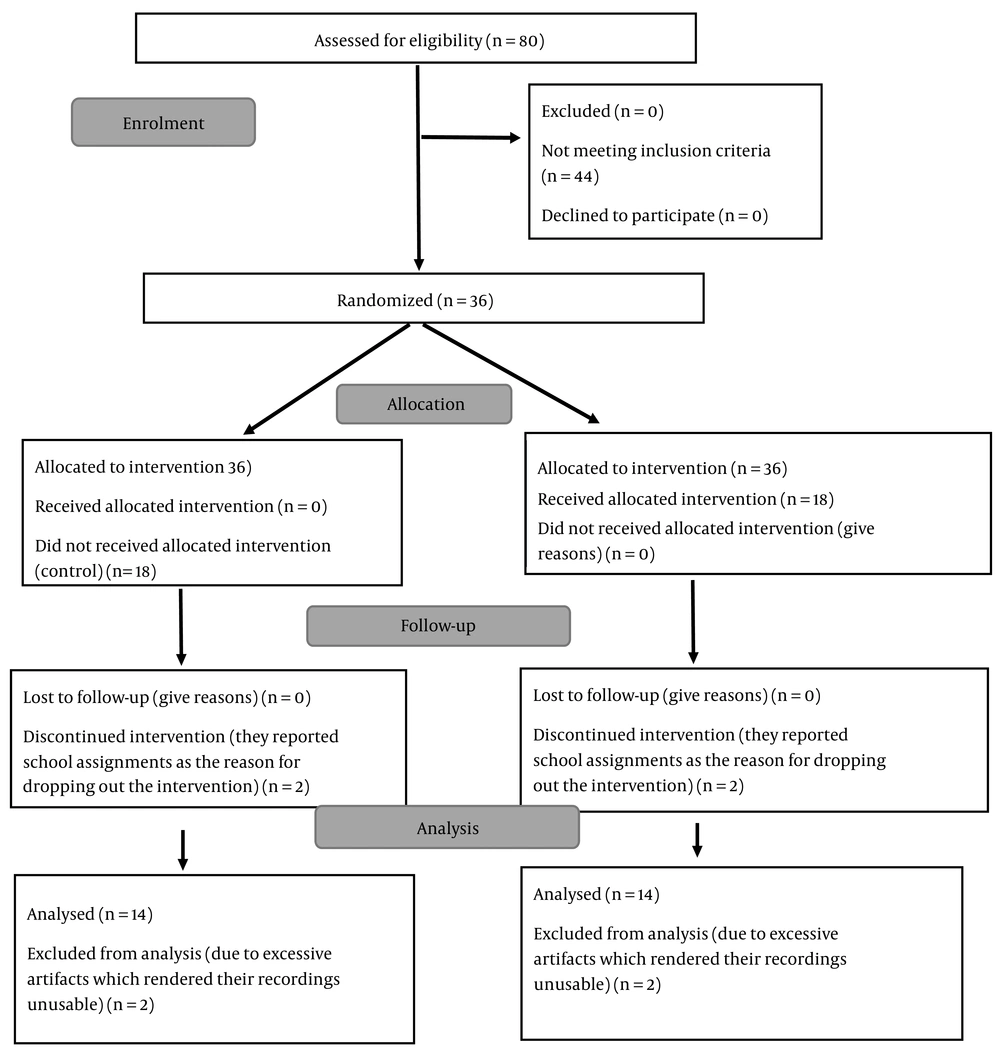
Figure 1.
CONSORT flow chart of study design
3.6. Blinding
Blinding procedures were applied where feasible in accordance with CONSORT NPT guidelines. The EEG technician responsible for QEEG recordings and the statistician conducting the analyses were blinded to group assignment to reduce detection and analytical bias. Because the intervention involved computerized cognitive training, blinding of participants and intervention providers was not possible. To mitigate potential bias related to this limitation, standardized intervention protocols were used, and outcome assessments were based on objective QEEG measures.
3.7. Intervention
3.7.1. Routine Clinical Treatment
During the study period, participants in both the intervention and control groups received standard first-line clinical management for ADHD under the supervision of a child and adolescent psychiatry subspecialist. Routine care included guideline-based pharmacotherapy, regular clinical monitoring, psychoeducation for parents, and periodic psychiatric evaluations. Pharmacological treatment consisted of stimulant or non-stimulant medications prescribed according to clinical judgment and established therapeutic guidelines. The medications administered included methylphenidate and atomoxetine. Medication dosages were adjusted during follow-up visits based on clinical response, reports from parents and teachers, and adverse effects.
Participants attended clinical follow-up appointments approximately every 2 weeks. During these visits, symptom severity, treatment response, and potential medication side effects were systematically evaluated. Brief psychoeducational counseling was also provided for parents, focusing on behavioral management strategies in the home environment, treatment adherence, and support for the adolescent's daily functioning.
No structured cognitive training or computerized rehabilitation program was provided to the control group during the intervention period. Consequently, the level of structured cognitive therapeutic exposure differed between groups. Participants assigned to the intervention group received approximately 450 minutes of structured cognitive training across 10 sessions, whereas those in the control group continued to receive only routine clinical care during the same period.
All components of routine treatment were delivered consistently to both groups to ensure comparable medical management. This approach was intended to minimize potential confounding effects and to ensure that any post-intervention differences could reasonably be attributed to the cognitive rehabilitation program rather than to variations in standard clinical care.
3.7.2. Cognitive Rehabilitation Program (RehaCom)
In addition to routine treatment, adolescents in the intervention group participated in computerized cognitive rehabilitation using the RehaCom system (version 6.2; Hasomed GmbH, Germany). The program consisted of 10 sessions administered over 5 weeks, with 2 sessions per week. Each session lasted approximately 45 minutes and was conducted in the cognitive rehabilitation room of the research center at Ibn-Sina Hospital. All participants included in the final analysis completed the full intervention protocol, attending all 10 sessions of computerized cognitive rehabilitation, for a total of approximately 450 minutes of structured training with the RehaCom system. No dropout or incomplete participation occurred among the analyzed cases.
The training environment was standardized to maintain consistent experimental conditions. Sessions were conducted in a quiet room with minimal auditory distractions, controlled natural lighting of approximately 300 lux, and a stable ambient temperature of 22 - 24°C. Participants were seated on an ergonomic chair, and body posture was adjusted to ensure a comfortable and standardized position with a fixed viewing distance from the computer monitor. The monitor was positioned approximately 50 - 60 cm from the participant's eyes. Only the examiner was present in the room during each session to maintain concentration and minimize external disturbances. Before each session, the software was calibrated, and monitor brightness was adjusted to ensure consistent testing conditions.
The RehaCom software was operated on an HP ProBook 4540s computer (Intel Core i5 - 3210M processor, 2.50 GHz, 8 GB RAM) equipped with a 15.6-inch display with a refresh rate of 60 Hz. The operating system was Windows 10 Enterprise (version 22H2, build 19045.6456).
All sessions were conducted under the supervision of the principal investigator by a therapist trained in cognitive rehabilitation. Before the study, the therapist completed formal training in the use of the RehaCom software and attended a dedicated 10-hour workshop on the study protocol. To maintain intervention fidelity, the therapist completed a researcher-developed session checklist after each session, documenting participant attendance, protocol adherence, potential technical issues, confirmation of module selection, task difficulty level, session duration, and participant engagement. The structure and reporting of the intervention were designed to align with the CONSORT extension for non-pharmacologic treatment trials (CONSORT-NPT) to ensure methodological transparency and intervention fidelity. No additional cues or motivational feedback beyond standardized instructions were provided. The intervention protocol was based on standardized procedures used in previous cognitive rehabilitation studies of ADHD (1).
The Response Control module of RehaCom was implemented in this study. Each session began with a warm-up phase lasting approximately 1 minute, consisting of simple reaction exercises designed to activate sustained attention and prepare participants for the task. This was followed by a brief instruction phase of approximately 1 minute, during which standardized instructions were presented on the screen and supplemented with short verbal explanations when necessary, according to the protocol.
The main training phase consisted of repeated task blocks lasting approximately 90 seconds each. During this stage, visual stimuli were continuously presented on the monitor, and participants were required to respond quickly and accurately to target stimuli while inhibiting responses to non-target stimuli. The software automatically recorded several performance indicators, including reaction time, number of correct responses, omission errors, and commission errors.
At the end of each session, a cool-down phase was implemented, during which the difficulty level of the task gradually decreased to reduce cognitive load and minimize mental fatigue.
The RehaCom system includes an adaptive algorithm that automatically adjusts task difficulty based on individual performance. When participants achieved response accuracy and speed above predefined thresholds, task difficulty increased; when performance declined, difficulty was reduced. Feedback provided by the software was standardized and limited to objective performance indices. Scores ranged from 0 to 130, with higher values reflecting better performance.
Participants engaged in approximately 25 minutes of active cognitive training during each session, excluding rest periods and transitions between stages. Training duration and performance metrics were automatically recorded by the software.
To ensure ethical fairness between groups, after completion of the study and all outcome assessments, participants in the control group received emotion regulation skills training based on the Gross model at Ibn-Sina Hospital. These sessions were conducted by a psychiatric nurse who had completed a specialized workshop on emotion regulation led by Dr. Laden Fathi. The training was provided only after the end of data collection and therefore did not influence study outcomes.
3.8. EEG Signal Recording
Electroencephalography recordings were obtained using a 32-channel system (NrSign 3840, Canada). Nineteen Ag/AgCl electrodes were embedded in an EEG cap (MCScap, Russia) according to the international 10 - 20 system of electrode placement (FP1, FP2, F7, F3, Fz, F4, F8, T3, C3, Cz, C4, T4, T5, P3, Pz, P4, T6, O1, and O2). Fpz served as the reference electrode, and the left forearm was used as the ground electrode. Conductive electrode gel was applied to reduce skin-electrode resistance and improve signal conductivity. Electrode impedance was measured before recording and maintained below 5 kΩ for all channels to ensure stable signal acquisition. Recording parameters included a sampling rate of 500 Hz and sensitivity of 70 μV/cm. All recordings were conducted in a controlled environment with soft lighting, minimal environmental noise, and a stable temperature of 22 - 24°C. EEG signals were recorded during a resting-state condition. Participants were fully awake, seated comfortably, and instructed to remain relaxed with their eyes closed while minimizing body movement. Before each recording session, the system was inspected to ensure stable signal acquisition. Although recalibration of the device was not required after setup, signal quality was continuously monitored throughout recording to detect potential artifacts caused by participant movement or muscle activity. When necessary, participants were gently reminded to relax and minimize movement. Each recording lasted approximately 10 minutes. The online band-pass filter was 0.5 - 70 Hz, and a 50-Hz notch filter was applied to suppress power-line interference. EEG recordings were obtained at 2 time points: baseline, before the first cognitive rehabilitation session, and after completion of the tenth cognitive rehabilitation session. Participants were instructed to avoid caffeine intake, intense physical activity, and non-prescribed stimulants for at least 12 hours before the recording session.
3.9. EEG Signal Processing
Electroencephalography signal processing was performed using NeuroGuide software version 3.2.3. Signals were visually inspected by an expert neuroscientist, and at least 120 seconds of artifact-free signals were selected for further analysis. Signals were filtered using a 0.5-Hz high-pass filter and a 30-Hz low-pass filter. Spectral power was calculated using the Fast Fourier Transform method. Absolute and relative power values were extracted for the theta (4 - 8 Hz), alpha (8 - 13 Hz), and beta (13 - 30 Hz) frequency bands in all electrodes. However, data from the frontal electrodes Fz, Fp1, and Fp2 were included in the statistical analysis because of their established relevance to executive control, attention regulation, and inhibitory processes in ADHD.
3.10. Demographic and Clinical Variables
Demographic information, including age, gender, academic grade point average (GPA), and parents' educational and occupational status, was collected and analyzed as potential covariates. Baseline group comparability was assessed accordingly.
3.11. Statistical Analysis
All statistical analyses were performed using SPSS software version 26. Baseline comparability between the intervention and control groups was examined using chi-square tests for categorical variables and independent-samples t-tests for continuous variables. Normality of distribution was evaluated using the Shapiro-Wilk test, and homogeneity of variances was assessed using Levene's test.
To evaluate intervention effects on QEEG outcomes at post-test, ANCOVA was used, with baseline values of the corresponding variables entered as covariates. Before conducting ANCOVA, the underlying statistical assumptions were carefully examined, including linear relationships between covariates and outcomes, homogeneity of regression slopes, independence of observations, normality of residuals, and absence of influential outliers. In cases in which parametric assumptions were not met, appropriate nonparametric alternatives were considered. Effect sizes were expressed as partial eta squared (η2), and statistical significance was defined as P < 0.05.
4. Results
4.1. Participant Characteristics and Baseline Comparisons
In this study, 28 students were randomly assigned using permuted block randomization to the intervention (n = 14) and control (n = 14) groups. Participants’ sociodemographic and baseline characteristics are presented in Table 1. The gender distribution was similar between the two groups, with 71.4% males and 28.6% females in each group (P = 1). The mean age and age range were comparable (P = 0.785). No significant differences were observed in parents’ education or occupation, indicating baseline homogeneity between groups.
Table 1.Sociodemographic and Selected Characteristics of Participants According to Study Group a
| Variables | Intervention (n = 14) | Control (n = 14) | P-Value b |
|---|---|---|---|
| Gender | 1 | ||
| Male | 10 (71.4) | 10 (71.4) | |
| Female | 4 (28.6) | 4 (28.6) | |
| Age (y) | 0.785 | ||
| 13 | 3 (21.4) | 2 (14.3) | |
| 14 | 4 (28.6) | 2 (14.3) | |
| 15 | 3 (21.4) | 3 (21.4) | |
| 16 | 2 (14.3) | 4 (28.6) | |
| 17 | 17 (14.3) | 3 (21.4) | |
| Father's education | 0.655 | ||
| Diploma or less | 7 (50) | 6 (42.85) | |
| Associate degree | 0 (0) | 2 (14.3) | |
| Bachelor's degree or above | 7 (50) | 6 (42.85) | |
| Mother's education | 0.706 | ||
| Less than diploma | 2 (14.3) | 2 (14.3) | |
| Diploma | 6 (42.85) | 8 (57.1) | |
| Bachelor's degree or above | 6 (42.85) | 4 (28.6) | |
| Father's job | 0.709 | ||
| Self-employed | 7 (50) | 6 (42.9) | |
| Employee | 3 (21.4) | 2 (14.3) | |
| Retired | 2 (14.3) | 4 (28.5) | |
| Other | 2 (14.3) | 2 (14.3) | |
| Mother's job | 0.361 | ||
| Housewife | 8 (57.1) | 11 (78.6) | |
| Employee | 2 (14.3) | 2 (14.3) | |
| Other | 4 (28.6) | 1 (7.1) |
a Values are expressed as No. (%).
b Chi-square test.
Comparisons of students’ GPA and baseline EEG measures showed that the mean GPA in the intervention group (16.94 ± 1.28) was slightly lower than that in the control group (17.67 ± 1.45); however, the difference was not statistically significant (P = 0.186). Baseline EEG indices were also comparable between groups (Table 2), confirming similar initial conditions.
Table 2.Comparison of Students' GPA and Main Baseline Variables Between the 2 Groups (N = 14) a
| Variables | Intervention | Control | P-Value b |
|---|---|---|---|
| GPA | 16.94 ± 1.28 | 17.67 ± 1.45 | 0.186 |
| Theta at Fz | 17.3 ± 11.45 | 12.01 ± 11.93 | 0.242 |
| Alpha at Fz | 8.10 ± 4.61 | 5.09 ± 4.77 | 0.101 |
| Beta at Fz | 9.15 ± 11.46 | 6.52 ± 6.83 | 0.468 |
| Theta at Fp1 | 4.46 ± 3.07 | 5.25 ± 3.76 | 0.546 |
| Alpha at Fp1 | 1.86 ± 1.37 | 2.15 ± 1.55 | 0.606 |
| Beta at Fp1 | 4.64 ± 4.55 | 4.68 ± 4.79 | 0.982 |
| Theta at Fp2 | 3.46 ± 2.20 | 4.92 ± 2.31 | 0.098 |
| Alpha at Fp2 | 1.58 ± 0.68 | 2.85 ± 2.51 | 0.081 |
| Beta at Fp2 | 3.59 ± 2.98 | 3.60 ± 2.59 | 0.993 |
a Values are expressed as mean ± SD.
b Independent-samples t-test.
Normality and homogeneity-of-variance tests indicated that some variables were not normally distributed, whereas others approximated a normal distribution, and most variables demonstrated acceptable homogeneity of variances (Table 3). Accordingly, appropriate statistical procedures, including ANCOVA and nonparametric alternatives, were applied as needed. Before conducting ANCOVA, its assumptions were assessed, including linearity between pre-test and post-test scores, homogeneity of regression slopes, independence of observations, and the absence of influential outliers. Independence of observations was considered satisfied based on the study design, random assignment of participants, and independent recording of each participant’s data. Standardized residuals from the ANCOVA models were also examined, and no residual values exceeded the ± 3 threshold, indicating the absence of influential outliers.
Table 3.Assessment of Assumptions Underlying ANCOVA for EEG Variables (N = 14)
| Post-test Variable | Intervention | Control | Variance Test P Value b | Pearson r | Regression-Slope F | Regression-Slope P-Value | ||
|---|---|---|---|---|---|---|---|---|
| Mean ± SD | P Value | Mean ± SD | P Value a | |||||
| Theta at Fz | 17.36 ± 6.28 | 0.242 | 11.60 ± 9.10 | 0.031 | 0.603 | 0.737 c | 0.724 | 0.403 |
| Alpha at Fz | 7.38 ± 4.13 | 0.101 | 7.19 ± 5.22 | 0.062 | 0.186 | 0.393 d | 0.014 | 0.906 |
| Beta at Fz | 15.96 ± 8.11 | 0.468 | 13.03 ± 8.36 | 0.009 | 0.407 | 0.734 c | 1.016 | 0.211 |
| Theta at Fp1 | 16.60 ± 7.64 | 0.546 | 12.39 ± 8.51 | 0.022 | 0.499 | 0.327 d | 0.035 | 0.853 |
| Alpha at Fp1 | 12.57 ± 7.05 | 0.606 | 16.42 ± 9.09 | 0.010 | 0.261 | 0.451 c | 0.026 | 0.874 |
| Beta at Fp1 | 13.21 ± 7.69 | 0.982 | 15.78 ± 8.81 | 0.386 | 0.548 | 0.542 c | 0.319 | 0.578 |
| Theta at Fp2 | 12.75 ± 9.33 | 0.098 | 16.25 ± 6.82 | 0.257 | 0.106 | 0.294 d | 0.092 | 0.764 |
| Alpha at Fp2 | 1.90 ± 1.28 | 0.081 | 3.75 ± 2.51 | 0.617 | 0.117 | 0.340 d | 3.406 | 0.077 |
| Beta at Fp2 | 15 ± 8.30 | 0.993 | 14 ± 8.43 | 0.037 | 0.343 | 0.314 d | 1.172 | 0.290 |
a Shapiro-Wilk test.
b Levene's test.
c Significant at the 0.01 level.
d Significant at the 0.05 level.
ANCOVA results indicated that, after controlling for baseline values, no statistically significant differences were observed between the intervention and control groups for most EEG indices (P > 0.05). However, a significant difference was found for beta power in the Fz region (F = 6.164, P = 0.020, η2 = 0.198), with a higher adjusted mean in the intervention group (15.21; 95% CI, 11.02 - 19.40) than in the control group (13.78; 95% CI, 9.59 - 17.97). This finding suggests that the intervention may have enhanced beta activity in the mid-frontal region. In addition, a significant difference was observed for alpha power at Fp2 (F = 4.771, P = 0.039, η2 = 0.160), with the control group showing a higher adjusted mean (3.71; 95% CI, 2.56 - 4.87) than the intervention group (1.93; 95% CI, 0.78 - 3.09). Effect sizes for both variables were in the moderate range. No statistically significant differences were observed for the remaining EEG indices, including theta and alpha at Fz; theta, alpha, and beta at Fp1; and theta and beta at Fp2 (P > 0.05). Although some adjusted means differed between groups, these differences did not reach statistical significance (Table 4).
Table 4.Effectiveness of the Cognitive Rehabilitation Intervention on EEG Changes
| Post-test Variable | Intervention | Control | F | P-Value a | Effect Size | ||
|---|---|---|---|---|---|---|---|
| Adjusted Mean | 95% CI | Adjusted Mean | 95% CI | ||||
| Theta at Fz | 14.65 | 10.86 - 18.44 | 11.85 | 8.06 - 15.64 | 0.773 | 0.388 | 0.030 |
| Alpha at Fz | 6.76 | 4.28 - 9.24 | 7.80 | 5.32 - 10.28 | 0.355 | 0.556 | 0.014 |
| Beta at Fz | 15.21 | 11.02 - 19.40 | 13.78 | 9.59 - 17.97 | 6.164 | 0.020 | 0.198 |
| Theta at Fp1 | 16.63 | 12.08 - 21.18 | 12.36 | 7.81 - 16.91 | 1.853 | 0.186 | 0.069 |
| Alpha at Fp1 | 12.75 | 8.26 - 17.24 | 16.24 | 11.75 - 20.73 | 1.275 | 0.270 | 0.049 |
| Beta at Fp1 | 13.21 | 8.57 - 17.85 | 15.78 | 11.14 - 20.43 | 0.649 | 0.428 | 0.025 |
| Theta at Fp2 | 13.72 | 9.79 - 17.65 | 15.27 | 11.34 - 19.20 | 0.321 | 0.576 | 0.013 |
| Alpha at Fp2 | 1.93 | 0.78 - 3.09 | 3.71 | 2.56 - 4.87 | 4.771 | 0.039 | 0.160 |
| Beta at Fp2 | 14.93 | 10.56 - 19.30 | 14.06 | 9.69 - 18.43 | 0.084 | 0.774 | 0.003 |
a ANCOVA results.
Because ANCOVA analyses were conducted separately for each EEG index based on a priori hypotheses, and given the exploratory nature of the study and the limited sample size, a strict correction for multiple comparisons was not applied. Applying highly conservative correction methods could increase the risk of type II error and potentially obscure meaningful intervention-related effects. Nevertheless, the findings were interpreted cautiously, and this issue is acknowledged as a study limitation.
Analysis of EEG changes according to gender, age, parents’ education, and parents’ occupation showed that most sociodemographic variables did not significantly influence EEG outcomes. Notably, alpha changes at Fz varied significantly by father’s education (P = 0.024) and father’s occupation (P = 0.030) (Table 5). Overall, the findings indicate that the cognitive rehabilitation intervention enhanced specific EEG rhythms related to attention and cognitive processing, particularly beta at Fz and alpha at Fp2, although these effects were not observed across all indices.
Table 5.Comparison of EEG Changes Across Demographic Variables a
| Variables | D_Theta at Fz | D_Alpha at Fz | D_Beta at Fz | D_Theta at Fp1 | D_Alpha at Fp1 | D_Beta at Fp1 | D_Theta at Fp2 | D_Alpha at Fp2 | D_Beta at Fp2 |
|---|---|---|---|---|---|---|---|---|---|
| Normality test (P value) b | 0.703 | 0.68 | 0.181 | 0.961 | 0.003 | 0.005 | 0.004 | 0.022 | 0.008 |
| Gender | |||||||||
| Male | -0.25 ± 9.06 | -0.07 ± 3.82 | 0.43 ± 2.57 | 1.07 ± 4.48 | 0.007 ± 0.94 | 0.37 ± 1.73 | 2.19 ± 3.27 | 0.48 ± 0.97 | 1.05 ± 2.55 |
| Female | -3.16 ± 9.29 | -2.35 ± 6.16 | -3.75 ± 5.26 | -2.38 ± 4.56 | -1.27 ± 2.32 | -5.74 ± 8.48 | 2.51 ± 7.38 | -0.109 ± 0.28 | -1.71 ± 4.88 |
| P value c | 0.6 | 0.41 | 0.061 | 0.218 | 0.076 | 0.181 | 0.374 | 0.374 | 0.24 |
| Age (y) | |||||||||
| 13 | -4.40 ± 7.29 | -1.48 ± 3.28 | -3.58 ± 2.40 | 1.91 ± 6.64 | 0.28 ± 1.17 | -3.30 ± 4.70 | 2.75 ± 6.75 | 0.14 ± 1.24 | -3.46 ± 4.65 |
| 14 | 4.19 ± 9.63 | 1.32 ± 5.04 | 0.93 ± 2.23 | 1.94 ± 3.40 | 0.22 ± 0.35 | 0.38 ± 0.86 | 1.51 ± 1.70 | 0.45 ± 0.57 | 0.72 ± 0.96 |
| 15 | -4.19 ± 11.05 | -0.03 ± 4.25 | -3.10 ± 6.04 | -3.41 ± 4.82 | -1.97 ± 2.77 | -6.32 ± 8.39 | -0.34 ± 2.02 | 0.09 ± 0.15 | 0.87 ± 1.60 |
| 16 | -6.07 ± 10.49 | -0.69 ± 4.57 | 1.006 ± 4.18 | -3.25 ± 4.01 | -1.01 ± 1.48 | 1.38 ± 3.48 | 2.31 ± 0.03 | 1.06 ± 1.91 | 4.38 ± 4.77 |
| 17 | 2.98 ± 5.19 | -4.74 ± 7.28 | 1.81 ± 1.44 | 2.20 ± 0.33 | -0.32 ± 0.95 | 2.69 ± 2.16 | 7.01 ± 9.17 | -0.14 ± 0.19 | -0.11 ± 0.09 |
| P value d | 0.581 | 0.695 | 0.325 | 0.407 | 0.384 | 0.147 | 0.497 | 0.714 | 0.197 |
| Father's education | |||||||||
| Diploma or less | 6.49 ± 7.24 | 5.04 ± 3.90 | -1.40 ± 6.61 | -1.01 ± 0.51 | -0.14 ± 0.06 | -4.40 ± 5.49 | 0.97 ± 2.56 | 0.36 ± 1.24 | -3.50 ± 7.39 |
| Associate degree | 1.90 ± 9.56 | 0.74 ± 2.68 | 1.23 ± 2.87 | 0.50 ± 2.40 | 0.03 ± 0.46 | 0.49 ± 2.35 | 1.22 ± 1.76 | 0.44 ± 1.18 | 1.29 ± 3.71 |
| Bachelor's degree or above | -5.38 ± 7.24 | -3.42 ± 3.82 | -2.01 ± 3.69 | 0.10 ± 6.46 | -0.96 ± 2.18 | -1.83 ± 6.58 | 3.41 ± 6.10 | 0.20 ± 0.62 | 0.59 ± 1.12 |
| P value d | 0.161 | 0.024 | 0.367 | 0.936 | 0.684 | 0.414 | 0.983 | 0.943 | 0.934 |
| Mother's education | |||||||||
| Diploma or less | -6.06 ± 10.50 | -0.82 ± 4.39 | -4.01 ± 2.92 | -3.37 ± 3.84 | -1.08 ± 1.39 | -4.68 ± 5.09 | 0.74 ± 2.24 | -0.40 ± 0.15 | -3.86 ± 6.88 |
| Associate degree | 1.88 ± 8.14 | 1.96 ± 3.76 | 1.24 ± 2.71 | -1.75 ± 3.89 | -0.95 ± 2.08 | -2.35 ± 6.96 | 0.93 ± 1.59 | 0.47 ± 1.14 | 1.27 ± 3.38 |
| Bachelor's degree or above | -2.39 ± 9.67 | -3.38 ± 4.11 | -1.68 ± 4.35 | 3.08 ± 4.21 | 0.17 ± 0.93 | 0.71 ± 2.35 | 4.14 ± 6.42 | 0.38 ± 0.62 | 0.61 ± 1.13 |
| P value d | 0.526 | 0.112 | 0.183 | 0.091 | 0.279 | 0.216 | 0.803 | 0.162 | 0.759 |
| Father's job | |||||||||
| Self-employed | -0.76 ± 9.72 | -0.37 ± 3.09 | -0.50 ± 3.68 | 0.65 ± 4.96 | -0.03 ± 1.13 | -0.82 ± 3.86 | 2.36 ± 3.99 | 0.39 ± 1.17 | -0.24 ± 4.83 |
| Employee | -1.56 ± 4.46 | -0.76 ± 3.32 | -0.51 ± 0.86 | -0.83 ± 7.54 | -1.54 ± 3.14 | -4.68 ± 9.71 | -0.01 ± 0.36 | -0.002 ± 0.12 | 0.21 ± 1.02 |
| Other | 6.18 ± 7.68 | 4.75 ± 4.31 | 1.84 ± 2.02 | -0.37 ± 1.42 | -0.14 ± 0.06 | -0.29 ± 0.32 | 2.18 ± 0.85 | 0.72 ± 0.73 | 1.15 ± 0.80 |
| Retired | -8.77 ± 11.44 | -7.39 ± 3.54 | -4.65 ± 7.69 | -0.07 ± 2.88 | -0.82 ± 0.24 | 0.59 ± 5.13 | 5.51 ± 11.28 | 0.07 ± 0.12 | 1.21 ± 1.97 |
| P value d | 0.456 | 0.030 | 0.426 | 0.977 | 0.55 | 0.972 | 0.653 | 0.609 | 0.673 |
| Mother's job | |||||||||
| Housewife | -0.105 ± 8.75 | 1.26 ± 8.87 | -0.068 ± 3.52 | -2.16 ± 3.67 | -0.98 ± 1.84 | -2.93 ± 6.28 | 0.88 ± 1.59 | 0.25 ± 1.05 | -0.006 ± 4.54 |
| Employee | 3.41 ± 2.03 | -2.71 ± 0.39 | -1.33 ± 0.060 | 4.71 ± 6.71 | 0.83 ± 1.09 | 0.66 ± 0.55 | 5.13 ± 7.65 | 0.75 ± 1.16 | -0.02 ± 0.19 |
| Other | -1.89 ± 12.39 | -3.71 ± 5.26 | -1.86 ± 5.60 | 2.26 ± 3.45 | -0.15 ± 0.74 | 0.74 ± 3.01 | 3.64 ± 6.95 | 0.20 ± 0.22 | 0.94 ± 1.30 |
| P value d | 0.892 | 0.153 | 0.758 | 0.080 | 0.176 | 0.364 | 0.81 | 0.498 | 0.765 |
a Values are expressed as mean ± SD.
b Shapiro-Wilk test.
c Independent-samples t-test for normally distributed variables and Mann-Whitney test for nonnormally distributed variables.
d ANOVA for normally distributed variables and Kruskal-Wallis test for nonnormally distributed variables.
5. Discussion
The present study investigated whether cognitive rehabilitation delivered via the RehaCom platform could influence QEEG indices in adolescents with ADHD. Among the available training modules, the Response Control module was selected because its exercises specifically target executive processes, inhibitory control, and mechanisms involved in emotion regulation. The results indicated that the intervention was associated with increased beta power in the mid-frontal region (Fz) and changes in alpha activity at the right frontal pole (Fp2). No statistically significant differences were observed for several other QEEG indices. Overall, these findings suggest that the training was related to selective neurophysiological modifications in frontal brain regions rather than clear improvements in observable clinical symptoms or behavioral outcomes of ADHD.
A growing body of evidence indicates that emotional dysregulation in ADHD is closely linked to abnormalities within fronto-limbic neural circuits, particularly those involving the prefrontal cortex, anterior cingulate cortex, and amygdala. Neuroimaging research has reported atypical maturation of limbic structures and altered functional connectivity between the amygdala and cortical regions in children and adolescents with ADHD. These neural alterations have been associated with heightened emotional reactivity and greater symptom severity. These findings align with previous neuroimaging studies documenting disrupted amygdala-prefrontal connectivity and structural differences within limbic networks in individuals with ADHD, both of which have been implicated in impaired emotional regulation (15-17).
Neural oscillatory activity is typically categorized into distinct frequency bands that reflect different cognitive and functional brain states. Among these, the theta (4 - 7 Hz), alpha (8 - 12 Hz), and beta (13 - 30 Hz) ranges have received the greatest attention in neurophysiological research. Alterations in these oscillatory patterns have been associated with disruptions in various cognitive and behavioral processes. Theta oscillations are primarily generated in frontal and hippocampal regions and are involved in processes such as working memory, internal attention, and emotional processing during relatively quiet or internally focused states. However, excessive frontal theta activity has frequently been associated with reduced attentional efficiency, slowed information processing, and increased distractibility. In ADHD research, elevated frontal theta power and an increased theta-to-beta ratio have repeatedly been reported, particularly among younger individuals. This electrophysiological pattern has been interpreted as reflecting dysfunction within frontoparietal attention networks and inefficient communication across inhibitory control systems (18, 19).
Alpha oscillations are commonly linked to states of relaxed wakefulness and play an important role in internal attention and emotional processing. Variations in alpha activity have also been reported across several psychiatric conditions. In particular, frontal alpha asymmetry has often been considered an electrophysiological indicator of emotional reactivity and regulatory processes. Nevertheless, findings across psychiatric populations have not always been consistent, and some studies have failed to demonstrate a strong relationship between frontal alpha asymmetry and symptom severity (20). Research in adolescents has suggested that changes in frontal alpha activity reflect engagement of prefrontal regions during emotion regulation. Such variations have been linked to impulse control and adaptive emotional responses. Consistent with this view, several EEG studies have reported that frontal alpha asymmetry is associated with individual differences in emotion regulation capacity and inhibitory control during adolescence (21-23).
Alterations in alpha activity have also been observed across several psychological conditions, including heightened anxiety, excessive attentional engagement, and increased physiological arousal. Conversely, markedly reduced alpha activity has sometimes been associated with diminished cognitive processing efficiency and lower levels of cortical activity (24-26).
Beta oscillations are strongly associated with higher-order cognitive functions, including attention, working memory, and response control. Activity in the mid-frontal region, particularly at the Fz electrode site, is considered important for behavioral monitoring, decision-making, and executive regulation. Reduced frontal beta power has frequently been reported as an electrophysiological indicator of impaired inhibitory control and executive dysfunction, especially among children and adolescents with ADHD. Conversely, increases in beta activity after cognitive training or neurofeedback interventions have been linked to improvements in attentional regulation and executive performance (27-29). Cognitive rehabilitation programs frequently focus on strengthening attentional control, self-regulation, and executive functioning, processes that are closely associated with beta activity in frontal regions. From this perspective, the observed alteration in alpha activity at Fp2 may reflect lateralized mechanisms related to attentional regulation, reduced distractibility, and improved integration between cognitive and emotional regulatory systems. The concomitant increase in beta power at Fz and modification of alpha activity at Fp2 therefore appears broadly consistent with current neuroscientific models of emotional and cognitive regulation within frontal brain networks.
The increase in frontal beta activity observed in the present study may reflect greater engagement of neural mechanisms underlying cognitive control after the training protocol. Previous research has similarly reported that digital or computerized cognitive rehabilitation programs can enhance executive functioning and metacognitive abilities in children with ADHD (30). Nevertheless, these neurophysiological findings should be interpreted with caution. The study did not include direct behavioral or clinical outcome measures, such as standardized ADHD symptom ratings or validated emotion regulation questionnaires. Consequently, the observed QEEG changes should be viewed primarily as indicators of neural modulation rather than conclusive evidence of clinical improvement.
Evidence from neuroimaging research suggests that computerized cognitive training can promote neuroplastic adaptations within large-scale brain networks, particularly those involved in cognitive control and frontoparietal functioning. Such interventions have been shown to influence functional connectivity and neural activation patterns, indicating that repeated engagement in structured cognitive exercises may strengthen neural circuits responsible for executive regulation (31-33).
The present findings are partially supported by previous research. For example, Cho et al. reported modulation of alpha activity across several frontal sites, including Fp2, Fp1, and F4, during computer-assisted cognitive rehabilitation in patients with stroke (34).
Similarly, Bluschke et al. demonstrated that neurofeedback protocols targeting frontal beta activity can improve response inhibition and self-control in individuals with ADHD (29). In addition, a meta-analysis by Chiu et al. suggested that interventions specifically targeting beta activity are associated with improvements in sustained attention, highlighting the close relationship between beta oscillations and attentional performance (28).
Zou et al. also reported beneficial effects of cognitive interventions on attention and executive functioning, although no significant effects were observed for impulsivity, particularly when training protocols extended beyond 30 days; however, longer interventions were associated with more durable outcomes (13). Likewise, game-based cognitive training approaches have been shown to improve cognitive flexibility and aspects of emotion regulation in children with ADHD (35).
Despite these supportive findings, the electrophysiological effects of cognitive training and neuromodulation interventions in ADHD have not been entirely consistent across studies. Some investigations have reported limited or absent EEG changes following such interventions. For example, Westwood et al. (2023) found no significant QEEG alterations after transcranial direct current stimulation in children and adolescents with ADHD. Differences in intervention modalities, stimulation parameters, and relatively small sample sizes may partly explain these discrepancies (36).
Similarly, Peyvandi et al. reported that cognitive rehabilitation was associated with a reduction in theta activity without significant changes in beta power (37). In another study, Geladé et al. did not observe significant EEG differences between intervention and control groups in neurofeedback training; however, they noted that increases in beta activity at the Fz site were related to improvements in certain executive functions (38).
Several factors may account for the variability observed across studies. Individual characteristics, such as baseline ADHD severity, pre-existing EEG patterns, and participant motivation, may influence intervention outcomes. In addition, methodological differences, including intervention duration and intensity, EEG recording conditions, electrode configurations, and sample size, may contribute to divergent findings. Variations in control over pharmacological treatment or environmental conditions may also affect electrophysiological results. In the present study, demographic variables, including age, sex, and parental educational or occupational status, did not appear to influence the observed QEEG changes. This suggests that the electrophysiological effects detected after the intervention were largely independent of these demographic characteristics.
5.1. Strengths and Limitations
Several strengths should be noted. First, the use of QEEG provided an objective neurophysiological indicator of brain activity. Second, baseline comparability between the intervention and control groups increased the internal validity of the findings. Third, the study evaluated a clinically relevant computerized cognitive rehabilitation program rather than relying solely on neurofeedback approaches. Finally, the focus on adolescents with ADHD addressed a population that remains relatively underrepresented in EEG-based research.
Several limitations should also be acknowledged. The study involved a relatively small sample size (n = 14 per group), which may limit statistical power and generalizability. The intervention period was relatively short, and EEG analysis was restricted to 3 frontal electrode sites: Fz, Fp1, and Fp2. In addition, the potential influence of concurrent treatments or medication effects cannot be entirely ruled out.
Future research could address these limitations by recruiting larger and more diverse samples, enabling more detailed analyses of potential moderating variables such as age, sex, and ADHD severity. Longer intervention periods and extended follow-up assessments would also help determine the durability of training effects. In addition, the use of more advanced QEEG metrics and broader electrode coverage may provide a more comprehensive understanding of neural changes. Comparative studies examining cognitive rehabilitation alongside or in combination with neurofeedback may further clarify their relative contributions. Tailoring intervention modules according to individual neurophysiological profiles may also enhance treatment effectiveness. Finally, tighter control of potential confounding variables, including pharmacological treatments and environmental factors, would strengthen future investigations.
5.2. Conclusions
The findings of the present study suggest that cognitive rehabilitation delivered via the RehaCom platform was associated with specific changes in QEEG indices among adolescents with ADHD, particularly increased beta power in the mid-frontal region (Fz) and alterations in alpha activity at the right frontal pole (Fp2). However, these results primarily reflect neurophysiological changes in brain activity and should not be interpreted as direct evidence of clinical improvement in ADHD symptoms in the absence of concurrent behavioral or clinical outcome measures. The observed electrophysiological changes, especially the increase in beta activity at Fz and the modification of alpha activity at Fp2, may indicate enhanced engagement of frontal neural systems involved in cognitive control and regulatory processing.
It is also possible that the selected electrophysiological indicators did not fully capture all training-related changes, particularly those reflected in behavioral performance or clinically observable outcomes. Nevertheless, the results provide preliminary evidence supporting the potential value of RehaCom as an adjunctive intervention aimed at addressing neurocognitive dysfunctions associated with ADHD.
These findings should be interpreted in light of several limitations, including the relatively small sample size, brief intervention period, limited EEG electrode coverage, and absence of long-term follow-up and concurrent behavioral assessments. Future investigations involving larger samples, broader neurophysiological and clinical outcome measures, and longitudinal follow-up designs are necessary to clarify the clinical significance and persistence of these observed neural changes.


