
1. Background
Attention deficit/hyperactivity disorder (ADHD) is a complex neurodevelopmental condition characterized by attention deficits, hyperactivity, and impulsivity, which impact academic, social, and occupational functioning. The disorder is categorized into three subtypes: Predominantly hyperactive/impulsive, predominantly inattentive, and combined type. Symptoms vary in severity and can affect different aspects of an individual's well-being. Cognitive symptoms of ADHD include impairments in attention, visuospatial working memory, and inhibitory control (1).
The prevalence of ADHD ranges between 3% and 7%, with higher rates observed in males compared to females. Attention deficit/hyperactivity disorder is more frequently diagnosed and treated in males. Research indicates that females may present with different symptoms, often exhibiting inattentiveness rather than the hyperactive-impulsive behaviors commonly seen in males. This difference in presentation can lead to underdiagnosis or delayed diagnosis in females, suggesting that the perceived prevalence may not accurately reflect the actual rates of ADHD in women (2). In Iran, ADHD affects approximately 8.7% of primary school children (3). Genetic, neurological, and environmental factors contribute to the development of ADHD, with deficits in executive functions potentially underlying the symptoms and leading to difficulties in social and behavioral domains (4).
Executive functions are cognitive processes that enable individuals to regulate their behavior and thoughts in pursuit of specific goals. These functions encompass metacognition (initiation, working memory, planning/organization, set-shifting, monitoring) and behavior regulation (inhibition, shifting, emotional control) (5). Various interventions, such as working memory training (6), inhibition control training (7), and activities targeting behavior regulation, have demonstrated efficacy in improving executive functions (8).
Pharmacotherapy is a primary method for managing ADHD symptoms, often used in conjunction with interventions, such as social skills training and behavioral strategies. Single approaches may not fully address the needs of children with ADHD, highlighting the importance of multimodal treatment strategies (9). Approximately 30% of individuals do not respond adequately to single-mode treatments, underscoring the significance of non-pharmacological interventions (10). Combining treatment approaches has been shown to enhance components of executive functions and alleviate ADHD symptoms (6, 11).
Digital-based cognitive rehabilitation (DBCR), a commonly used method alongside pharmacotherapy, involves structured cognitive training through technology (12, 13) to improve cognitive functions such as memory, attention, problem-solving, and executive functions. These programs offer tailored cognitive tasks, dynamic task adjustments (14), accessibility, and engagement (15) through interactive interfaces (16). Leveraging technology enables individualized cognitive training at a preferred pace and environment, which is particularly suitable for enhancing neuroplasticity during critical developmental stages (17). By simulating computer games and utilizing various media (14), DBCR programs are cost-effective, interactive, measurable, and flexible in training schedules (15). Numerous studies have highlighted the effectiveness of technologies that impact neurodevelopmental disorders (11, 13, 18). Recent research shows that DBCR can increase dopamine receptors in crucial brain regions, indicating a dynamic interplay between brain activity and biochemistry (19).
The attention and memory rehabilitation program (ARAM), developed by Iranian researchers (14), is a user-friendly software designed to enhance attention through structured tasks for individuals aged four and above. Several studies support ARAM's efficacy in improving executive functions across different populations (15-17).
Research on ARAM has focused on enhancing executive functions in various groups, including preschoolers with ADHD, individuals with autism spectrum disorder, adults, and elderly populations. Different studies have targeted specific aspects of executive functions such as memory, sustained attention, problem-solving, inhibitory control, and selective attention (20).
In summary, numerous researchers agree that the primary components of executive functions include working memory, inhibitory control, cognitive flexibility (shifting), and planning. Given that the Metacognition Index (MI) incorporates working memory and planning, while the Behavior Regulation Index (BRI) encompasses control and inhibition, it can be inferred that the BRI and MI hold greater significance relative to other components of executive functions. However, fewer studies have directly addressed the core indicators of executive functions, such as the BRI and MI indices, in children with ADHD. The advanced nature of tasks in ARAM helps children with ADHD to actively engage their cognitive processes (particularly attention and working memory) and may help prevent academic failure.
2. Objectives
Given the impact of executive function deficits on personal, social, and academic functioning in children with ADHD, the present study aimed to assess the effect of the ARAM intervention on the Global Executive Composite (GEC) related to the BRI and MI in this population.
3. Methods
In a quasi-experimental study using a pre-test, post-test design with a control group and a five-week follow-up period, the research adhered to the code of ethics (IR.USWR.REC.1400.039). Samples were drawn from individuals referred to psychology and counseling clinics (Varin, Peivand, Mehryar) in Sanandaj city. Sampling was conducted in a non-random, convenience-driven manner.
The inclusion criteria for this study were as follows: Male participants aged 6 to 11 years who had been diagnosed with the combined type of ADHD through a clinical interview conducted by a psychiatrist at the clinic; those with a T-score of 60 or higher on the Conner's Parent Rating Scale (CPRS); individuals who scored 85 or higher on the Raven Progressive Matrices (RPM); participants with no neurodevelopmental disorder other than ADHD; individuals without visual or auditory impairments; and those who expressed a willingness to participate in the research.
Participants were excluded if they missed two or more sessions of the DBCR if they were simultaneously participating in a similar cognitive rehabilitation intervention, or if they had done so within the previous six months. Sixty male children who scored 60 or higher on the CPRS underwent individual evaluations using the RPM. Based on previous studies (21), considering a type 1 error of 0.05, a test power of 0.84, and a dropout probability of 20%, the sample size for each of the experimental and control groups (waiting list) was determined to be 15 participants using the formula provided below.
A total of 50 children who scored 85 or higher on the RPM were initially identified for potential inclusion in the study. Ultimately, 30 children were selected based on specific inclusion and exclusion criteria. The selection process was non-random due to constraints imposed by the COVID-19 pandemic, which limited direct access to clinic services. The sample collection took approximately two months during the spring season.
Parents of the selected children were individually invited to the clinics to complete the Behavior Rating Inventory of Executive Function (BRIEF) in face-to-face meetings. After completing the questionnaires and considering the children's consent, participants were randomly assigned to either the experimental group or the control group (waiting list). The experimental group participated in ten individual sessions of the DBCR program, focusing on memory and attention using the ARAM software. In contrast, the control group used a generic computer game during their sessions.
The cognitive rehabilitation intervention was conducted under the supervision of a knowledgeable researcher at the Cognitive Neuroscience Research Center of Shahid Beheshti University. Parental feedback on executive functions was collected post-intervention and during a five-week follow-up period. SPSS version 25 was used for data analysis in the pre-test, post-test, and follow-up phases.
The ARAM program consists of ten tasks designed to progressively challenge and engage participants, enhancing attention and cognitive abilities in a user-friendly manner suitable for children aged four and above. Tasks are presented in a rewarding and motivating format, with parental or researcher supervision necessary to ensure task completion accuracy. The tasks in this software are as follows: (1) colored home task, (2) faces task, (3) similar windows task, (4) marked table task, (5) segmented images task, (6) acronym making task, (7) last colored Task, (8) animal tracing task, (9) letter matching task, and (10) repetitive images task (14).
In each session, tasks are personalized based on the child's interests. Upon successfully completing 80% or more of the tasks, the next session will introduce more advanced challenges. If the child struggles to achieve the 80% success rate, they will continue with the same task until mastery is achieved. This approach ensures a gradual progression of tasks tailored to the child's abilities and achievements.
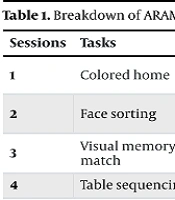
The ARAM program includes four specific tasks aimed at enhancing particular cognitive functions: The Faces Task for attention shifting, the Colored Home Task for sustained attention, the Marked Table Task for attention inhibition, and the Last Colored Task for working memory (14). These tasks are structured hierarchically, progressing from simple to complex based on factors such as stimulus quantity, stimulus speed, target stimuli quantity, and rule variations. The development of this package incorporates Sohlberg and Mateer's memory model (16) and the working memory model. The tasks of the ARAM in the DBCR program are outlined in Table 1.
Table 1.
Content of Analysis of Variance Cognitive Rehabilitation Program by Each Session
| Session | Task | Objective | Assignment |
|---|---|---|---|
| 1 | Colored home | Training of sustained and selective attention | In a visual search task, participants locate a target home among similar images. Difficulty increases with varied colors, distractors, and home samples. Speed and accuracy are measured. |
| 2 | Face | Engaging sustained, selective attention, shifting attention, divided attention | Participants arrange falling faces based on rules like skin color, hair color, and emotion. Speed and complexity increase as players progress, earning scores for correct matching. |
| 3 | Similar window | Training visuospatial span in working memory | Participants match hidden images in cells of a table by revealing and remembering pairs. Difficulty increases with more chains to click, cells, similarity, and shape complexity. |
| 4 | Marked tables | Training visuospatial span in working memory | Participants select a table matching a cued sequence of tables. Difficulty increases with cues, show time, inter-stimulus interval, and choice delay, focusing on spatial cue locations for selection. |
| 5 | Segmented images | Training visuospatial span component of working memory | Participants select the whole image from fragments after a delay among choices. Difficulty increases with fragment number, intervals, choice delay, image complexity, and choice similarity. |
| 6 | Acronym making | Enhancing phonological processing, inhibitory control, and phonological span | Participants form words from the initial letters of presented stimuli and select matching choices. Complexity increases with stimuli number, meaning, length, and choice similarity. |
| 7 | Last colored | Training updating ability | Participants select a choice based on the last color in a sequence of colored squares. Difficulty increases with color variety, sequence length, and number of choice items. |
| 8 | Animal tracing | Enhancing visual-spatial working memory span and ability to update | Present animal images within different houses on a table, accompanied by directional arrows guiding participants in locating the animals. |
| 9 | Repetitive image | Enhancing updating ability | Participants identify repeated images displayed on-screen. Progress is determined by goal percentage, complexity, and image similarity. The N-back task improves updating skills. |
| 10 | Letter matching | Enhancing phonological processing span and inhibitory control | Participants match the initial and final letters of sequential text. Varying text length adjusts task complexity. Phonological span utilization, inhibition, and updating assist in information filtering. Task modifications include difficulty, speed, and quantity adjustments. |
Data were gathered using CPRS, RPM, and BRIEF. The CPRS is a widely used tool for evaluating ADHD. Developed by Conners et al. in 1997, this scale consists of 27 items to be completed by parents. Each item is rated using four response options (not at all, just a little, pretty much, and very much), corresponding to scores of zero to three, respectively. Conners' factor analysis identified five key factors within the scale: Conduct problems, learning, psychosomatic symptoms, impulsivity/hyperactivity, and anxiety. To confirm its validity, correlations between these factors were computed, ranging from 0.52 to 0.80. The construct validity of the CPRS was further affirmed through factor analysis, confirming its differential validity in distinguishing individuals with ADHD from those without. The scale's reported reliability is 0.90, with a retest reliability coefficient for a total score of 0.58, a Cronbach's alpha coefficient for a total score of 0.73, and an overall validity rating of 0.84. A T-score higher than 70 confirms the presence of ADHD (22). Using Cronbach’s alpha, the internal reliability of the Persian version of the CPRS was calculated at 0.91. The retest reliability was ICC = 0.89, and the Pearson correlation coefficient was 0.82 (23).
Raven’s progressive matrices is a non-verbal test that is culturally, linguistically, and educationally unbiased, and it is used to assess intelligence quotient (IQ). There are two versions of Raven’s Progressive Matrices: Color and black-and-white. This research employs the color version. Originally introduced in 1947, the color version is designed to evaluate the intelligence of individuals aged 5 to 12 years, as well as adults with suspected cognitive impairments. It consists of 36 colored geometric images divided into three sections (A, AB, B), each containing 122 problems. Within each section, the patterns display a geometric shape or design with a missing segment. Below the incomplete figure, six pattern options are provided, and the individual is required to identify the correct pattern to complete the figure. A score of one is awarded for every correct response, with total scores ranging from 0 to 36. The raw scores are then transformed into intelligence scores, normalized to an average of 100 with a standard deviation of 15, accounting for the individual's age based on normative data (24).
The high validity of RPM in assessing general intelligence has been demonstrated in prior research (24). The correlation coefficient of RPM with the Stanford-Binet IQ test was found to be 0.40, and with the Wechsler IQ test, it was reported as 0.76. The reliability coefficients of the RPM across various age groups ranged from 0.40 to 0.92. In the current study, Raven’s Progressive Matrices were administered to participants individually (24). The reliability and validity of the RPM were found to be satisfactory in a sample of Iranian children attending schools in Tehran (25).
The BRIEF primary school version, developed by Gioia et al. in 2000, assesses the GEC in children aged 6 to 12 through reports on their daily performance in natural settings (26). The questionnaire consists of 86 items that evaluate eight scales: Response inhibition, shifting, working memory, emotional control, planning, organizing materials, initiation, and monitoring. These scales are categorized into two indices: Metacognition (which includes initiation, working memory, planning, and organizing materials) and behavioral regulation (which includes response inhibition, shifting, and emotional control).
Response options are scored on a scale from 1 to 3, indicating the frequency of behaviors: 1 for "never," 2 for "sometimes," and 3 for "often." The minimum possible total score is 86, and the maximum is 258 (26). A score of 50 indicates potential issues in that index, while a score above 65 suggests a significant deficit in that index (26). The questionnaire’s validity was assessed through two scales: Inconsistency and Negativity. The former evaluates response consistency, and the latter assesses negative responses. The scores derived from the Inconsistency scale reflect responses to identical questions. This scale comprises 10 pairs of questions that exhibit a high degree of correlation. To derive the raw score for the Inconsistency scale, the difference between each paired question is computed, and the cumulative sum of these differences is then determined. The resulting score ranges from 0 (indicating complete consistency) to 20 (indicating a very high level of inconsistency). A total score of 8 or higher signifies the presence of inconsistency.
The negativity scale quantifies the frequency of abnormally negative responses to the questionnaire items, consisting of 9 questions that assess how often the most negative option (a score of 3) is selected. A total score of 6 or greater on the negativity scale suggests unusual response patterns. Interpretation guidelines indicate that scores above 65 may reflect significant issues in the corresponding scale.
The Persian-translated version of the BRIEF demonstrated good validity (ranging from 0.80 to 0.98) and reliability (ranging from 0.84 to 0.88) in assessing the BRI and the MI (27). In this study, parents completed the questionnaire.
3.1. Statistical Analysis
The collected data were analyzed using descriptive statistics, including the mean and standard deviation, along with inferential statistics comprising the chi-square test, Mann-Whitney U test, Shapiro-Wilk test, Mauchly's test of sphericity, and analysis of variance (ANOVA) with repeated measures.
4. Results
The mean age of children in the experimental and control groups was 10.20 ± 1.14 years and 9.47 ± 1.50 years, respectively. Chi-square tests showed no significant differences between the groups in terms of age and educational level. The Mann-Whitney U test indicated no significant differences in IQ between the groups, confirming that the two groups were equivalent in terms of age, educational level, and IQ. An independent t-test revealed no significant disparities in the Conner’s grading scale factors between the experimental and control groups (P = 0.037).
The mean and standard deviation of the GEC scores in the pre-test, post-test, and follow-up phases for the experimental and control groups are shown in Table 2. Results indicate that the experimental group improved GEC scores in both the post-test and follow-up phases, unlike the control group. The BRI and MI scores also showed improvement in the experimental group but not in the control group. Repeated measures ANOVA was employed to test whether the computerized cognitive training program enhanced executive functions as hypothesized for children with ADHD.
Table 2.
Descriptive Indices of the Global Executive Composite and Its Components (the Behavior Regulation Index and the Metacognition Index) in the Experimental and Control Groups a
| Variables and Groups | Pre-test | Post-test | Follow-up |
|---|---|---|---|
| GEC | |||
| Experimental | 161.183 ± 2.25 | 139.25 ± 22.45 | 142.66 ± 24.67 |
| Control | 151.15 ± 30.66 | 150.46 ± 28.64 | 152.53 ± 30.44 |
| BRI | |||
| Experimental | 58.08 ± 12.68 | 53.41 ± 9.39 | 46.35 ± 11.38 |
| Control | 56.76 ± 14.33 | 56.38 ± 12.86 | 56.92 ± 13.16 |
| MI | |||
| Experimental | 103.75 ±14.42 | 85.83 ± 13.82 | 89.08 ± 14.26 |
| Control | 94.38 ± 18.27 | 94.07 ± 17.39 | 95.61 ± 18.83 |
Abbreviations: BRI, Behavior Regulation Index; MI, Metacognition Index.
a Values are expressed as mean ± SD.
The results of assessing the assumptions for ANOVA with repeated measures confirmed the validity of the quantitative assumption for the dependent variable, as it was measured at three different time points. The analysis revealed no outliers in the dataset. Skewness and kurtosis were evaluated using the Shapiro-Wilk test, with values below 2 for skewness and kurtosis indices across the GEC, BRI, and MI variables in the experimental group at pre-test, post-test, and follow-up. This suggests a normal distribution for these variables in the experimental group (P > 0.05).
Mauchly’s Sphericity assumption was not met for any of the variables, necessitating the use of the Greenhouse-Geisser correction due to higher values than the significance level. With all assumptions met, ANOVA with repeated measures was utilized to compare the GEC, BRI, and MI between the experimental and control groups across pre-test, post-test, and follow-up time points (Table 3).
Table 3.
Results of Analysis of Variance with Repeated Measures to Compare the Means of the Global Executive Composite and Its Components (the Behavior Regulation Index and the Metacognition Index) at Pre-test, Post-test, and Follow-up
| Variables and Source of Change | SS | df | MS | F Statistics | P-Value | ɳ2 | Power of Test |
|---|---|---|---|---|---|---|---|
| GEC | |||||||
| Time | 1847.32 | 1.15 | 1603.23 | 13.19 | < 0.001 | 0.365 | 0.996 |
| Group | 1879.004 | 1.15 | 1630.72 | 13.42 | < 0.001 | 0.368 | 0.960 |
| Error | 3220.09 | 26.502 | 121.505 | ||||
| BRI | |||||||
| Time | 93.396 | 1.351 | 69.151 | 3.151 | 0.074 | 0.12 | 0.467 |
| Group | 83.476 | 1.351 | 61.806 | 2.816 | 0.093 | 0.109 | 0.425 |
| Error | 357.34 | 31.064 | 21.948 | ||||
| MI | |||||||
| Time | 114.006 | 1.190 | 936.157 | 19.598 | < 0.001 | 0.46 | 0.995 |
| Group | 1176.726 | 1.190 | 988.864 | 20.701 | < 0.001 | 0.47 | 0.997 |
| Error | 1307.380 | 27.369 | 47.768 |
Abbreviations: SS, sum of squares; GEC, general executive composite; BRI, Behavior Regulation Index; MI, Metacognition Index; df, degree of freedom; MS, mean of squares; ɳ2, Eta quotient.
The results in Table 3 indicate a significant difference in the average scores of the GEC and MI between the experimental and control groups at pre-test, post-test, and follow-up, with 37% and 47% of the variance explained by the cognitive rehabilitation program. This confirms the first and third hypotheses. However, the BRI did not show significant differences across the groups, with only 11% of the variance explained in the experimental group, failing to support the second hypothesis.
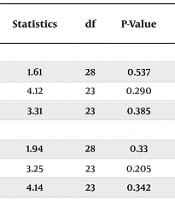
Independent t-tests at each time point showed no significant differences in the GEC and MI at the pre-test, suggesting that the cognitive rehabilitation program's effect remained consistent even after five weeks of follow-up (P > 0.01) (Table 4).
Table 4.
Results of Independent t-Tests at Different Time Points for Variables: Global Executive Composite and Metacognition Index in the Experimental and Control Groups
| Variables and Time | Statistics | df | P-Value | Mean Difference | Confidence Interval 0.95 for Mean Difference | |
|---|---|---|---|---|---|---|
| Low Level | High Level | |||||
| GEC | ||||||
| Pre-test | 1.61 | 28 | 0.537 | 6.00 | -13.64 | 25.64 |
| Post-test | 4.12 | 23 | 0.290 | -11.21 | -32.63 | 10.23 |
| Follow-up | 3.31 | 23 | 0.385 | 9.87 | -32.92 | 13.17 |
| MI | ||||||
| Pre-test | 1.94 | 28 | 0.33 | 5.66 | -6.12 | 17.45 |
| Post-test | 3.25 | 23 | 0.205 | -8.24 | -21.09 | 4.83 |
| Follow-up | 4.14 | 23 | 0.342 | -6.53 | -20.44 | 7.38 |
Abbreviations: GEC, general executive composite; BRI, Behavior Regulation Index; MI, Metacognition Index; df, degree of freedom.
5. Discussion
The study aimed to investigate the impact of a computerized cognitive rehabilitation program on the GEC, BRI, and MI scores in children with ADHD. The initial findings revealed that the program led to improvements in the GEC scores in children with ADHD, consistent with prior research (14). According to previous studies (14), learning new skills and enhancing learning abilities can induce changes in neural network structures through neuroplasticity mechanisms. By tailoring DBCR like ARAM to target specific brain structures, based on neural flexibility, improvements in brain function can be achieved.
Progressing tasks from easy to challenging in the ARAM program, along with providing immediate feedback, boosts children's self-confidence and motivation, leading to increased engagement and focus on subsequent tasks. Moreover, the ARAM computerized cognitive rehabilitation program specifically targets attention and working memory, which are key components of executive functions, helping children succeed in game-like exercises. This success contributes to improvements in executive function performance. Consequently, exposing children to a series of cognitive exercises through the program is expected to enhance their executive function abilities.
The second significant finding of the study indicates that the DBCR program does not lead to changes in the BRI among children with ADHD. This outcome is consistent with findings from previous research studies (13, 14, 20). Building on recent explanations from a study (14), it is observed that most tasks and exercises within the ARAM program primarily focus on attention and working memory. As a result, improvements in these cognitive processes may not have translated into changes in components of the BRI specifically, inhibition, cognitive flexibility, and emotional control.
Moreover, incorporating behavioral management programs and reinforcement strategies by parents alongside the ARAM program could potentially enhance behavior regulation in children with ADHD. It is also possible that the assessment of the BRI (inhibition, cognitive flexibility, and emotional control) through Conners’ Parent Behavior Scale may not fully capture the emotional aspects of behavior regulation and instead primarily measures its functional aspects. Therefore, supplementing assessments with other neuropsychological tools, such as a more detailed cognitive evaluation like the Cambridge Neuropsychological Test Automated Battery (CANTAB), may yield different or more positive results (19).
Furthermore, as suggested by another study (20), the cognitive load involved in the DBCR program may significantly influence the children’s motivation to regulate responses and control emotional inhibition. Given that changes in emotional response control and inhibition are closely tied to motivational factors and cognitive load, it can be inferred that by reducing cognitive load within tasks, both in computer-based interventions and in children's daily routines, their motivation to regulate and inhibit responses may increase. This, in turn, could potentially lead to improvements in the BRI.
The third set of findings from the research indicates that the DBCR program significantly impacts MI in children with ADHD. This discovery aligns with the findings of a previous study (28). Consistent with the outcomes reported by Kazemi et al. (28), it can be observed that the incorporation of engaging games and exercises within the DBCR program, along with the progression of tasks from simple to complex, fosters a sense of empowerment and mastery in children, improving their performance in homework and exercises. Given that many computer-based programs rely more on visual stimuli than textual cues, the presentation of images through exercises enables children to track moving objects, discern their positions at different intervals, and thereby heighten their perception of reality, which significantly impacts their performance.
Furthermore, the competitive and dynamic nature of computer-based programs, characterized by features such as flexibility and testability, can profoundly influence children's learning experiences. In line with the research findings of Kazemi et al. (28), it is suggested that computer-based programs offer a learning environment that mirrors brain functions and daily activities in a child's life. This immersive experience not only fosters the motivation needed to complete tasks successfully but also employs learning principles to enhance all components of the MI (such as inhibition, working memory, organization, planning, and monitoring).
Key limitations of this study include the non-random sample selection, the lack of comparative analysis across neurological variables, the reliance on parents to complete questionnaires for executive function information, and the absence of behavior regulation assessment across multiple emotional contexts. Caution should be taken when generalizing these results, and future research should focus on random sample selection and the inclusion of functional assessments to deepen the understanding of executive functions, particularly regarding behavior regulation.
5.1. Conclusions
The findings indicate that cognitive skills, particularly the GEC, with a focus on metacognitive abilities, improved following the DBCR intervention for children with ADHD, and these improvements remained stable after five weeks. However, no significant changes were observed in the BRI. Experts could use these results to guide the development of targeted programs addressing the specific challenges faced by children with ADHD by utilizing the neurocognitive mechanisms underlying the disorder. This approach could help address not only cognitive issues but also associated behavioral challenges, enhancing the overall effectiveness of interventions. In addition to cognitive rehabilitation, incorporating behavior therapy methods may be necessary to achieve improvements in the BRI and ensure their stability in children with ADHD.