


1. Background
In recent decade, the concept of mindfulness received the attention of many researchers and the mindfulness-based interventions increased (1, 2). Mindfulness as a method to pay attention, originated from eastern Meditation practices (3), and is described as complete attention to the present experiences (4). Two components are emphasized in defining mindfulness: self-regulation of attention and nurturing a non-judgmental orientation based on acceptance (5). Through mindfulness-based techniques, one becomes mindful towards daily activities. The individual becomes aware of the automatic function of the mind and it’s ruminating over the past and the possible future. Through this insight, the person gains control over thoughts, feelings, and sensations, and becomes free from automatically focusing on the past and future (6). Studies showed a negative correlation between mindfulness and psychological disorders such as depression, anxiety, and drug abuse (7, 8). Also, effectiveness of mindfulness training on these disorders in adults was reported (9, 10).
However, the education of mindfulness for children and adolescents is growing rapidly, but studies on its effectiveness are still in the early stages (11, 12). A few preliminary studies show the effectiveness of mindfulness-based treatments in children with anxiety (13, 14), conduct disorder and aggressive behaviors (15), depression, and stress (16). As mindfulness-based interventions in adolescents are increasing, there is a need for tools to measure mindfulness skills in this population (17). Various tools are designed to measure mindfulness, some widely in use are: the Freiburg mindfulness inventory (FMI) (18), the mindfulness attention awareness scale (MAAS) (19), the Kentucky inventory of mindfulness skills (KIMS) (20), the Toronto mindfulness scale (TMS) (21), the cognitive and affective mindfulness scale-revised (CAMS-R) (22), and the five facet mindfulness questionnaire (FFMQ) (17). However, there are only two tools available to measure mindfulness in children and adolescents, which are the MAAS-A (23), and child and adolescent mindfulness measure (CAMM) (24). The MAAS-A developed by Brown et al. (23), is based on its adult version (MASS). Brown et al. (23), reported one factor for it by EFA. The results of studies conducted by its authors showed a good reliability and validity for this tool (23). The psychometric proportion of this scale is reported in various countries. For example, the study of the MASS-A Dutch version confirmed the one-factor structure of this scale, and reported a high internal consistency. The MAAS-A also showed a positive correlation with happiness and negative correlation with stress (25). Another study in Spain also confirmed one-factor model of the MAAS-A in teenagers of 14 - 18 years. The study reported the negative correlations between MASS-A with depression, anti-social behaviors, and aggression (26). According to the current study review, there is no tool to measure mindfulness in children and adolescents in Iran. Therefore, the current study aimed at investigating the factor structure and reliability of the Persian version of the MAAS-A, and examining the relationship between mindfulness and anxiety in adolescents.
2. Objectives
Due to the importance of mindfulness, the current study aimed at examining the factor structure and reliability of a Persian version of MAAS-A, and investigating the relationship between mindfulness and anxiety in adolescents.
3. Materials and Methods
3.1. Participants
The current cross sectional and psychometric study was conducted on 12 - 18-year-old school students of Kashan city, Iran, in the school year 2016 - 2017. According to Polit and Beck (27), to perform the EFA, for each item in scale, 5 - 10 samples are required; and for the CFA, Myers et al. (28), suggested that a sample size of 200 individuals is adequate. Therefore, given the number of MASS-A items (14 items) and by calculating probability drop, the sample size was considered 160 subjects to study EFA and 210 individuals for CFA that were selected by multi-stage cluster sampling across 12 schools (six females’ schools, six males’ schools). In the end, 354 individuals (154 for EFA and 200 for CFA) fully responded to all the scales (mean age ± standard deviation (SD) = 15.27 ± 1.36).
3.2. Procedure
In order to use the MAAS-A in an Iranian adolescent population, the following was performed:
Permission from the scale author was secured via email; next, the scale was translated into Persian by two individuals, separately, fluent in both Persian and English, then the translated copies were presented to a group of clinical psychologists familiar with the acceptance and commitment-based treatment (ACT), and their comments were considered. The translated versions, along with a copy of the original version were given to two translators familiar with English and psychology, not present in previous stages. They were asked to evaluate the equivalence of the translated and original version. Then, 10 adolescents were asked to complete the questionnaire and their opinions about the readability, clarity, and comprehensibility of the items were examined. They did not report a problem with clarity of items. Afterwards, the back-translation of the Persian version into English was performed by two individuals expert in English and psychology that had not seen the original version. Then, this copy was compared with the original version, and it was evaluated in terms of inconsistencies.
In the next step, the psychometric properties of the scale were studied. For this purpose, 370 individuals were selected from Kashan students via cluster sampling. Furthermore, 45 respondents were tested again after four weeks.
The construct validity of the scale was studied via the EFA and CFA. The test-retest method, as well as the internal consistency (IC) was used to determine the reliability of this scale. To examine the relationship between mindfulness and anxiety, participants completed the revised children’s manifest anxiety scale (RCMAS).
3.3. Ethical Considerations
The research process and objectives of the study were explained to the enrolled students and their parents and written informed consent, considering the ethical issues, was obtained from them. Then, the study subjects responded to the scales. Also, the current study protocol was approved by the Ethics Committee of Kashan University of Medical Sciences (grant number: IR.KAUMS.REC.1396.27).
3.4. Measures
3.4.1. Mindfulness Attention Awareness Scale for Adolescents
This 14-item scale was developed by Brown et al. (23), based on its adult version designed by Brown and Ryan (19). The scoring is based on a six-point Likert scale (from 1 = almost always to 6 = almost never). A higher score in this scale indicates a higher degree of mindfulness. The result of Cronbach’s alpha (0.82 - 0.84) and the retest reliability (r = 0.79, P < 0.001) were acceptable in two groups of adolescents (23). They reported the correlation between the negative affect (the positive and negative affect schedule (PANAS) (r = -0.41, P < 0.001) and MAAS-A (23). This scale was psychometrically confirmed in Spain and the Netherlands.
3.4.2. Revised Children’s Manifest Anxiety Scale
This 37-item scale is developed by Reynolds and Richmond (29) to evaluate various signs of anxiety. The children are asked to answer each item with yes/no, and each item is scored either “zero” or “one”. The items were designed for children aged 8 and higher. A retest reliability of r = 0.77 (P < 0.01) was reported for this scale (30). The convergent validity of MASS-R with RCMAS (r = 0.85, P < 0.001), and the state-trait anxiety inventory for children were reported good (STAIC) (31).
Taghavi and Alishahi (32) examined the validity and reliability of the Persian version of this scale. They reported its test-retest reliability with an interval of three to four weeks (r = 0.67, P < 0.001). They showed that RCMAS could distinguish the children and adolescents with anxiety from the normal ones (P < 0.001).
3.5. Statistical Analysis
Data normality was examined by the Shapiro-Wilk test. EFA was conducted using the Kaiser-Meyer-Olkin (KMO) index and the Bartlett test, principal components analysis, and the varimax rotation. Fit indexes used to examine the model were relative χ2 (χ2/df), goodness-of-fit index statistic (GFI), the adjusted goodness-of-fit statistic (AGFI), the Tucker-Lewis index (TLI), the comparative fit index (CFI), and the root mean square error of approximation (RMSEA).To calculate the reliability of the MAAS-A, Cronbach’s alpha and test-retest reliability (four-week interval) were used. The results were analyzed with SPSS version 19.0 and AMOS-22 software.
4. Results
The participants consisted of 187 males (52.8%) and 167 females (47.2%), in the age range of 12 - 18 years, with 15.27 ± 1.36 years as the mean ± SD of age. Of the 354 participants, 107 individuals were in the age range of 12 - 15 and 247 in the range of 15 - 18 years. The mean age was 59.43 ± 10.30 years for the MAAS-A and 10.69 ± 5.77 years for the RCMAS. The two subsamples were not significantly different in terms of age (t = 0.26, P = 0.79), gender (χ2 = 126, P = 0.72), MAAS-A total (t = 1.13, P = 0.25), and anxiety (t = 0.50, P = 0.61).
4.1. Factor Structure
4.1.1. Exploratory Factor Analysis
To study the construct validity, the EFA was applied using principal component analysis. According to this analysis, the KMO coefficient value was 0.73, and the Bartlett χ2 was 468.80 (P < 0.001). It was suggested that the sample and selected variables were adequate for the factor analysis. The EFA showed two factors for this scale (Table 1).
Table 1.EFA Results of the MAAS-A
| Item | Factor 1 | Factor 2 |
|---|---|---|
| 1 | 0.29 | 0.58 |
| 2 | 0.61 | 0.17 |
| 3 | 0.22 | 0.75 |
| 4 | 0.56 | -0.00 |
| 5 | 0.47 | -0.07 |
| 6 | 0.67 | -0.08 |
| 7 | 0.47 | 0.14 |
| 8 | 0.59 | 0.14 |
| 9 | 0.25 | 0.64 |
| 10 | 0.48 | 0.17 |
| 11 | -0.23 | 0.57 |
| 12 | -0.07 | 0.77 |
| 13 | 0.59 | 0.09 |
| 14 | 0.60 | 0.06 |
| Eigenvalues | 3.15 | 2.38 |
| Factor variances, % | 22.55 | 17.38 |
| Total variance, % | 39.59 | |
The current study results showed that items 2, 4, 5, 6, 7, 8, 10, 13, and 14 could be loaded on the first factor (eigenvalue = 3.15). Items 1, 3, 9, 11, and 12 were placed on the second factor (eigenvalue = 2.38). Based on the content of the items and the definition of mindfulness concept in the third wave theories, it can be said that the first factor measures the “acting with attention and mindfulness” and the second factor measures the “attention to the present-moment”.
4.1.2. Confirmatory Factor Analysis
The results of the EFA were different from those of the Brown et al.; therefore, the one-factor structure was changed to a two-factor structure. The CFA was employed to ensure the accuracy of this structure (Table 2).
Table 2.CFA Results of the MAAS-A
| Model | Goodness-of-Fit Index | |||||
|---|---|---|---|---|---|---|
| χ2/Df | GFI | AGFI | TLI | CFI | RMSEA (90% CI) | |
| Two-factor model | 1.303 | 0.93 | 0.90 | 0.96 | 0.96 | 0.03 (0.00 - 0.06) |
It is suggested that the χ2/DF < 5 reveals an acceptable fit of the model and < 2 indicates a good fit of the model (33). Also, GFI, AGFI, TLI, and CFI ≥ 0.90 and the RMSEA ≤ 0.05 show a good fit of the model (34). Based on the abovementioned issues, and according to Table 2, it can be concluded that the two-factor model had a desirable fit (Figure 1).
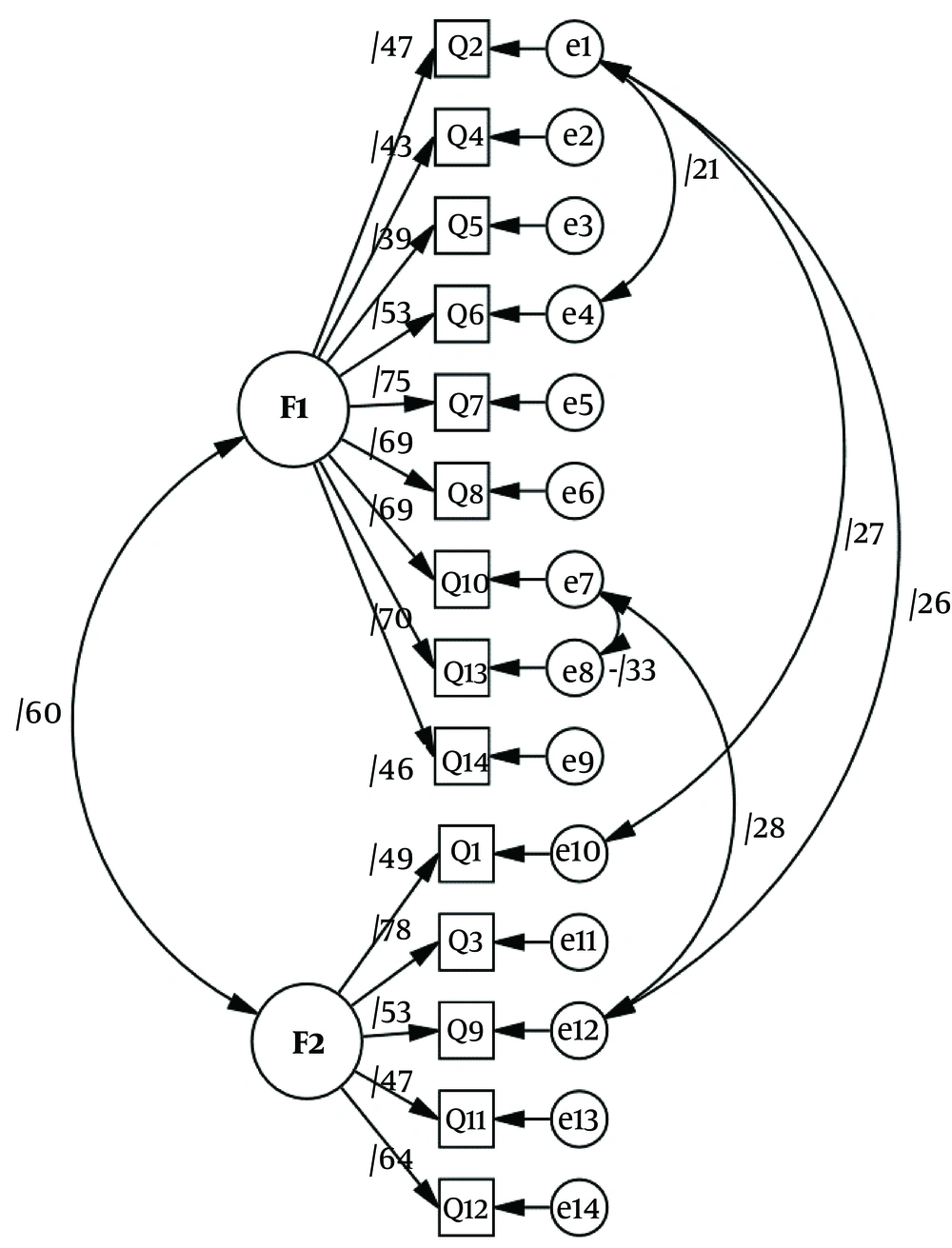
Figure 1.
The CFA of MASS-A
4.2. Reliability
Cronbach’s alpha for the total score, factor 1, and factor 2 was 0.81, 0.78, and 0.70, respectively. This finding indicated the good internal consistency of this scale. The test-retest reliability (four-week interval) total, factor 1, and factor 2 was 0.86, 0.75, and 0.74, respectively; and all were significant at P < 0.01.
4.3. Correlation Between Mindfulness and Anxiety
The current study results indicated that the MAAS-A total and the RCMAS total were significantly related (r = -0.43). The correlations between the MASS-A subscales and that of the RCMAS total were -0.30 (subscale 1), -0.40 (subscale 2), and all were significant (P < 0.01). This meant the divergent validity of MASS-A.
Table 3 shows the correlations between the factors of the RCMAS and MAAS-A disaggregated by gender.
Table 3.Correlations Between the MAAS-A and the RCMASa
| Scale | Gender | |
|---|---|---|
| Male | Female | |
| MAAS-A total | -0.46** | -0.44** |
| Factor 1 | -0.26** | -0.35** |
| Factor 2 | -0.46** | -0.39** |
a** P < 0.01.
5. Discussion
Given the rising interest in a tool to measure mindfulness in adolescents, the current study aimed at evaluating the psychometric properties and cross-cultural perspectives of a Persian version of the MAAS-A in Iranian adolescents. The factor structure, internal consistency, and test-retest reliability of this scale were studied. The results of the EFA revealed two factors called “acting with attention and awareness” and “attention to the present moment”. Further, the CFA showed that the two-factor model of this scale had a desirable fit. In total, the two factors accounted for 39.59% of the total variance, which was higher than the 32.52% of the results for the original version by Brown et al. (23), and the 33.59% obtained by the Spanish version (25). Consequently, it is better to use the two-factor model. Regarding the reliability of this scale, the results showed an acceptable internal consistency of the scale total (α = 0.81), which is similar to the original version (α = 0.82).
Another aim was to examine the relationship between mindfulness and anxiety. It was observed that the total score and its subscales were negatively correlated with RCMAS, suggesting that more mindful people experience less anxiety. Many studies show a negative relationship between the mindfulness and neuroticism in various samples (17, 19). In a study, negative correlation between the four scales of anxiety and mindfulness was found (19). Moreover, in another study, a negative correlation between MAAS and anxiety arousal was acquired (35). Since defective attention is the main sign of anxiety, strategies such as mindfulness can be effective in improving the attention of the students and alleviating anxiety (14). Furthermore, given the effectiveness of mindfulness-based interventions on anxiety (36) and according to the present result, it can be said the mindfulness-based interventions can be used for the treatment of anxiety in adolescents.
The limitations of the present study were: (1) Use of a non-clinical sample similar to the study by Brown on its original version (23), and (2) use of the limited adequate questionnaires to assess the convergent validity of the scale because of a few valid questionnaires in the adolescent population in Iran. Therefore, it is recommended to assess the validity and reliability of this scale in further studies in clinical adolescent samples, and also to take advantage of more questionnaires. Despite these limitations, it can be said that the MAAS-A has acceptable psychometric properties in the Iranian population, and is confident to measure mindfulness. This scale can also be used to evaluate the effectiveness of the mindfulness-based interventions in adolescents.




