


1. Background
Mindfulness is an attention concentration approach originated from eastern meditation (1) and defined as the act of focusing on a particular goal in the present without judgment (2). Through mindfulness, people learn to perceive internal and external events freely and without judgment and they learn how to deal with a wide range of pleasant and unpleasant thoughts, emotions, and experiences (3, 4). In recent years, mindfulness-based interventions have shown beneficial results for clinical problems, including depression, anxiety, OCD, substance abuse, chronic pain, eating disorder, psychosis, and borderline personality disorder (1, 5-10). Such interventions have also been reported as efficient treatment options for adults in several meta-analysis studies (11-14). These interventions are also effective for children and adolescents for whom stressors increase the risk of emotional, behavioral, and social problems and poor educational performance (15). Mindfulness-based interventions provide promising results in the management of children’s stress through self-regulation and facilitation of social and emotional growth (15). Accordingly, recent efforts have reflected the increasing consideration of child and adolescent mindfulness in research (16-18). A number of these studies have indicated the effectiveness of mindfulness education for child anxiety (19, 20), emotional-social flexibility (19), conduct disorder, and aggressive behaviors (21). Despite the insights provided by these studies, research on the effectiveness of mindfulness-based treatments for children and adolescents is still in the early stages. Thus, there is a need to develop tools that concretely identify the mindfulness skills of the younger population (22, 23).
Various tools have been designed for measuring mindfulness in adults, with some of the most commonly used instruments being the Kentucky Inventory of Mindfulness Skills (KMIS) (22), the Freiburg Mindfulness Inventory (FMI) (24), the Cognitive and Affective Mindfulness Scale-Revised (CAMS-R) (25), the Toronto Mindfulness Scale (TMS) (26), the Five-Facet Mindfulness Questionnaire (FFMQ) (21), the Mindfulness Attention Awareness Scale (MASS) (27), and the Southampton Mindfulness Questionnaire (SMQ) (28). By contrast, only have two tools been developed for measuring mindfulness in children and adolescents: the MAAS-A (27) and CAMM (29).
The CAMM was developed by Greco et al. (29) to measure mindfulness skills such as current awareness and nonjudgmental and inevitable responses to thoughts and feelings in 10 to 17-year-old children and adolescents. The scale has been standardized in various countries around the world. In a study on the Portuguese version of the CAMM involving 410 adolescents with a mean age of 15.18 years, the results showed that the instrument is a univariate scale that presents desirable internal consistency (α = 0.80, CR = 0.85) and retest reliability (r = 0.46). In another study, negative and positive correlations were found between the CAMM and the AFQ-Y and between the CAMM and the Social Comparison Scale (SCS), respectively (30). In research on the Spanish version of the CAMM involving children aged 11 to 16, the results indicated that the instrument is a univariate scale that is similar to the original version with regard to internal correlation (α = 0.80). The CAMM scores were positively correlated with the Personal Wellbeing Index, the Early Adolescent Temperament Questionnaire-Revised, and the Multidimensional Self-concept Scale (31). Researchers have also investigated a Dutch version of the CAMM in a sample of 10 to 12-year-old children and 13 to 16-year-old adolescents (32); the factor analysis results confirmed the one- and two-factor models of the scale and its internal consistency (α = 0.71 for children, α = 0.80 for adolescents). The CAMM, likewise, showed to be positively correlated with the Subjective Happiness Scale, the Healthy Self-regulation Subscale, and the Pediatric Quality of Life Inventory Scale but negatively correlated with stress, self-blame, rumination, and catastrophizing (32). An investigation on the Australian version of the CAMM involving non-clinical adolescents (12 to 15 years) confirmed the one-factor model and good internal consistency of the scale (α = 0.84). In other studies, CAMM scores were positively correlated with worry scores (Penn State Worry Questionnaire for Children) and negative affect but negatively correlated with positive affect (33). The findings on the Italian version confirmed the one-factor model of the scale and its negative correlation with the Difficulties in Emotion Regulation Scale, attention deficit problems, and depression; the scale was also positively correlated with the Life Satisfaction Scale (34). In another study on the Italian version, the analysis indicated that the scale is consisted of two factors, namely, “awareness” and “willingness”, and of one high-order factor, namely, mindfulness skills. The scale showed acceptable internal consistency and convergent validity (35).
Considering the wide use of mindfulness interventions in recent years for children and adolescents and the effects of mindfulness on mental health, it was necessary for us to evaluate the effectiveness of the CAMM in the Iranian context. Correspondingly, it was hypothesized that the one-factor structure of the CAMM would be confirmed by confirmatory factor analysis (CFA) (aim 1), that CAMM items would be internally consistent as shown by Cronbach’s alpha > 0.70 and test-retest reliability (aim 2), and that the convergent and divergent validity of the CAMM would be shown by suitable correlations between the CAMM scores and relevant psychological measures such as MAAS-A, AFQ-Y8, RCMAS, and CDI (aim 3). Proving these hypotheses would provide further support for the use of the CAMM as a reliable and valid self-report test of mindfulness skills and a valid assessment tool in child and adolescent mindfulness-based programs.
2. Objectives
The purpose of this study was to examine the validity and reliability of a Persian version of the CAMM.
3. Methods
3.1. Participants
According to Comfrey and Lee (36), a sample size of 300 individuals for EFA and according to Myers et al.’s suggestion (37), a sample size of 200 individuals for CFA are good; thus, by accounting for the probability of drop-out, we considered a sample size of 620 students. The inclusion criteria for this study were as follows: (a) being not younger than 12 and not older than 18 years, (b) with any history of comorbid axis I and II psychiatric disorders, and (c) adequate Persian language skills. Participants were excluded if there was evidence of psychosis, cognitive dysfunction, and alcohol dependence. Participants were recruited from schools in Kashan city, Iran, (Table 1) that were selected via random cluster sampling in 2017 among 12 middle and high schools for boys (six schools) and girls (six schools). After the participants were assured of the confidentiality of their participation, they were administered with the Persian CAMM. A total of 600 students fully completed the questionnaires.
The sample was randomly divided into two subsamples of 300 participants for separate analyses of EFA and CFA. The first subsample comprised 154 boys and 146 girls with a mean age of 15.18 years (SD = 1.66) and the second comprised 158 boys and 142 girls with a mean age of 14.97 years (SD = 1.38). The two subsamples were similar in age [t (598) = 0.103, ns, and sex, χ2 (1, N = 600) = 0.74, ns]. To examine the retest reliability, 50 subjects were reevaluated after four weeks.
Table 1.Sociodemographic Characteristics and Mean Child and Adolescent Mindfulness Measure (CAMM) Score of the Sample
| Characteristics | N (%) | Mean (SD) |
|---|---|---|
| Sex | ||
| Male | 312 (52) | 18.60 (6.99) |
| Female | 288 (48) | 18.67 (6.77) |
| Age | ||
| 12 | 44 (7.3) | 18.57 (7.70) |
| 13 | 52 (8.7) | 20.88 (5.55) |
| 14 | 101 (16.8) | 17.95 (6.77) |
| 15 | 150 (25.0) | 19.09 (7.11) |
| 16 | 153 (25.5) | 17.43 (7.27) |
| 17 | 71 (11.8) | 20.07 (5.78) |
| 18 | 29 (4.8) | 17.45 (6.04) |
3.2. Procedure
To ensure the applicability of the CAMM in Iranian society, permission was obtained from the developers of the original tool through e-mail for the translation of the CAMM into the Persian language. The Persian version was then sent for review by a specialized group of clinical psychology professors. Next, the Persian CAMM was piloted in a small sample (five students) to examine the understanding of each item. At this stage, the final Persian version was presented to two translators who were familiar with English and psychological concepts for back-translation. The back-translated version was then compared with the original version to assess the degree of conceptual and semantic equivalence between the two versions. A satisfactory level of equivalence was found.
Next, the original model of the CAMM (single-factor model) was investigated by CFA. The results of CFA showed that the one-factor model of the CAMM did not meet the goodness of fit indexes. Then, EFA was carried out with 300 individuals. As EFA should be followed by CFA using a different and separate sample to evaluate the EFA-informed model, finally, in a separate sample of 300 individuals, the CFA of the model was examined. Correlations between the CAMM scores and the scores of AFQ-Y8, CDI, RCMAS, and MAAS-A were calculated. After four weeks, 50 participants were randomly selected to obtain a second CAMM score for evaluating test-retest reliability. The required minimum level of significance in all statistical tests was P < 0.05.
3.3. Ethical Considerations
The research process and objectives of the study were explained to the enrolled students and their parents and written informed consent, considering the ethical issues, was obtained from them. Then, the study subjects responded to the scales. Also, the current study protocol was approved by the Ethics Committee of Kashan University of Medical Sciences (grant number: IR.KAUMS.REC.1396.27).
3.4. Instruments
3.4.1. Child and Adolescent Mindfulness Measure (CAMM)
This measurement developed by Greco et al. (29) is used to measure mindfulness skills with items that reflect acting with present-moment awareness (e.g., “at school, I walk from class to class without noticing what I’m doing”) with an attitude of acceptance and non-judgment (e.g., “I think that some of my feelings are bad and I shouldn’t have them”). This 10-item questionnaire was characterized by a single-factor structure obtained by means of exploratory and confirmatory factor analysis. The scale items are rated on a 5-point Likert scale (0 = false to 4 = always true). The lowest total score is zero and the highest total score is 40; the higher the score, the more the individual's willingness for mindfulness. Cronbach's alpha for this questionnaire was reported as α = 0.81. Also, CAMM had a positive correlation with Youth Quality of Life-Revised (YQOL, r = 0.25) and Academic Competence Scale (r = 0.25; P < 0.01) but a negative correlation with Children’s Somatization Inventory-Short Form (r = -0.40), internalizing (r = -0.51) and externalizing (r = -0.36) symptoms (Symptoms and Functioning Scale, SFS) (29). The psychometric questionnaire features have been studied in various countries, including Spain, Portugal, Italy, the Netherlands, and Australia.
3.4.2. Mindfulness Attention Awareness Scale for Adolescents (MAAS-A)
This 14-item scale was constructed by Brown et al. (27) based on its adult version designed by Brown. This scale is a self-report questionnaire that measures mindfulness in adolescents. The items are rated on a 6-point Likert scale (1 = almost always to 6 = almost never). A high score on this scale indicates a higher degree of one’s mindfulness. The results of studies conducted by its authors showed the good reliability and validity of this tool (27). In the Persian version of MASS-A, the results of the EFA at the age of 12 to 18 years suggested two factors for this scale labeled as “acting with attention and awareness” and “attention to the present moment”. The reliability of this scale was good (α = 0.81, retest reliability = 0.86) and the correlation between mindfulness and anxiety was significant and negative (r = -0.43; P < 0.01) (38).
3.4.3. Avoidance and Fusion Questionnaire for Youth (AFQ-Y8)
The AFQ-Y8 (39) is an eight-item questionnaire for measuring psychological inflexibility in youth that measures two constructs: experiential avoidance and cognitive fusion. All questions are rated on a 5-point Likert scale (0 = always disagree to 4 = always agree). Higher scores show higher levels of psychological inflexibility. The internal consistency of AFQ-Y8 was satisfactory and its reported Cronbach’s alpha coefficient was 0.83. The AFQ-Y8 was poorly correlated with the scales for constructs such as acceptance, mindfulness, suppression of thoughts, anxiety, depression, and life quality. The psychometric features of this tool have been confirmed in the United States, Spain, Sweden, and the Netherlands. In the Persian version of AFQ-8, the results of factor analysis at the age of 12 to 18 years showed the existence of one factor known as “psychological inflexibility” in this questionnaire. The CFA also confirmed a single-factor model for this scale. In addition, this questionnaire was convergent to the RCMAS (r = 0.60, P < 0.001) and the reported reliability of this scale was α = 0.71 (40).
3.4.4. Revised Children's Manifest Anxiety Scale (RCMAS)
This scale was developed by Reynolds and Richmond in 1978 to assess and diagnose general anxiety symptoms in children and adolescents aged 6 to 19 years. The scale consists of 37 items, 28 of which assess the mental, psychic, and motor indices of anxiety and the remaining nine items form a false scale that evaluates the subject's non-honest answers. Subjects are asked to answer each of the items in the form of yes/no and each gets a “zero” or “one” score. Therefore, the ranges of the total scores were from zero to 28 for anxiety items and zero to nine for items related to the lie detector (41). In the study of samples from 6 to 19-years-old, the retest reliability coefficient showed that this scale had r = 0.86 at a one-week interval and r = 0.77 within a five-week period. Another study showed a positive correlation between RCMAS and State-Trait Anxiety Inventory (r = 0.85, P < 0.001) (42).
In the study by Taghavi and Alishahi, the Persian version of RCMAS had good retest reliability (r = 0.67, P < 0.001). Also, the discriminant validity analysis between the two groups of anxious patients and healthy individuals of Iranian nationality showed that the RCMAS could significantly discriminate between the two groups (P < 0.001). Therefore, the scale had good discriminant validity. Also, the results of this study showed that all scale items had satisfactory correlations with the total scale score. Therefore, based on this study, the RCMAS had suitable psychometric appropriateness for use in Iran (43).
3.4.5. Children’s Depression Inventory (CDI)
This inventory was developed by Kovacs (44) based on the Beck Depression Inventory to measure depression in children and adolescents aged 7 to 17 years. The CDI is a 27-item self-report instrument, in which each question consists of three sentences. It was designed to measure the symptoms of depression such as crying, suicidal thoughts, and the ability to focus on the school homework. The adolescents select one of the three statements reflecting his/her feelings, emotions, and behaviors in the past two weeks. The questions are rated from 0 to 2 and the minimum and maximum total scores are 0 and 54, respectively. Therefore, a higher score on this scale indicates a higher level of depression. The total CDI score showed the satisfactory internal consistency of a clinical sample (α = 0.86) and the acceptable retest reliability (correlation after one month = 0.43). The discriminant validity of CDI was satisfactory and thus, this inventory could properly make a distinction between people with and without depression disorders (44). The reported retest reliability and internal consistency of the Persian version of CDI were 0.82 and 0.83, respectively. Also, the correlations between CDI and Children’s Depression Scale and between CDI and the Beck Depression Inventory were 0.79 and 0.87, respectively, reflecting the convergent validity of this inventory (45).
3.5. Statistical Analysis
The statistical analysis was performed using SPSS V. 19.0 and AMOS V. 22. Antecedent to analysis, the data were screened for missing data and normality. Normality was assessed using the values of skewness and kurtosis, with absolute skewness values above 3 and absolute kurtosis values above 10 as the indicators of non-normality (46). The EFA was conducted using the principal components analysis method by the first half of the sample (n = 300), which was randomly selected. The CFA was performed on the second half of the sample (n = 300), using the method for estimating maximum likelihood (ML) (47). To test the fit of the model, we used the following indices: χ2/df index, CFI (comparative fit index), GFI (goodness of fit index), AGFI (adjusted goodness of fit index), and RMSEA (root mean square error of approximation). We calculated Cronbach’s alpha coefficients to analyze the internal consistency. The Pearson correlation was used to determine convergent and divergent validities and retest reliability. A two-tailed test with α < 0.05 was applied for all statistical tests.
4. Results
Data screening indicated that 20 participants had a missing value on one of the CAMM items. Little’s Missing Completely At Random (MCAR) test showed that all observations were MCAR and they were consequently removed from the dataset. The terminal sample consisted of n = 600 observations. The proportion of cases to model parameters was 600 to 10, which was excellent. The values of skewness and kurtosis showed that the data did not diverge from normal distribution on any of the measures.
4.1. Construct Validity
The results of CFA showed that the one-factor model of the CAMM did not meet the goodness of fit indexes (Table 3). Therefore, we extracted the factors of this questionnaire using EFA.
4.1.1. Exploratory Factor Analysis (EFA)
Based on this analysis, the numerical value of the Kaiser-Meyer-Olkin coefficient was 0.79 and the χ2 index in the Bartlett test was 772.67 (P < 0.001), indicating the adequacy of the sample and the selected variables for the factor analysis.
Using a factor analysis with Varimax rotation with Kaiser normalization (extraction criterion > 1 and scree test) and based on eigenvalue and scree plot, two factors were extracted for this scale. The highest load factor was 0.83 for items 5 and 9 and the lowest factor load was 0.59 for item 1. Based on the contents of factor items, factors were named as “present moment awareness” and “avoidance of thoughts and feelings” (Table 2).
Table 2.Item Factor Load of Child and Adolescent Mindfulness Measure (CAMM) in the Current Study, Correlations Between the CAMM Items, and Descriptive Analysis
| CAMM items | EFA Result | CAMM Items | Descriptive Analysis | ||||||||||||
|---|---|---|---|---|---|---|---|---|---|---|---|---|---|---|---|
| Factor 1 | Factor 2 | 2 | 3 | 4 | 5 | 6 | 7 | 8 | 9 | 10 | Minimum | Maximum | Skewness | Kurtosis | |
| 1 | 0.59 | 0.17 | 0.24a | 0.24a | 0.30a | 0.07 | 0.28a | 0.37a | 0.20a | 0.21a | 0.18a | 0 | 4 | 0.050 | -1 |
| 2 | 0.71 | -0.14 | - | 0.32a | 0.26a | -0.08 | 0.31a | 0.24a | 0.24a | 0.04 | -0.03 | 0 | 4 | 0.752 | -0.71 |
| 3 | 0.63 | 0.27 | - | - | 0.43a | 0.15a | 0.30a | 0.26a | 0.22a | 0.21a | 0.21a | 0 | 4 | 0.228 | -1.0 |
| 4 | 0.65 | 0.39 | - | - | 0.11a | 0.25a | 0.30a | 0.25a | 0.33a | 0.20a | 0 | 4 | 0.161 | -1.0 | |
| 5 | -0.02 | 0.83 | - | - | - | - | 0.08 | 0.01 | -0.01 | 0.42a | 0.32a | 0 | 4 | -0.523 | -0.81 |
| 6 | 0.68 | 0.12 | - | - | - | - | - | 0.40a | 0.29a | 0.12a | 0.11a | 0 | 4 | 0.037 | -1.1 |
| 7 | 0.72 | 0.08 | - | - | - | - | - | - | 0.35a | 0.15a | 0.18a | 0 | 4 | 0.111 | -1.0 |
| 8 | 0.61 | -0.05 | - | - | - | - | - | - | - | 0.12a | 0.09 | 0 | 4 | 0.114 | -0.97 |
| 9 | 0.13 | 0.82 | - | - | - | - | - | - | - | - | 0.33a | 0 | 4 | -0.278 | -0.91 |
| 10 | 0.12 | 0.63 | - | - | - | - | - | - | - | - | - | 0 | 4 | -0.139 | -0.98 |
| Eigen values | 3.11 | 2.08 | |||||||||||||
| Factor variance, % | 31.09 | 20.86 | |||||||||||||
| Total variance, % | 51.96 | ||||||||||||||
aP < 0.001.
4.1.2. Confirmatory Factor Analysis (CFA)
In this study, χ2, χ2/df, GFI, AGFI, CFI, and RMSEA indices were used to examine the fitting of the hypothesized models. It is said that if χ2/df is smaller than 2, it is desirable and if it is smaller than 5, it is acceptable with connivance (48). Also, GFI, AGFI, TLI, and CFI > 0.9 correspond to the goodness of fit of the model (49-51). In the case of RMSEA, a value of less than 0.05 indicates a good fit, between 0.05 and 0.08 represents a relatively good fit, and greater than 0.1 indicates a poor fit of the model (46).
Table 3 shows the goodness of fit indices for the three models. In the models, all 10 items were considered. Of the three models, the two-factor model (RMSEA = 0.05) had a better fit than the second-order model (RMSEA = 0.08) and the one-factor model (RMSEA = 0.07; Figure 1).
Table 3.The Results of Confirmatory Factor Analysis of Various Child and Adolescent Mindfulness Measure (CAMM) Models
| Model | Goodness of Fit Indices | ||||||
|---|---|---|---|---|---|---|---|
| χ2 | df | χ2/df | GFI | AGFI | CFI | RMSEA (90% CI) | |
| One-factor | 83.36 | 32 | 2/60 | 0.92 | 0.90 | 0.84 | 0.07 (0.05 - 0.09) |
| Two-factor with second-order factor | 137.24 | 34 | 4/03 | 0.94 | 0.90 | 0.85 | 0.08 (0.06 - 0.10) |
| Two-factor | 62.45 | 32 | 1.95 | 0.96 | 0.93 | 0.91 | 0.05 (0.03 - 0.07) |
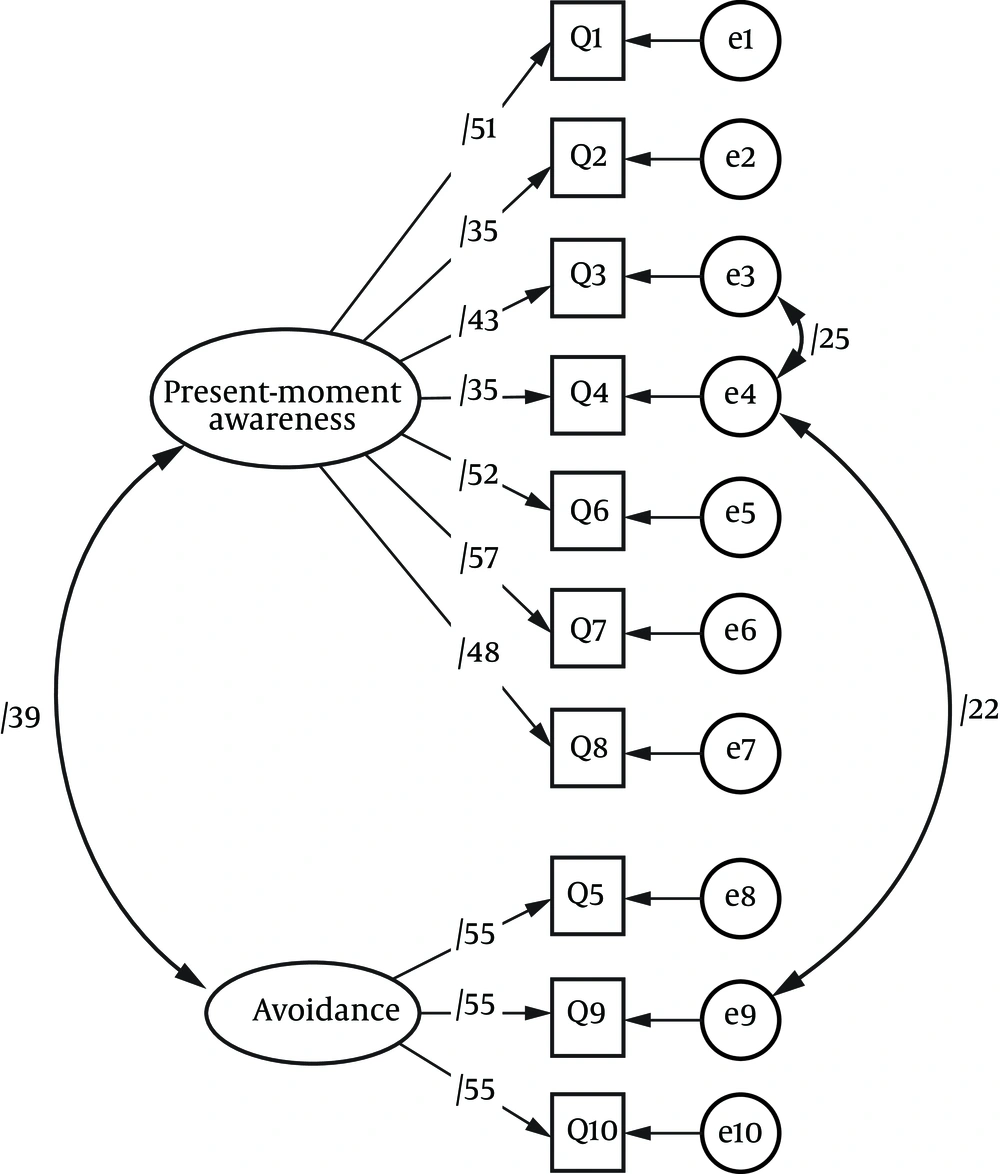
Figure 1.
The two-factor model of Child and Adolescent Mindfulness Measure (CAMM)
4.2. Reliability
The Cronbach’s alpha coefficient (desirable if above 0.70), the mean inter-item correlation (MIIC; considered good if ranged between 0.15 and 0.50), the corrected item-total correlation range (CITCR; desirable if above 0.20) (52, 53), and a test-retest after a four-week interval were used to assess the reliability of this scale. The Cronbach’s alpha coefficient depends on the number of items on a scale, and when the number of items is less than 10, the Cronbach’s alpha can be smaller (54). As a result, it is proposed to use MIIC and CITCR instead of Cronbach’s alpha.
Table 4.Cronbach’s Alpha, Mean Inter-Item Correlation (MIIC), and Corrected Item-Total Correlation (CITCR) for Child and Adolescent Mindfulness Measure (CAMM) and its Factors (N = 600)
| Items | Alpha | MIIC | CITCR | |
|---|---|---|---|---|
| CAMM total | 1, 2, 3, 4, 5, 6, 7, 8, 9, 10 | 0.73 | 0.21 | 0.31 - 0.50 |
| Factor 1 | 1, 2, 3, 4, 6, 7, 8 | 0.74 | 0.29 | 0.40 - 0.51 |
| Factor 2 | 5, 9, 10 | 0.62 | 0.35 | 0.38 - 0.46 |
The test-retest reliability with a four-week interval was 0.81 for the total scale and 0.75 and 0.71 for the “present moment awareness” and “avoidance of thoughts and feelings” factors, respectively (P < 0.01). According to Table 4, the total scale and the “present moment awareness” factor showed acceptability internal consistency based on the alpha coefficient (above 0.70), MIIC (ranged between 0.15 and 0.50), and CITCR (above 0.20). The factor “avoidance of thoughts and feelings” revealed low Cronbach’s alpha (below 0.70); however, it showed a good MIIC (ranged between 0.1 and 0.5) and CITCR (above 0.2).
4.3. Convergent and Divergent Validity
The results showed that CAMM was negatively correlated with RCMAS (r = -0.54, P < 0.001), CDI (r = -0.50, P < 0.001) and AFQ-Y8 (r = -0.33, P < 0.001), which indicated the divergent validity of CAMM. It was also positively correlated with MAAS-A scores (r = 0.71, P < 0.001), which indicated the convergent validity of the total scale and subscales of Persian CAMM (Table 5).
Table 5.Correlation of Child and Adolescent Mindfulness Measure (CAMM) Subscales with Measures of Validity (N = 600)
Abbreviations: AFQ-Y8, avoidance and fusion questionnaire for youth; CAMM, child and adolescent mindfulness measure; CDI, children’s depression inventory; MAAS-A, mindfulness attention awareness scale for adolescents; RCMAS, revised children's manifest anxiety scale.
aP < 0.001.
5. Discussion
Given the increasing interest of researchers and psychologists in measuring mindfulness in children and adolescents and the lack of valid and reliable tools for measuring it in Iran, this study examined the psychometric properties of the Persian version of the CAMM and the relationship between mindfulness and anxiety, depression, and psychological inflexibility in adolescents. To assess the psychometric adequacy of the scale, we determined its factor structure, internal consistency, and retest reliability. The EFA revealed the existence of two factors in the scale, namely, “present moment awareness” and “avoidance of thoughts and feelings”. The CFA verified the suitability of the two-factor model of the scale (RMSEA = 0.05) and indicated that it was more favorable than the original and Italian versions (RMSEA = 0.07 and 0.06, respectively). The Netherland and Portuguese versions of the CAMM (30, 32) have two factors that are similar to those in the Persian version.
Regarding reliability, the results indicated the appropriate reliability of the scale, as evidenced by its Cronbach’s α value of 0.73. In comparison, the Cronbach’s alpha values of the Australian, Dutch, Portuguese, Spanish, and Italian versions of the CAMM were 0.84, 0.80, 0.79, 0.87, and 0.79, respectively. The total score of the CAMM pointed to its significant negative correlation with the RCMAS (r = -0.54) and CDI (r = -0.50), indicating that individuals with strong mindfulness experience less anxiety and depression. Similarly, Roemer et al. (55) found a negative correlation between mindfulness and anxiety. Because defective attention is the main symptom of anxiety and depression, mindfulness exercises can effectively improve attention and reduce psychological symptoms in adolescents (56). Previous studies also demonstrated the effectiveness of mindfulness-based interventions in reducing adolescent anxiety (57, 58). The correlation between the Portuguese version of the CAMM and the RCMAS is similar to the correlation between RCMAS and the Persian version of the CAMM (r = -0.55 for the Portuguese version and r = -0.54 for Persian version). Various studies asserted that mindfulness can be expected to predict anxiety (11).
In a similar vein, the observed association between mindfulness and depression in the current work is consistent with the results of other studies (30, 34). We found that weak mindfulness is related to greater depression. Also, we found a negative correlation between CAMM and AFQ-8. Different studies also showed a negative relationship between mindfulness and psychological inflexibility (24, 30, 32). The original (r = -0.60), Portuguese (r = -0.56), and Italian (r = -0.70) versions of the CAMM showed a negative correlation with the AFQ-Y. The constructs of mindfulness and psychological inflexibility indicate how a person responds to internal and external conditions and they are strongly correlated with diverse forms of psychopathology and behavioral health (3, 6). As previously stated, mindfulness helps people perceive internal and external events freely and without distortion (3), thereby increasing psychological flexibility. Consistent with previous studies, the present research showed that the Persian CAMM was negatively correlated with psychological inflexibility (AFQ-Y8). This finding indicates that the scale has acceptable divergent validity. As predicted, the scale was positively correlated with the MAAS-A, demonstrating that both scales measure the same structure (i.e., mindfulness) and that the CAMM exhibits suitable convergent validity.
Similar to any other study, the current research is encumbered by a number of limitations. The participants were selected from schools belonging to only one geographical area (Kashan city). Although the sample size was large, sample selection from a single city restricts the generalizability of the results to adolescent populations from different societies with varying socioeconomic status. Various cities in Iran do not differ much in terms of these attributes, but we recommend the examination of the scale in other cities for a more comprehensive analysis. Another limitation was the administration of the CAMM to non-clinical samples. We suggest that future research probe into the validity and reliability of the scale in more widespread adolescent samples with psychiatric symptoms or disorders. Researchers should also use more questionnaires for comparison.
5.1. Conclusions
The findings indicated that the CAMM has good psychometric properties for the measurement of mindfulness in Iranian adolescents and children. The analysis showed that the instrument is best represented by a two-factor structure. The CAMM can also be used to predict the level of anxiety and depression and evaluate the efficiency of mindfulness-based interventions.




