To assess the affinity of newly synthesized ligands against benzodiazepine (BZD) receptors, radioligand receptor binding assays are frequently used. The assays are relatively simple but extremely powerful tool for studying receptors and identify a lead compound for future investigations (
9). The assay includes incubation of radioligand with the receptor preparation, separation bound ligand from free ligand, quantify the amount of bound radioligand, and finally analyze the data. The optimum conditions are necessary for experiments in order to get reproducible and reliable results, which are used by researchers to study receptor, analyze the SAR, and finally find a lead compound. Since it is not possible to try out various factors in an attempt to optimize binding, factors such as incubation time and temperature, concentration of radioligand and receptors were evaluated in preliminary studies based on assay conditions by other laboratories. In first attempt, rat cortical membranes were prepared as the source of the BZD receptors. Membrane preparations are most widely used in radioligand receptor binding assays as source of receptors because of reproducibility and reliability of data (
1,
14-
15). After removal of membrane, the tissue was washed a few times with ice cold buffer to remove any soluble interfering substances such as natural ligand, and guanine nucleotides, which may interfere with the radioligand binding assay (
1). Measurement of bound radioligand to membrane preparation containing receptors requires separation of bound from free radioligand, which can be achieved by filtration, centrifugation, or equilibrium dialysis. Based on our previous studies, centrifugation was used to separate bound from unbound ligand (
19). Since saturation and competition binding studies are based on equilibrium (theoretical model), thus the time of incubation of ligands and receptors should be enough to ensure that equilibrium or steady state (the time after which the bound no longer increases) has been reached. The time to reach steady state depends on temperature, radioligand and receptor concentration. The incubation can be done on ice, room temperature or at 37 °C. It is most convenient to do the assay at room temperature (
1,
14-
16). We did the experiment at room temperature, which was measured to be 30 °C. The temperature was kept at 30 °C in all of the experiments. To minimize NSB and prevent ligand depletion, a low concentration of radioligand and membrane preparation is required in assay. Based on literature review, the range of radioligand concentrations should be from (0.1-10) kd if possible (
1,
14-
16). We obtained the appropriate radioligand concentration in preliminary experiments regarding NSB and reliable measurement of radioactivity (cpm). NSB was determined by excess concentrations of diazepam to occupy all of the available receptors in the presence of radioligand. For most receptor assays a tissue concentration in the range of 100-500 μg of membrane protein is used (
1). In preliminary studies, we used 100 μg of membrane protein, which was later proved (in zone A determination) to be the right amount. The appropriate incubation time was determined with incubation of 100 μg of rat cortical membrane contains BZD receptors with the 8.6×10⁻⁵ nmole 3H-flumazenil at 30 °C until steady state conditions were reached. The amount of radioligand, which was bound to the receptors at various times after the start of the incubation, was measured. The results were plotted with bound on the Y-axis and time on the X-axis. The appropriate incubation time was determined from the curve where the binding is shown to be constant (
1,
14-
18). The results of our studies are shown in
Table 1 and
Figure 2. As can be seen, an incubation time of 35 min is appropriate to reach steady state at 30 °C.
Receptor concentration
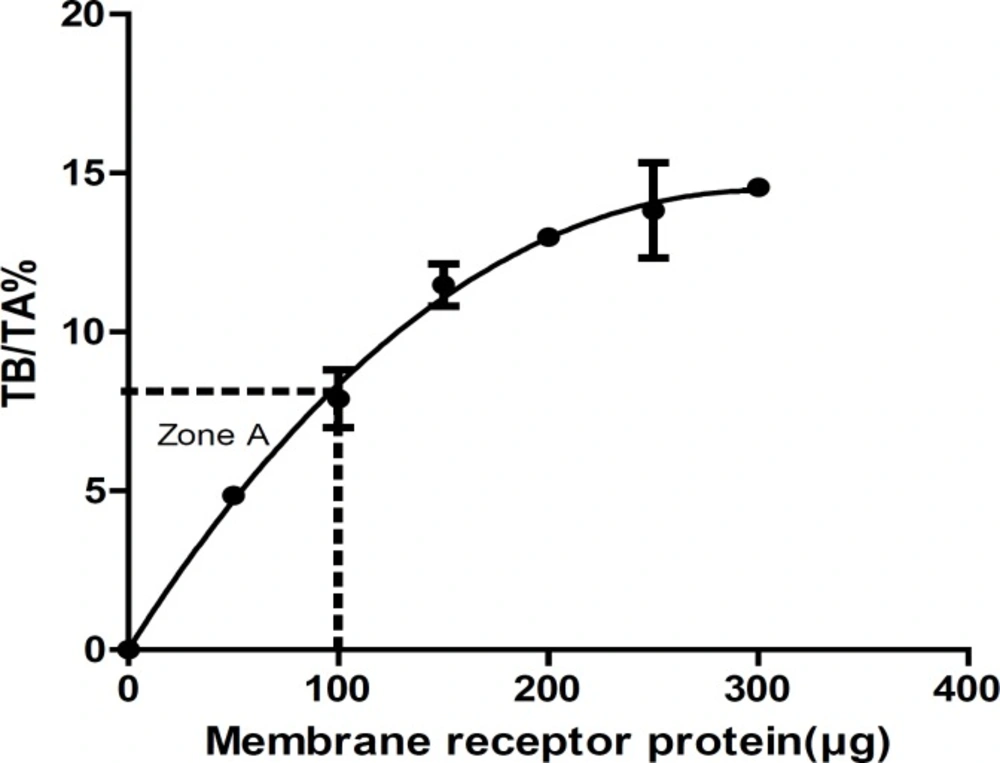
: In order to obtain the suitable concentration of receptors in the assays, Zone A (the level of receptor that yields <10% TB/TA) must be evaluated from receptor concentration curve by plotting % TB/TA versus receptor concentration. To avoid ligand depletion, the TB of radioligand should be less than 10% of TA radioligand (
9,
14-
18). Saturation studies must be performed at <10% total ligand binding at all radioligand concentrations. In this study, we measured the amount of TB at various concentrations of receptors in optimum incubation time (35 min).
Table 2 summarized the results of receptor concentration. The membrane receptor protein concentration that yields <10% TB/TA (Zone A) was 100 μg (
Figure 3).
Saturation binding study: For the saturation binding studies of [3H]-flumazenil, seven different concentrations of [3H]-flumazenil (ranging from 0.05 nM to 0.97 nM) were used.
The amount of radioligand required to saturate the receptors was used to determine the receptor binding affinity of [3H]-Flumazenil (Kd) and the benzodiazepine receptor density (Bmax) based on non-linear regression analysis of the saturation curve data (
18). As the concentration of radioligand increases the amount of bound increases until a point is reached where no matter how much more radioligand is added, the amount bound does not increase further. As shown in
Table 3 and
Figure 4, the binding parameters (Bmax and Kd) of [3H]-Flumazenil were calculated from the saturation binding experiments. Bmax and Kd were calculated as 0.638 ± 0.099 pmol/mg and 1.35 ± 0.316 nM respectively.
The affinity of the non-radioactive ligands for the receptor is determined indirectly by measuring their ability to compete and inhibit the binding of radioligand to its receptor. In a competition experiment, various concentrations of a non-radioactive ligand compete with a fixed concentration of radioligand for binding to the receptor. As the concentration of non-radioactive ligand increases, the amount of radioligand bound to the receptor decreases. The concentration of non-radioactive ligand that inhibits the binding of [3H]-flumazenil by 50% is IC50 value (
18).
In this study, the affinity of compound A was measured in competition studies at optimum conditions by displacement of [3H]-Flumazenil from rat cortical membrane (
Table 4 and
Figure 5). The affinity was 1.9 nM comparable with diazepam (1.53 nM), a known benzodiazepine agonist. This finding makes the compound an interesting lead for further optimization. Starting from this compound, new ligands were designed and synthesized. The design was based on a pharmacophore model of the benzodiazepine binding site of GABAA. The affinity and IC50 of new compounds were measured in competition studies. The
in-vivo biological evaluation of compounds with good affinity is on the way. The results (design, synthesis, and biological evaluation) would be published soon.
In conclusion, radioligand receptor binding assays at optimum conditions provide in-vitro screening of compounds quickly and precisely. Compounds with high affinity would go through biological evaluation. Based on receptor structure, essential pharmacophore groups, and affinity of ligands, a lead compound would be identified.


![The structure of 2-phenyl-5-oxo-7-methyl-1,3, 4-oxadiazolo [a, 2, 3]-pyrimidine (compound A).](https://brieflands.com/journals/ijpr/articles/125469/figures/ijpr-13-079-g001-preview.webp)
![Time course of the specific binding of [3H]-flumazenil to rat cortical membrane benzodiazepine receptors. Each point represents Mean ± SEM of three independent determinations. The line is the best fit to single exponential determined by nonlinear regression analysis](https://brieflands.com/journals/ijpr/articles/125469/figures/ijpr-13-079-g002-preview.webp)
![The Saturation curve for the binding of increasing concentrations of [3H]-flumazenil to rat cortical membrane. The amount of radioactivity bound to the tissue, measured in cpm by liquid scintillation counting has been converted to pmol of [3H]-flumazenil per mg of protein present in the incubation mixture.](https://brieflands.com/journals/ijpr/articles/125469/figures/ijpr-13-079-g004-preview.webp)
![Competition binding curve of 2-phenyl-5-oxo- 7-methyl-1,3,4-oxadiazolo[a,2,3]-pyrimidine as a new benzodiazepine agonist. IC50 curve shows the effect of competitor concentration on the inhibition of radioligand binding. The IC50 value is the concentration of competitor that correlates to the midpoint between the high and low plateaus of the curve.](https://brieflands.com/journals/ijpr/articles/125469/figures/ijpr-13-079-g005-preview.webp)

