Introduction
Multiple sclerosis is an inflammatory and autoimmune disease of the central nervous system and the relapsing remitting form is its most prevalent subtype. Despite the multiple therapeutic options for relapsing remitting multiple sclerosis (RRMS), interferons are still very commonly prescribed medications universally and in the Middle East (1-6). The highest prevalence of the disease is seen in the third or fourth decade of life with occurrence of one or more neural symptoms including sensory and motor, visual, brainstem, cerebellar, genitourinary tract, mood and digestion symptoms in patients. There may be partial recovery in the early stages of the disease, but progressive disability occurs over time (7).
Interferons cause reduction in annualized relapse rate (ARR) and slow the progression of disability. It has been shown that the progression of disability in patients treated with interferons ranges from 19 to 28%, which is similar to glatiramer acetate and fingolimod while, ARR is reduced 15-36% under treatment with interferons, glatiramer acetate (GA), and teriflunomide (8).
Considering the role of interferons in treating RRMS and the ability of domestic pharmaceutical industry in producing these biologic products with lower cost, we designed this study to evaluate the safety and efficacy of Iranian Biosimilar Interferon beta-1a (Actovex) in comparison with the reference product in the Iranian patients diagnosed with RRMS in accordance to the regulations of Iranian food and drug administration.
Experimental
In this double-blind randomized phase 3 clinical trial, 138 patients with RRMS were recruited to investigate the non-inferiority of the biosimilar interferon 1-a in comparison with the reference product from 1390 to 1395. This trial was registered at IRCT under the code IRCT2013020812398N1.
Eligibility criteria included age of 18 to 55 years, a definite RRMS diagnosis based on 2010 McDonald′s criteria, a history of at least 2 relapses over the last year, expanded disability status scale (EDSS) of 0 to 5.5, a wash-out period of 3 months if history of previous interferon or GA treatment existed.
The patients with progressive subtypes, history of recent recurrence (current or in the past 30 days) that resulted in at least 1 point increase in EDSS, any systemic disease or any organ dysfunction, history of hypersensitivity to interferons or other components of the drug, uncontrolled seizure, severe depression or the history of suicide in the previous three months, pregnancy, nursing, unwillingness to use a safe contraceptive method during the study, hypersensitivity or inability to perform MRI with gadolinium contrast, concomitant treatment with other immunomodulators, history of receiving cytotoxic drugs in the previous three months, history of receiving corticosteroid or other investigational drugs in the last month were excluded.
The patients were assigned to two arms with 4-block randomization scheme and were treated with 30 µg/1 mL/weekly of each drug for a year in identical manners.
The change in EDSS (primary outcome), severity and rate of relapses, percentage of relapse-free patients, radiologic findings (the number of Gadolinium enhancing lesions, enlarging, and new T2 lesions in MRI) represented efficacy outcomes, while flu-like symptoms, injection site reactions and laboratory measures represented safety outcomes for evaluation at 6 and 12-month intervals.
We evaluated systemic adverse events (AEs) (headache, flu-like syndrome, fever, chills, and general pain) and local AEs (pain, erythema, itching, ecchymosis, and necrosis at the site of injection) during the study.
In this study, non-inferiority margin was considered 0.1 differences of EDSS changes during one year follow up, which was estimated with Analysis of Covariance (for repeated observations). The analysis approach was per-protocol and missing data were replaced through multiple imputations by using linear regression.
Results
One-hundred and seventy patients were evaluated for meeting the eligibility criteria of this study, out of which 8 did not meet the criteria and 24 refused to participate in the study. As a result, 138 patients (69 patients in each group) were randomized and divided into two arms of 69 patients each. The primary outcome endpoint was analyzed using intention-to-treat analysis containing all patients. The disposition of the patients throughout the study and the baseline characterisits of both arms are mentioned in Figure 1 and Table 1, respectively.
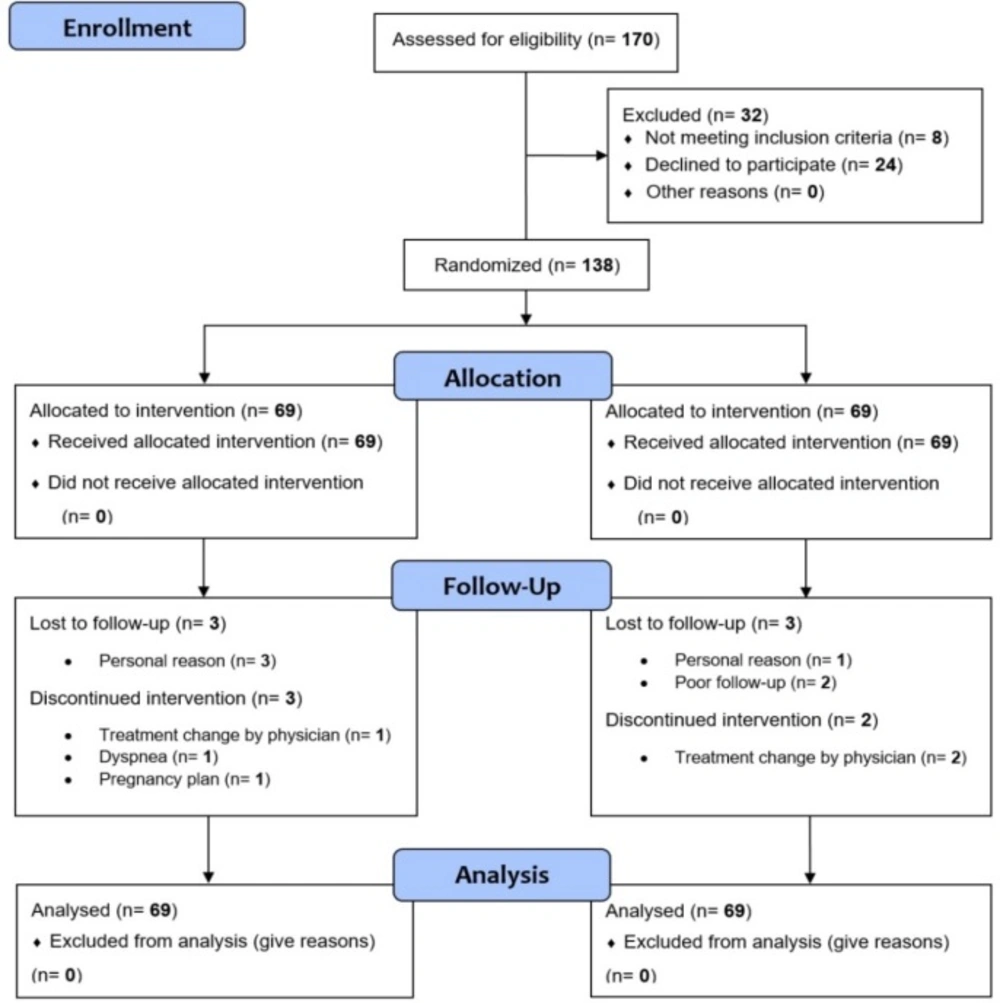
Figure 1
Disposition of patients throughout the study
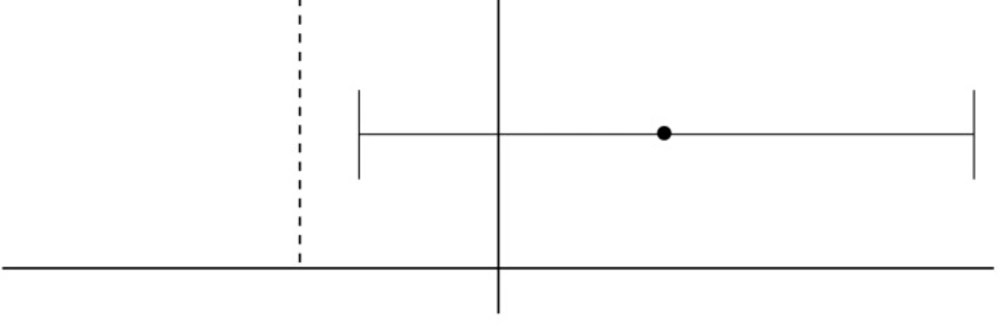
Figure 2
Estimation of difference of changes in EDSS in group Actovex versus Avonex
Table 1
Demographic and basic characteristics of the patients in two groups of Actovex and Avonex
| Variables | Group | ||
|---|---|---|---|
| Actovex (69) | Avonex (69) | P-value | |
| Age (Mean ± SD) | 32.48 (8.82) | 31.51 (8.09) | 0.502 |
| Female | 76.8% (53) | 87.0% (60) | 0.122 |
| Family marriage | 15.9% (11) | 11.6% (8) | 0.459 |
| Family history | 23.2% (16) | 33.3% (23) | 0.186 |
| Currently employed | 41.8% (28) | 45.6% (31) | 0.464 |
| Diabetes Mellitus | 2.9% (2) | 1.4% (1) | 0.559 |
| Thyroid disease | 11.6% (8) | 8.7% (6) | 0.573 |
| Collagen-vascular disease | 1.4% (1) | 1.4% (1) | 1.00 |
| Hypertension | 0 | 1.4% (1) | 0.336 |
| Liver disease | 2.9% (2) | 2.9 (2) | 1.00 |
| Renal disease | 2.9% (2) | 1.4% (1) | 0.559 |
| Migraine | 10.1% (7) | 21.7% (15) | 0.063 |
| Presenting symptoms | |||
| Sensory | 52.2% (36) | 47.8% (33) | 0.610 |
| Motor | 14.5% (10) | 17.4% (12) | 0.642 |
| Brain stem | 20.3% (14) | 18.8% (13) | 0.830 |
| Cerebellar | 21.7% (15) | 13% (9) | 0.178 |
| Spinal | 1.4% (1) | 2.9% (2) | 0.559 |
| Visual | 40.6% (28) | 31.9% (22) | 0.288 |
| Sphincteric | 4.3% (3) | 0 | 0.080 |
Table 2
Comparison the side effects in first 6 months, second 6 months and one year
| Patients (n) | |||||||||
|---|---|---|---|---|---|---|---|---|---|
| Variable | First 6 month | Second 6 month | Total 1 year | ||||||
| Actovex (69) | Avonex (69) | p-value | Actovex (64) | Avonex (63) | p-value | Actovex (69) | Avonex (69) | p-value | |
| Headache | 68.1% (47) | 79.7% (55) | 0.121 | 43.8% (28) | 69.8% (44) | 0.003 | 71.0% (49) | 84.1% (58) | 0.066 |
| Fever | 65.2% (45) | 78.3% (54) | 0.089 | 28.1% (18) | 41.3 (26) | 0.120 | 71.0% (49) | 79.7% (55) | 0.236 |
| Chills | 65.2% (45) | 68.1% (47) | 0.718 | 29.7% (19) | 44.4% (28) | 0.085 | 71.0% (49) | 72.5% (50) | 0.850 |
| General myalgia | 78.3% (54) | 85.5% (59) | 0.269 | 60.9% (39) | 73.0% (46) | 0.148 | 81.2% (56) | 85.5% (59) | 0.493 |
| Flu-like | 59.4% (41) | 73.9% (51) | 0.071 | 21.9% (14) | 41.3% (26) | 0.019 | 63.8% (44) | 75.4% (52) | 0.139 |
Table 3
The mean serum levels of hepatobiliary function tests in both groups at baseline, month 6 and month 12
| Serum level mean (SD) | |||||||||||
|---|---|---|---|---|---|---|---|---|---|---|---|
| First 6 month | Second 6 months | Total 1 year | p-value | ||||||||
| Actovex (69) | Avonex (68) | p-value | Actovex (59) | Actovex (59) | p-value | Actovex (57) | Avonex (59) | ||||
| SGOT (AST) | 17.86 (7.10) | 15.85 (4.95) | 0.058 | 16.81 (3.97) | 18.37 (8.56) | 0.208 | 17.35 (5.0.) | 18.22 (8.21) | 0.494 | ||
| SGPT (ALT) | 18.03 (7.90) | 17.00 (9.73) | 0.498 | 16.78 (7.00) | 18.25 (9.03) | 0.324 | 20.37 (12.00) | 19.42 (10.20) | 0.648 | ||
| Alkaline phosphatase | 152.28 (50.65) | 150.46 (34.77) | 0.807 | 146.56 (38.77) | 152.12 (42.06) | 0.455 | 156.54 (41.06) | 146.10 (43.42) | 0.186 | ||
| Total Bilirubin | 0.62 (0.36) | 0.58 (0.31) | 0.443 | 0.61 (0.27) | 0.53 (0.30) | 0.121 | 0.57 | 0.52 | 0.296 | ||
The results of this study showed that in the biosimilar group, the mean EDSS change (primary efficacy outcome) was 1.416 and 1.500 in the reference group, therefore, the EDSS of those in the biosimilar recipients was 0.084 lower than those with the other group (1.416; 95% CI: 1.308-1.525 in the biosimilar arm, 1.500; 95% CI: 1.392-1.608 in the reference arm) (Figure 2).
Seventy-two point five percent and eighty-one point five percent of the patients were relapse-free in Actovex and Avonex treatment arm, respectively (p-value = 0.23). In addition, the incidence of relapses and their severity during the first and second six months were not significantly different. The evaluation of MRI changes showed that the incidence of new T2 and GAD enhancing lesions were significantly lower in Actovex comparing with Avonex group both during the first 6 month and the 12 month evaluation.
During the study, no serious AEs were recorded. The incidence of headache and flu-like symptoms in the Actovex group were reportedly lower in the second six months in comparison with the reference group. There was also no significant difference between the two groups in terms of liver function tests (Tables 2 and 3).
Discussion
This study aimed to investigate the non-inferiority of Actovex a biosimilar interferon to its reference product through a phase 3 clinical trial in treatment of RRMS. Non-inferiority analysis of the EDSS changes showed that in Actovex recipients, the score of disability was decreased 0.084 score more than other group during a year (Figure 2). Since this value is higher than the proposed non-inferiority margin of 0.1, non-inferiority of Actovex versus Avonex was proven. The EDSS changes in this trial in Avonex recipients were similar to the results in previous studies in Iranian patients in 2006 and 2012 (9, 10). We chose EDSS as the primary outcome measure in this trial to demonstrate efficacy of the treatment. EDSS was the primary outcome in the original trial that introduced Avonex as well. Investigating the incidence and severity of relapses showed no significant difference between the two groups. This finding was similarly reported in the Iranian population in the studies of Etemadifar and Naffisi and their colleagues as well (9, 10).
While there was no significant difference in the percentage of enlarging lesion between the two groups, we recorded significantly fewer new T2 and GAD enhancing lesions in Actovex treatment arm. Less radiologic activity of Actovex recipients may be explained by their slightly more advanced disease at baseline (Baseline EDSS 1.74 vs. 1.44) (11, 12).
Although, the safety measures between two groups were not significantly different, headache complaints and overall flu-like symptoms were significantly lower in Actovex treatment arm. This has a significant effect on long-term treatment and tolerability of the patient.
The prevalence of flu-like symptoms in this study was higher in comparison with previous Iranian studies (9, 10). The difference in the definition of these adverse events and its measurement method seems to be the main causes of this result. In the assessment of AEs (systemic, local and laboratory), there was no significant difference between the two groups and the results are similar to other studies.
Conclusion
The findings of this study show that the efficacy of Actovex is non-inferior to Avonex while safety and tolerability of the two drugs are comparable. This study emphasizes the lower cost and widespread availability of Actovex, a domestically manufactured medication, with comparable efficacy and safety to the reference product.