Curcumin is also well-known as an anti-inflammatory and chemopreventative agent (
24). Studies in the last three decades about curcumin indicate poor bioavailability, hydrophobicity, poor cellular uptake, and rapid metabolism of this component (
25). Various experiments have been performed to solve this problem, many of which have performed nano-carriers (
26). Nanotechnology employs curative agents at the nanoscale level to develop nanomedicines. Nanostructures could be utilized to deliver drugs to target tissues, specifically with controlled cell release. Also, in treating cancers, they can increase drug absorption inside tumor cells and improve biodistribution and accumulation in tumor sites (
27,
28).
Previous studies have examined the anticancer properties of nano-curcumin made by curcumin and OA400 nano-carrier in various cancers (
6,
10,
29). This curcumin nanoformulation can affect different cellular pathways, including differentiation and cell proliferation (
2,
30). In vivo studies indicated that treating BALB/c tumor-bearing mice with nano-curcumin could more effectively and efficiently reduce tumor size than curcumin (
10). Due to the high prevalence of cervical cancer, drug resistance, and systemic toxicity of conventional chemotherapy and radiation therapy, it is necessary to identify safe, effective, and chemopreventive anticancer natural compounds. Therefore, in the present study, we investigated the potential therapeutic effects of the new nano-curcumin on cervical cancer. In this regard, we evaluated the expression of
E6 and
E7 human papillomavirus oncogenes and
P53 and
Rb factors in the HeLa cell line.
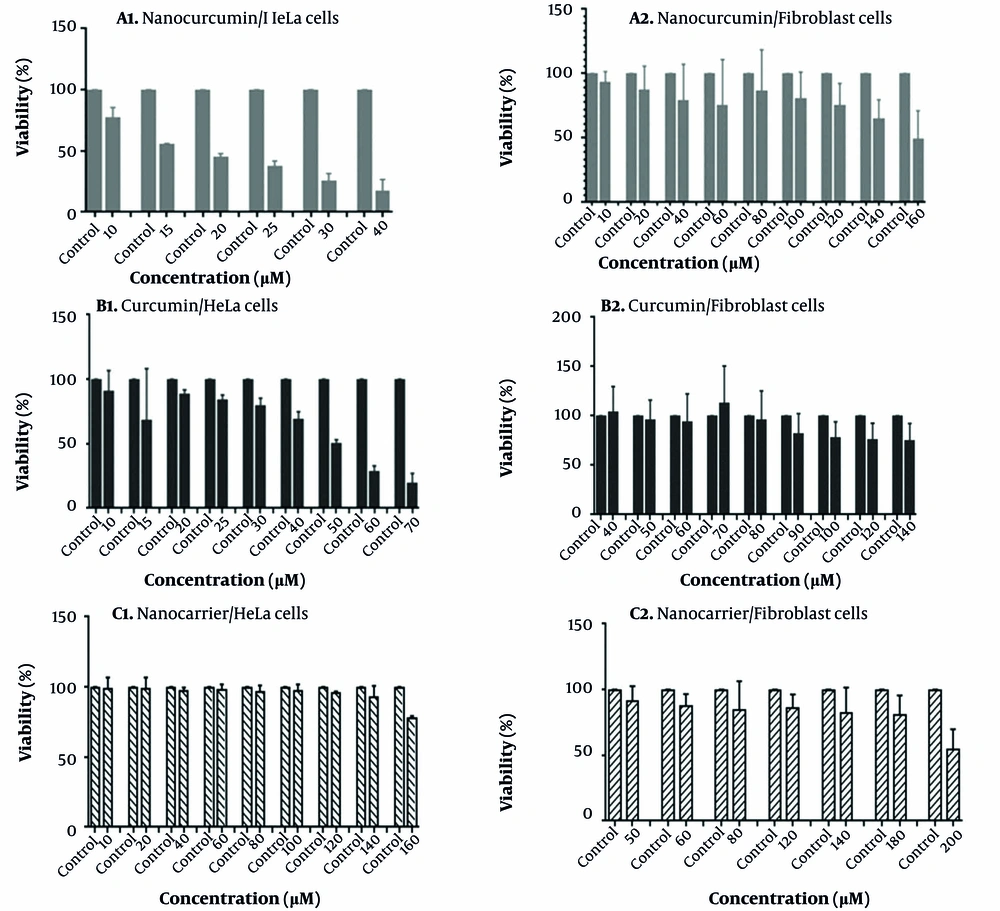
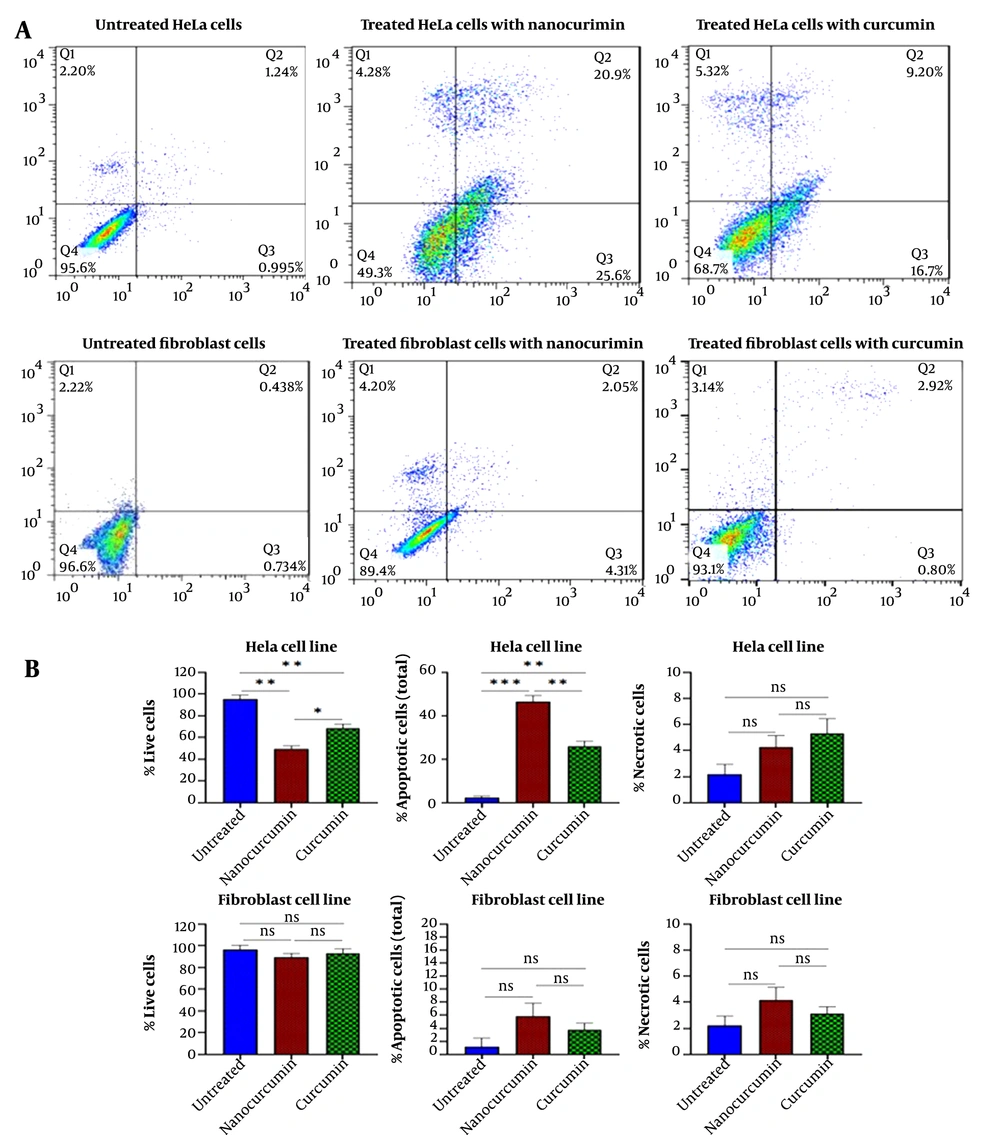
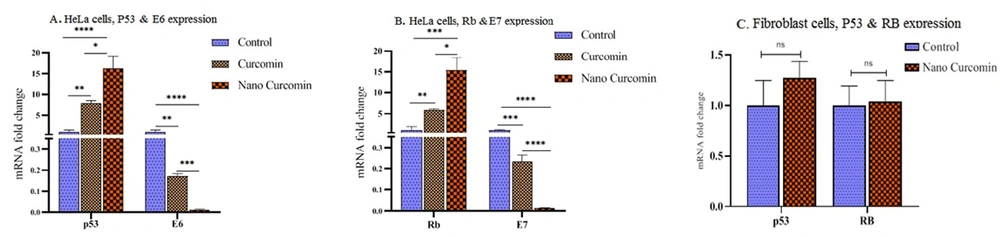
Moreover, cell viability and apoptosis rate were assessed in normal and cancer cell lines. Our findings indicated that nano-curcumin could increase cellular apoptosis and reduce cell viability in human cervical cancer HeLa cells. Moreover, the significant overexpression of P53 and Rb genes and under-expression of E6 and E7 was found in HeLa cells treated with nano-curcumin in lower concentrations than curcumin; however, in fibroblast cells that treated by nanocurcumin, the expression of P53 and Rb genes did not altered significantly.
Based on a comparison between the effects of curcumin and nano-curcumin on HeLa cell viability and apoptosis, it was found that nano-curcumin is much more effective than curcumin. Nanocurcumin progressed the apoptosis process in HeLa cancer cells; however, it had no significant effect on normal fibroblast cells. This finding has been demonstrated in previous studies for other cancer cells (
6,
8,
31,
32) and may happen because nano-curcumin has higher cellular uptake and biostability than curcumin. Furthermore, HeLa and fibroblasts were treated separately with an OA400 nano-carrier, and it was observed that the carrier had no significant effect on cell apoptosis or cellular viability. The non-toxic function of the nano-carrier proves its safety. This component at very high concentrations (160 μM) reduced fibroblast cell viability by approximately 50%. This amount was not a functional concentration. Therefore, it can be concluded that nano-curcumin is safe for normal cells at the studied concentration. Several reasons explain why curcumin does not affect normal cells. It has been shown that the reduction of intracellular glutathione in cancer cells by buthionine sulfoximine increases ROS levels and makes these cells more sensitive to curcumin (
23). Curcumin also has target molecules that are more common in cancer cells (
33). In previous studies, the capability of nano-curcumin to induce cancerous and undifferentiated cell apoptosis was detected in a time and dose-dependent manner, while on normal cells, no significant effects were observed (
6,
31,
34). HeLa cells are derived from a woman’s aggressive glandular cervical cancer and are used in many studies to evaluate cervical cancer treatment methods (
35).
E6 and
E7 oncogenes in the HeLa cell line are derived from the HPV genome. The integration of HPV type 16 or 18 DNA into the HeLa cells genome has been proven in previous studies. Human papillomavirus type 18 transcripts in the 8q24 chromosome region of the HeLa cell line (
36).
E6 and
E7 play a central role in the pathogenesis of HPV. These genes encode proteins that bind to
P53 and
Rb tumor suppressors, respectively, and suppress them. This phenomenon disrupts cell cycle regulation. The expression of these two viral oncogenes is essential for cervical cancer tumorigenesis (
37). In this study, the expression of
E6 and
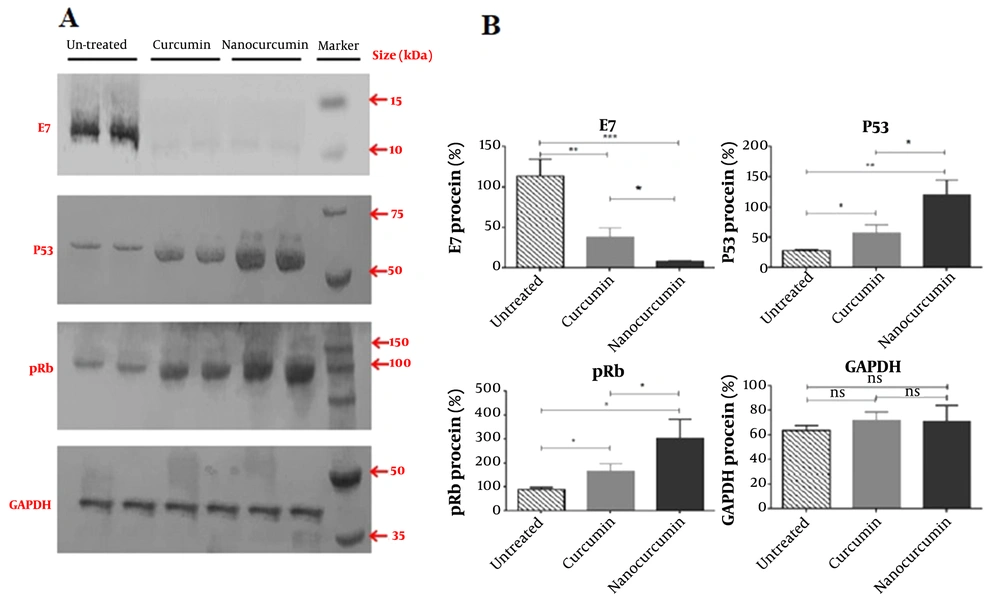
E7 viral genes was significantly reduced in HeLa cells during treatment with nano-curcumin compared to curcumin. As expected, following the down-regulation of
E6 and
E7 genes, the expression level of
P53 and
Rb tumor suppressors increased both at the RNA and protein levels. Thus, nano-curcumin provides a condition for the progression of apoptosis in HeLa cancer cells and can be considered a safe complementary drug for cervical cancer. In line with our findings, another type of nano-curcumin (poly (lactic-co-glycolic acid) based curcumin nanoparticle formulation) has been applied to apoptosis induction in cervical cancer. Results indicated that this type of nano-curcumin effectively inhibits the growth of cervical cancer cell lines in 20 μM and 25 μM, abrogates expression of
E6 and
E7 oncogenes, and leads them to apoptosis (
21). In another study, curcumin concentrations above 40 μM induced apoptosis in HeLa cancer cells (
38). However, inconsistent with the present study that revealed the functional effect of nano-curcumin in a low concentration (15 μM), other studies activated apoptosis with higher concentrations. This observation may confirm that the nano-curcumin was made using the OA400 nano-carrier works more effectively and has more cellular uptake than curcumin.
5.1. Conclusions
According to the results of the present study, nanoformulation of curcumin containing OA400 nano-carrier can suppress HPV oncogenes, restore P53 and Rb proteins and induce apoptosis of human cervical cancer HeLa cells more than curcumin. Therefore, this nanostructure of curcumin has significant potential to be used as a complement drug for cervical cancer treatment. The improvement of the anti-proliferative function of curcumin in different cancer cells can occur by using nano-types. Nanocurcumin, as a safe and herbal drug, may have the potential to be used as a supplement along with common cervical cancer treatment strategies such as chemotherapy drugs.