




1. Background
2. Objectives
3. Methods
3.1. Synthesis
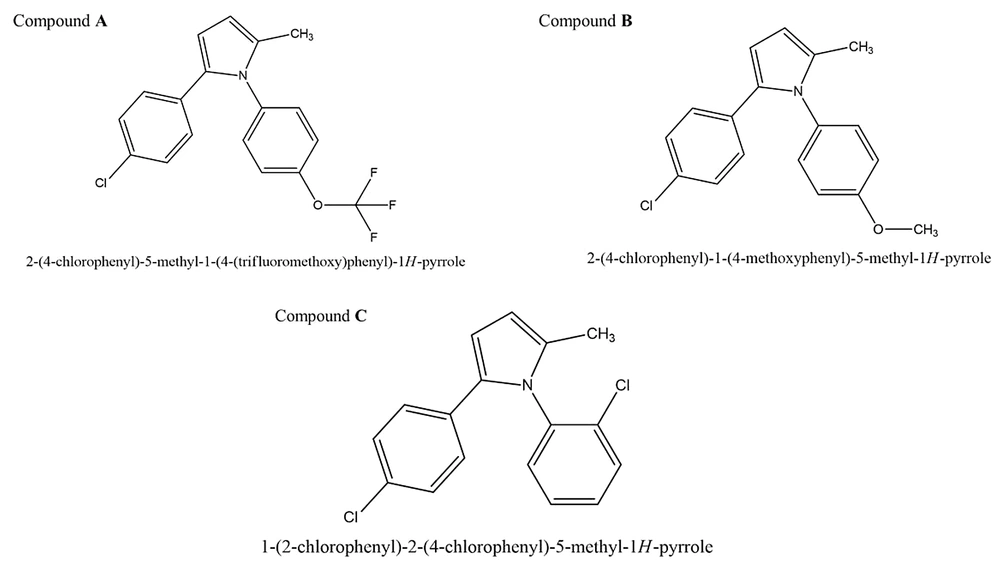
Scheme depicting target compounds A, B, and C.
3.2. Cell Culture
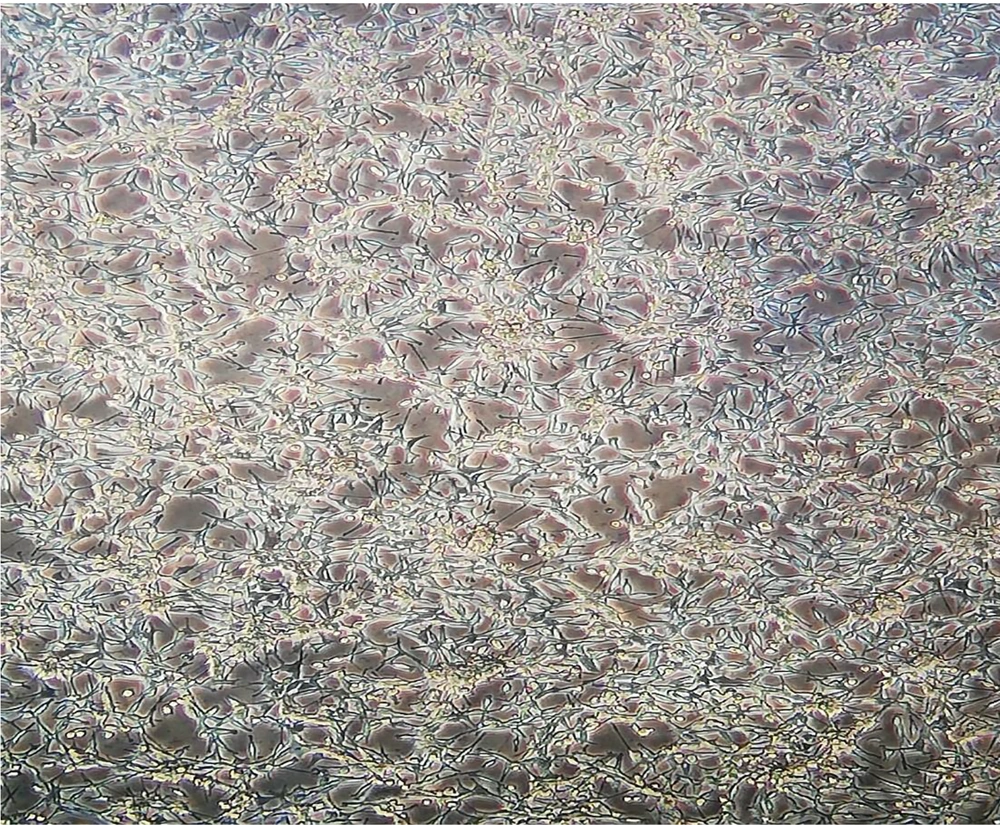
PC12 cell morphology observed under a light microscope (10X magnification).
3.3. In Vitro Model and Experimental Design
3.4. Cell Viability Assay
3.5. Lipid Peroxidation Assay
3.6. Reactive Oxygen Species Assay
3.7. Hoechst Staining
3.8. Annexin V/PI Assay
3.9. Western Blot Analysis
3.10. Prostaglandin E2 Enzyme-Linked Immunosorbent Assay
3.11. Statistical Analysis
4. Results and Discussion
4.1. Effect of Pyrrolic Compounds on PC12 Cell Viability
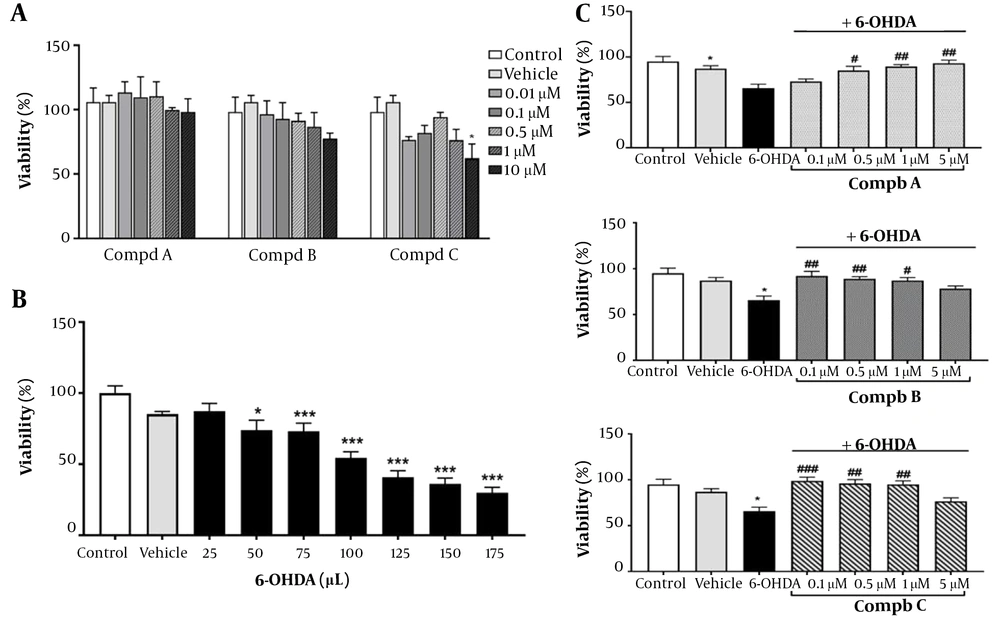
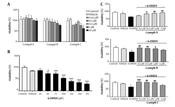
(A) Effect of pyrrole derivatives on cell viability. PC12 cells were treated with different concentrations of compounds A, B, and C for 24 h. (B) PC12 cells were exposed to 6-hydroxydopamine (6-OHDA;10, 25, 50, 75, and 100 μM) for 24 h. (C) Effect of pre-treatment with compounds A, B, and C (0.1, 0.5, 1, and 5 μM) on cell viability 24 h before 6-OHDA (100 μM) exposure. All data represent the mean ± SEM performed in at least 3 replicates. *P < 0.05 and ***P < 0.001 indicate a significant difference compared with the vehicle group. #P < 0.05, ##P < 0.01, ###P < 0.001 indicate a significant difference compared with the 6-OHDA group.
4.2. Effect of Pyrrolic Compounds on 6-OHDA-Induced Lipid Peroxidation
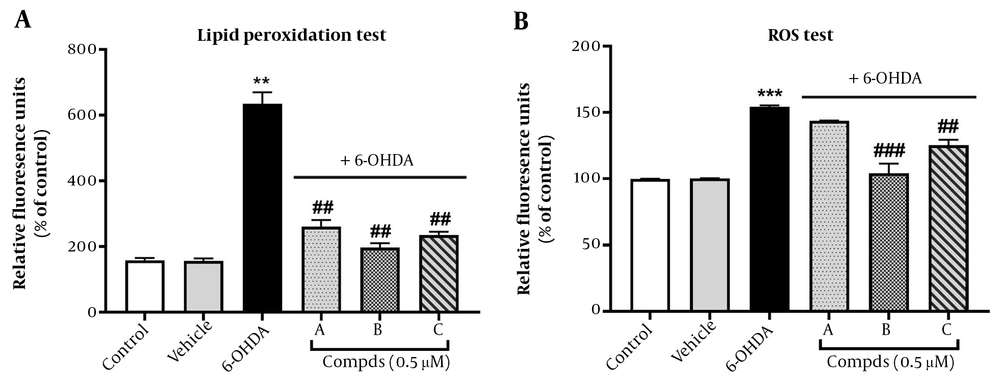
Effect of pre-treatment with compounds A, B, C on oxidative stress. Cells were pre-treated with compounds A, B, and C (0.5 μM) 24 h before 6-hydroxydopamine (6-OHDA; 100 μM) administration. (A) Lipid peroxidation and (B) reactive oxygen species generation were measured. Values shown are means ± SEMs of three independent experiments performed in four replicates. **P < 0.01 and ***P < 0.001 versus the untreated cells; ##P < 0.01 and ###P < 0.001 versus the 6-OHDA treated cells.
4.3. Effect of Pyrrolic Compounds Pre-treatment on 6-OHDA-Induced Intracellular ROS Levels
4.4. Effects of Pyrrolic Compounds on the Nuclear Morphological Changes Induced by 6-Hydroxydopamine
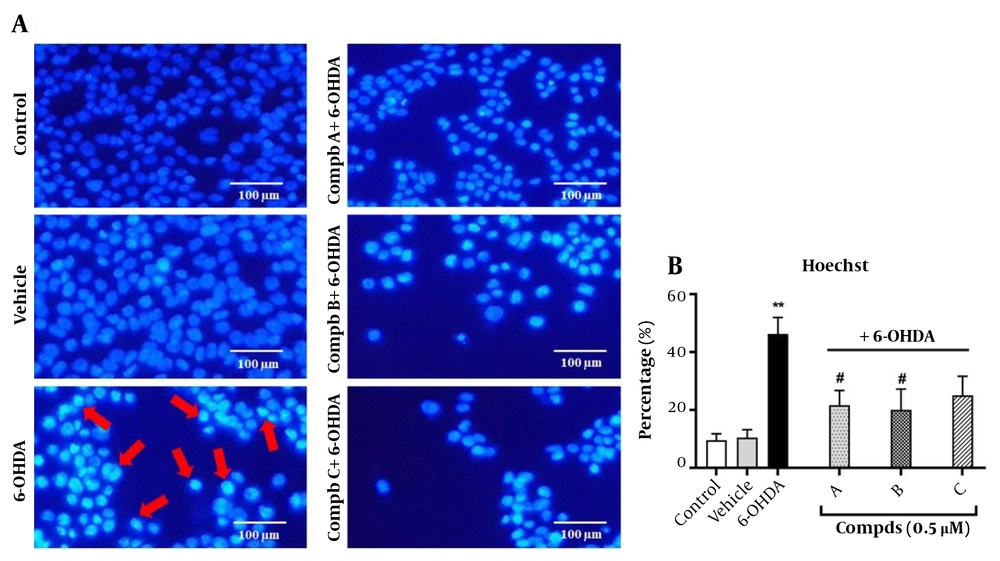
Effect of compounds A, B, and C (0.5 µM) on 6-hydroxydopamine (6-OHDA)-induced apoptosis in PC12 cells. Cells were stained with the DNA-binding fluorochrome Hoechst 33258. (A) Red arrows represent apoptotic cells. (B) Histograms show the ratio of condensed nuclei to total nuclei. **P < 0.01 versus the untreated cells; #P < 0.05 versus the 6-OHDA treated cells. The morphological changes were observed using a fluorescent microscope (10X).
4.5. Effects of Pyrrolic Compounds on Apoptosis in PC12 Cells Upon Pre-treatment with the Compounds
| Groups | Vital Cells (%) An-/PI- | Early Apoptosis (%) An+/PI- | Late Apoptosis (%) An+/PI+ | Necrosis (%) An-/PI+ |
|---|---|---|---|---|
| Control | 83.65 ± 9.75 | 0.81 ± 0.34 | 5.33 ± 2.00 | 1.66 ± 0.46 |
| Vehicle | 88.35 ± 4.95 | 1.23 ± 0.26 | 5.39 ± 0.95 | 1.53 ± 0.23 |
| 6-OHDA | 49.00 ± 17.4 | 15.15 ± 1.55 c | 31.95 ± 14.15 | 3.87 ± 1.77 |
| Compd A + 6-OHDA | 70.55 ± 3.45 | 6.79 ± 2.19 d | 20.90 ± 5.1 | 1.78 ± 0.58 |
| Compd B + 6-OHDA | 70.55 ± 4.45 | 6.42 ± 1.34 d | 17.45 ± 3.25 | 5.54 ± 0.11 |
| Compd C + 6-OHDA | 67.85 ± 2.15 | 12.7 ± 1.5 | 15.80 ± 0.20 | 3.80 ± 1.03 |
a The data presented are the mean ± SEM of 3 independent experiments.
b PC12 cells were also pre-treated with 0.5 µM of compounds A, B, and C for 24h.
c P < 0.01 versus the untreated cells.
d P < 0.05 versus the 6-OHDA treated cells.
4.6. Effects of Pyrrolic Compounds on Alterations in Cyclooxygenase-2 Protein Expression Following Pre-treatment with the Compounds in 6-Hydroxydopamine-Treated PC12 Cells
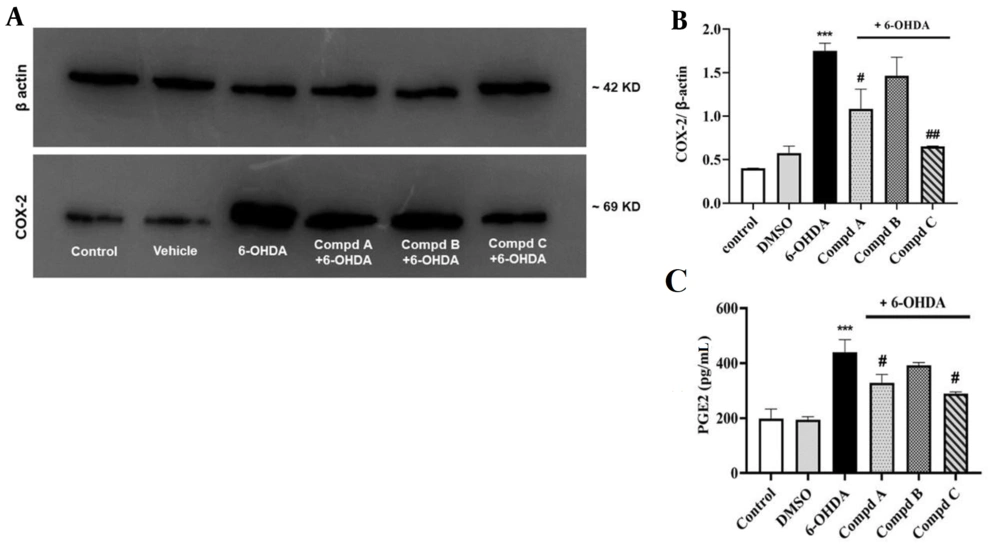
Effect of compounds A, B, C (0.5 µM) on cyclooxygenase-2 (COX-2) protein expression and PGE2 level induced by 6-hydroxydopamine (6-OHDA) in PC12 cells. (A) The relative level of COX-2 expression was calculated and normalized to the loading control. (B) Corresponding protein levels were assessed using densitometry. (C) Effect of compounds A, B, and C (0.5 µM) on PGE2 levels in 6-OHDA-treated PC12 cells. Values shown are means ± SEMs of 3 independent experiments performed in 3 replicates. *** P < 0.001 versus the untreated cells; # P < 0.05 and ## P < 0.01 versus the 6-OHDA treated cells.