![Cover image of the article: Novel Ethyl 2-Aminopyrano[3,2-c]isochromene-3-carboxylate Derivatives: Synthesis, Spectral Characterization, and Cytotoxicity](https://brieflands.com/journals/ijpr/articles/168116/figures/thumbnail.webp)

1. Background
Despite its ancient origins and advances in treatment, cancer remains one of the most challenging medical problems worldwide. Surgery, chemotherapy, radiotherapy, and biological agents are used in cancer treatment (1). However, these approaches cannot cure or eradicate all cancers because of the complex nature and heterogeneity of cancer, serious adverse effects, and drug resistance. In some cases, chemoresistance is acquired during therapy, whereas in others, it is intrinsic and present before chemotherapy (2). Therefore, novel drugs are still needed for the treatment of different types of cancer as primary or adjuvant therapeutic agents, and many studies have focused on this issue.
Isocoumarins, a class of naturally occurring bicyclic lactones, possess diverse pharmacological activities (3, 4), including antidiabetic (3, 4), antibacterial (4), antifungal (4), antiviral (5), antiparasitic (4), antialgal (4), anti-inflammatory (4, 6), antioxidant (4, 7), and cytotoxic (4, 8-10) activities. These compounds are found in plants, fungi, bacterial strains, and even in insect pheromones and venom (11, 12). Their importance arises not only from their various biological effects but also from their use as intermediates in the synthesis of different heterocyclic structures (12).
2. Objectives
This study aimed to synthesize a series of novel ethyl 2-aminopyrano[3,2-c]isochromene-3-carboxylate derivatives using 4-hydroxyisocoumarin, aromatic aldehydes, and ethyl cyanoacetate in the presence of triethylamine, with ethanol as the reaction solvent. The reaction was performed as a one-pot, three-component process under reflux conditions. The cytotoxic effects of the synthesized compounds were subsequently evaluated in three cell lines: MCF-7 (breast cancer), A549 (lung cancer), and MCF-10A (normal human breast cells).
3. Methods
All chemicals and reagents were obtained from commercial sources. Dulbecco modified Eagle medium (DMEM) was purchased from Biosera (France), fetal bovine serum (FBS) from Gibco (USA), and MTT reagent from Melford (UK). Cell lines were obtained from the Iranian Biological Resource Center (IBRC) in Tehran, Iran. Melting points were determined using an Electrothermal 9100 apparatus without correction. IR spectra were recorded as KBr pellets on a Bruker Alpha FTIR spectrophotometer. 1H NMR (300 MHz) and 13C NMR (75 MHz) spectra were recorded in dimethyl sulfoxide (DMSO-d6) on a Bruker AVANCE III 300 MHz spectrometer using TMS as an internal standard. Coupling constants (J) are reported in hertz (Hz), and chemical shifts (δ) are reported in parts per million (ppm). Reactions were monitored by thin-layer chromatography (TLC) on aluminum-backed silica gel sheets (GF254). Spots were visualized under UV light at 254 nm. Elemental analyses were performed using a Heraeus CHN-O-Rapid analyzer.
3.1. General Procedure for the Preparation of Ethyl 2-Aminopyrano[3,2-C]isochromene-3-Carboxylate Derivatives (4a-O)
In a 50 mL round-bottom flask equipped with a magnetic stirring bar and reflux condenser, 1 mmol of 4-hydroxyisocoumarin (1) (13), 1.2 mmol of ethyl cyanoacetate (2), and 1 mmol of aromatic aldehydes (3a-o) were mixed with triethylamine (three drops) in 10 mL of ethanol. The mixture was stirred under reflux in an oil bath for two hours. Reaction progress was monitored by TLC using hexane/ethyl acetate as the mobile phase. After completion, the mixture was allowed to cool, and the formed product was collected by filtration. The product was washed with cold ethanol and recrystallized from ethanol to afford a pure solid for analysis.
Ethyl 2-amino-6-oxo-4-phenyl-4,6-dihydropyrano[3,2-c]isochromene-3-carboxylate (4a): Cream powder; yield: 88%; mp 229 - 231°C; IR (KBr): (νmax, cm-1) 3399 and 3290 (NH2), 3027 (CH, aromatic), 2983 (CH, aliphatic), 1738 and 1693 (2C=O), 1607 (C=C), 1094 (C-O); 1H NMR (300 MHz, DMSO) δppm: 8.14 (d, J=6 Hz, 1H, ArH), 8.04 - 7.99 (m, 1H, ArH), 7.86 (d, J=6 Hz, 1H, ArH), 7.80 (s, 2H, NH2), 7.71 - 7.66 (m, 1H, ArH), 7.35 - 7.20 (m, 5H, ArH), 4.73 (s, 1H, CH), 4.00 - 3.90 (m, 2H, OCH2CH3), 1.02 (t, J=6 Hz, 3H, OCH2CH3); 13C NMR (75 MHz, DMSO) δppm: 168.25 and 160.38 (2C=O), 159.90 (C-2), 144.19, 139.96, 136.07, 130.84, 130.07, 129.73, 128.77, 128.59, 128.34, 127.33, 120.35, 119.99, 76.26 (C-3), 59.30 (OCH2CH3), 31.15 (C-4), 14.55 (OCH2CH3); Anal. calcd. for C21H 17NO5: C, 69.41; H, 4.72; N, 3.85%. Found: C, 69.32; H, 4.50; N, 3.69%.
Ethyl 2-amino-6-oxo-4-(p-tolyl)-4,6-dihydropyrano[3,2-c]isochromene-3-carboxylate (4b): White powder; yield: 91%; mp 219 - 221°C; IR (KBr): (νmax, cm-1) 3390 and 3276 (NH2), 3062 (CH, aromatic), 2979 (CH, aliphatic), 1720 and 1687 (2C=O), 1607 (C=C), 1098 (C-O); 1H NMR (300 MHz, DMSO) δppm: 8.14 (d, J=6 Hz, 1H, ArH), 8.03 - 7.98 (m, 1H, ArH), 7.85 (d, J=6 Hz, 1H, ArH), 7.77 (s, 2H, NH2), 7.70 - 7.65 (m, 1H, ArH), 7.18 - 7.10 (m, 4H, ArH), 4.68 (s, 1H, CH), 3.95 (q, J=6 Hz, 2H, OCH2CH3), 2.25 (s, 3H, CH3), 1.05 (t, J=6 Hz, 3H, OCH2CH3); 13C NMR (75 MHz, DMSO) δppm: 168.29 and 160.39 (2C=O), 159.85 (C-2), 141.23, 140.16, 136.42, 136.04, 130.86, 130.05, 129.67, 129.33, 128.49, 128.19, 120.32, 119.94, 76.37 (C-3), 59.31 (OCH2CH3), 39.88 (C-4), 21.08 (CH3), 14.59 (OCH2CH3); Anal. calcd. for C22H19NO5: C, 70.02; H, 5.07; N, 3.71%. Found: C, 69.88; H, 4.71; N, 3.48%.
Ethyl 2-amino-4-(4-fluorophenyl)-6-oxo-4,6-dihydropyrano[3,2-c]isochromene-3-carboxylate (4c): White powder; yield: 92%; mp 228 - 229°C; IR (KBr): (νmax, cm-1) 3391 and 3276 (NH2), 3068 (CH, aromatic), 2979 (CH, aliphatic), 1724 and 1689 (2C=O), 1606 (C=C), 1097 (C-O); 1H NMR (300 MHz, DMSO) δppm: 8.14 (d, J=6 Hz, 1H, ArH), 8.04 - 7.99 (m, 1H, ArH), 7.85 (d, J=6 Hz, 1H, ArH), 7.82 (s, 2H, NH2), 7.71 - 7.66 (m, 1H, ArH), 7.34 - 7.29 (m, 2H, ArH), 7.17 - 7.11 (m, 2H, ArH), 4.75 (s, 1H, CH), 4.02 - 3.90 (m, 2H, OCH2CH3), 1.02 (t, J=6 Hz, 3H, OCH2CH3); 13C NMR (75 MHz, DMSO) δppm: 168.18 and 163.17 (2C=O), 160.34 (C-2), 159.85, 140.38, 140.34, 139.60, 136.04, 130.80, 130.25, 130.14, 130.06, 129.77, 128.60, 120.38, 120.03, 115.63, 115.34, 76.10 (C-3), 59.31 (OCH2CH3), 39.59 (C-4), 14.56 (OCH2 CH3); Anal. calcd. for C21H 16FNO5: C, 66.14; H, 4.23; N, 3.67%. Found: C, 65.87; H, 4.20; N, 3.47%.
Ethyl 2-amino-4-(4-bromophenyl)-6-oxo-4,6-dihydropyrano[3,2-c]isochromene-3-carboxylate (4d): White powder; yield: 89%; mp 227 - 228°C; IR (KBr): (νmax, cm-1) 3446 and 3318 (NH2), 3036 (CH, aromatic), 2979 (CH, aliphatic), 1725 and 1694 (2C=O), 1608 (C=C), 1091 (C-O); 1H NMR (300 MHz, DMSO) δppm: 8.13 (d, J=6 Hz, 1H, ArH), 8.00 (t, J=6 Hz, 1H, ArH), 7.84 (t, J=3 Hz, 3H, NH2, ArH), 7.67 (t, J=6 Hz, 1H, ArH), 7.50 (d, J=9 Hz, 2H, ArH), 7.24 (d, J=9 Hz, 2H, ArH), 4.72 (s, 1H, CH), 4.03 - 3.87 (m, 2H, OCH2CH3), 1.03 (t, J=6 Hz, 3H, OCH2 CH3); 13C NMR (75 MHz, DMSO) δppm: 168.10 and 160.27 (2C=O), 159.87 (C-2), 143.62, 139.25, 136.02, 131.64, 130.73, 130.61, 130.05, 129.79, 128.69, 120.39, 120.05, 75.75 (C-3), 59.37 (OCH2CH3), 39.84 (C-4), 14.57 (OCH2CH3); Anal. calcd. for C21H16BrNO5: C, 57.03; H, 3.65; N, 3.17%. Found: C, 56.71; H, 3.57; N, 2.91%.
Ethyl 2-amino-4-(4-nitrophenyl)-6-oxo-4,6-dihydropyrano[3,2-c]isochromene-3-carboxylate (4e): Pale yellow powder; yield: 88%; mp 218 - 219°C; IR (KBr): (νmax, cm-1) 3387 and 3278 (NH2), 3073 (CH, aromatic), 2987 (CH, aliphatic), 1729 and 1692 (2C=O), 1609 (C=C), 1522 and 1349 (NO2), 1096 (C-O); 1H NMR (300 MHz, DMSO) δppm: 8.21 - 8.17 (m, 2H, ArH), 8.14 (d, J=9 Hz, 1H, ArH), 8.05 - 8.00 (m, 1H, ArH), 7.92 (s, 2H, NH2), 7.86 (d, J=6 Hz, 1H, ArH), 7.72 - 7.67 (m, 1H, ArH), 7.61 - 7.57 (m, 2H, ArH), 4.92 (s, 1H, CH), 3.99 - 3.89 (m, 2H, OCH2CH3), 1.01 (t, J=6 Hz, 3H, OCH2CH3); 13C NMR (75 MHz, DMSO) δppm: 167.93 and 160.17 (2C=O), 159.92 (C-2), 151.78, 146.95, 138.47, 136.08, 130.62, 130.08, 129.99, 129.80, 129.01, 124.03, 120.48, 120.17, 75.21 (C-3), 59.45 (OCH2CH3), 40.28 (C-4), 14.53 (OCH2CH3); Anal. calcd. for C21H 16N2O7: C, 61.77; H, 3.95; N, 6.86%. Found: C, 61.69; H, 3.80; N, 6.77%.
Ethyl 2-amino-6-oxo-4-(m-tolyl)-4,6-dihydropyrano[3,2-c]isochromene-3-carboxylate (4f): White powder; yield: 91%; mp 221 - 222°C; IR (KBr): (νmax, cm-1) 3413 and 3296 (NH2), 3014 (CH, aromatic), 2987 (CH, aliphatic), 1732 and 1690 (2C=O), 1607 (C=C), 1098 (C-O); 1H NMR (300 MHz, DMSO) δppm: 8.13 (d, J=9 Hz, 1H, ArH), 8.02 - 7.97 (m, 1H, ArH), 7.85 (d, J=9 Hz, 1H, ArH), 7.78 (s, 2H, NH2), 7.69 - 7.63 (m, 1H, ArH), 7.19 (t, J=9 Hz, 1H, ArH), 7.08 - 7.01 (m, 3H, ArH), 4.68 (s, 1H, CH), 4.01 - 3.90 (m, 2H, OCH2CH3), 2.27 (s, 3H, CH3), 1.04 (t, J=6 Hz, 3H, OCH2CH3); 13C NMR (75 MHz, DMSO) δppm: 168.28 and 160.39 (2C=O), 159.83 (C-2), 144.13, 140.03, 137.78, 136.00, 130.85, 130.03, 129.65, 128.92, 128.62, 128.00, 125.57, 120.34, 119.97, 76.38 (C-3), 59.29 (OCH2CH3), 40.28 (C-4), 21.48 (CH3), 14.52 (OCH2CH3); Anal. calcd. for C22H19NO5: C, 70.02; H, 5.07; N, 3.71%. Found: C, 69.78; H, 3.85; N, 3.46%.
Ethyl 2-amino-4-(3-methoxyphenyl)-6-oxo-4,6-dihydropyrano[3,2-c]isochromene-3-carboxylate (4g): White powder; yield: 90%; mp 196 - 197 °C; IR (KBr): (νmax, cm-1) 3392 and 3275 (NH2), 3046 (CH, aromatic), 2980 (CH, aliphatic), 1724 and 1690 (2C=O), 1607 (C=C), 1100 (C-O); 1H NMR (300 MHz, DMSO) δppm: 8.14 (d, J=6 Hz, 1H, ArH), 8.03 - 7.98 (m, 1H, ArH), 7.85 (d, J=6 Hz, 1H, ArH), 7.80 (s, 2H, NH2), 7.70 - 7.64 (m, 1H, ArH), 7.26 - 7.21 (m, 1H, ArH), 6.86 - 6.79 (m, 3H, ArH), 4.70 (s, 1H, CH), 4.02 - 3.92 (m, 2H, OCH2CH3), 3.93 (s, 3H, OCH3), 1.05 (t, J=6 Hz, 3H, OCH2CH3); 13C NMR (75 MHz, DMSO) δppm: 168.26 and 160.37 (2C=O), 159.90 (C-2), 159.61, 145.76, 139.86, 136.02, 130.82, 130.05, 129.87, 129.69, 128.62, 120.45, 120.35, 119.99, 114.56, 112.26, 76.18 (C-3), 59.32 (OCH2CH3), 55.42 (OCH3), 40.28 (C-4), 14.58 (OCH2CH3); Anal. calcd. for C22H19NO6: C, 67.17; H, 4.87; N, 3.56%. Found: C, 66.88; H, 4.60; N, 3.41%.
Ethyl 2-amino-4-(3-fluorophenyl)-6-oxo-4,6-dihydropyrano[3,2-c]isochromene-3-carboxylate (4h): White powder; yield: 88%; mp 216 - 217°C; IR (KBr): (νmax, cm-1) 3405 and 3290 (NH2), 3041 (CH, aromatic), 2978 (CH, aliphatic), 1730 and 1690 (2C=O), 1609 (C=C), 1098 (C-O); 1H NMR (300 MHz, DMSO) δppm: 8.14 (d, J=6 Hz, 1H, ArH), 8.01 (t, J=6 Hz, 1H, ArH), 7.85 (t, J=6 Hz, 3H, NH2, ArH), 7.68 (t, J=6 Hz, 1H, ArH), 7.36 (q, J=6 Hz, 1H, ArH), 7.15 - 7.04 (m, 3H, ArH), 4.77 (s, 1H, CH), 4.05 - 3.87 (m, 2H, OCH2CH3), 1.01 (t, J=6 Hz, 3H, OCH2CH3); 13C NMR (75 MHz, DMSO) δppm: 168.12 and 164.17 (2C=O), 160.94 (C-2), 160.29, 159.91, 147.14, 147.06, 139.13, 136.01, 130.75, 130.60, 130.04, 129.79, 128.77, 124.41, 124.38, 120.42, 120.10, 115.32, 115.04, 114.30, 114.02, 75.71 (C-3), 59.32 (OCH2CH3), 40.05 (C-4), 14.51 (OCH2CH3); Anal. calcd. for C21H 16FNO5: C, 66.14; H, 4.23; N, 3.67%. Found: C, 65.87; H, 4.11; N, 3.44%.
Ethyl 2-amino-4-(3-chlorophenyl)-6-oxo-4,6-dihydropyrano[3,2-c]isochromene-3-carboxylate (4i): White powder; yield: 90%; mp 211 - 212°C; IR (KBr): (νmax, cm-1) 3415 and 3303 (NH2), 3059 (CH, aromatic), 2977 (CH, aliphatic), 1732 and 1692 (2C=O), 1614 (C=C), 1097 (C-O); 1H NMR (300 MHz, DMSO) δppm: 8.14 (d, J=6 Hz, 1H, ArH), 8.04 - 7.99 (m, 1H, ArH), 7.86 (t, J=6 Hz, 3H, NH2, ArH), 7.71 - 7.66 (m, 1H, ArH), 7.38 - 7.23 (m, 4H, ArH), 4.76 (s, 1H, CH), 4.05 - 3.86 (m, 2H, OCH2CH3), 1.02 (t, J=6 Hz, 3H, OCH2CH3); 13C NMR (75 MHz, DMSO) δppm: 168.07 and 160.29 (2C=O), 159.87 (C-2), 146.66, 139.01, 136.03, 133.29, 130.70, 130.06, 129.84, 128.84, 128.36, 127.35, 127.10, 120.44, 120.13, 75.66 (C-3), 59.36 (OCH2CH3), 40.07 (C-4), 14.50 (OCH2CH3); Anal. calcd. for C21H 16ClNO5: C, 63.40; H, 4.05; N, 3.52%. Found: C, 63.22; H, 3.75; N, 3.36%.
Ethyl 2-amino-4-(3-bromophenyl)-6-oxo-4,6-dihydropyrano[3,2-c]isochromene-3-carboxylate (4j): White powder; yield: 91%; mp 206 - 207°C; IR (KBr): (νmax, cm-1) 3414 and 3302 (NH2), 3057 (CH, aromatic), 2974 (CH, aliphatic), 1731 and 1692 (2C=O), 1614 (C=C), 1097 (C-O); 1H NMR (300 MHz, DMSO) δppm: 8.14 (d, J=6 Hz, 1H, ArH), 8.05 - 7.99 (m, 1H, ArH), 7.85 (t, J=3 Hz, 3H, NH2, ArH), 7.72 - 7.66 (m, 1H, ArH), 7.46 - 7.40 (m, 2H, ArH), 7.32 - 7.25 (m, 2H, ArH), 4.75 (s, 1H, CH), 4.03 - 3.89 (m, 2H, OCH2CH3), 1.03 (t, J=6 Hz, 3H, OCH2 CH3); 13C NMR (75 MHz, DMSO) δppm: 168.06 and 160.30 (2C=O), 159.85 (C-2), 146.90, 139.01, 136.04, 131.27, 131.04, 130.72, 130.25, 130.07, 129.86, 128.86, 127.48, 121.91, 120.45, 120.14, 75.70 (C-3), 59.37 (OCH2CH3), 39.73 (C-4), 14.51 (OCH2CH3); Anal. calcd. for C21H 16BrNO5: C, 57.03; H, 3.65; N, 3.17%. Found: C, 56.71; H, 3.22; N, 2.91%.
Ethyl 2-amino-4-(3-nitrophenyl)-6-oxo-4,6-dihydropyrano[3,2-c]isochromene-3-carboxylate (4k): White powder; yield: 87%; mp 208 - 209°C; IR (KBr): (νmax, cm-1) 3383 and 3274 (NH2), 3061 (CH, aromatic), 2986 (CH, aliphatic), 1729 and 1689 (2C=O), 1614 (C=C), 1092 (C-O), 1528 and 1348 (NO2); 1H NMR (300 MHz, DMSO) δppm: 8.14 - 8.10 (m, 3H, ArH), 8.05 - 8.00 (m, 1H, ArH), 7.92 (s, 2H, NH2), 7.87 (d, J=6 Hz, 1H, ArH), 7.80 - 7.77 (m, 1H, ArH), 7.72 - 7.60 (m, 2H, ArH), 4.94 (s, 1H, CH), 4.00 - 3.88 (m, 2H, OCH2CH3), 1.00 (t, J=6 Hz, 3H, OCH2CH3); 13C NMR (75 MHz, DMSO) δppm: 167.94 and 160.22 (2C=O), 159.91 (C-2), 148.17, 146.42, 138.48, 136.03, 135.25, 130.64, 130.36, 130.05, 129.94, 129.11, 123.08, 122.49, 120.49, 120.25, 75.41 (C-3), 59.43 (OCH2CH3), 40.08 (C-4), 14.45 (OCH2CH3); Anal. calcd. for C21H 16N2O7: C, 61.77; H, 3.95; N, 6.86%. Found: C, 61.37; H, 3.60; N, 6.45%.
Ethyl 2-amino-6-oxo-4-(o-tolyl)-4,6-dihydropyrano[3,2-c]isochromene-3-carboxylate (4l): Yellow powder; yield: 88%; mp 234 - 235°C; IR (KBr): (νmax, cm-1) 3386 and 3277 (NH2), 3018 (CH, aromatic), 2975 (CH, aliphatic), 1721 and 1687 (2C=O), 1615 (C=C), 1091 (C-O); 1H NMR (300 MHz, DMSO) δppm: 8.11 (d, J=6 Hz, 1H, ArH), 8.02 - 7.97 (m, 1H, ArH), 7.83 (d, J=6 Hz, 1H, ArH), 7.79 (s, 2H, NH2), 7.68 - 7.63 (m, 1H, ArH), 7.17 - 7.05 (m, 4H, ArH), 5.02 (s, 1H, CH), 3.89 (q, J=6 Hz, 2H, OCH2CH3), 2.53 (s, 3H, CH3), 0.94 (t, J=6 Hz, 3H, OCH2CH3); 13C NMR (75 MHz, DMSO) δppm: 168.25 and 160.27 (2C=O), 160.07 (C-2), 143.27, 140.77, 136.17, 136.02, 130.84, 130.26, 130.03, 129.62, 128.16, 126.98, 126.86, 120.26, 119.91, 76.38 (C-3), 59.29 (OCH2CH3), 35.83 (C-4), 19.60 (CH3), 14.39 (OCH2CH3); Anal. calcd. for C22H19NO5: C, 70.02; H, 5.07; N, 3.71%. Found: C, 69.81; H, 4.93; N, 3.56%.
Ethyl 2-amino-4-(2-fluorophenyl)-6-oxo-4,6-dihydropyrano[3,2-c]isochromene-3-carboxylate (4m): White powder; yield: 89%; mp 238 - 239°C; IR (KBr): (νmax, cm-1) 3402 and 3287 (NH2), 3042 (CH, aromatic), 2973 (CH, aliphatic), 1735 and 1693 (C=O), 1606 (C=C), 1096 (C-O); 1H NMR (300 MHz, DMSO) δppm: 8.13 (d, J=6 Hz, 1H, ArH), 8.03 - 7.98 (m, 1H, ArH), 7.84 (t, J=6 Hz, 3H, NH2, ArH), 7.70 - 7.64 (m, 1H, ArH), 7.31 - 7.24 (m, 2H, ArH), 7.18 - 7.12 (m, 2H, ArH), 5.06 (s, 1H, CH), 3.98 - 3.86 (m, 2H, OCH2CH3), 0.98 (t, J=6 Hz, 3H, OCH2CH3); 13C NMR (75 MHz, DMSO) δppm: 168.08 and 162.35 (2C=O), 160.27 (C-2), 160.15, 159.09, 138.75, 136.03, 131.08, 130.91, 130.72, 130.64, 130.59, 130.05, 129.78, 129.38, 129.27, 128.91, 124.96, 124.92, 120.33, 120.08, 115.79, 115.50, 74.98 (C-3), 59.28 (OCH2CH3), 33.84 (C-4), 14.33 (OCH2CH3); Anal. calcd. for C21H 16FNO5: C, 66.14; H, 4.23; N, 3.67%. Found: C, 65.80; H, 3.99; N, 3.51%.
Ethyl 2-amino-4-(2-chlorophenyl)-6-oxo-4,6-dihydropyrano[3,2-c]isochromene-3-carboxylate (4n): White powder; yield: 91%; mp 240 - 241°C; IR (KBr): (νmax, cm-1) 3400 and 3287 (NH2), 3061 (CH, aromatic), 2975 (CH, aliphatic), 1731 and 1677 (C=O), 1607 (C=C), 1093 (C-O); 1H NMR (300 MHz, DMSO) δppm: 8.13 (d, J=6 Hz, 1H, ArH), 8.04 - 7.98 (m, 1H, ArH), 7.85 (d, J=6 Hz, 3H, NH2, ArH), 7.70 - 7.65 (m, 1H, ArH), 7.43 - 7.40 (m, 1H, ArH), 7.32 - 7.21 (m, 3H, ArH), 5.29 (s, 1H, CH), 3.95 - 3.84 (m, 2H, OCH2CH3), 0.95 (t, J=6 Hz, 3H, OCH2CH3); 13C NMR (75 MHz, DMSO) δppm: 168.12 and 160.21 (2C=O), 160.13 (C-2), 141.62, 139.03, 136.02, 133.36, 130.83, 130.69, 130.05, 129.81, 129.64, 128.95, 128.75, 127.95, 120.38, 120.12, 75.45 (C-3), 59.27 (OCH2CH3), 37.21 (C-4), 14.36 (OCH2CH3); Anal. calcd. for C21H 16ClNO5: C, 63.40; H, 4.05; N, 3.52%. Found: C, 63.27; H, 3.82; N, 3.22%.
Ethyl 2-amino-4-(2,4-dichlorophenyl)-6-oxo-4,6-dihydropyrano[3,2-c]isochromene-3-carboxylate (4o): Cream powder; yield: 90%; mp 212 - 214°C; IR (KBr): (νmax, cm-1) 3402 and 3289 (NH2), 3062 (CH, aromatic), 2981 (CH, aliphatic), 1723 and 1694 (2C=O), 1615 (C=C), 1097 (C-O); 1H NMR (300 MHz, DMSO) δppm: 8.14 (d, J=6 Hz, 1H, ArH), 8.05 - 8.00 (m, 1H, ArH), 7.90 (s, 2H, NH2), 7.85 (d, J=6 Hz, 1H, ArH), 7.72 - 7.67 (m, 1H, ArH), 7.57 (d, J=6 Hz, 1H, ArH), 7.39 - 7.32 (m, 2H, ArH), 5.28 (s, 1H, CH), 3.97 - 3.86 (m, 2H, OCH2CH3), 0.98 (t, J=6 Hz, 3H, OCH2CH3); 13C NMR (75 MHz, DMSO) δppm: 167.97 and 160.14 (2C=O), 140.84 (C-2), 138.47, 136.06, 134.23, 132.50, 132.19, 130.62, 130.08, 129.93, 128.94, 128.88, 128.21, 120.42, 120.20, 75.02 (C-3), 59.36 (OCH2CH3), 36.86 (C-4), 14.42 (OCH2CH3); Anal. calcd. for C21H15Cl2NO5: C, 58.35; H, 3.50; N, 3.24%. Found: C, 58.13; H, 3.34; N, 3.01%.
3.2. Cell Culture
The MCF-7 (IBRC C10082), A549 (IBRC C10080), and MCF-10A (IBRC C10788) cell lines were cultured in DMEM supplemented with 10% heat-inactivated FBS, 100 U/mL penicillin, and 100 μg/mL streptomycin. Cultures were incubated in a humidified atmosphere containing 5% CO2 at 37 °C.
3.3. Cytotoxicity Assay
The MTT assay was performed to assess the cytotoxicity of the compounds. When cells reached 80% confluency, they were trypsinized, counted, and seeded in 96-well microplates at a density of 1 × 10⁴ cells per well. The plates were incubated under the conditions described above for 24 hours. The next day, the growth medium in each well was replaced with fresh medium containing different concentrations of the compounds (7.81 to 500 μg/mL) or doxorubicin (2 to 32 μg/mL), which was used as the standard drug because it is a well-documented anticancer agent with activity against a wide range of cancer cell lines. The microplates were then incubated for 24 hours. The compounds were dissolved in the minimum amount of DMSO at high concentration and diluted with FBS-free medium; thus, the solvent concentration at the highest tested concentration (500 μg/mL) was below 1% (v/v). A solvent control was also used for each concentration. On the third day, 10 μL of MTT dye (5 mg/mL) was added to each well, and the microplates were incubated for 3 hours in the dark. Then, 100 μL of DMSO was added to each well to dissolve the formazan crystals formed by viable cells. Absorbance was measured at 570 nm with a reference wavelength of 620 nm using a multiwell plate reader (14). The absorbance values were used to calculate the percentage of viable cells. IC50 values were determined using GraphPad Prism version 5 (San Diego, CA, USA), with a nonlinear dose-response curve generated from the percentage of viable cells against the logarithm of compound concentrations. The SIs were calculated by dividing the IC50 value of each compound for MCF-10A cells by the IC50 value of the same compound for A549 or MCF-7 cells (15). Differences between compound concentrations were compared using one-way ANOVA with a Tukey post hoc test, with P < 0.05 considered statistically significant.
4. Results
Table 1.
Selected Physicochemical Descriptors of Representative Compounds Calculated Using Standard Fragments
| Compound | Substituent | MW (g/mol) | cLogP (est.) | HBD | HBA | TPSA (Å2) |
|---|---|---|---|---|---|---|
| 4a | H | ~363 | ~2.2 | 1 | 6 | ~86 |
| 4c | 4-fluoro | ~381 | ~2.3 | 1 | 6 | ~86 |
| 4g | 3-methoxy | ~393 | ~2.5 | 1 | 7 | ~95 |
| 4m | 2-fluoro | ~381 | ~2.4 | 1 | 6 | ~86 |
| 4n | 2-chloro | ~397 | ~2.8 | 1 | 6 | ~86 |
| 4o | 2,4-dichloro | ~432 | ~3.2 | 1 | 6 | ~86 |
4.1. Chemistry
A series of novel ethyl 2-aminopyrano[3,2-c]isochromene-3-carboxylate derivatives (4a-o) were synthesized as shown in Figure 1. Building on our previous work on environmentally friendly multicomponent reactions (16-18), we performed a one-pot, three-component reaction of 4-hydroxyisocoumarin (1) (13), ethyl cyanoacetate (2), and aromatic aldehydes (3a-o) in the presence of triethylamine, using ethanol as the solvent, under reflux conditions. After completion, the crude product was purified by recrystallization to afford a series of new ethyl 2-amino-4-aryl-4,6-dihydropyrano[3,2-c]isochromene-3-carboxylate derivatives (4a-o) in 87% to 92% yield. The high yields, operational simplicity, clean reaction conditions, and facile product isolation are advantages of this procedure, making it a practical method for synthesizing these compounds.
![Synthesis of ethyl 2-aminopyrano[3,2-c]isochromene-3-carboxylate derivatives (4a-o)](https://brieflands.com/journals/ijpr/articles/168116/figures/ijpr-25-1-168116-i001-preview.webp "Synthesis of ethyl 2-aminopyrano[3,2-c]isochromene-3-carboxylate derivatives (4a-o)")
Figure 1.
Synthesis of ethyl 2-aminopyrano[3,2-c]isochromene-3-carboxylate derivatives (4a-o)
A series of substituted benzaldehyde derivatives bearing electron-donating (CH3 and OCH3) and electron-withdrawing (NO2, F, Cl, and Br) groups at the para (4b-4e), meta (4f-4k), ortho (4l-4n), and disubstituted (4o) positions were synthesized. In total, 15 derivatives of ethyl 2-aminopyrano[3,2-c]isochromene-3-carboxylate (4a-o) were successfully synthesized, and their structures were comprehensively characterized by standard spectroscopic techniques (IR, 1H NMR, and 13C NMR) and elemental analysis.
4.2. Cytotoxicity Assay
The cytotoxic activity of the synthesized derivatives was evaluated using the MTT assay against two cancer cell lines (MCF-7 and A549) and one normal cell line (MCF-10A). As summarized in Figure 2, the most active compounds against MCF-7 cells were 4g, 4n, and 4m, with IC50 values of 120.77 ± 7.64, 141.43 ± 13.81, and 168.62 ± 3.59 μg/mL, respectively. Against A549 cells, compounds 4a, 4l, and 4n showed comparatively lower IC50 values (131.12 - 259.38 μg/mL). Most other derivatives had IC50 values above 300 μg/mL.
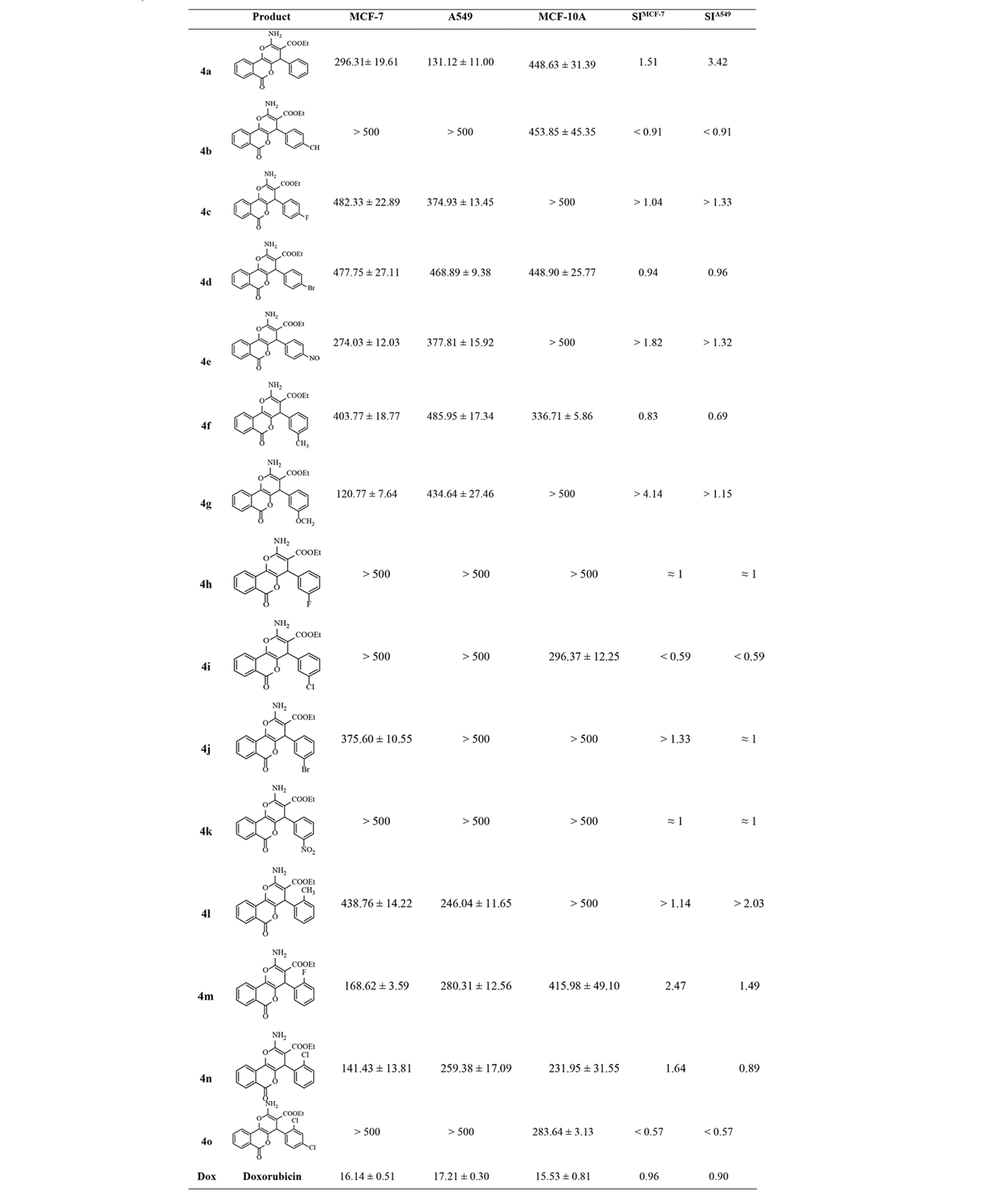
Figure 2.
The IC50 (μg/mL) values (Mean ± S.E.M) of the synthesized compounds tested on MCF-7, A549, MCF-10A, and 3T3 cell lines, and the calculated SI values
According to the National Cancer Institute (NCI) classification, compounds with IC50 values lower than 20 μg/mL are considered highly cytotoxic, those between 21 and 200 μg/mL are considered moderately cytotoxic, those between 201 and 500 μg/mL are considered weakly cytotoxic, and those greater than 500 μg/mL are considered non-cytotoxic (19). Based on this classification, most synthesized compounds were in the weak-to-moderate cytotoxicity range. Several derivatives (4b, 4h, 4i, 4j, 4k, and 4o) had IC50 values above 500 μg/mL and were therefore considered non-cytotoxic under these conditions. Most compounds showed mild or no toxicity toward normal MCF-10A cells (Figure 3). Doxorubicin, used as a reference drug, had substantially lower IC50 values under identical experimental conditions, confirming the relatively limited potency of the synthesized derivatives (Figure 4).

Figure 3.
Viability percentages of (A) MCF-7; (B) A549; and (C) MCF-10A cells treated with various concentrations of selected synthesized compounds for 24 hours, as assessed by the MTT assay. For clarity, not all tested compounds and concentrations are displayed in the graph. All data were normalized to the solvent control (100%), indicated by the horizontal red dashed line. Bars represent mean ± SD (n ≥ 3). Values slightly exceeding 100% reflect normalization to the solvent control and normal experimental variability. ***P < 0.001, **P < 0.01, and *P < 0.05.
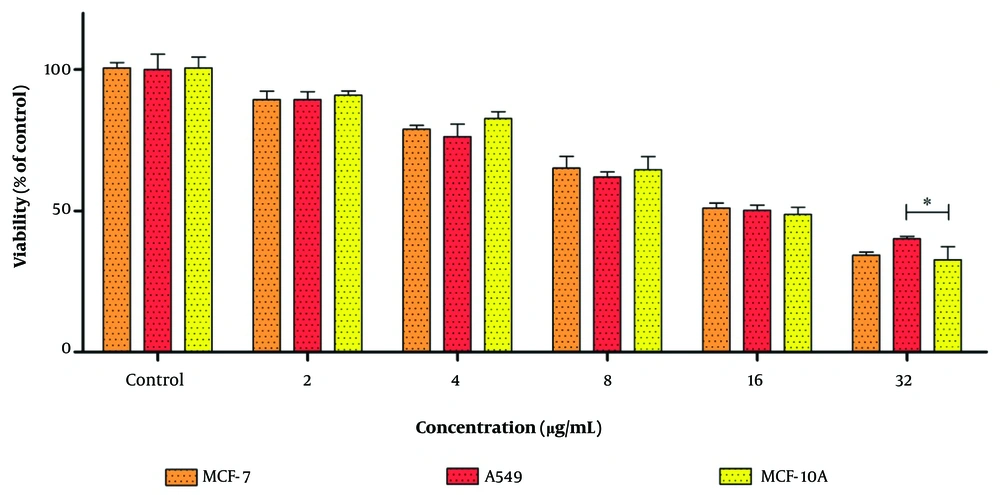
Figure 4.
Viability percentages of MCF-7, A549, and MCF-10A cells treated with various concentrations of doxorubicin for 24 hours, as assessed by the MTT assay. Bars represent mean ± SD (n ≥ 3). *P < 0.05.
Although the observed cytotoxic activity was limited, these results provide preliminary insight into the biological profile of this scaffold and may guide future structural optimization.
The SI values were calculated to estimate preferential toxicity toward cancer cells relative to normal cells. Although some compounds showed SI values greater than 1, most remained below the generally accepted threshold for meaningful selectivity (SI ≥ 3 - 10) (20, 21). Therefore, the observed selectivity should be interpreted cautiously. Overall, the synthesized derivatives showed limited potency and modest selectivity compared with doxorubicin (Figure 5).
Taken together, these findings indicate that although certain structural features, such as ortho-halogen substitution, may influence cytotoxic activity, the current scaffold demonstrates only weak-to-moderate biological effects under the tested conditions. Further structural refinement is required to enhance both potency and selectivity before advanced biological evaluation.

Figure 5.
The SI values of the tested compounds for A, MCF-7 and B, A549 cells calculated by dividing the IC50 value of the compound for normal cell to the IC50 value of the compound for the cancerous cell. The horizontal red dashed line is used for comparison to the SI of Dox (Dox.: doxorubicin).
5. Discussion
A detailed structure–activity relationship (SAR) analysis suggests that both the nature and position of substituents on the phenyl ring markedly influence cytotoxic activity within this series. A positional dependence was observed among halogenated derivatives. Ortho-substituted compounds generally exhibited lower IC50 values than their meta- and para-substituted counterparts. For example, the ortho-fluoro derivative 4m showed a substantially lower IC50 value against MCF-7 cells (168.62 μg/mL) than the para-fluoro analogue 4c (482.30 μg/mL), indicating an approximately threefold enhancement in activity. A similar trend was observed for the ortho-chloro compound 4n, which displayed improved potency relative to the meta- and para-chloro derivatives (4i and 4d, respectively). This positional effect may be associated with steric and electronic influences that alter molecular conformation or cellular interactions. However, given the overall moderate activity levels, these observations should be considered preliminary.
In contrast, para-substituted derivatives consistently showed reduced activity, suggesting that excessive planarity or an unfavorable electronic distribution may impair effective target engagement. Introducing a chlorine atom at the para position in addition to the ortho position, as shown by comparison of compound 4o with 4n, rendered the molecule non-toxic. The IC50 values of compound 4n were 141.43 ± 13.81 and 259.38 ± 17.09 μg/mL for MCF-7 and A549 cells, respectively, and these values increased by more than 3.5-fold and 2-fold, respectively, after the addition of the second Cl atom in compound 4o. In contrast, another study synthesized halogenated dihydropyrano[3,2-b]chromene-3-carbonitrile derivatives and evaluated their cytotoxicity in the MCF-7 cell line, concluding that cytotoxicity increased when a group was present at the para position of the aromatic ring (22).
The electronic nature of the substituents also influenced cytotoxicity. Electron-donating substituents, such as the meta-methoxy group, were associated with comparatively improved activity in some cases (4g), whereas strong electron-withdrawing groups, such as nitro, especially when positioned at the meta or para locations (e.g., 4k and 4e), generally resulted in weak or absent cytotoxicity.
Disubstitution on the phenyl ring, as observed in compound 4o, led to a complete loss of cytotoxic activity, likely due to excessive steric hindrance that interferes with productive molecular interactions. Additionally, bulky substituents at unfavorable positions may negatively affect membrane permeability or intracellular distribution.
Although certain derivatives showed relatively higher SI values than other compounds in this series, their selectivity remains limited in absolute terms. Therefore, these compounds cannot be considered selective anticancer agents at this stage, but they may provide structural insight for further optimization.
Overall, the SAR trends suggest that small ortho substitution and balanced lipophilicity may modestly improve activity within this scaffold (Table 1). Nevertheless, substantial structural modification would be necessary to achieve biologically meaningful potency.
Although the observed cytotoxic activity was limited, the present findings contribute to the growing body of literature on biologically active isocoumarin-based scaffolds. The present study was limited to a preliminary in vitro MTT assay performed in only two cancer cell lines. No mechanistic assays were performed, and the molecular targets remain unidentified. Therefore, the current results should be interpreted as an initial biological characterization of these derivatives.
5.1. Conclusions
In summary, this study describes the efficient synthesis of a new series of ethyl 2-amino-4-aryl-4,6-dihydropyrano[3,2-c]isochromene-3-carboxylate derivatives via a one-pot, three-component reaction. The compounds were obtained in high yields and fully characterized by spectroscopic techniques, demonstrating the practicality of this synthetic approach. The advantages of this procedure include simple operational steps, clean reaction conditions, and easy product isolation. Biological evaluation revealed weak to moderate cytotoxic activity against the MCF-7 and A549 cancer cell lines, with limited selectivity relative to normal MCF-10A cells. Ortho substitution on the phenyl ring was associated with relatively improved activity within this series; however, overall potency remained substantially lower than that of the reference drug doxorubicin. These findings indicate that, although the synthesized scaffold exhibits measurable biological activity, it cannot currently be considered a promising anticancer candidate in its present structural form. Further structural optimization would be necessary to enhance cytotoxic potency and selectivity before advanced mechanistic or in-depth biological investigations.
![Design and Synthesis of Pyrrolo[2,1-a]Isoquinoline-Based Derivatives as New Cytotoxic Agents](https://brieflands.com/journals/ijpr/articles/125239/figures/thumbnail.webp)