A 50-year-old local man came back to Shaoxing form Wuhan, China on January 18, 2020. He visited the hospital on January 24, 2020 (counted as day 1) with fever, chills, and occasional cough, but no nasal discharge, myalgia, or diarrhea. On admission, the same day, his body temperature was 38°C and there were coarse breath sounds in both lungs at auscultation. Digital radiography (DR) of the chest failed to find any abnormality at that moment. Laboratory tests showed a normal total white blood cell count of 5.68 × 10
9/L (normal range, 4.0 - 10.0 × 10
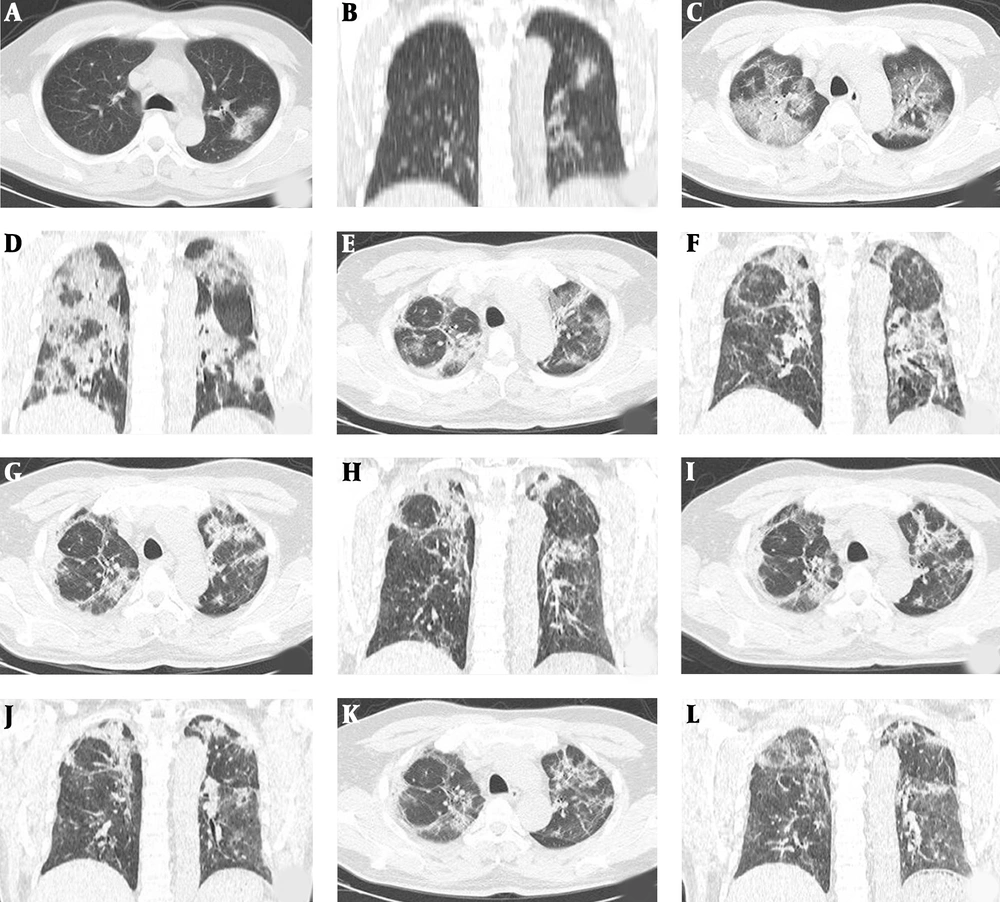
9/L), and the differential count showed 54.7% neutrophils (normal range, 40.0% - 75.0%) and 30.9% lymphocytes (normal range, 20.0% - 50.0%). C-reactive protein was normal (2.44 mg/L; normal range, 0 - 4 mg/L). Real-time polymerase chain reaction (RT-PCR) of the patient’s pharyngeal swab was positive for COVID-19 nucleic acid the next day. Day 2, early CT lung manifestation was ground glass shadow of the upper lobe of the left lung on January 25 (
Figure 1A and
B), and local consolidation in the edge, with interlobular septal thickening. Pneumonia involved only one lobe of the lung. However, on day 9, his body temperature increased to 38.9°C. Unenhanced chest CT illustrated multiple bilateral ground glass shadows (
Figure 1C and
D), and local consolidation, without mediastinal lymphadenopathy or pleural fluid. Blood gas analysis: partial pressure of carbon dioxide was 31.4 mmHg, and partial pressure of oxygen was 66.7 mmHg. Meanwhile, the patient was treated with low dose of glucocorticoids and non-invasive ventilation. For the next 6 days, human immunoglobulin was injected intravenously to enhance the immunity of the patient. On day 15, after a period of support therapy, the patient’s body temperature returned to normal; while, CT examination indicated that prior inflammation was absorbed slightly (
Figure 1E and
F).
Meanwhile, a small amount of pleural effusion on both sides was observed. Day 20, by the disease progressing, chest CT showed obvious absorbing of the ground glass shadow and the consolidating area of the lesion (
Figure 1G and
H). On day 25, pneumonia lesion was further absorbed, and the two lungs were scattered with fiber lesions (
Figure 1I and
J). No pleural effusion was detected anymore. On day 29, the lung showed fiber cord focus (
Figure 1K and
L). Finally, on day 33, after using antiviral drugs, symptomatic treatment, and immunoglobulin for human intravenous injection, RT-PCR of the patient’s pharyngeal swab was negative for COVID-19 nucleic acid. At the same time, we recorded the dynamic changes of laboratory parameters (
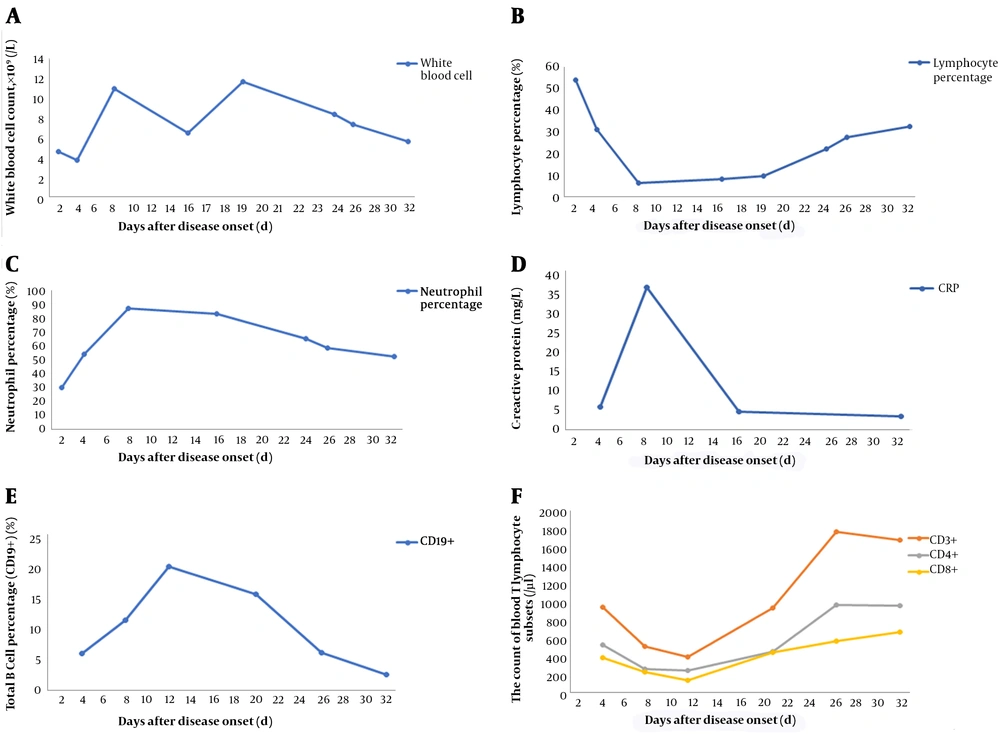
Figure 2).