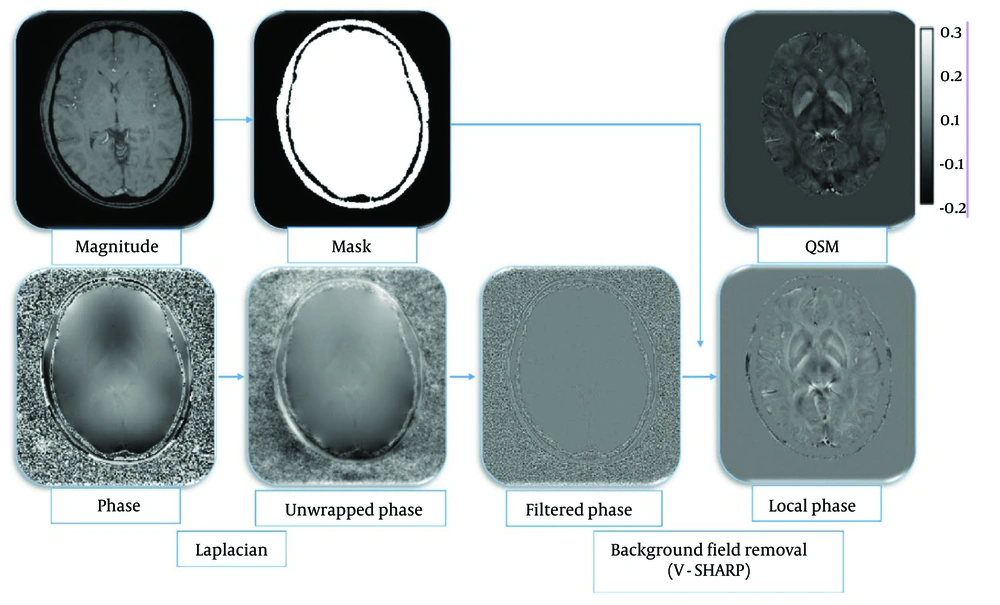
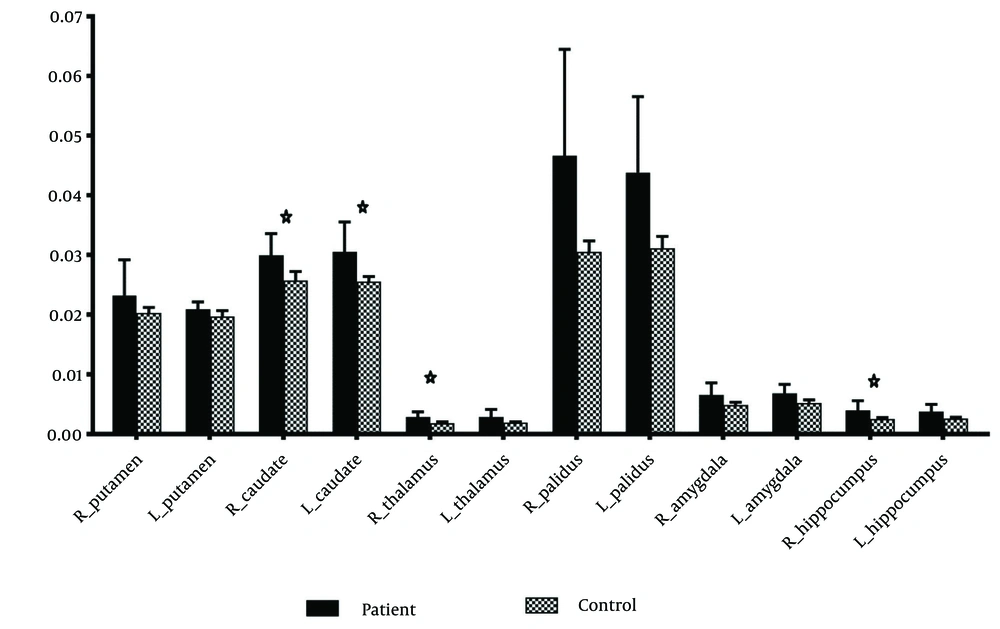
This study aimed to evaluate alterations in iron deposition (magnetic susceptibility) in the basal ganglia and thalamus of mTBI patients using the QSM technique. While white matter is also important in the context of brain injury, our primary focus on DGM was driven by the well-established involvement of these regions in cognitive and neurological impairments associated with mTBI.
Our findings revealed a notable increase in magnetic susceptibility values within the DGM nuclei regions in an average of ten patients. These changes were significant in the right and left caudate nuclei, right thalamus, and right hippocampus. These results suggest a potential link between mTBI and iron deposition in the brain, contributing to our understanding of the role of iron accumulation in mTBI pathophysiology.
The DGM nuclei house critical structures, such as the basal ganglia and thalamus, which play a vital role in motor control, cognition, executive functions, and emotional regulation (
36). Higher iron deposition in the thalamus and hypothalamus has been correlated with poor memory performance, while higher iron levels in the caudate nucleus have been linked to cognitive decline (
37). Iron is essential for various neurological functions, but excess iron can lead to oxidative stress and neurotoxicity (
38), potentially contributing to mTBI symptoms such as fatigue, cognitive decline, and movement disorders (
14,
15).
To understand the long-term pathogenesis resulting from TBI, Onyszchuk et al. subjected mice to controlled impact and performed MRI scans on their brains two months post-injury. The results revealed a decrease in T2 signal in the injured side of the thalamus, indicating increased iron levels in this region (
39). The initial study examining iron accumulation in the DGM nuclei included 28 patients with mTBI. The results showed a significant increase in magnetic field correlation values within the thalamus and globus pallidus of mTBI patients, indicating iron accumulation. These findings support the idea that DGM nuclei are affected by mTBI and suggest a potential association between iron accumulation and pathophysiological processes following mTBI (
7).
To confirm these post-injury changes, Liu et al. collected brain tissue samples from 19 patients undergoing surgical intervention for TBI 3 - 17 days after trauma. Tissue iron deposition and ferritin heavy chain expression were measured using tissue staining, polymerase chain reaction, western blot, and immunohistochemistry, showing an increase in ferritin chain expression and iron accumulation in the brain (
40). In a study conducted six months post-injury using SWI phase images, an increase in the radian angle was observed in various brain regions, such as the thalamus, lenticular nucleus, hippocampus, substantia nigra, and red nucleus (
5).
Several studies have also investigated changes in iron levels in the brain following injury using the QSM technique. Among these, Lin et al. reported changes in the thalamus 14 days after mTBI (
41). Additionally, a recent study by Koch et al. on athletes two days after mTBI reported a general decrease in magnetic susceptibility values in the DGM regions (
42). In contrast, some studies have indicated no significant changes in magnetic susceptibility values in the DGM regions of individuals with brain injury (
43,
44).
An increase in magnetic susceptibility values in the DGM nuclei likely indicates iron deposition resulting from neuroinflammatory processes following mTBI. Trauma-induced disruption of the blood-brain barrier may facilitate iron accumulation in brain tissue, accompanied by oxidative stress and neuronal damage. This process creates a vicious cycle, where the generation of ROS and subsequent activation of microglia further contribute to iron dysregulation. Over time, these pathophysiological changes may lead to cell death, resulting in the long-term cognitive and motor impairments commonly observed in mTBI patients. Understanding these mechanisms in detail is crucial, as identifying them could lay the foundation for potential therapeutic interventions, such as iron chelation therapy, which may mitigate the effects of mTBI.
Our study had several limitations. The relatively small sample size necessitates further research to confirm these findings. Financial and time constraints, as well as limited access to participants, contributed to the small sample size. However, given this limitation, researchers prioritized data quality and measurement accuracy. Despite the small sample size, a significant difference was observed between the two groups. Nonetheless, it is important to acknowledge the impact of the limited sample size on the study’s ability to draw strong conclusions and its implications for the generalizability of the findings. The sample size was determined based on feasibility and the exploratory nature of the study. Additionally, longitudinal studies with larger cohorts are needed to track iron accumulation patterns over time and understand their association with mTBI recovery.
Further investigation is required to determine the precise timeline of iron accumulation following mTBI and its potential correlation with symptom severity and long-term outcomes. Additionally, exploring iron chelation therapy as a potential intervention for mTBI patients with iron overload is warranted.
In conclusion, our findings revealed iron deposition in the DGM nuclei of mTBI patients. These regions are integral components of cognitive networks, suggesting that alterations in iron levels may disrupt these circuits and contribute to the diverse clinical manifestations of mTBI, including neuropathological, neurophysiological, and neurocognitive changes. While replication in larger cohorts and longitudinal studies is necessary, these findings underscore the potential of quantitative neuroimaging biomarkers, such as QSM, to non-invasively characterize neural pathology involving iron in mTBI. Future research should further explore the role of iron in mTBI pathophysiology and investigate the potential for iron-targeted therapies to improve patient outcomes.