


1. Introduction
Spontaneous ureteropelvic rupture (SUPR) is rare, and its co-occurrence with ureteral intraluminal dissection (UID) is even rarer. Both conditions are attributed to elevated intraluminal pressure, leading to urinary extravasation and ureteral dissection in the absence of trauma (1, 2). Urolithiasis is the most common etiology of SUPR; other causes include tumors, trauma, and iatrogenic injuries (3). Prompt clinical recognition is essential to prevent complications such as urinoma formation, infection, sepsis, and abscess formation. This report presents a case of SUPR combined with UID.
2. Case Presentation
A 62-year-old Chinese man presented to the emergency department with a 3-day history of acute, severe right flank pain accompanied by nausea and vomiting. The pain was persistent, with paroxysmal exacerbations. He denied urinary frequency, urgency, dysuria, gross hematuria, and fever. His medical history was unremarkable, with no recent trauma, acute inciting events, or prior urinary endoscopy. Physical examination revealed no abnormalities of the cardiorespiratory system. Abdominal examination showed tenderness in the right lower quadrant and right costovertebral angle on palpation. Admission laboratory tests showed leukocytosis (white blood cell count: 12.56 × 10⁹/L), elevated inflammatory markers (high-sensitivity C-reactive protein: 37.14 mg/L; procalcitonin: 21.1 ng/mL), and increased serum creatinine (231 μmol/L). Urinalysis and urine culture were normal. Ultrasonography and computed tomography (CT) of the urinary system were performed promptly. Ultrasonography revealed mild right-sided hydronephrosis with dilation of the proximal right ureter. CT identified focal stenosis in the middle to lower segment of the right ureter. This stenosis was accompanied by upstream dilation of the ureter and renal pelvis, as well as evidence of infection in the perinephric and periureteral tissues. The appendix appeared normal. Based on these imaging findings, the patient was admitted to the urology service.
After admission, the patient received supportive care, including analgesics, antispasmodics, and antibiotics. A subsequent contrast-enhanced CT scan of the abdomen and pelvis was obtained. During the excretory phase, CT demonstrated a characteristic double-lumen appearance with septation in the middle to upper segment of the right ureter. No ureteral stones, filling defects, or other potential causes of rupture were identified (Figure 1). However, prominent periureteral stranding was noted (Figure 2A). After one week of antibiotic therapy, the patient’s symptoms had not improved significantly, and he continued to require intermittent diclofenac suppositories for lumbar pain relief. Ureteral stent placement was considered to prevent worsening urinary extravasation and sepsis. The patient was also informed that the ureteral dissection could enlarge or that ureteral perforation could occur during ureteral stent placement. Ultimately, the patient was concerned about possible complications and chose to continue conservative treatment. Antibiotic therapy was maintained for an additional week, after which the patient’s symptoms were markedly relieved. A subsequent CT scan showed mild resolution of the perinephric and periureteral stranding (Figure 2B). The patient was then discharged with arrangements for outpatient follow-up. A surveillance urinary system CT scan performed one month after discharge showed complete resolution of the periureteral stranding (Figure 2C). A limitation of the follow-up was that only non-contrast CT, rather than CT urography (CTU), was performed. Nevertheless, plain CT demonstrated substantial resolution of periureteral extravasation, confirming clinical improvement.
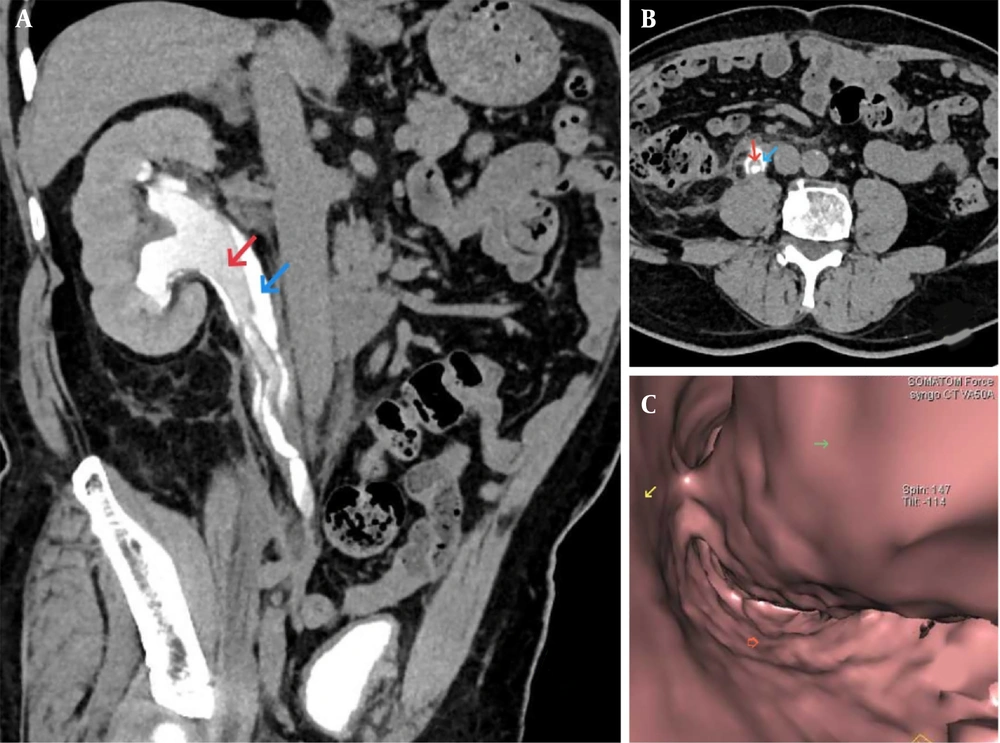
Figure 1.
CT urography: A and B, During the contrast excretion phase, the middle to upper ureter shows a double-lumen appearance, with separation of the luminal structure (red arrow: ureter; blue arrow: ureteral dissection). CT virtual endoscopy: C, Ureteral dissection (green arrow: ureteral mucosa; yellow arrow: ureteral muscularis; arrowhead: ureteral dissection).
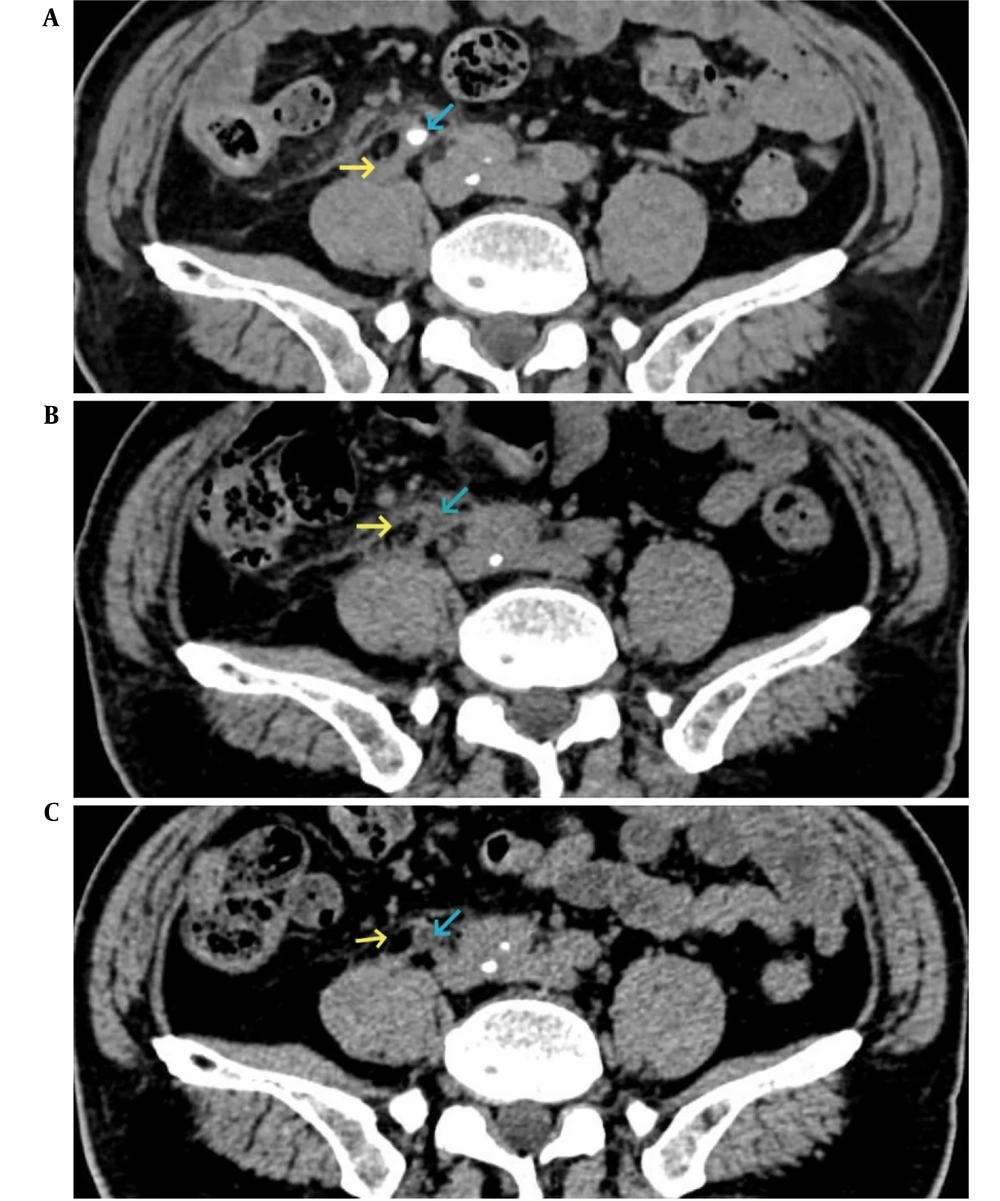
Figure 2.
A, CT urography (2025 - 02 - 24): Prominent periureteral stranding is noted. B, CT scan (2025 - 03 - 06): Mild resolution of periureteral stranding is noted. C, CT scan (2025 - 04 - 14): The periureteral stranding has completely resolved (blue arrow: ureter; yellow arrow: periureteral stranding).
2. Discussion
Spontaneous ureteropelvic rupture is rare and has variable, nonspecific clinical manifestations. Prompt recognition and management are critical because delayed diagnosis can lead to serious complications. The ureter is a muscular tubular structure that is anatomically divided into an inner mucosal layer, a middle muscular layer, and an outer layer of loose connective tissue. This anatomical configuration includes inherent predisposing factors for dissection formation. The lower segment of the ureteral wall contains three smooth muscle layers (inner, middle, and outer), whereas the middle and upper segments have only two relatively weaker layers (inner longitudinal and outer circular). This structural characteristic explains why ureteral rupture, with or without concomitant dissection, occurs more frequently in the middle and upper segments. The core pathophysiological process of ureteral intimal dissection can be summarized as follows: various injurious factors lead to separation of the ureteral mucosal layer and the underlying superficial muscle layer from the outer muscle layer and adventitia, forming a false passage or dissection that disrupts the anatomical integrity and normal function of the ureter. The pathogenesis of ureteral dissection and rupture remains unclear. Current case reports suggest potential pathological bases for this condition and propose theoretical mechanisms of formation. Ureteral dissection and rupture often result from increased pressure in the urinary collecting system and may serve as a protective mechanism against further renal damage. Urinary extravasation splits the muscle layer of the upper ureteral wall into inner and outer layers, creating true and false lumens (4). CT findings resemble those of aortic dissection. The term spontaneous indicates no external trauma, endoscopic manipulation of the ureter, external compression, destructive renal disease, or history of surgery, as in our case.
The true incidence of SUPR is unknown because only sparse case reports are available in the literature. Studies have noted no sex predominance, with a reported mean age of 40 years (5). Spontaneous ureteropelvic rupture often poses a diagnostic challenge because of its nonspecific presentation and lack of characteristic clinical signs. It is often confused with urolithiasis, cholecystitis, appendicitis, urinary tract infection, and other diseases, which must be considered in the differential diagnosis. Patients may present with sudden-onset flank and abdominal pain, nausea, vomiting, dysuria, and/or hematuria. The initial presentation of severe flank pain in our patient mimicked renal colic and infection. Our workup was tailored to rule out urolithiasis and lower urinary tract obstruction.
The most frequent cause of SUPR is obstruction by a ureteral stone; however, SUPR has also been associated with malignancy, pregnancy, lymphoid hyperplasia, renal cysts, fibrosis, radiation, and various causes of intrinsic and extrinsic genitourinary compression (6, 7, 8). However, some cases occur without an obvious cause. Stravodimos et al. reported five cases of spontaneous ureteric rupture; one patient had an obstructing ureteric stone, but the others had no obvious cause (9). Case reports have also documented that microlithiasis, with a diameter of only approximately 3 mm, can cause spontaneous rupture of the pelvicalyceal system, although this condition is relatively uncommon (2, 10). In our case, there was no stone, tumor, trauma, or iatrogenic procedure, only localized stenosis of the middle and lower ureter. An inflammatory stricture in the lower segment of the ureter led to infection and increased pressure in the upper renal pelvis and ureter, which subsequently resulted in SUPR. In addition, transient microlithiasis is a possible hypothesis. The mechanism of transient urolithiasis may involve severe ureteral obstruction, which not only causes inflammatory damage to the ureteral mucosa but also eventually resolves spontaneously without the patient's awareness. Assaker et al. noted higher rates of spontaneous rupture with distal ureteric stones than with proximal stones (76.7% vs 24.3%). The greater likelihood of rupture with smaller distal ureteric stones is attributed to prolonged obstruction and the narrower diameter of the distal ureter (11). In summary, the formation of ureteral dissection and rupture involves the following key elements: 1) injury to the renal pelvis and ureteral mucosa, 2) chronic ureteral obstruction, and 3) preserved renal function.
Given the rarity of this pathology, the diagnosis and management of ureteral dissection complicated by spontaneous rupture of the upper urinary tract remain uncodified. This condition is difficult to detect with routine examinations such as ultrasonography, abdominal CT, and urinalysis. Imaging is necessary to confirm the diagnosis, and CT with contrast injection has higher specificity and sensitivity than other imaging modalities for a definitive diagnosis. It can reveal the location of a stone in the ureter on non-contrast sections and show the exact site of iodinated contrast-agent extravasation on delayed phases. It is also necessary for excluding differential diagnoses (12). In this case, the renal pelvis intima was torn and extended downward, whereas the muscular layer remained intact. Curved planar reconstruction can clearly show the extent of ureteropelvic dissection. Delayed-acquisition contrast-enhanced CT is currently recommended as the initial imaging modality of choice for confirming this diagnosis (13).
Treatment of SUPR is an emerging field because no clearly established guideline or management protocol is available. Treatment is determined on a case-by-case basis. Depending on the patient's overall clinical condition, either surgical intervention or conservative treatment may be selected. In the study by Sultan et al., 57.5% of cases were managed conservatively, while 35% required double-J stent placement (14). Akpinar et al. reported successful conservative management in three of four patients, with one case requiring double-J stenting (15). However, Chen et al. managed 72.2% of cases with double-J stents and 27.8% conservatively, with favorable outcomes in all cases (16). Stravodimos et al. highlighted the effectiveness of double-J stent insertion, with occasional use of percutaneous drainage for infected urinomas (9). Conservative treatment carries potential risks, including worsening ureteral mucosal tears or urinary extravasation and the development of sepsis, necessitating close monitoring of the patient's condition. Factors such as urinary extravasation with urinoma formation, sepsis, and hemodynamic status may determine the management approach (17). Although conservative management may be sufficient for small stones and ureteral inflammatory stenosis, stenting is necessary in cases of obstructive uropathy and significant infection and extravasation (18). In our case, the patient refused urologic intervention because of the possible risk that the ureteral tear would worsen, with conversion of a partial tear into a full tear during double-J stent placement. We believe that conservative treatment was justified because of the patient's clinical stability, limited urinary extravasation, and absence of urinoma or overt sepsis. However, intervention is necessary in cases with persistent symptoms, infection risk, or worsening extravasation. Minimally invasive treatment options, including ureteric stenting or a percutaneous nephroureteral catheter tube, are preferred in addition to supportive care. In summary, treatment decisions should be based on the patient's overall condition. Double-J stent placement should be emphasized during treatment because it is minimally invasive and provides safer management for the patient. Regarding its potential adverse effects, no clinical reports have been documented to date. We believe that the risk of recurrence depends on the underlying cause of SUPR and the completeness of treatment. Recurrence after treatment has not been reported in the literature, and we propose that ureteral obstruction remains a significant contributing factor. We suggest that patients seek medical attention promptly if they experience severe or dull lumbar or abdominal pain; fever or chills; nausea or vomiting; difficulty urinating; urinary frequency, urgency, or pain; cloudy or foul-smelling urine; or gross hematuria.
Spontaneous ureteropelvic rupture is a rare and emergent disease process that is often misdiagnosed because of limited clinical awareness. Misdiagnosis may lead to complications such as renal failure, abscess formation, urinoma, and septic shock. This condition should be suspected in patients who present with severe lower back or abdominal pain, even if no obvious obstructive ureteral lesions are present or laboratory findings are normal. We acknowledge that this case report has several limitations: its single-case nature, the lack of definitive etiologic confirmation, and the absence of a metabolic evaluation for urolithiasis. Nevertheless, this case report may enhance awareness of this rare disease and emphasize the unique diagnostic methods required to confirm the diagnosis. It has important reference value for both radiologists and urologists.

