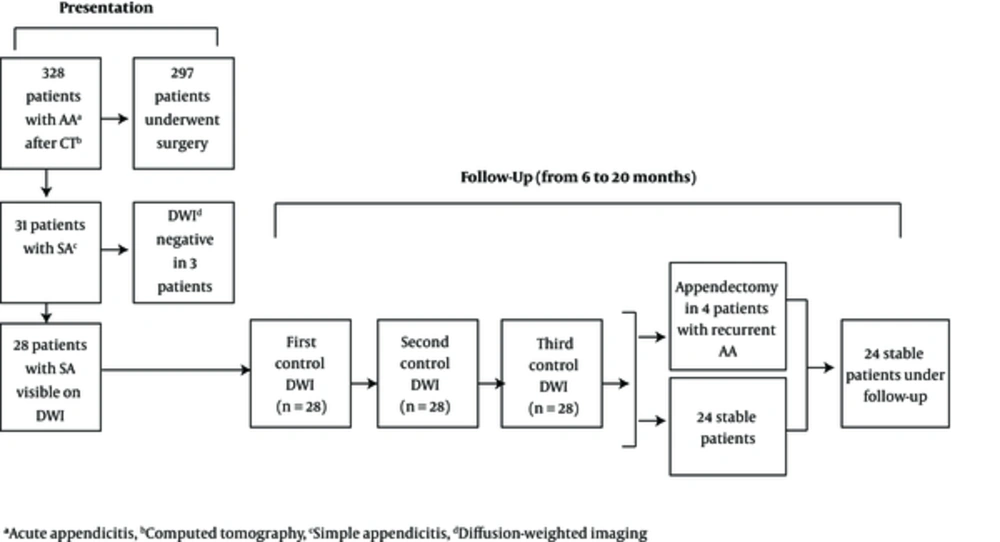
Computed tomography is the type of imaging modality that is most commonly used to diagnose appendicitis and its complications. The type of appendicitis (complicated or simple) and the associated anatomic relationships are well depicted with CT, which also helps determine the appropriate treatment approach (
27-
29). In the present study, the CT images clearly showed SA in all 28 patients based on the CT criteria mentioned above.
In the surgical literature, appendectomy has been the gold-standard treatment for AA. However, non-surgical treatment is the current trend for treating simple appendicitis. This approach aims to reduce healthcare costs and avoid the potential complications related to surgery. Recently, new studies on adult and pediatric age groups have been encouraging (
30). The Appendicitis Acuta (APPAC) study is a recently published study of a large adult age group that reported on antibiotic therapy for simple appendicitis (
6). Their findings showed that most patients with CT-proven SA who received antibiotic therapy during the first one-year follow-up did not require an appendectomy, and those who underwent surgery did not have significant complications. In our study, the percentage of recurrent appendicitis was lower than the percentage reported in the APPAC study (27.3%), while in the present study only four patients (14.2%) developed acute relapse of appendicitis, and they underwent an emergency appendectomy within a few hours of the relapse without any complications. The higher rate of acute relapse in the APPAC study might be due to the inclusion of patients with appendicoliths. In a recently published pediatric study, the recurrence rate was found to be 5.3% for patients with appendicoliths and 0% for patients without appendicoliths (
31).
In another study (
32) reported that appendicoliths were significantly associated with a greater risk for complicated appendicitis. They concluded that appendicoliths were associated with antibiotic therapy failure. This finding also emphasizes the significance of imaging to rule out appendicoliths. Knowing this fact, we excluded appendicitis associated with appendicoliths even if the patient was diagnosed with SA. Diffuse peritonitis and intra-abdominal abscess are the most severe complications of appendicitis (
6). It has been suggested that in CT-proven SA, a delay in surgery due to antibiotic therapy does not increase the risk of complications (
6). To date, none of the patients in our study have faced any complications during follow-up.
In the APPAC study, the incidence of tumors was found to be 1.5%, which is in concordance with the literature (
6). That study stated that imaging facilitated the detection of incidental tumors (
6). In general, colonoscopy is recommended in patients over the age of 40 to rule out serious conditions when conservative management is utilized. In our study, 11 patients over the age of 40 underwent colonoscopy during the fourth week follow-up period; pathology was not found in any of these patients. However, during follow-up of SA, even with a colonoscopy, diagnosis of an underlying tumor or inflammatory bowel disease may still be problematic, and imaging may be required. It has been reported that in conditions in which therapeutic alternatives to surgery are favored, patient satisfaction might be also problematic during follow-up (
31). When considering these facts and patient satisfaction during follow-up, imaging may become critical. In this respect, imaging may play a key role. The unique features of DWI (free of ionizing radiation and no need for a contrast agent) may make it an alternative imaging method during follow-up when conservative management of simple appendicitis is ordered.
In modern medical practice, imaging is widely used to diagnose AA; with the widespread use of modern imaging technology, false positive appendectomy rates have significantly decreased (
2,
13). With the increasing use of imaging, an alternative diagnosis that might mimic AA may be made with high success rates. In patients who receive conservative medical treatment for SA rather than undergoing immediate surgery, imaging may play a fundamental role in the follow-up. In reviewing the literature, we have not found any well-studied standard imaging method for follow-up for antibiotic-treated simple appendicitis. Conventionally, CT and US are the most commonly used modalities for the diagnosis of AA and its complications. In spite of this, imaging during follow-up is still controversial. This is critical when considering the risks of alternative diagnoses (e.g. tumors or inflammatory bowel disease) and the risk of recurrence of appendicitis that is reported to be 25% - 30% during first-year follow-up (
1). An initial CT scan has been reported to improve patient care and reduce costs, regardless of whether the patient receives antibiotic therapy or undergoes surgery (
6). However, there are disadvantages to both US and CT. US is highly operator-dependent, and it may be less sensitive, especially in patients with large body habitus. Bowel distension is another limiting factor in US, obscuring the underlying posteriorly located pathologies. CT is an excellent tool for abdominal imaging; it can be quickly performed in a matter of seconds and it is also widely available. However, the main disadvantage of using repeat CT scans is the overall accumulation of radiation, especially in the pediatric age group and young adults. The cumulative IV contrast load may also be problematic in patients who are allergic to contrast media or who have low renal reserves. In such cases, a low-dose CT scan may be an option; however, the use of cumulative radiation and contrast media will be still problematic with repeated scans.
Magnetic resonance imaging may be a perfect method in these groups of patients, with its lack of radiation and excellent soft tissue resolution. There are also disadvantages to using MRI, including longer imaging time, lack of local expertize and other logistical challenges. The use of DWI as the only imaging sequence for follow-up of these patients may significantly help in overcoming some of the limitations of MRI. DWI is a very fast imaging sequence, which also helps patients avoid the burden of cumulative radiation and contrast media. DWI provides qualitative and quantitative analysis at the cellular level. While it is considered to be an effective type of functional imaging (
33), some morphological information may also be acquired. Conventionally, DWI is most commonly used in neuroimaging applications; however, with the recent advances in MRI technology, body applications are becoming more common. Restricted diffusion is commonly observed if high cellularity is found within the lesion (e.g. tumors, abscesses, fibrosis and cytotoxic edema). DWI is sensitive to the micro-environmental changes in tumors at the molecular level that result from treatment; thus, it may predict tumor response to treatment (
34). DWI may also be used as an imaging tool to monitor infectious-inflammatory processes to evaluate the evolution of disease during a conservative treatment period, as we tried to determine whether DWI could be used to monitor the evolution of simple appendicitis with antibiotic therapy.
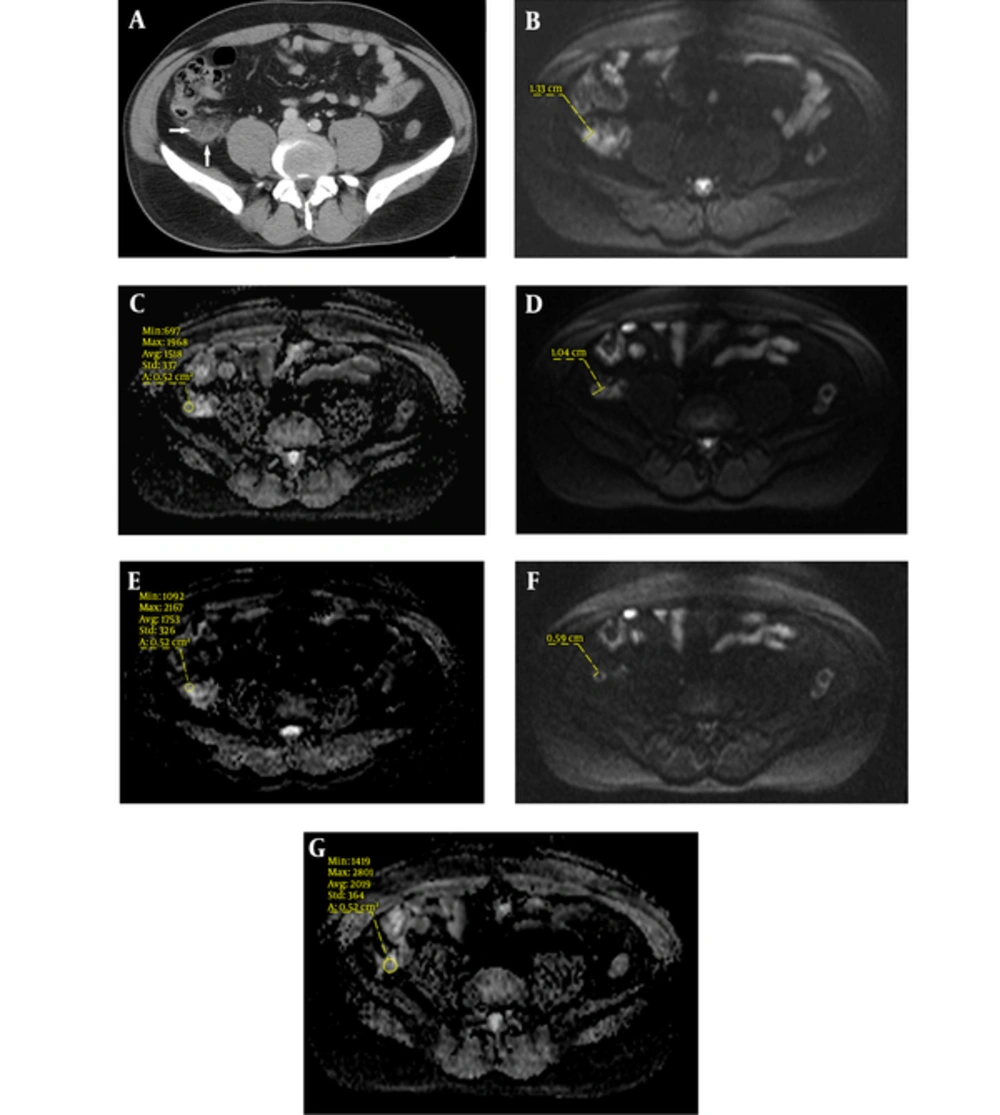
In the present study, we evaluated DWI as an imaging tool to assess changes in inflamed appendices, qualitatively and quantitatively, during follow-up (
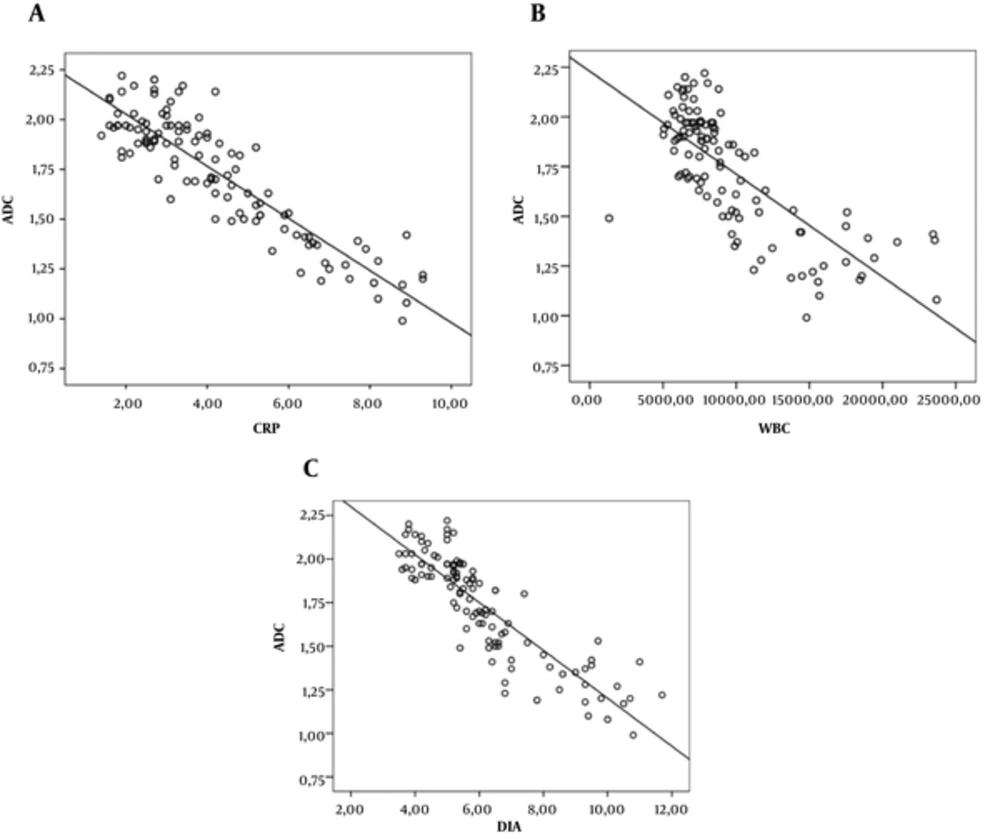
Figure 3). We evaluated the relationship between ADC values of appendixes, and we correlated the imaging data with the laboratory results (CRP and WBC). We also used morphological information provided by DWI to assess the dimensions of the appendixes. We found a statistically significant correlation between ADC values and laboratory parameters. We observed that, as ADC values increased (which suggests decreased cellularity within the appendix) serum inflammatory markers (i.e., CRP and WBC) normalized and the appendix diameter decreased (
Figure 2). A statistically significant correlation was found between the increase in ADC values and the decrease in the appendix diameter, WBC counts and serum CRP levels (P < 0.001). These findings may show that utilization of DWI may allow practitioners to evaluate the clinical response to conservative therapy by providing qualitative and quantitative data about appendixes. Knowing the primary infectious-inflammatory focus (in this case, SA during the early period of follow-up of conservative therapy might support the use of DWI as an effective monitoring tool instead of analyzing serum inflammatory markers. However, this needs to be investigated with a larger patient population with detailed data analysis.
During follow-up, four patients developed acute right lower quadrant pain and were found to have recurrent appendicitis visualised by DWI. The DWI findings were compatible with the clinical findings and the laboratory results. All four patients underwent emergency surgery, and the pathological specimens revealed SA without perforation. Knowing that there was no statistically significant difference in the ADC values of the relapse and non-relapse patients during the early periods of follow-up, DWI did not help in anticipating recurrent appendicitis. However, this must be further studied with larger patient groups.
In the present study, the length of the primary hospitalization at presentation was similar to what was reported in the APPAC study (mean 3 days) with a mean of 2.92 (± 097) days. In the APPAC study (
6), the length of hospital stay was statistically significantly shorter in the surgical group than in the antibiotic-treated group (P < 0.001). Unfortunately, our study did not have a surgical control group, so we were unable to compare that variable with the hospital stay length of surgical patients reported in the APPAC study.
Our study had several limitations. We only included 28 patients in this study, and this limited number may decrease the accuracy of our findings. For a better statistical assessment, larger patient groups with longer follow-up periods should be enrolled into future studies based on the information provided in this study. Our study did not have a control group without any screening protocol to compare the DWI results of the patients during the follow-up period to address the potential benefits of DWI. Another important limitation of this study was that we did not assess inter-observer variability. Moreover, we did not include other MRI sequences that could provide morphological information; as such, the lesion borders could have been more effectively identified, especially with the use of IV contrast media. However, the inclusion of other MRI sequences would go against the aim of this study, as we tried to implement the fastest MRI method without the use of IV contrast media. Finally, in the present study, the concept of performing repeated DWIs contradicts the efforts of conservative therapy for simple appendicitis, which aims to reduce healthcare costs.
In conclusion, we think that DWI would be highly successful for the follow-up of patients with SA who received antibiotic therapy instead of undergoing emergency surgery. Although medical history, physical examination findings and serum inflammatory markers are critically important for the diagnosis and follow-up of AA, DWI may be highly effective during early periods of conservative therapy. Furthermore, the lack of radiation in MRI may be especially useful in the follow-up of pregnant patients and pediatric patients. Although not present in our study patients, DWI may also help in diagnosing alternative conditions mimicking AA such as cecal cancer or inflammatory bowel disease, during follow-up. Finally, as DWI does not require IV contrast media, its use may be critical in patients with renal impairment.