


1. Background
Every year, imaging is performed using millions of boxes of intravascular (i.v.) contrast agents across the country. The side effects of these medications are considered to be rather rare (1). However, they may lead to irreversible consequences that are proved to be fatal or to impair the life quality in patient groups known to be at risk (2, 3). We can classify the side effects as nephrotoxicity and non-nephrotoxicity side effects. Some of the non-nephrotoxicity side effects are excessive vomiting, explicit urticaria, bronchospasm, facial or larynx edema, vasovagal syncope, hypotensive shock, respiratory arrest, cardiac arrest, convulsion, thyrotoxicosis, and nephrogenic systemic fibrosis. When considered from this point of view, the process of prescribing a contrast agent needs the clinician, the radiologist and the organization where they work to develop standardized applications. These applications are carried out through guidelines that are prepared both on the institutional basis and throughout the country. When contrast agents are considered, the most known guidelines are those of the American college of radiology (ACR) and European society of urogenital radiology (ESUR) (1, 4). Since these guidelines act on evidence-based information, they not only provide recommendations for proper and safe clinical practice but also form the basis for the expert witnesses to make the right decisions about the cases that have been brought into court. However, the clinical guideline should be established by a group that consists of specialist doctors related to the clinical situation institutionally (5). The intention behind the initiative was to determine who plays the dominant role regarding reactions to contrast agents. For this purpose, a questionnaire named control preferences scale (CPS) was applied to the clinicians working in two local hospitals. However, a verbal interview was performed with the participants before decision-making. In the interview, the participants were asked about the role of collaboration with the radiologist. Before the questionnaire, we talked about most of the side effects of contrast substance of the group that were known to cause risks for the patients, and the legal consequences of the substance. This lead to clarify the aim of our study for comprehension. The last research conducted by using CPS found in the literature is “preliminary identification of coping profiles relevant to surrogate decision making in the ICU” conducted by Butler et. al. (6). In this study, participants’ preferences concerning shared decision-making mechanisms were evaluated via Degner CPS. However, Sepuca et al. used 17 different measurement methods evaluating decision-making processes in their study “establishing the effectiveness of patient decision aids: key constructs and measurement instruments”. The decisional conflict scale was most commonly used (n = 47), followed by the CPS (n = 9) (7).
Control preferences of the clinicians may be either clinician or radiologist dominant. Both preferences have their own drawbacks. However, when the arising problems are left aside, the implementation of this scale reveals the degree of collaboration between radiologists and clinicians in making clinical decisions.
2. Objective
This study aimed to create a guideline preparation group that consisted of institutional radiologists and clinicians towards preventing contrast agent reactions and investigated the control preferences of the clinicians on taking initiatives as a part of the team.
3. Materials and Methods
The current study involved 110 senior physicians from internal and surgical branches who worked in two training and research hospitals. Twenty-five physicians were excluded from the survey because of not filling the questionnaire within the specified time (1 month) and ten physicians were excluded due to inconsistent answers (inconsistency criteria were presented in the title of CPS.) The questionnaires filled by the remaining 75 participants were subjected to statistical analysis.
3.1. Groups and Demographic Characteristics
Participants were classified according to their position, age, gender, and internal/surgical branches. The participants consisted of 30 females (40%) and 45 males (60.37%). Internal specialist physicians were 49.3%, and the rest of the physicians were from surgical branches. Ten were either a lecturer or a chief resident. The majority of participants (90%) were within the age range of 31 - 50 years.
3.2. Control Preferences Scale
It is a scale developed for determining the management of life-threatening diseases (8). The goal is to identify physician’s and patient’s control preferences (their roles in the decision mechanism) in shared decision-making mechanism. It was predominantly implemented in cancer patients, and its effectiveness has been proven on thousands of patients. The measuring system consists of five preferences, each represented by a letter.
Control preferences scale (CPS) is a scale administered by personal interview. In the current study, the scale needed implementation of a written questionnaire. Therefore, it was modified in the written questionnaire based on the logic of the scale. Participants were asked to specify their primary (the most preferred) and secondary (subsequent) preferences. In our work, modified preferences were used. The manner in which these preferences were determined is presented in Table 1.
Table 1.Components of Modified Control Preferences Scale
| Letter | Preference | Who is Active in This Preference? |
|---|---|---|
| A | I prefer to make a decision as a clinician. | Only the clinician |
| B | I prefer to make a decision as a clinician but should get radiologist’s opinion. | Clinician > Radiologist |
| C | Radiologist and I should make a decision together. The ideas of the two of us are equally important. | Clinician = Radiologist |
| D | The radiologist should make a decision but after getting my opinion. | Radiologist > Clinician |
| E | I prefer the radiologist to make a decision. | Only the radiologist |
However, not all kinds of arrangements are valid on this scale. Results obtained in the studies conducted so far have revealed that the measuring system was suitable for the arrangement of ABCDE or EDCBA. Since preferences would be made as two by two in this system, consistent arrangements consisted of the first two letters of coherent alignment indicated above for original scale and their numbers were 8, namely:
AB, BA, BC, CB, CD, DC, DE, ED
These arrangements were classified under the headings mentioned in Table 2.
Table 2.Classification of Arrangements in Our Study
| Category | Corresponding Arrangements |
|---|---|
| Non-cooperative | AB, ED |
| Cooperative- dominant clinician | BA, BC |
| Equalitarian | CB, CD |
| Cooperative- dominant radiologist | DC, DE |
The respondents with inconsistent alignment (n = 10) were excluded from the current study. During the questionnaire, the participants were asked to select only two choices. The only criterion for validation was to be consistent statistically. Therefore, inconsistent selections were eliminated.
Considering the preference in Table 1, there are some options that are considered as relevant, i.e. in A option, the participant prefers to make a decision as a clinician. In case of selecting A, for the second choice, the participant can select only B option, because the other options are not statistically consistent. In other words, the participant who selects A in the first choice can not select C, D or E. Because of that, the “Who is active in this preference?” column gives a restriction depending on consistency criteria. For instance, selecting option A indicates only the clinician, while option E indicates only the radiologist. This is an example of inconsistency. Therefore, the case of AE is not valid. Furthermore, AC and AD are also invalid choices. As a result, the invalid answers were considered as out of the study.
3.3. Statistical Analysis
IBM Corp. Released 2011. IBM SPSS Statistics for Windows, Version 20.0. Armonk, NY: IBM Corp. software package was used for statistical analysis. The age groups were classified into slices of 10 years (categorical variable). The gender, title, and branch differences were classified as dichotomous variables. Chi-square analysis was performed to analyze the data. P values less than 0.05 were considered as statistically significant.
4. Results
The first two preferences of the participants who consistently responded are presented in Table 3 (in subsequent letters).
Table 3.Clinicians’ Control Preferences in Our Survey
| Preferences | Number, No. | Percentage, % |
|---|---|---|
| AB | 18 | 24.0 |
| BA | 6 | 8.0 |
| BC | 6 | 8.0 |
| CB | 14 | 18.7 |
| CD | 6 | 8.0 |
| DC | 3 | 4.0 |
| DE | 11 | 14.7 |
| ED | 11 | 14.7 |
| Total | 75 | 100.0 |
The results were classified as follows: Non-cooperative (n = 29, 38.6%) - those who had chosen AB and DE options. Eighteen participants (62%) stated that clinicians should be active in the decision-making process by selecting AB option. Eleven participants (37.9%) expressed that radiologist should be active in the decision-making process by marking ED option. Among the cooperative participants who preferred the clinician to be more active in making the decision (n = 12, 16%) - six participants marked BA option, while the other six participants preferred BC option. Among those who preferred that the clinician and radiologist should take equal responsibility in decision-making (n = 20, 26.6%) - 14 participants marked CB option, while the other six participants preferred CD option. Those who were cooperative but preferred that the radiologist should be more active in decision-making (n = 14, 18.6%) - three participants marked DC option, while the other 11 participants preferred DE option.
4.1. Results of Statistical Analysis
The results of the study showed that option C was marked with a significantly higher ratio in women compared to men (43.3% versus 15.6%, P < 0.05). Moreover, option E was marked with a significantly greater ratio in men compared to women (22.2% versus 3.3%, P < 0.05). There were no statistically significant differences among age groups of ten-year intervals in our questionnaire. When the equalitarian approach (C) was mentioned, the number of physicians in branches of internal medicine was statistically significantly greater than that of surgical branches (37.8% versus 15.8%, P < 0.01). The physicians of surgical branches marked the option of radiologist being dominant more frequently than those of internal branches (47.4% versus 18.9%, P < 0.05). There were no statistically significant differences between the specialist physicians and the chief residents/ lecturers.
5. Discussion
In terms of business management, health services can be considered as marketing activities. Patients are the ultimate customers of these activities. Therefore, strategies for customer satisfaction used in marketing facilities can also be utilized for the management of patient satisfaction. The marketing communication model proposed by Albrecht and Zemke for hospitals and outlined in the following scheme may be implemented to determine an accurate service strategy (Figure 1) (9).
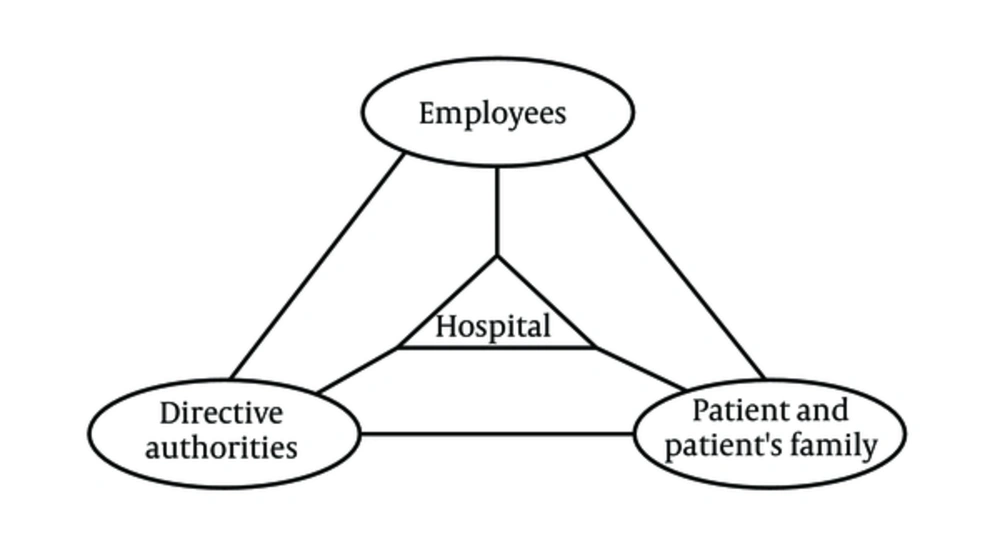
Figure 1.
Marketing communication model for hospitals
According to this triangular-shaped model, not only the patients’, but also their family’s satisfaction is an essential instrument of the marketing process (bottom-right corner). In addition, hospital personnel are also considered as “internal customers” (top corner). Likewise, they should be happy first in order to ensure patient satisfaction (10, 11). It is important to understand that each internal customer is a critical point in fulfilling patients’ needs. Thus, programs intended to develop relationships in health units are crucial. The third leg of this model is defined as referral authorities (bottom-left corner). Referral authorities function as counselor and policy maker, and patient satisfaction is essential for them.
Institutions providing healthcare should expand their customer satisfaction programs to include patients and their families, hospital employees and directive authorities, based on the model above.
The progress, made as the result of growing interest regarding customer satisfaction, led the term “relationship marketing” to emerge, as described in the model above. The word “relationship” means the relations among people who offer the service (internal customers). A good rapport necessitates having shared values in the service production, mutual trust, the establishment of frequent communication, collaboration and commitment to goals (12). Otherwise, lack of communication between the doctors who provide primary health care becomes an issue, which leads to time and financial loss. This lack of communication can result in poor patient care.
It is evident that the relationship described above plays a vital role in preparing clinical guidelines. Clinical guidelines are the documents developed with the aim of creating criteria for diagnosing certain diseases or guiding their treatment (5). Otherwise, lack of communication between the doctors who provide primary health care becomes an issue, which leads to time and financial loss. This lack of communication can result in poor patient care.
It is expected that the decision concluded as the result of teamwork is more efficient than the decision made by any one of the parties.
How do groups make a decision?
The group’s output of decision-making is associated with both the input and the process factors. The input factors include:
1. Individual factors (individuals’ skills, status, and personality structure)
2. Factors related to the group (group structure, size, and maxim)
3. Environmental factors (task quality, environmental stress level, and reward structure)
These factors affect the process and hence the “output” (13). The process factors contain elements such as intragroup communication, information interchange, an alliance among the members, and the tendency to develop a strategy for fulfilling a duty. Input factors determine the group potential. The process loss is the loss of potential earnings which result from motivation and coordination errors (13). Therefore, group performance can be defined as follows:
Group Performance = Group Potential - Process Losses
However, process factors can produce more earnings expected from the inputs. For example, interaction may improve motivation and may contribute to a more efficient combination of the resources and hence to process earning. On the other hand, process and input factors are not independent of each other and are usually interrelated. Thus, for example, a specific group structure can influence the intragroup communication process.
The concept of “group thinking” was developed to explain group members’ efforts to build consensus and the group’s decision-making process. Group thinking can also lead to bad decisions in group interaction. In particular, those who are isolated from out-group individuals, who manifest high interdependence, who have a dominant leader and who are engaged with stressful decision-making can make wrong decisions. Behavioral models constructed by experimental research in social and cognitive psychology have revealed that the following factors stand out in the group’s decisions (13):
1. Group members who are planned to reach a consensus to make a decision should benefit from both their experience and new information presented in the group.
2. The relationship of the people with knowledge (manner of examining, organizing and recalling the information) determines which information will be used, what impact will this information have, and possible bias that may be effective in using the information.
3. Efforts to reach a consensus may need the perspectives of some people on the event to change. This change may be through persuasion and social influence.
4. The intragroup behavior is shaped by the perceptions of the group members towards group work: Do members consider themselves as a group with a common purpose or are sub-group identities residing at a more salient position? In turn, does consensus lead to a conflict of interest among sub-group members?
This last statement summarizes the purpose of our work.
Upon the need to develop a corporate attitude towards preventing reactions to contrast agents, clinicians working in the institution were requested to fill in a questionnaire and were asked who should become dominant about prevention of the reactions. When we reinterpret the figures in the result section:
1. The number of physicians who preferred the clinician to maintain an active or collaborative dominant attitude in the decision-making mechanism was 30 (40%).
2. The number of physicians who preferred the radiologist to maintain an active or collaborative dominant attitude in the decision-making mechanism was 25 (33.3%).
3. The number of physicians who preferred a collaborative attitude was 46 (61.3%) when those who preferred both parties to take equal responsibility in the decision-making mechanism were added to the collaborative physicians.
4. The number of non-collaborative physicians was 29 (38.7%). Of these, 18 (24%) and 11 (14.6%) wanted the clinicians and radiologists to be active in the decision-making mechanism, respectively. This ratio was at a considerable level and posed an obstacle to the issue that a consensus is needed for prevention of such reactions to the contrast agents.
Clinicians’ attitudes may depend on various factors. Statistical inferences drawn from the current study may provide partial insight into this situation. Accordingly, physicians in surgical specialties prefer the radiologist to become dominant in the decision-making process, with a significant difference. This tendency suggests that surgeons are focused on surgical repair by isolating their clinical interests from patients’ internal problems.
Surgeons may have a tendency to solve their patients’ internal problems by consulting internal specialists, but this trend may put patients at risk in some outpatient cases or in reactions to contrast agents. In conclusion, the physician is first and foremost, a general practitioner regardless of the specialty, and the patient does not consist of a single system that only concerns a single specialty. This fact is a fundamental tenet that is also taught in medical school.
On the other hand, female physicians prefer an equalitarian attitude in the decision-making process, with a significant difference. This finding indicates that female physicians are more prone to group work that requires cooperation and communication. However, good communication within the group does not mean that good clinical practice, which is our main aim, will take place. Because of that no matter what decision the group makes, practical application will be interrupted due to the ratio (38.7%) of doctors who have a non-cooperative attitude. In other words, group performance seems to be low from the beginning. However, any decision should not be made on this topic without seeing the process losses during practice, because being non-cooperative is a first preference according to the scale that we have implemented. It may be possible that non-cooperative doctors maintain a cooperative attitude during group work. In other words, the process losses remain less than expected.
14.6% of non-cooperative physicians want only the radiologist to be active in the decision-making mechanism. In our opinion, this ratio is not high. However, it does not mean that the radiologist will not play an active role in clinical practice. The most significant challenge of accomplishing this task is that radiology is a laboratory branch. In other words, the radiologist is often unaware of the clinical and laboratory findings of a patient whose examination is requested. Trying to identify these (meeting each patient who has exposure to contrast agent and questioning risky situations) will lead to assigning a separate physician to the task, thereby leading to labor loss. This already seems impossible to implement in many organizations, including ours.
In conclusion, when we attempt to establish a clinical guideline committee towards preventing reactions to contrast agents, the ratio of physician clinicians with non-collaborative attitude may lead us to encounter difficulties in developing a consensus. However, it is difficult to foresee what the final group performance will be and we do not think it will be understood unless clinical practical work begins.
The study conducted by Sepuca et al., which used 17 different measurement methods to evaluate decision-making processes, was not able to find a single measurement method determining decision-making process and its quality. We also agree with them.
As in the present study, preliminary studies using various scales about the preferences of physicians to form groups may help in predicting future application difficulties.



