LVNC has been classified as a primary genetic cardiomyopathy. It occurs more frequently in males and its prevalence ranges from 0.06% - 0.24%; nearly half of the cases are familial (
5). Recently, clinicians and researchers have debated whether LVNC is a physiologic or a pathologic phenotype of the myocardium. LVNC can be a myocardial disorder (genetic cases), as in patients with hypertrophic cardiomyopathy or dilated cardiomyopathy. It can be an epiphenomena of a pathologic pressure/volume load of the ventricle, or it can be a physiologic response to loading conditions (
1,
6).
Although many patients are asymptomatic with preserved LV systolic function, others develop heart failure, thromboembolic events, and malignant arrhythmias. Heart failure symptoms varying from mild to severe have been observed in approximately half of patients (
7). Systolic dysfunction and arrhythmias may be a consequence of dysfunction at the microcirculation level and subepicardial hypoperfusion (
4).
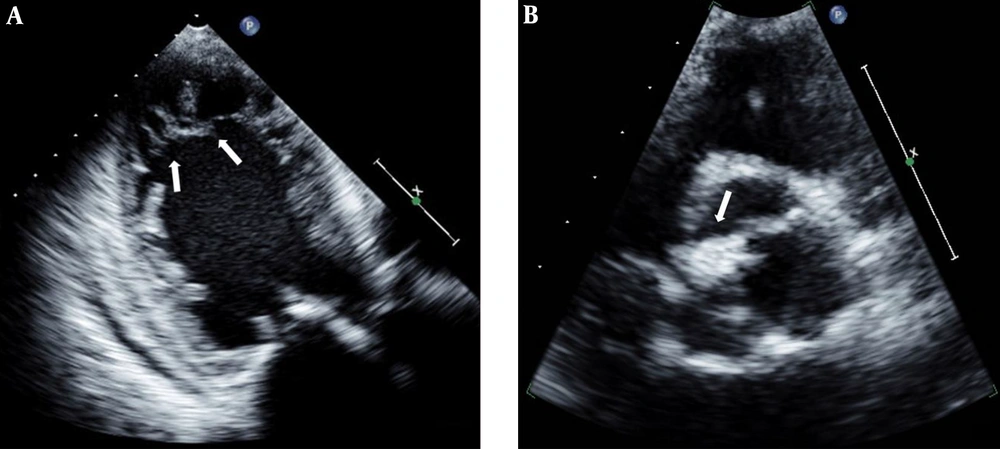
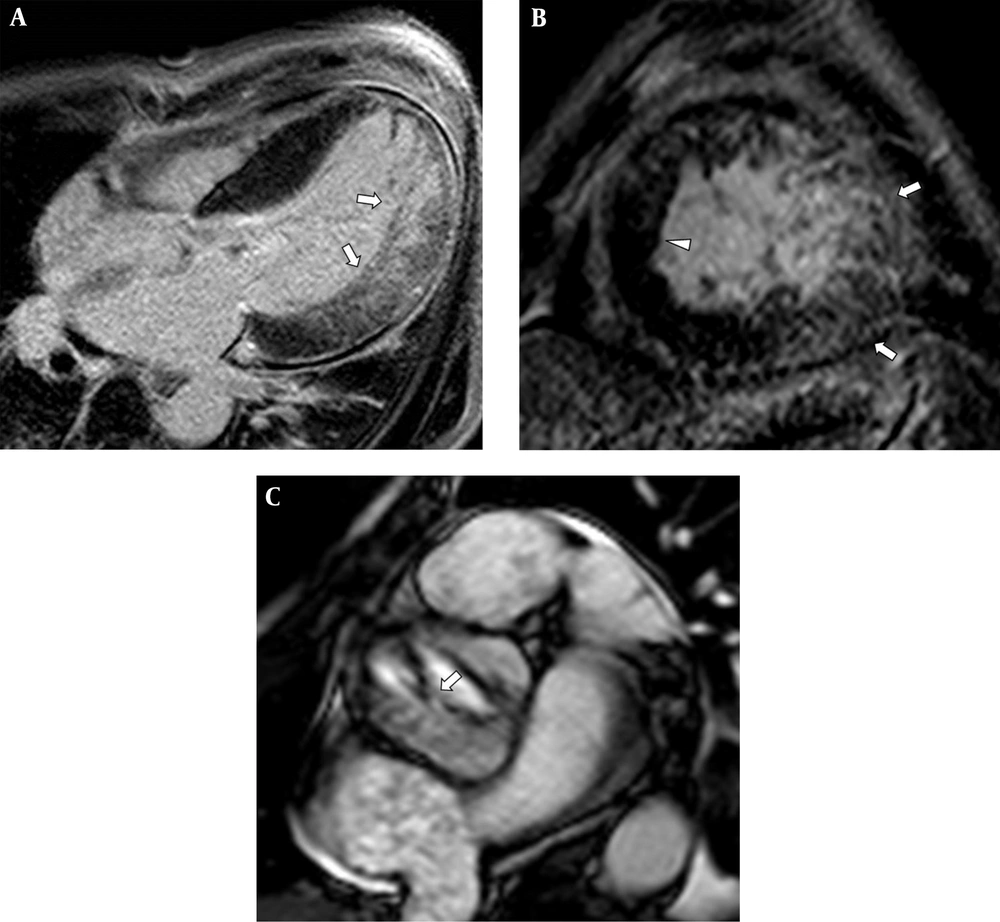
Echocardiography is the main diagnostic tool for the diagnosis of noncompaction. Especially, TEE might have a complementary role in the detection of LVNC, particularly in adult patients, in whom this unusual condition may be misdiagnosed. Cardiac MRI is becoming increasingly important in confirming the diagnosis and evaluating concomitant complications and myocardial scarring. Advantages of cardiac MRI compared with echocardiography for diagnosing LVNC include the high spatial resolution; better delineation between the noncompacted and compacted layer; the ability to visualize the apex, false tendons, prominent papillary muscles, and aberrant bands (
8). Furthermore, the assessment of myocardial fibrosis on delayed gadolinium enhancement on cardiac MRI can provide valuable prognostic information. Nucifora et al. revealed that myocardial fibrosis on delayed-enhancement MRI is related to clinical disease severity and LV systolic dysfunction in isolated LVNC (
9). An abnormal contractile mechanism and inadequate microvasculature in the setting of increased myocardial mass have been postulated as potential causes of fibrosis given the usual finding of normal epicardial coronary arteries (
10). In this case, extensive delayed myocardial and trabecular enhancement of the non-compacted myocardium might be closely related with gradual deterioration of cardiac function on follow-up echocardiography.
Coexisting valvular anomalies are an emerging association with LNVC that requires further investigation, because it can attribute to expedite the potential for adverse clinical events. BAV is a common congenital cardiac malformation in adults, and it occurs in isolation, or in association with other congenital heart diseases. In Agarwal et al.’s study, an 11% incidence of LVNC was noted within the BAV population, which was significantly higher than in the general population (
11). Several cases illustrate an unusual association of noncompaction cardiomyopathy with morphologic and functional abnormalities of the mitral valve in the form of thickened leaflets with restricted movement (
12). In these reports, the authors noted that atrioventricular valve abnormalities seemed to be secondary to valvular dysplasia or chordal enlongation or rupture, which could be related to endocardial fibroelastosis or papillary muscular involvement (
12).
Prognosis is variable in patients with LVNC. Although some patients remain asymptomatic, rapid deterioration of cardiac function can result in early death (
4). Considering the potential for coexisting congenital heart disease to contribute to declines in cardiac function, patients with LNVC should be comprehensively evaluated for concurrent cardiac anomalies and myocardial fibrosis using echocardiography and cardiac MRI.