
1. Background
Coronary artery disease (CAD) remains the leading cause of mortality and morbidity worldwide and imposes a substantial economic burden on healthcare systems (1). In Iran, cardiovascular diseases are the primary cause of death and disability, with a rising prevalence that mirrors global trends (2).
Extensive research has focused on the primary prevention of CAD, leading to the well-established identification of traditional risk factors such as hypertension, dyslipidemia, diabetes, and smoking (3, 4). Accordingly, clinical guidelines provide robust recommendations for managing these factors to prevent first-time cardiac events (5). However, substantially less attention has been devoted to the determinants of disease recurrence among patients who have already experienced a CAD event.
Secondary prevention is critical because patients with established CAD are at a significantly elevated risk of recurrent events, including rehospitalization, myocardial infarction, and death (6). Although controlling traditional risk factors is essential, emerging evidence suggests that socioeconomic status (SES) and lifestyle factors play independent and substantial roles in long-term prognosis (7, 8). Factors such as educational attainment, physical activity level, and psychosocial stressors may influence medication adherence, the ability to sustain lifestyle changes, and access to care, thereby affecting clinical outcomes.
The existing literature on CAD recurrence in Middle Eastern populations, particularly in Iran, is limited. Moreover, many studies do not comprehensively assess lifestyle factors such as specific substance use, including opium use, which is prevalent in the region, and physical activity.
2. Objectives
This study aimed to investigate the demographic, clinical, lifestyle, and socioeconomic factors associated with CAD recurrence in a cohort of patients from Sabzevar, Iran, to inform more effective, culturally tailored secondary prevention strategies.
3. Methods
3.1. Study Design and Population
This hospital-based cross-sectional study was conducted at Heshmatieh Hospital in Sabzevar, Iran. The study population comprised patients with a definitive diagnosis of CAD, including myocardial infarction or unstable angina, who had a history of more than one hospitalization for a CAD-related event between March 2017 and March 2020. In total, 300 patients were enrolled. The sample size was estimated based on a previous study, with a 10% attrition rate; however, a formal power calculation for multiple comparisons was not performed.
3.2. Data Collection
Data were collected using a researcher-designed checklist based on a review of patients’ medical records and direct interviews. The checklist included the following variables:
3.2.1. Demographics
Age, sex, educational level, occupation categorized as high-stress or low-stress, job satisfaction, and place of residence, categorized as urban or rural.
3.2.2. Clinical History
Family history of CAD and comorbidities, including diabetes mellitus, hypertension, hyperlipidemia, and psychiatric disorders.
3.2.3. Lifestyle and Behavioral Factors
Smoking status, opium use, and waterpipe (qalyan) use. Physical activity was defined according to World Health Organization guidelines as at least 5 times per week for at least 30 minutes. Dietary adherence and regular self-monitoring of blood pressure and glucose were also recorded.
3.2.4. Disease Management
Regular follow-up visits and adherence to prescribed medications for comorbidities.
3.2.5. Outcome Vvariable
The number of recurrent CAD events leading to hospitalization.
3.3. Statistical Analysis
Data were analyzed using SPSS software, version 25.0. Descriptive statistics were presented as means ± standard deviations for continuous variables and as frequencies and percentages for categorical variables. Independent t-tests were used to assess associations between binary categorical variables and the number of recurrences as a continuous variable, and analysis of variance (ANOVA) was used for variables with more than 2 categories. Relationships between continuous variables, including age and body mass index (BMI), and recurrence were assessed using Pearson correlation coefficients. Multivariate regression modeling was not performed to adjust for potential confounders because the dependent variable was not dichotomous. A P value < 0.05 was considered statistically significant.
3.4. Ethical Considerations
The study protocol was approved by the Ethics Committee of Sabzevar University of Medical Sciences (code: IR.SABZU.REC.1399.166). Written informed consent was obtained from all participants.
4. Results
4.1. Baseline Characteristics
In this study, most participants experienced a single recurrence of heart disease (n = 253, 84.3%), whereas 36 (12.0%) had 2 recurrences and 11 (3.7%) had 3 recurrences. The study included 300 patients (149 men and 151 women) with a mean age of 58.7 ± 10.5 years. Most participants had nonacademic education. Comorbidities were common, with diabetes present in 43.3% of patients, hypertension in 40.7%, and hyperlipidemia in 28.3%. Opium use was reported by 31.7% of participants, hookah use by 7.7%, and smoking by 18.0% (Table 1).
Table 1.
Demographic and Clinical Factors Associated with CAD Recurrence a
| Variables | No. (%) | Recurrence (Mean ± SD) | Test Statistic | P-Value |
|---|---|---|---|---|
| Sex | -1.54 b | 0.123 | ||
| Male | 149 (49.7) | 1.21 ± 0.45 | ||
| Female | 151 (50.3) | 1.28 ± 0.52 | ||
| Age, y | - | 58.7 ± 10.5 | 0.002 c | 0.97 |
| BMI | - | 26.1 ± 4.4 | 0.095 c | 0.10 |
| Comorbidities | ||||
| Diabetes | 130 (43.3) | 1.28 ± 0.51 | 1.25 b | 0.21 |
| Hypertension | 122 (40.7) | 1.27 ± 0.50 | 1.08 b | 0.28 |
| Hyperlipidemia | 85 (28.3) | 1.26 ± 0.48 | 0.43 b | 0.67 |
| Substance use | ||||
| Opium use | 95 (31.7) | 1.32 ± 0.54 | 1.83 b | 0.069 |
| Smoking | 54 (18.0) | 1.31 ± 0.54 | 1.17 b | 0.24 |
| Hookah | 23 (7.7) | 1.30 ± 0.47 | 0.58 b | 0.56 |
a Abbreviations: BMI, Body Mass Index; CAD, coronary artery disease.
bt-value (df = 298).
c Pearson r value.
4.2. Factors Associated with CAD Recurrence
The analysis identified several significant associations.
4.2.1. Socioeconomic Factors
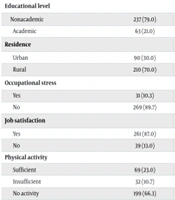
A lower educational level was significantly associated with a higher number of recurrences (P = 0.019). Patients residing in urban areas had a significantly higher mean number of recurrences than those in rural areas (2.2 vs 2.1, P = 0.021). No significant associations were observed for occupational stress or job satisfaction.
4.2.2. Lifestyle Factors
Patients who engaged in regular physical activity according to World Health Organization guidelines had significantly fewer recurrences than inactive patients (2.1 vs 2.3, P = 0.007). No significant associations were found for smoking, opium use, or dietary adherence.
4.2.3. Clinical Factors
A higher number of follow-up visits was strongly associated with more recurrences (P = 0.035). Although the associations were not statistically significant, patients with uncontrolled diabetes, hypertension, or hyperlipidemia tended to have a higher mean number of recurrences. Age and BMI showed positive but nonsignificant correlations with recurrence (Tables 1 and 2).
Table 2.
Socioeconomic and Lifestyle Factors Associated with CAD Recurrence a
| Variables | No. (%) | Recurrence (Mean ± SD) | Test Statistic | P-Value |
|---|---|---|---|---|
| Educational level | 2.35 b | 0.019 | ||
| Nonacademic | 237 (79.0) | 1.28 ± 0.50 | ||
| Academic | 63 (21.0) | 1.13 ± 0.38 | ||
| Residence | 2.32 b | 0.021 | ||
| Urban | 90 (30.0) | 1.33 ± 0.52 | ||
| Rural | 210 (70.0) | 1.21 ± 0.47 | ||
| Occupational stress | 0.77 b | 0.445 | ||
| Yes | 31 (10.3) | 1.29 ± 0.53 | ||
| No | 269 (89.7) | 1.24 ± 0.48 | ||
| Job satisfaction | -0.60 b | 0.547 | ||
| Yes | 261 (87.0) | 1.24 ± 0.48 | ||
| No | 39 (13.0) | 1.28 ± 0.51 | ||
| Physical activity | F(2, 297) = 5.03 | 0.007 | ||
| Sufficient | 69 (23.0) | 1.12 ± 0.36 | ||
| Insufficient | 32 (10.7) | 1.19 ± 0.40 | ||
| No activity | 199 (66.3) | 1.30 ± 0.52 |
a Abbreviation: CAD, coronary artery disease.
bt-value (df = 298).
5. Discussion
This study provides valuable insights into factors associated with CAD recurrence in an Iranian population, highlighting a complex interplay among socioeconomic status, lifestyle, and clinical management. The key findings indicate that lower educational attainment, urban residence, and physical inactivity were associated with a higher number of prior CAD recurrences. Because of the cross-sectional design, the direction of these associations cannot be determined; for example, it is unclear whether low education contributes to recurrence or whether recurrent disease affects socioeconomic status. Conversely, the lack of significant associations with several traditional risk factors and the paradoxical association with follow-up visits provide important nuances for understanding secondary prevention in this context.
The strong inverse relationship between educational level and disease recurrence is a pivotal finding, consistent with the global literature on SES and cardiovascular health (9). Patients with low educational attainment, most of whom were illiterate or had below-diploma education in our cohort, are likely to have lower health literacy. This may impair their understanding of the chronic nature of CAD, limit their ability to adhere to complex medication regimens, and reduce their capacity to navigate the healthcare system effectively. This socioeconomic gradient underscores the need for tailored patient education programs that are accessible to all literacy levels.
The association between urban residence and a higher number of recurrences is notable and may reflect distinct environmental and behavioral challenges. Although urban areas offer better access to healthcare facilities, they may also expose individuals to higher levels of chronic stress, environmental pollution, and dietary patterns characterized by greater consumption of processed, high-calorie foods. This finding contrasts with some Western studies in which rural food deserts are a greater concern, suggesting that the specific risk profile of urban environments in this region requires further investigation.
As demonstrated in previous research (10), regular physical activity was confirmed as a cornerstone of secondary prevention. The significantly lower recurrence among patients adhering to World Health Organization activity guidelines reinforces the protective mechanisms of exercise in improving cardiovascular fitness, lipid profiles, and blood pressure control. This result underscores a critical gap in promoting and providing accessible, structured cardiac rehabilitation programs for all post-CAD patients.
The nonsignificant associations for several traditional risk factors, such as smoking, opium use, and uncontrolled diabetes, hypertension, and hyperlipidemia, are intriguing. This may be due to limited variability in the outcome, as mean recurrence values were low; the homogeneous high-risk nature of the cohort, in which all patients had multiple prior events; or the lack of adjustment for key confounders, such as medication adherence, in a univariate model. Furthermore, this finding could indicate overall suboptimal management of these comorbidities across the entire population, diluting the measurable effect of controlled versus uncontrolled disease. The positive, although nonsignificant, correlations of age and BMI with recurrence align with established pathophysiology and may reach significance in a larger or longer-term study.
Finally, the lack of association with occupational stress and job satisfaction, although unexpected, may reflect measurement limitations or the overriding impact of more tangible socioeconomic disadvantages, such as education, and clinical factors in this population.
5.1. Limitations
This study has several limitations that should be considered when interpreting the results. Its cross-sectional design precludes causal inferences and identifies only associations at a single time point. Data on lifestyle factors were self-reported, which are subject to recall and social desirability bias, and were not validated by objective measures such as accelerometers. The single-center design and inclusion criteria, namely patients with more than 1 prior hospitalization, may limit the generalizability of the findings to the broader Iranian population or to CAD patients with a less severe history and may introduce selection bias toward a sicker cohort. Crucially, the analysis did not adjust for potential confounders, most importantly adherence to cardioprotective medications such as antiplatelet agents and statins, which could significantly influence recurrence risk. The outcome was limited to hospitalizations for recurrence, potentially missing less severe events managed in outpatient settings. Furthermore, although a sample size was estimated, a formal power calculation for the multiple comparisons undertaken was not performed, increasing the risk of type II error for some analyses.
5.2. Conclusions
In conclusion, this cross-sectional study identifies associations suggesting that secondary prevention strategies for CAD may need to address socioeconomic and lifestyle determinants aggressively alongside traditional clinical management. Interventions aimed at improving health literacy among less-educated patients and promoting physical activity warrant investigation as potential components of secondary prevention. However, the observed associations require confirmation in prospective, longitudinal studies that can establish temporality and adjust for key confounders such as medication adherence. Future research should also explore the underlying mechanisms linking urban residence to CAD recurrence in this population.