


1. Background
2. Objectives
3. Methods
3.1. Study Procedures
| Item | Score (0) | Score (1) | Score (2) |
|---|---|---|---|
| Facial expressions | No particular expression | Occasional grimacing and frowning | Frequent grimacing and frowning |
| Patient’s activity and movement | Lying quietly | Seeking attention through cautious movement | Actively moving |
| Patient’s guarding | Lying quietly | Splinting areas of his body | Lying rigid |
| HR and BP | Unchanged | Increased by > 20/bpm | Increased by > 25/bpm |
| Respiratory rate | Unchanged | Increased by > 10/m | Increased by > 20/m |
Abbreviations: bpm, beat per minute; HR, heart rate; BP, blood pressure.
3.2. Sample Size
3.3. Statistical Analysis
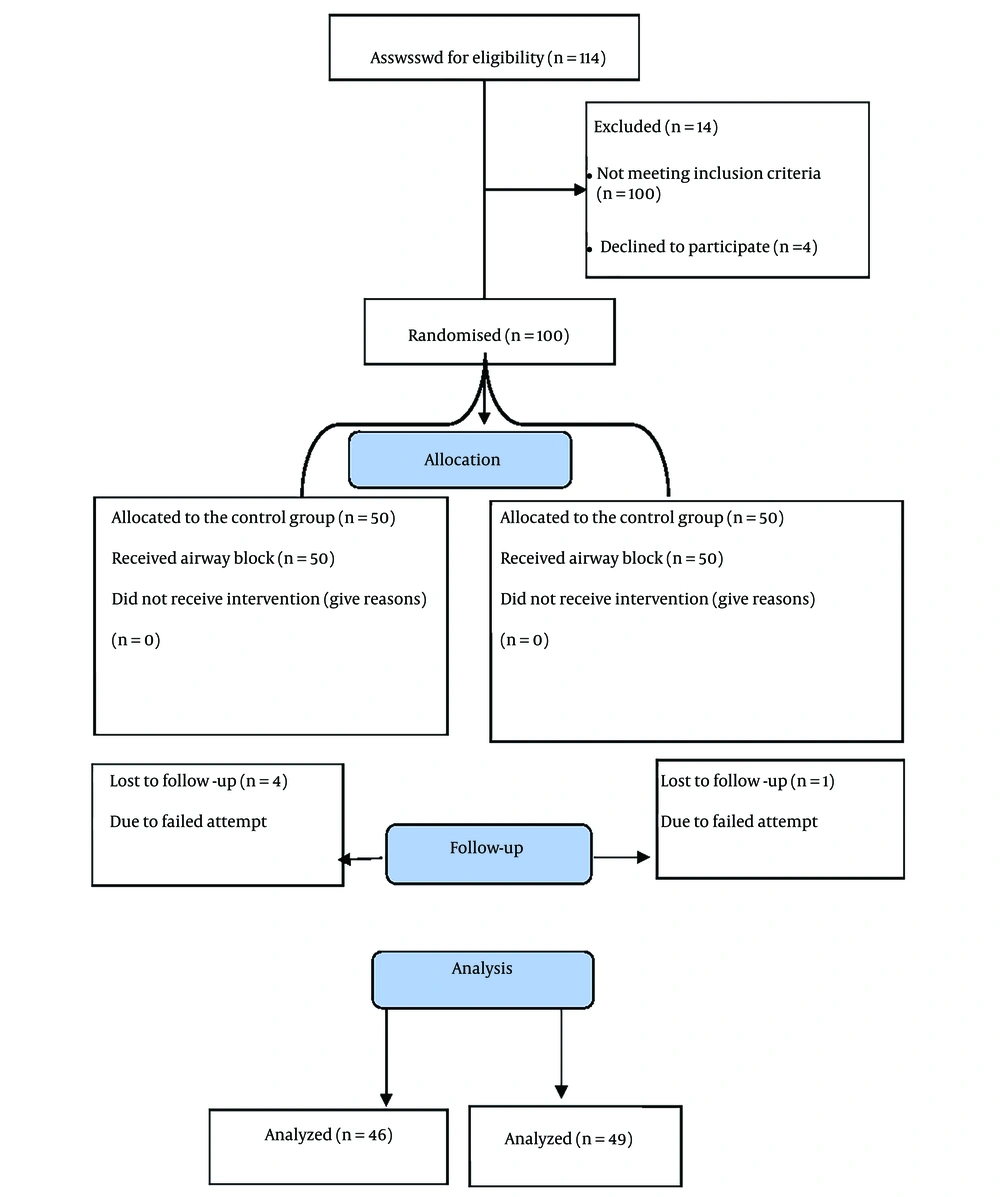
Assessment for eligibility and enrolment of patients
4. Results
Abbreviations: ASA, American Society of Anesthesiologists; AB, airway block; LN, lidocaine nebulization.
a Values are expressed as mean ± SD or Number.
b Measured by an independent t-test.
c Measured by the chi-square test.
| Variables | AB Group; (n = 50) | LN Group; (n = 50) | P-Value |
|---|---|---|---|
| HR before intubation (bpm) | 81.40 ± 11.3 | 80.14 ± 11.7 | 0.590 |
| HR immediately after intubation (bpm) | 107.01 ± 16.5 | 109.28 ± 15.9 | 0.490 |
| HR 5 min later (bpm) | 109.81 ± 15.1 | 100.88 ± 14.3 | 0.003 |
| MAP before intubation (mmHg) | 94.64 ± 10.6 | 97.18 ± 10.6 | 0.242 |
| MAP immediately after intubation (mmHg) | 107.49 ± 13.8 | 110.38 ± 13.1 | 0.293 |
| MAP 5 min later (mmHg) | 87.43 ± 14.1 | 91.43 ± 15.1 | 0.182 |
| SpO2 before intubation (%) | 97.19 ± 1.3 | 97.44 ± 1.3 | 0.342 |
| SpO2 was immediately after intubation (%) | 96.31 ± 1.2 | 96.46 ± 1.4 | 0.543 |
| SpO2 5 min later (%) | 99.09 ± 0.9 | 98.92 ± 1.3 | 0.474 |
Abbreviations: bpm, beat per minute MAP, mean arterial pressure; AB, airway block; LN, lidocaine nebulization; HR, heart rate.
a Values are expressed as mean ± SD.
b P values measured by an independent t-test.
Abbreviations: AB, airway block; LN, lidocaine nebulization.
a Values are expressed as mean ± SD, No. (%), or median (range); AB, airway block; LN, lidocaine nebulization.
b Measured by the independent t-test.
c Measured by the chi-square test.
d Measured by independent-samples Mann–Whitney U test.
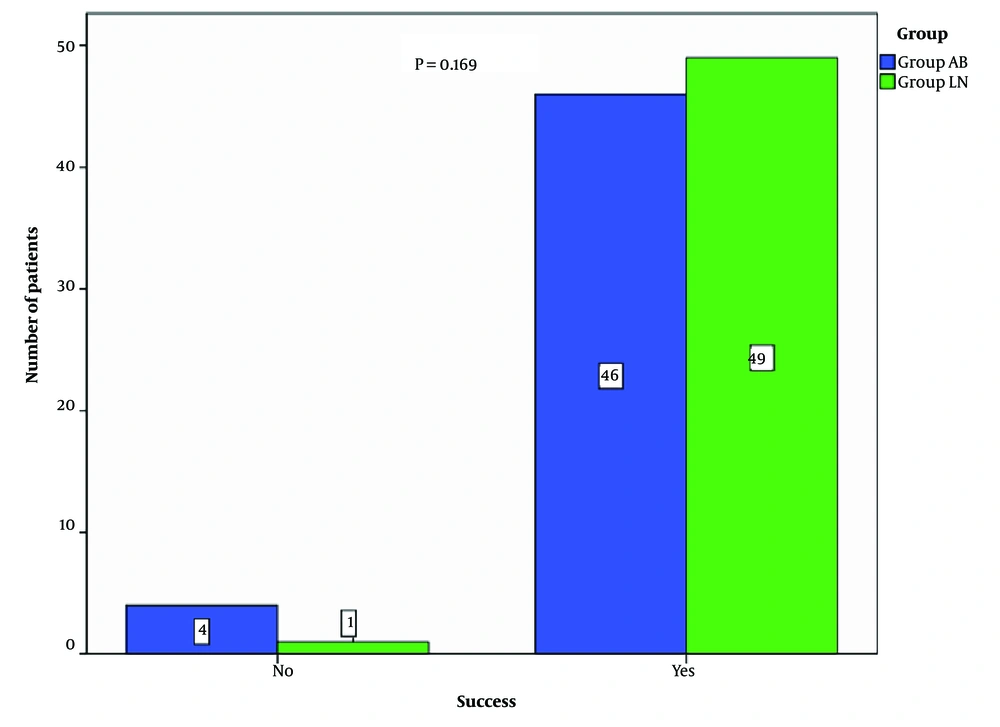
Bar chart comparing the number of successful trials in both groups. The P-value indicates a non-significant difference.
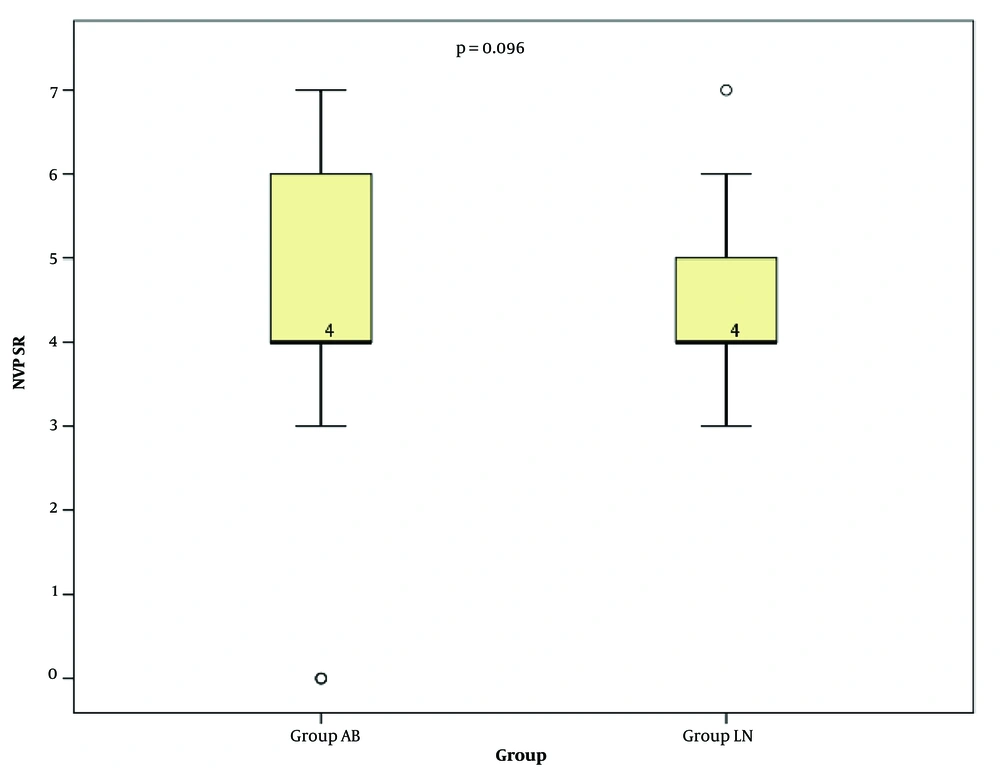
Boxplot comparing the median Nonverbal Pain Scale (NVPS-R) score in both groups. The P-value indicates a non-significant difference.

