


1. Background
2. Objectives
3. Methods
3.1. Study Design and Setting
3.2. Participants
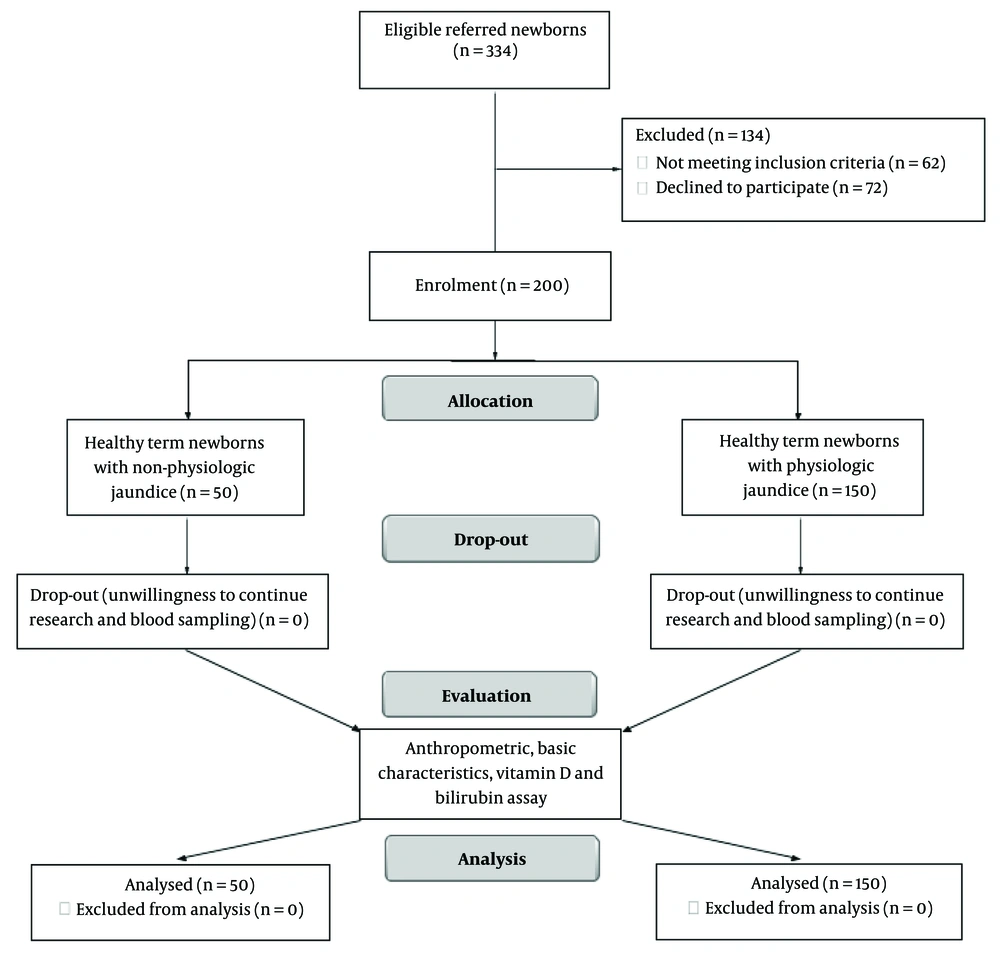
The study’s flow diagram
3.3. Vitamin D and Bilirubin Assays
3.4. Main Outcome Measures
3.5. Statistical Analysis
3.6. Ethics Statement
4. Results
| Variables | Case Group | Control Group | P-Value |
|---|---|---|---|
| Neonates | |||
| Gender | 0.68 | ||
| Boy | 27 (54) | 76 (51) | |
| Girl | 23 (46) | 74 (49) | |
| Age (d) | 4.5 ± 0.59 (3 - 5) | 4.5 ± 0.58 (3 - 5) | 0.96 |
| Weight (kg) | 3.43 ± 0.49 (2.7 - 4.2) | 3.41 ± 0.53 (2.9 - 4.3) | 0.93 |
| Height (cm) | 51.1 ± 1.67 (48 - 54) | 52 ± 1.63 (47 - 55) | 0.87 |
| Bilirubin (ng/dL) | 14.66 ± 1.05 (13.1 - 19) | 9.55 ± 1.28 (7.3 - 11.7) | 0.001 |
| Mothers | |||
| Age (y) | 28.5 ± 2.5 (22 - 33) | 27.5 ± 3.75 (18 - 36) | 0.15 |
| Weight (kg) | 65.12 ± 8.63 (47 - 83) | 63.5 ± 9.21 (47 - 90) | 0.25 |
| Height (cm) | 163.8 ± 5.25 (154 - 175) | 162.8 ± 4.92 (152 - 174) | 0.27 |
| BMI before pregnancy | 24.3 ± 3.66 (18 - 31) | 24.06 ± 3.73 (17 - 36) | 0.81 |
| BMI pregnancy (kg/m2) | 29.27 ± 3.49 (22.49 - 35.69) | 29.1 ± 3.58 (21.61 - 37.73) | 0.85 |
| Weight gain (kg) | 13.5 ± 2.21 (8 - 19) | 13.72 ± 2.07 (8 - 20) | 0.49 |
| Gravid | 1 | ||
| 1 | 20 (40) | 60 (40) | |
| 2 | 29 (58) | 87 (58) | |
| 3 | 1 (2) | 3 (2) | |
| Education | 0.07 | ||
| < Diploma | 18 (36) | 67 (45) | |
| Diploma | 17 (34) | 16 (11) | |
| > Diploma | 15 (30) | 67 (45) | |
| Delivery | |||
| Cesarean | 42 (84) | 110 (73) | |
| Vaginal | 8 (16) | 40 (27) | 0.14 |
Abbreviations: BMI, Body Mass Index; SD, standard deviation.
a There was no significant difference in anthropometrics variables in two groups.
b Values are expressed as mean ± SD (min - max) or No. (%).
| Variables and Correlation | Correlation Coefficient (r) | 95 % CI for (r) Lower to Upper | P-Value b |
|---|---|---|---|
| Case | |||
| Newborn vit D vs. maternal vit D c | 0.74 | 0.544 to 0.857 | 0.01 |
| Newborn Bilirubin vs. maternal vit D d | -0.21 | -0.453 to 0.046 | 0.04 |
| Newborn Bilirubin vs. newborn vit D e | -0.34 | -0.548 to 0.052 | 0.02 |
| Control | |||
| Newborn vit D vs. maternal vitamin D c | 0.77 | 0.67 to 0.89 | 0.01 |
| Newborn Bilirubin vs. maternal vit D d | -0.42 | -0.54 to -0.27 | 0.01 |
| Newborn Bilirubin vs. newborn vit D e | -0.41 | -0.54 to -0.26 | 0.01 |
Abbreviations: Vit, vitamin; CI, confidence interval.
a It seems that vitamin D level in babies and their mothers was significant factor in hyperbilirubinemia of newborns. However, despite reaching statistical significance, these coefficients suggest a weak association.
b P < 0.05 was considered statistically significant.
c Model one, the neonatal vitamin D versus maternal vitamin D, adjusted for neonatal gender, weight, height, age, and bilirubin level and maternal age, weight, height, BMI, delivery type, gravidity, and education.
d Model two, the neonatal bilirubin level versus maternal vitamin D, adjusted for neonatal gender, weight, height, age, and vitamin D, as well as maternal age, weight, height, BMI, delivery type, gravidity, and education.
e Model three, the newborns’ bilirubin levels versus the newborns’ vitamin D levels, adjusted for neonatal gender, weight, height, and age, as well as maternal age, weight, height, BMI, delivery type, gravidity, education, and vitamin D.
| Variables | Case Group | Control Group | Crude OR 95% CI (Lower - Upper) | Adjusted OR 95% CI (Lower - Upper) | P-Value |
|---|---|---|---|---|---|
| Neonates vitamin D (ng/mL) | 27.8 ± 10.04 (12 - 50) | 33.9 ± 9.39 (9 - 65) | 2.63 (1.3 - 5.1) | 1.98 (0.9 - 2.1) | 0.006 |
| < 20 | 14 (28) | 15 (10) | 0.007 | ||
| 20 - 30 | 10 (20) | 20 (13.3) | |||
| > 30 | 26 (52) | 115 (76.7) | |||
| Maternal vitamin D (ng/mL) | 20.56 ± 10.2 (8 - 45) | 26 ± 8.92 (9 - 55) | 2.98 (1.39 - 6.4) | 1.95 (0.89 - 2) | 0.001 |
| < 20 | 30 (60) | 53 (35.3) | 0.006 | ||
| 20 - 30 | 10 (20) | 26 (17.3) | |||
| > 30 | 10 (20) | 71 (47.4) |
Abbreviations: Min, minimum; Max, maximum; SD, standard deviation.
a Values are expressed as mean ± SD (min - max) or No. (%).
b Vitamin D level of babies and their mothers were significantly lower in case group than in the control group (P < 0.05).



