1. Background
Anxiety is defined as the anticipation of an adverse event, while fear is a normal unpleasant psychological reaction to a threat (1, 2). Management of dental fear and anxiety in children is the first and most important step in the successful provision of dental care for children. Dental anxiety can impede dental visits and bring about adverse consequences for both the patient and the dental clinician. It can lead to poor oral health, dental pain, abscess, tooth loss, and malocclusion (3, 4). Anxiety can also cause sleep disturbances, negative thoughts, and low self-esteem (5). Dental anxiety can be due to several factors such as maternal anxiety, lack of knowledge about dental problems, negative dental experiences, and unknown and strange sounds and odors in the dental office setting (6, 7). A previous study reported a higher level of dental pain in children with dental anxiety or a previous history of toothache (8). Another study reported a prevalence of 22.2% for dental anxiety in children (9).
Several techniques are available to control dental anxiety in children, such as the use of sedatives, hypnotics, or tranquilizers (10), behavioral control measures (11), or a combination of both (12). Aromatherapy was also reported to be effective for anxiety control in some patients (13). In highly uncooperative children, general anesthesia may be required if several teeth need to be treated (14).
It has been reported that the majority of 8-year-old Iranian children have one carious permanent tooth, and this number increases to 2 carious permanent teeth by the age of 12 years (15). Thus, caries control is highly important during the mixed dentition period. Evidence shows that better understanding of the factors causing dental fear and anxiety can help prevent them and enhance the quality of care (16). Considering the scarcity of studies on dental fear and anxiety of Iranian children residing in Zahedan city,
2. Objectives
Iran, this study aimed to identify the influential factors on dental fear and anxiety of 8 - 12-year-old children.
3. Methods
This cross-sectional study was conducted on 88 children between 8 - 12 years presenting to a private dental clinic in Zahedan, Iran. The study protocol was approved by the ethics committee of the university (IR.ZAUMS.REC.1400.317).
Eligibility criteria: The inclusion criteria were children between 8 - 12 years, and parental consent for participation in the study. The exclusion criteria were psychological or psychiatric disorders, children with no previous history of dental visits, mental retardation, intake of anxiolytic medications, children with medical experiences such as hospitalization or surgery, children who had not experienced all the procedures mentioned in the questionnaire, and children presenting with pain other than pain due to food impaction. The children were enrolled by convenience sampling.
3.1. Sample Size
The sample size was calculated according to a previous study by Katanec et al. (17) assuming alpha = 0.05, beta = 0.10, and study power of 90% using the sample size calculation formula.
3.2. Data Collection
This study was conducted from January to April 2021. Demographic information including age, gender, birth order, history of dental visits, chief complaint, level of education of the parents, occupation of the parents, and ethnicity was collected. To assess the dental anxiety of children, the Persian version of the Modified Child Dental Anxiety Scale Figurated (MCDASF) was used (18), which is a new version of MCDAS with added faces. It includes 7 questions that assess the children’s feelings towards dental examination, prophylaxis, anesthetic injection, tooth extraction, and tooth restoration. It is scored using a 5-point Likert scale, with 1 indicating no anxiety and 5 indicating a very high level of anxiety. The validity and reliability of the Persian version of this questionnaire were confirmed by Javadinejad et al. (18) with a Cronbach’s alpha of 0.85 and internal consistency of 0.82, indicating its optimal validity and reliability.
The dental fear of children was assessed using the Persian version of the Dental Subscale of the Children’s Fear Survey Schedule (CFSS-DS), which is a standard questionnaire for this purpose (19). It has 15 items that encompass all dental procedures. Each item is scored 1 to 5, and the total score may range from 15 to 75. Scores equal to or higher than 38 indicate the presence of dental fear in children. One question of this questionnaire asked for the reason for stress and fear of children, which had 6 answer choices to identify the reason behind dental fear of children. The validity and reliability of the Persian version of this questionnaire were confirmed by Safari et al. (19) with an agreement percentage of over 80% for all questions, and kappa values of moderate to good, and intraclass correlation coefficient of good and very good (> 0.4) for all questions (20).
The questionnaires were filled out by the researcher after completion of dental treatment of the children. The first question asked for a history of a previous dental visit. Children who had no previous dental visits were excluded and were no longer required to answer the rest of the questions. Also, children who had not experienced one or more procedures mentioned in the questionnaire were asked not to answer the related questions and skip them.
3.3. Statistical Analysis
The normality of data distribution was analyzed by the Shapiro-Wilk test. Accordingly, parametric tests (ANOVA and t-test) were applied for normally distributed data while non-parametric tests were used for non-normally distributed data (Kruskal-Wallis and Mann-Whitney tests). In brief, dental anxiety and dental fear were compared between girls and boys using independent t-test. Independent t-test was also used to compare dental anxiety between different age groups (< or ≥ 10 years) while dental fear was compared using the Mann-Whitney test. Independent t-test was also used to assess the effect of birth order, level of education of the parents, and duration of procedure. ANOVA was applied to compare dental anxiety, and the Kruskal-Wallis test was used to compare dental fear based on the type of procedure. Also, ANOVA with Welch correction was used to assess dental fear based on ethnicity while ANOVA was applied to analyze the association of ethnicity and dental anxiety. P < 0.05 was considered statistically significant.
4. Results
4.1. Demographics
A total of 88 children between 8 - 12 years were evaluated, including 44 girls (50%) and 44 boys (50%). The 8-year-old children had the highest frequency (44.3%) while 11-year-old children had the lowest frequency (4.5%). The mean age of children was 9.12 ± 1.31 years (range 8 - 12 years). Also, the majority (50%) of the children were the first child, and the fifth child had the lowest frequency (1.1%). Mothers with university education had the highest frequency (53.4%) while illiterate mothers had the lowest frequency (4.5%). Also, fathers with university education had the highest frequency (58%) while illiterate fathers had the lowest frequency (3.4%). Most mothers (64.8%) were housewives while businesswomen had the lowest frequency (6.8%). Most fathers were employees (62.2%) while retired fathers had the lowest frequency (1.1%). Of all children, 28.4% were Balouch, 37.5% were Sistani, and 34.1% had other ethnicities.
Of all children, 50% required pulpectomy, pulpotomy, or stainless-steel crown, 31.8% required restoration or fissure sealant therapy, and 13.6% required tooth extraction. The majority of the procedures (28.4%) took 45 minutes.
4.2. Dental Fear and Anxiety
The mean dental fear and dental anxiety scores were 11.45 ± 7.55 (range 1 - 40) and 8.13 ± 4.66 (range 0 - 18), respectively.
Gender: As shown in Table 1, girls and boys had no significant difference in dental anxiety. However, dental fear was significantly higher in girls than boys (P < 0.001).
Table 1.
Mean Dental Fear and Dental Anxiety Scores of Children Based on Their Gender, Age and Birth Order
| Variables | Dental Anxiety | Dental Fear |
|---|---|---|
| Gender | ||
| Female | ||
| Mean ± SD | 8.86 ± 4.35 | 14.59 ± 8.8 |
| 95% CI | 7.53 - 10.18 | 11.91 - 17.26 |
| Male | ||
| Mean ± SD | 7.40 ± 4.89 | 8.50 ± 4.37 |
| 95% CI | 5.92 - 8.89 | 7.16 - 9.83 |
| P-value | 0.15 | < 0.001 |
| Age (y) | ||
| < 10 | ||
| Mean ± SD | 7.40 ± 4.24 | 11.41 ± 7.96 |
| 95% CI | 6.30 - 8.49 | 9.35 - 13.47 |
| ≥ 10 | ||
| Mean ± SD | 9.71 ± 5.19 | 11.82 ± 6.72 |
| 95% CI | 7.70 - 11.72 | 9.21 - 14.42 |
| P-value | 0.03 | 0.45 |
| Birth order | ||
| First child | ||
| Mean ± SD | 6.77 ± 4.59 | 10.65 ± 6.99 |
| 95% CI | 5.37 - 8.17 | 8.53 - 12.78 |
| Other | ||
| Mean ± SD | 9.50 ± 4.36 | 12.43 ± 8.06 |
| 95% CI | 8.17 - 10.82 | 9.98 - 14.88 |
| P-value | 0.005 | 0.27 |
Age: As shown in Table 1, children ≥ 10 years had a significantly higher dental anxiety than those < 10 years (P = 0.03). No significant difference was found between the two groups in dental fear (P = 0.45).
Birth order: As shown in Table 1, children who were not the first child had a significantly higher dental anxiety than children who were the first child (P = 0.005). However, the two groups had no significant difference in dental fear (P = 0.27).
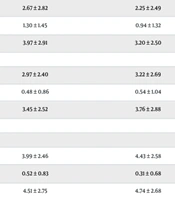
Father and mother’s educational level: Table 2 presents the mean dental fear and dental anxiety scores of children based on the educational level of mothers and fathers. As shown, no significant association was found between the father’s level of education with dental anxiety (P = 0.96) or dental fear (P = 0.63) of their children. The same was true about the mother’s level of education (P = 0.8 and P = 0.93, respectively).
Table 2.
Mean Dental Fear and Dental Anxiety Scores of Children Based on Educational Level of Mothers and Fathers
| Educational Level | Dental Anxiety | Dental Fear |
|---|---|---|
| Father | ||
| Illiterate-below high-school | ||
| Mean ± SD | 8.10 ± 4.39 | 11.08 ± 6.95 |
| 95% CI | 6.64 - 9.57 | 8.76 - 13.40 |
| University education | ||
| Mean ± SD | 8.15 ± 4.89 | 11.88 ± 8.01 |
| 95% CI | 6.78 - 9.53 | 9.62 - 14.13 |
| Mother | ||
| High-school diploma and below high-school diploma | ||
| Mean ± SD | 8.26 ± 4.31 | 11.46 ± 7.07 |
| 95% CI | 6.90 - 9.63 | 9.23 - 13.69 |
| University education | ||
| Mean ± SD | 8.02 ± 4.98 | 11.61 ± 8.03 |
| 95% CI | 6.55 - 9.48 | 9.25 - 13.97 |
| P-value | 0.96 | 0.63 |
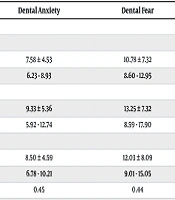
Type and duration of procedure: Table 3 shows the mean dental fear and anxiety scores of children based on the type and duration of dental procedure. As shown, dental anxiety (P = 0.45) and dental fear (P = 0.44) had no significant association with the type of procedure. Dental anxiety (P = 0.27) and dental fear (P = 0.64) were not significantly different between children who underwent procedures shorter and longer than 30 minutes.
Table 3.
Mean Dental Fear and Anxiety Scores of Children Based on the Type and Duration of Dental Procedure
| Variables | Dental Anxiety | Dental Fear |
|---|---|---|
| Type of procedure | ||
| Pulpectomy, pulpotomy, SCC | ||
| Mean ± SD | 7.58 ± 4.53 | 10.78 ± 7.32 |
| 95% CI | 6.23 - 8.93 | 8.60 - 12.95 |
| Restoration, fissure sealant therapy | ||
| Mean ± SD | 9.33 ± 5.36 | 13.25 ± 7.32 |
| 95% CI | 5.92 - 12.74 | 8.59 - 17.90 |
| Extraction | ||
| Mean ± SD | 8.50 ± 4.59 | 12.03 ± 8.09 |
| 95% CI | 6.78 - 10.21 | 9.01 - 15.05 |
| P-value | 0.45 | 0.44 |
| Duration of procedure (min) | ||
| < 30 | ||
| Mean ± SD | 8.63 ± 4.59 | 11.20 ± 6.41 |
| 95% CI | 7.31 - 9.95 | 9.36 - 13.04 |
| > 30 | ||
| Mean ± SD | 7.51 ± 4.72 | 11.97 ± 8.85 |
| 95% CI | 5.97 - 9.04 | 9.10 - 14.84 |
| P-value | 0.27 | 0.64 |
Ethnicity: Ethnicity had no significant association with dental fear (P = 0.26) or dental anxiety (P = 0.96).
5. Discussion
This study assessed the influential factors on dental fear and anxiety of 8 - 12-year-old children. The results showed no significant difference between girls and boys in dental anxiety; however, dental fear was significantly higher in girls. Socially and culturally, it is more acceptable for girls to express fear, while boys are usually taught to hide their negative emotions. Similarly, Alshoraim et al. (21) reported higher dental fear in girls than boys. Kothari and Gurunathan (22) demonstrated that girls had higher dental anxiety than boys. Murad et al. (16), in their review study, found a significant association between gender and dental fear and anxiety. However, Gao et al. (23) found no significant association between dental fear and gender of 5 to 12-year-old children using the CFSS-DS. Also, Son et al. (24) assessed the relationship of dental fear and incipient caries in 7-year-old children and reported a similar level of dental fear in girls and boys. Variations in the reported results can be due to using different instruments for quantification of dental fear and anxiety. Differences in sample size and study design, and presence of confounding factors can also explain the differences in the results.
In the current study, dental anxiety in children ≥ 10 years was significantly higher than that in children < 10 years. However, dental fear was not significantly different between the two age groups. The results also showed that dental anxiety was higher in children over 10 years of age than in younger children. This could be due to cognitive development and greater awareness of the nature of dental treatments and the possibility of pain in this age group. Previous negative experiences, hearing stories and warnings from others, and a greater ability to mentally imagine unpleasant situations can also exacerbate this anxiety. In addition, with age, sensitivity to judgment and self-consciousness increases, which may increase anxiety in medical settings. Dental anxiety is highly common among children, and age is a determining factor of dental anxiety. Dental anxiety may continue into adulthood and adversely affect the oral health-related quality of life of individuals. Murad et al. (16) confirmed the association of dental anxiety and age. Also, Alshoraim et al. (21) reported a higher level of dental fear in younger children. Gao et al. (23) showed that dental fear and anxiety of 8 - 10-year-old children decreased as they aged. However, Sathyaprasad et al. (25) found no significant association between age and dental anxiety of children. Another study showed that dental anxiety in children was mainly physiological rather than psychological; therefore, age cannot serve as an important factor in the generation of anxiety (26).
The present study showed a significantly lower dental anxiety level in children who were the first child, compared with others. However, dental fear had no significant association with birth order. The present study also showed that dental anxiety was lower in firstborns. This finding can be explained based on the personality characteristics and developmental experiences of firstborns. Firstborns usually acquire more stress coping skills due to their role as role models for younger siblings. Also, in the early years of life, parents pay more attention and support to the firstborn, which can strengthen the sense of security and self-confidence. On the other hand, firstborns are less likely to transmit fear through observing negative reactions from older siblings, while subsequent children may learn this fear from the family environment. The role of birth order as a possible influential factor on the behavior of children in the dental office has been largely neglected and needs further investigations. Aminabadi et al. (27) indicated that children who were the first child or the only child were more likely to show adverse behaviors in the dental office setting. Ghaderi et al. (28) assessed the effect of birth order on children’s behavior in the dental office setting and reported less likelihood of optimal cooperation of children who were the only child. According to Wu and Gao (29), single-parent family and having siblings are important determinants of dental fear and anxiety of children. Unlike the abovementioned studies, the present results showed lower dental fear and anxiety in children who were the first child.
Level of education of the parents had no association with dental fear or anxiety of children in the present study, which was similar to the results of Ghasempour et al. (30). Also, Kothari and Gurunathan (22) stated that the social level of the family did not affect the anxiety of children (22). However, Amorim Junior et al. (31) found an association between dental anxiety of children and level of education of mothers. Shin et al. (32) emphasized the significance of communicating with the parents and their suitable educational level to decrease dental anxiety of children. It should be noted that small sample size and variations in grading of educational level of the parents do not allow precise comparison of the results of different studies.
Type of procedure, duration of procedure, and ethnicity had no significant association with dental fear or anxiety in the present study. Consistent with the present results, Kothari and Gurunathan (22) showed no significant effect of type of treatment on dental anxiety of children. Piano et al. (33) reported that gender, age, and type of procedure had no significant effect on dental anxiety of children. Nilchiyan and Mohammadi (34) reported maximum fear during anesthetic injection and minimum fear during dental prophylaxis. Alshoraim et al. (21) demonstrated that dental fear was correlated with previous painful dental experiences and negative behaviors during dental examination. Considering the multi-dimensional nature of dental fear and anxiety, precise comparison of the results of different studies is not possible.
Evaluation of both dental fear and anxiety and assessment of all parameters by the same researcher were the main strengths of the present study. Also, the children did not have pain and were not agitated when answering the questions.
Cross-sectional design was a limitation of this study, which does not allow finding a causal relationship, and limits the generalizability of the findings. Controlled longitudinal studies are required to identify factors influencing dental fear and anxiety. Future studies are recommended with a larger sample size to analyze the relationship of dental fear and anxiety with parents’ fears and parenting style.
5.1. Conclusions
Children ≥ 10 years and those who were not the first child had a higher level of dental anxiety than others. Girls had a significantly higher dental fear than boys.