
1. Background
Magnetic resonance imaging (MRI) is a safe procedure in children. However, the accuracy of the images depends on the child’s immobility and cooperation. The MRI can cause moderate to severe anxiety in children due to separation from parents, lack of familiarity with the environment and medical staff, fear of enclosed spaces, lying down, and loud noises. Anxiety and agitation in children during imaging prevent the acquisition of high-quality images and disrupt the diagnosis and treatment process (1, 2). Statistics from the annual imaging dataset show that from 2014 to 2020, there was a 35.4% increase in children undergoing MRI scans. Given the increasing use of MRI in diagnosing pediatric diseases, the need for sedation during MRI is expanding (3). To obtain the best quality images, the child must be completely still, which requires effective and adequate preparation of the child before imaging begins. Research has shown that children with attention and adaptation disorders experience more anxiety and difficulties (4). In infants, when the baby is fed and asleep, there is no problem during imaging. However, in older children, moderate sedation is required, in which the child is drowsy but can be awakened (5). The American Academy of Pediatrics (AAP) defines the goals of sedation in children as follows: To protect their safety and well-being, to minimize physical discomfort, and to control anxiety and agitation to complete the procedure (6). In the field of pediatric sedation, studies have also examined non-pharmacological methods such as parental presence (7). A number of these studies have reported unsuccessful results (8, 9). These studies often report that non-pharmacological methods have only been able to reduce the need for anesthetic drugs (3, 10, 11). There is strong evidence that pediatric MRI sedation can be administered safely when guided by standardized protocols and by trained anesthesiologists (12). Recent studies demonstrate that many parents and physicians still refuse to accept pediatric sedation due to fear of side effects, indicating the need for such studies (13). It should be noted that physicians’ knowledge alone is not enough and effective, because what matters is what they do in real clinical situations. Studies have shown that this issue is influenced by the socioeconomic status of societies. In poorer countries, this issue is less addressed (14). Additionally, in order to provide sedation to children, legal issues, including the need to obtain informed consent, must be considered, so parental awareness and attitude are also important (2). Studies have shown unique challenges in this process (15).
2. Objectives
To the best our knowledge, no study has been conducted in this field in Iran. The present study was designed to obtain accurate information about the attitudes of parents and radiologists toward performing sedation for children in MRI.
3. Methods
First, the study protocol was approved by the Institutional Ethical Committee of Guilan University of Medical Sciences (GUMS), receiving the ethics code ID: IR.GUMS.REC.1403.331. This descriptive cross-sectional study was then conducted in the radiology departments of university hospitals and private centers in Rasht, Iran. The study population consisted of all parents of children referred to the mentioned sectors and involved radiologists. Two researcher-made questionnaires were designed to assess attitudes towards pediatric sedation during MRI. The first questionnaire included 7 items for parents, and the second consisted of 9 questions for radiologists. The content validity of the questions was examined by surveying 10 faculty members from the radiology and anesthesia departments, and the content validity ratio (CVR) for all questions was above 0.62. Regarding reliability, 30 questionnaires were filled out via direct interviews, and Cronbach’s alpha was 0.72.
3.1. Statistical Analysis
The collected data were entered into SPSS version 21 software. Descriptive statistics such as mean, standard deviation, frequency, and frequency percentage were used to describe the results. The chi-square test and Fisher’s exact test were used to analyze the results. The significance level of statistical tests was considered less than 0.05.
4. Results
Finally, data from 110 parents, with a mean age of 37.94 ± 8.1 years, were analyzed. Parental demographic data and their sources of information are shown in Table 1. Additionally, 56.4% knew about the availability of pediatric sedation for imaging, while 58.2% were willing to receive sedation for their child. Furthermore, 75.5% believed that sedation was harmful to their child, and 80.9% declared that the stressful experience during imaging had a negative impact on their child. The internet was the main source of their information, while 60.9% believed that public media was the most effective. The frequency of parents’ answers to the questions assessing their knowledge about pediatric sedation is shown in Table 2.
Table 1.
Parents’ Demographic Data and Their Source of Information
| Variables | No. (%) |
|---|---|
| Gender | |
| Male | 39 (35.5) |
| Female | 71 (64.5) |
| Age | |
| < 40 | 73 (66.4) |
| > 40 | 37 (33.6) |
| Mean ± SD (range) | 37.94 ± 8.1 (23 - 53) |
| Educational level | |
| Under diploma | 14 (12.7) |
| Diploma | 50 (45.5) |
| University | 46 (41.8) |
| Residency | |
| Urban | 102 (92.7) |
| Rural | 8 (7.3) |
| Information sources | |
| Medical team | 18 (16.4) |
| Internet | 65 (59.1) |
| Friends | 20 (18.2) |
| Media | 7 (6.4) |
Table 2.
The Frequency of Parents’ Answers to the Questions Assessing Their Knowledge About Pediatric Sedation
| Questions and Options | No. (%) |
|---|---|
| Are you aware of the possibility of imaging under sedation or anesthesia? | |
| Yes | 62 (56.4) |
| No | 24 (21.8) |
| Don’t know | 24 (21.8) |
| Would you prefer sedation or anesthesia for your child during imaging? | |
| Yes | 64 (58.2) |
| No | 34 (30.9) |
| Don’t know | 12 (10.3) |
| Which sedation method do you prefer for your child? | |
| Oral medication | 25 (22.7) |
| Injectable | 6 (5.5) |
| Inhalation | 9 (8.2) |
| Non-pharmacological | 70 (63.6) |
| Do you believe anesthesia drugs for imaging could endanger your child? | |
| Yes | 83 (75.5) |
| No | 8 (7.3) |
| Don’t know | 19 (17.3) |
| In your opinion, what is the most effective way to raise awareness about pediatric sedation in dentistry? | |
| Public media | 67 (60.9) |
| Newspapers and magazines | 6 (5.5) |
| Internet | 37 (33.6) |
| Can a negative experience of fear and anxiety during imaging have side effects on your child? | |
| Yes | 89 (80.9) |
| No | 6 (5.5) |
| Don’t know | 15 (13.6) |
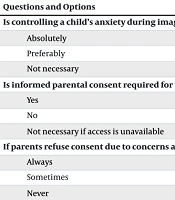
Thirty radiologists from governmental and private sectors, with a mean age of 38.7 ± 9.29 years and 10.46 ± 7.59 years of experience, participated in the survey (Table 3). The frequency of radiologists’ answers regarding their attitude towards pediatric sedation is shown in Table 4. Of the radiologists, 53.3% stated that controlling a child’s anxiety during imaging was absolutely necessary, and 66.7% stated that if parents refused to accept sedation for their child due to concerns about the side effects of anesthesia, efforts were made to inform them about the adverse effects of anxiety and its psychological damage, which were considered much worse and more harmful. Additionally, 16.7% were very knowledgeable about possible complications of pediatric sedation.
Table 3.
Radiologists’ Characteristics and Their Working Section
| Variables | No. (%) |
|---|---|
| Gender | |
| Male | 14 (46.7) |
| Female | 16 (53.3) |
| Age | |
| < 40 | 19 (63.3) |
| > 40 | 11 (36.7) |
| Mean ± SD (range) | 38.7 ± 9.29 (28 - 61) |
| Years of experience | |
| ≤ 10 | 18 (60.0) |
| 10 - 20 | 8 (26.7) |
| > 20 | 4 (13.3) |
| Mean ± SD (range) | 10.46 ± 7.59 (2 - 26) |
| Working section | |
| Private | 15 (50.0) |
| Governmental/academic | 15 (50.0) |
Table 4.
The Frequency of Radiologists’ Answers Assessing Their Attitude Towards Pediatric Sedation
| Questions and Options | No. (%) |
|---|---|
| Is controlling a child’s anxiety during imaging necessary? | |
| Absolutely | 16 (53.3) |
| Preferably | 14 (46.7) |
| Not necessary | 0 (0) |
| Is informed parental consent required for using anesthetic drugs? | |
| Yes | 29 (96.7) |
| No | 1 (3.3) |
| Not necessary if access is unavailable | 0 (0) |
| If parents refuse consent due to concerns about anesthetic side effects, do you discuss the psychological effects of anxiety with them? | |
| Always | 20 (66.7) |
| Sometimes | 10 (33.3) |
| Never | 0 (0) |
| What is your opinion about the neurotoxicity of anesthetic drugs? | |
| The risk doesn’t occur with single use | 13 (43.3) |
| Should never be used in children under 4 years | 2 (6.7) |
| Safe | 15 (50) |
| Who do you think should perform pediatric sedation? | |
| Specialist | 24 (80) |
| Resident | 3 (10) |
| Technician | 3 (10) |
| Has your center developed a specific protocol for pediatric sedation? | |
| Yes | 4 (13.3) |
| No but is done | 8 (26.7) |
| Sedation is not performed | 18 (60) |
| How knowledgeable are you about potential side effects of pediatric sedation? | |
| Very knowledgeable | 5 (16.7) |
| Moderately knowledgeable | 13 (43.3) |
| No knowledge | 12 (40) |
| Who performs pediatric sedation for imaging procedures at your center? | |
| Radiologist | 4 (19) |
| Anesthesiologist | 12 (57.1) |
| Mobile nurse | 5 (23.8) |
| Does your center frequently encounter poor-quality images in pediatric imaging? | |
| Very often | 4 (18.2) |
| Sometimes | 10 (45.5) |
| Rarely | 8 (36.4) |
Finally, as Table 5 presents, the data were compared between private and university sectors, revealing a significant difference regarding the availability of specific protocols for pediatric sedation in their centers (P = 0.006).
Table 5.
The Relationship Between the Radiologists’ Working Section and Their Attitude and Performance Regarding Pediatrics’ Sedation a
| Questions and Options | Private Sector | Academic Sector | P-Value |
|---|---|---|---|
| Is controlling a child’s anxiety during imaging necessary? | 0.464 | ||
| Absolutely | 7 (46.7) | 9 (60) | |
| Preferably | 8 (53.3) | 6 (40) | |
| Not necessary | 0 (0) | 0 (0) | |
| Is informed parental consent required for anesthetic drugs? | 0.309 | ||
| Yes | 14 (93.3) | 15 (100) | |
| No | 1 (6.7) | 0 (0) | |
| Not necessary if unavailable | 0 (0) | 0 (0) | |
| If parents refuse consent due to anesthetic concerns, do you discuss psychological effects of anxiety? | 1.0 | ||
| Always | 10 (66.7) | 10 (66.7) | |
| Sometimes | 5 (33.3) | 5 (33.3) | |
| Never | 0 (0) | 0 (0) | |
| What is your opinion about anesthetic neurotoxicity? | < 0.001 | ||
| No risk with one exposure | 2 (13.3) | 11 (73.3) | |
| Should never be used in children < 4 years | 0 (0) | 2 (13.3) | |
| Safe | 13 (86.7) | 2 (13.3) | |
| Who should perform pediatric sedation? | 0.397 | ||
| Specialist | 13(86.7) | 11(73.3) | |
| Resident | 2(13.3) | 1(6.7) | |
| Technician | 0(0) | 3(20) | |
| Has your center developed a pediatric sedation protocol? | 0.006 | ||
| Yes | 0 (0) | 4 (26.7) | |
| No but is done | 2 (13.3) | 6 (40) | |
| Sedation is not performed | 13 (86.7) | 5 (33.3) | |
| How much do you know about pediatric sedation side effects? | 0.242 | ||
| Completely | 1 (6.7) | 4 (26.7) | |
| Partly | 6 (40) | 7 (46.7) | |
| No information | 8 (53.3) | 4 (26.7) | |
| Who performs pediatric sedation for imaging at your center? | 0.004 | ||
| Radiologist | 4 (57.1) | 0 (0) | |
| Anesthesiologist | 3 (42.9) | 9 (64.3) | |
| Technician or nurse | 0 (0) | 5 (35.7) | |
| Does your center encounter poor-quality pediatric images? | 0.03 | ||
| Very often | 0 (0) | 4 (28.6) | |
| Some times | 2 (25) | 8 (57.1) | |
| Rarely | 6 (75) | 2 (14.3) |
a Values are expressed as No. (%).
5. Discussion
The crucial topic of anesthesia in young children and its consideration has been discussed and addressed (16, 17). However, depriving a child of sedation and analgesia can have serious complications, and institutionalizing this practice requires team cooperation. In the first stage, the child's parents must have a positive attitude and be receptive to this intervention to cooperate with the treatment team. However, studies show that parents often refuse sedated scans if possible, citing fears such as anesthesia exposure (18). Radiologists also acknowledge the potential side effects and risks of sedation in pediatrics but accept it due to the importance of image quality (19). It is important that doctors’ act based on their knowledge and beliefs. In fact, the correspondence of knowledge, awareness, belief, and practice is important. Additionally, the anesthesiologist must be interested in this field. It is evident that pediatric anesthesia comes with its own challenges. Previous research has not yielded promising results regarding the awareness and attitudes of society towards the neurotoxicity of anesthetic drugs (16, 20). Given the importance of the subject, numerous studies have investigated the safety and efficacy of anesthetic drugs to provide sedation in children (21, 22).
In line with the present study, Thimmegowda et al. showed that parents were often unaware of the possibility of sedation in pediatric diagnostic and therapeutic procedures. They emphasized the importance of providing information in this area (23). In another study from Saudi Arabia that investigated the satisfaction and acceptance of parents in pediatric sedation in dentistry, it was reported that most parents had a positive attitude towards this method (24). In another study conducted on an oncology population, most parents did not have a favorable attitude towards pediatric sedation. They often believed that their child should not be exposed to anesthetic drugs (13). In the study by Gardling and Mansson, both children and their parents were questioned about MRI challenges and their fears. Children were severely stressed from being in a closed space in a lying and motionless position and stated that the presence of parents could reduce their anxiety. Parents stated that the biggest cause of their anxiety was the lack of information and reassurance from the treatment team (25).
As mentioned, in pediatric dentistry, most parents were willing to have sedation during procedures, while in the field of oncology, parents had more fear and anxiety about anesthetics. Indeed, parents of healthy children were more cooperative, which shows that the study population is a vital influential factor. In a study from India, Bhandari et al. examined parents’ awareness, knowledge, and attitudes toward sedation during dental procedures. This study included 350 subjects. Parents with higher education, especially those with a university degree, considered sedation to be appropriate and safe for their child's dental care. Seventy-eight percent of parents were willing to be with their child during sedation. Overall, 50% of parents agreed that they preferred their child to be sedated during the procedure. Also, the level of education of parents was directly related to the acceptance of the issue that sedation in children is safe (26).
Studies show that the results are not consistent. Communication strategies with parents, cultural and communicative complexities, the level of literacy, social status of the community, personal experience, and the importance that public health policymakers attach to this issue are all influential factors (13, 27, 28).
5.1. Conclusions
This study revealed that efforts should be made by health policymakers to enhance the knowledge of parents about pediatric sedation in imaging. Moreover, the situation in radiology departments needs improvement in some aspects, especially in developing a standard and practical protocol for pediatric sedation.
5.2. Limitations
It can be assumed that parents who did not participate in the survey or refused to continue answering the questions at the beginning of the interview were those with lower literacy levels. As a result, it is conceivable that the level of awareness of the community on this issue is probably lower than what was detected in this study.