
1. Background
Fever is one of the most common reasons for pediatric visits, representing a substantial proportion of outpatient and emergency encounters. In most children, the cause of fever can be identified clinically; however, approximately 5 - 7% of febrile children present without any focal signs at their initial assessment. These cases are classified as fever without focus (FWF). Fever without focus is clinically challenging because the spectrum of underlying causes ranges from benign viral infections to potentially serious bacterial infections (SBI). Missing early-stage bacterial illness is a concern, yet excessive testing and antibiotic use in self-limiting viral illnesses expose children to harm and contribute to antimicrobial resistance (1). Only a limited number of studies have investigated FWF across a broad pediatric age range. Understanding patterns in etiology, diagnostic evolution, and outcomes is crucial to improving clinical management strategies (2).
2. Objectives
The aim of this study was: (1) To determine the causes and seasonal distribution of FWF in children, (2) to identify the diagnostic evolution and outcomes of these cases, and (3) to propose rational, age-stratified management recommendations based on observed patterns.
3. Methods
3.1. Study Design and Setting
This cross-sectional descriptive study was conducted at a tertiary pediatric outpatient and ambulatory clinic in Southern Iran between January 2015 and December 2023.
3.2. Eligibility Criteria
3.2.1. Inclusion Criteria
- Age 0 - 15 years.
- Fever ≤ 10 days (reported or measured).
- No focal findings on thorough clinical examination.
- Normal urinalysis and a negative urine culture.
3.2.2. Exclusion Criteria
- Known immunodeficiency.
- Chronic immunosuppressive illness.
- Recent major surgery.
- Clear infectious source at presentation.
3.3. Patient Selection and Sampling
All consecutive children who met the inclusion criteria were enrolled. Cases were identified using clinic electronic records and fever-related diagnostic codes. Because all eligible cases were included, no prior sample size calculation was required.
3.4. Data Collection
Data were collected using a standardized form and included:
- Demographic information.
- Duration of fever.
- Season of presentation.
- Complete blood count (CBC), C-reactive protein (CRP), procalcitonin (when available).
- Urinalysis and urine culture.
- Additional test results [e.g., throat culture, viral polymerase chain reaction (PCR) when available].
- Final diagnosis after follow-up.
- Time to defervescence.
3.5. Follow-up Protocol
A structured follow-up was implemented:
- 24 - 72-hour clinic revisit or telephone follow-up.
- Day 7 evaluation.
- Immediate return if symptoms worsened.
- Infants < 28 days or clinically unwell children were hospitalized until cultures finalized.
3.6. Age-Stratified Management
3.6.1. < 28 Days (Neonates)
- Full sepsis work-up [blood, urine, cerebrospinal fluid (CSF)].
- Hospital admission.
- Empirical intravenous (IV) antibiotics.
3.6.2. 28 - 90 Days
- Low-risk infants: Outpatient management + close monitoring.
- High-risk infants: Lumbar puncture, cultures, empiric ceftriaxone, or admission.
3.6.3. > 90 Days
- Well-appearing, immunized children: Observation with safety-net advice.
- Concerning symptoms / abnormal laboratory results: Targeted testing.
3.7. Statistical Analysis
Descriptive statistics were performed. Proportions were compared using chi-square or Fisher’s exact tests. Continuous variables were analyzed with t-tests or Mann-Whitney U tests as appropriate. A two-sided P-value < 0.05 was considered significant.
3.8. Ethics
Ethical approval was granted (IR.SUMS.REC.1401.311). Written informed consent was obtained from parents or legal guardians.
4. Results
4.1. Demographic Characteristics
A total of 384 children met criteria for FWF (Table 1). Of these, 49.4% were male and 50.5% female. Half of all children were under 2 years old, and 85% were below 5 years (Table 2).
Table 1.
Overview of Febrile and Fever Without Focus Cases (2015 - 2023)
| Categories | No. (%) |
|---|---|
| Total children referred | 23,775 |
| Illness visits | 16,325 (68.6) |
| Febrile children | 6,245 (38.2) |
| FWF cases | 384 (6.1) |
Abbreviation: FWF, fever without focus.
Table 2.
Sex and Age Distribution of Fever Without Focus Cases
| Variables | No. (%) |
|---|---|
| Gender | |
| Male | 190 (49.4) |
| Female | 194 (50.5) |
| Age | 43 (11.1) |
| < 6 (mo) | |
| 6 - 12 (mo) | 54 (14) |
| 12 - 24 (mo) | 96 (25) |
| < 2 (y) total | 193 (50.2) |
| 2 - 5 (y) | 135 (35.1) |
| 5 - 15 (y) | 56 (14.5) |
4.2. Seasonal Distribution
Fever without focus cases demonstrated clear seasonality, with 63% occurring in warm seasons (spring and summer). Detailed seasonal breakdown is shown in Table 3.
Table 3.
Seasonal Distribution of Fever Without Focus Cases
| Seasons | No. (%) |
|---|---|
| Spring | 100 (26) |
| Summer | 142 (36.9) |
| Fall | 86 (22.3) |
| Winter | 56 (14.5) |
| Warm seasons (spring summer) | 242 (63) |
4.3. Final Diagnoses
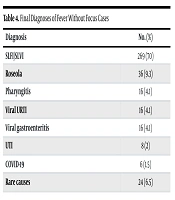
Final diagnoses are summarized in Table 4. Most cases (70%) were due to self-limited viral syndromes, followed by roseola (9.3%), pharyngitis (4.1%), viral upper respiratory tract infection (URTI, 4.1%), and viral gastroenteritis (4.1%). Less common etiologies included urinary tract infections (2%) and COVID-19 (1.5%). Our data (Tables 1 - 4) show that most children with FWF have viral and self-limiting illnesses, consistent with global literature.
Table 4.
Final Diagnoses of Fever Without Focus Cases
| Diagnosis | No. (%) |
|---|---|
| SLFI/SLVI | 269 (70) |
| Roseola | 36 (9.3) |
| Pharyngitis | 16 (4.1) |
| Viral URTI | 16 (4.1) |
| Viral gastroenteritis | 16 (4.1) |
| UTI | 8 (2) |
| COVID-19 | 6 (1.5) |
| Rare causes | 24 (6.5) |
4.4. Time to Defervescence
Approximately 75% of children became afebrile within 72 hours.
5. Discussion
This study provides a comprehensive analysis of FWF in children and demonstrates that most cases are viral and self-limiting, consistent with global findings. Only a small proportion of children had bacterial disease warranting antibiotic treatment.
5.1. Definition and Importance of Age
Our definition aligns with accepted criteria: Fever ≤ 10 days, no focal findings, and normal urine studies. Age stratification is essential because the risk of serious bacterial infection (SBI) is highest in infants < 90 days.
5.2. Diagnostic Evolution
Conditions such as otitis media, group A streptococcal pharyngitis, and pneumonia may not be detectable initially but become apparent within 24 - 48 hours. Our structured follow-up minimized missed diagnoses while preventing unnecessary empirical treatment.
5.3. Comparison with Previous Research
- Viral etiologies consistently account for 70 - 80% of FWF cases.
- Urinary tract infection (UTI) incidence (2%) aligns with published data.
- Roseola accounted for approximately 10% of infant cases, similar to global figures.
5.4. Implications for Management (3-7)
This study supports:
- Limiting antibiotic use to confirmed or strongly suspected bacterial infections.
- Routine urine testing in infant girls and uncircumcised boys.
- Adopting age-based risk assessment.
- Structured follow-up to ensure diagnostic accuracy.
5.5. Strengths
- Large sample.
- Multiyear dataset.
- Standardized follow-up.
5.6. Limitations
- Single-center study.
- Variation in laboratory availability.
- Retrospective elements.
5.7. Conclusions
Most children presenting with FWF have viral, self-limiting illnesses. Only a small proportion have bacterial causes. Age-based evaluation combined with structured follow-up enables safe, efficient, and evidence-supported management while avoiding unnecessary antibiotic use. Future multicenter prospective studies are encouraged to validate these findings and refine management pathways.