1. Background
Febrile seizures (FS), which occur in 3%–4% of young children, are the most common type of convulsions in young children (1). Febrile seizures are age dependent and commonly occur in children between the ages of 6 months and 6 years (2). There are certain factors, including abnormalities in cerebrospinal fluid neurotransmitters, cerebrospinal fluid neopterin concentration, and a family history of febrile convulsions, that predispose young children to febrile seizures (3, 4, 5). Iron insufficiency may be another risk factor and may also play a role in the pathogenesis of febrile seizures. In some studies, mean ferritin levels were lower in children with a first febrile seizure than in matched controls with febrile illness but no convulsions (6, 7, 8). Iron plays a role in the metabolism of several neurotransmitters, and monoamine and aldehyde oxidases are reduced in iron deficiency anemia (6). In our prospective study of 179 children, we attempted to establish an association between iron status [serum iron, ferritin, red blood cell (RBC), hemoglobin (Hb), hematocrit (HCT), mean corpuscular volume (MCV), mean corpuscular hemoglobin (MCH), mean corpuscular hemoglobin concentration (MCHC), and total iron-binding capacity (TIBC)] and febrile seizure.
2. Objectives
Our objective was to determine the association between iron status and febrile seizure.
3. Patients and Methods
We performed a prospective case-control study of children with first simple febrile seizure admitted to the Pediatrics Ward of the Amin Hospital, which is affiliated to Isfahan University of Medical Sciences, Isfahan, Iran. Approval from the institute’s ethical committee and informed consent from the parents of the children were obtained. Simple febrile seizure was characterized by a single seizure that lasted less than 15 minutes, had no focal features, and had no evidence of central nervous system infection or other causes of seizure. Complex febrile seizure was characterized by episodes that lasted more than 15 minutes, had focal features or postictal paresis, and occurred more than once in 24 hours (1, 2). Children who were admitted to the hospital with a history of fever and convulsions were included in the study. Children with a history of congenital anomalies of the central nervous system (CNS), delayed development, family history of epilepsy, family history of FS, neonatal seizure, prematurity, CNS infection, electrolyte abnormalities, and other metabolic conditions causing seizure were excluded from study. Data were collected by residents unaware of the study hypothesis. An informed parental consent was obtained for each patient in our study. We enrolled 109 children between the ages of 6 months and 6 years with a diagnosis of first febrile seizure. Ninety patients had simple first febrile seizure, and 19 had complex first febrile seizure. A control group (70 patients) was selected randomly from patients between 6 months and 6 years of age who were admitted to the same ward with the same diagnosis of infection (respiratory and gastrointestinal) but without seizure. The control and case groups were matched based on family history of FS, age, sex, temperature, cause of illness, erythrocyte sedimentation rate (ESR), white blood cells (WBC) count, and platelets (PLT) count. Within 2 hours of hospitalization, venous blood samples were obtained for complete blood count (CBC), serum iron (SI), serum ferritin (SF) and TIBC. CBC, including RBC, Hb, HCT, MCV, MCH, MCHC, WBC, and PLT, was measured by: CBC was measured by using a 19-parameter Sysmex KX-21N analyzer (Sysmex, Japan).”Plasma samples were maintained at -20°C until analyzed. Serum ferritin level was measured using a human ferritin enzyme immunoassay test. The ferritin assay was performed using a Stat Fax 2100 ELISA plate reader (Awareness Technology Inc., USA). Serum iron concentration and TIBC were measured by direct spectrophotometry using an RA 1000 autoanalyser (Technicon Instruments Corporation, USA). All data collected in this study were stored in a computer database and analyzed using SPSS 15 for Windows (SPSS Inc., Chicago, USA). The difference between means was assessed by an independent samples t-test, and the difference in proportions was tested with χ2. P < 0.05 was considered significant.
4. Results
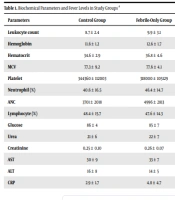
Of the 179 children studied, 109 with FS were enrolled in the case group, and the remainder (70) were considered as controls. Ninety patients had simple FS, and 19 had complex FS. Table 1 shows that there were no differences between the study groups in terms of age, sex, temperature, ESR, WBC, and platelets. As presented in Table 2, Hb, HCT, mean serum ferritin, serum iron, and MCH were significantly lower in the febrile convulsion group than in the control group. The mean level of MCV in the FS group was lower than that in the control group, but the differences were not significant. There were no differences in the mean RBC, MCHC, and TIBC levels between the case group and the control group.
Table 1
Mean Levels of Age, Temperature, ESR, PLT, and WBC Between Cases and Controls
| Age, mo | 21.7 ± 12.6 | 23.07 ± 12.65 | 0.13 |
| Temperature, °C | 38.5 ± 0.4 | 38.4 ± 0.5 | 0.61 |
| ESR a, mm/hr | 13.2 ± 9.8 | 11.8 ± 8.3 | 0.25 |
| PLT a, /mm 3 | 288275 ± 88779 | 322693 ± 103749 | 0.08 |
| WBC a, /mm 3 | 10577 ± 4007 | 8561 ± 3846 | 0.26 |
aAbbreviations: ESR, erythrocyte sedimentation rate; PLT, platelets; WBC, white blood cells
Table 2
Mean Levels of RBC, HB, HCT, MCV, MCH, MCHC, SF, SI, and TIBC Between Cases and Controls
| RBC a, mL/Cumm | 4.28 ± .44 | 4.21 ± .54 | 0.16 |
| HB a, g/dL | 11.59 ± 1.24 | 11.77 ± 1.55 | 0.00 |
| HCT a, % | 34.38 ± 3.01 | 34.86 ± 4.03 | 0.00 |
| MCV a, fL | 79.70 ± 6.20 | 83.23 ± 7.87 | 0.25 |
| MCH a, pg | 27.34 ± 2.78 | 28.16 ± 3.58 | 0.03 |
| MCHC a, g/L | 33.76 ± 2.22 | 33.79 ± 2.57 | 0.39 |
| SF a, ng/mL | 51.87 ± 41.03 | 81.25 ± 85.96 | 0.00 |
| SI a, μg/dL | 59.32 ± 29.03 | 88.37 ± 39.27 | 0.00 |
| TIBC a, μg/dL | 376.58 ± 43.29 | 376.11 ± 50.11 | 0.83 |
aAbbreviations: HB, hemoglobin; HCT, hematocrit; RBC, red blood cell; MCH, mean corpuscular hemoglobin; MCHC, mean corpuscular hemoglobin concentration; MCV, mean corpuscular volume; SF, serum ferritin; SI, serum iron; TIBC, total iron-binding capacity
5. Discussion
Febrile seizures are a common condition in children. They occur in 2% to 4% of children younger than 6 years of age that are admitted to an emergency department; however, the incidence is as high as 15% in some populations (1). Among 1546 children (1 month to 6 years of age) who were admitted to the Amin Pediatric Emergency Department from March 2005 to September 2007, 347 children presented with a febrile seizure (4% to 5%) (1). These convulsions probably have a variety of causes, but the genetic and familial component has been recognized (9, 10, 11).
Iron deficiency anemia may play a role in the pathogenesis of FS. Daoud et al. reported that the mean level of ferritin in cases with first febrile seizure is significantly lower than that in a reference group, but the mean levels of HB, MCV, and MCH were lower in children with first febrile seizure than in children in a control group, although the differences were not significant (6). Naveed et al. found that the proportions of cases with low levels of HB, HCT, MCV, MCH, and ferritin were higher among children with FC than among controls and the differences were statistically significant (12). Further, Pisacane et al. compared the levels of HB, MCV, and serum iron among controls and patients with FC, and they reported that iron deficiency anemia is significantly more frequent among the cases than among the controls (7). In contrast, a study by Kobrinsky et al. suggested that iron deficiency anemia may protect children against febrile seizure (8).
Compared with the Kobrinsky study, we measured more iron status components (serum iron, ferritin, RBC, Hb, HCT, MCV, MCH, MCHC, and TIBC) among cases and controls. In the present study, we found that the mean ferritin level, serum iron level, HB, HCT, and MCH in the FS group were significantly lower than the corresponding levels in the control group. Iron is involved in the metabolism of several neurotransmitters and monoamine and aldehyde oxidases (4, 13); therefore, low levels of serum iron may be associated with febrile seizure. There were no significant differences in other measures of iron status components, such as RBC, MCV, MCHC, and TIBC, between cases and controls. Because the serum ferritin level is higher in males than in females (14) and increases in response to fever and inflammation (8), we matched the case and control groups by age, sex, ESR, and underlying illness. However, we were unable to identify any reason for the lack of differences in RBC, MCHC, and TIBC.
Daoud et al. reported that the proportion of cases with a plasma ferritine (PF) ≤ 30 μg/L was significantly higher among the cases with first febrile seizure than among the controls, and that the proportion of cases with HB < 110 g/L, MCV < 72 fL, and MCH < 24 μg/L was also higher among cases than controls, although the differences were not statistically significant (6). In contrast to this study, we compared the mean levels of CBC components. In contrast to this study, we compared the mean levels of CBC components because a small number of patients had HB < 11.0 g/dL, HCT < 33%, MCV < 72 μg/m², MCH < 24 pg, MCHC < 32 g/dL, SF ≤ 20 μg/dL, SI < 30 μg/L, and TIBC > 480 μg/dL. Further, because lead toxicity lowers the seizure threshold (15), we attempted to exclude this potential confounder. For this purpose, we selected patients and controls from the same area of residence.
In summary, low SF and SI levels may play a role in the pathogenesis of simple febrile seizure. Further studies, particularly in developed countries with a high frequency of FS and good nutritional conditions, are clearly needed. In addition, a follow-up study of patients with febrile seizure after treatment for iron deficiency will be required to determine the incidence of subsequent febrile seizures and to confirm our preliminary findings.