1. Background
Preterm and sick full-term neonates admitted to the neonatal intensive care unit (NICU) are routinely subjected to many invasive diagnostic and therapeutic procedures, which are associated with pain (1-3). The heel-lancing procedure is the most common tissue damaging procedure that premature neonates undergo. In the NICU, preterm neonates are subjected to an average of 10 to 16 painful invasive procedures per day with repeated heel sticks accounting for 55% to 86% of these procedures. Neonates have more pain response to heel sticks than to venipuncture for blood sampling (2, 3).
The fibers that transfer the pain stimuli are organized in the fetus. Nerve fibers, which form the peripheral nervous system, begin migration from the neural crest at seven weeks of gestation and are completely developed by 20th week of gestation. By 28th to 30th weeks, the density of nociceptive nerve endings is equal to that of adults. Thus, newborns are able to feel and remember the pain (4-6). Pain increases the demand for oxygen and causes disturbances in cerebral blood flow and intracranial pressure, which increases the risk of intracranial hemorrhage (7). Repetitive painful stimuli have been associated with behavioral and emotional problems during childhood, major psychosis, altered responses to pain, and intractable pain states in later life (8). Despite the increased knowledge of physicians and caregivers regarding neonatal pain, 40% to 90% of neonates do not receive preventive and/or effective treatment to reduce procedural pain. Pain is a major public health concern throughout the world (9). Alleviation of pain is a human right regardless of age. Prevention and alleviation of pain is important not only because of being an imperative issue but also because of potential deleterious effects of repeated painful exposures. Thus, the goal of all caregivers should be prevention of pain in neonates (10, 11). Pain assessment is the foundation of all pain treatment (12). The pain assessment tool used for neonates should be multidimensional, including measurements for both physiologic and behavioral indicators of pain, because neonates cannot self-report (11, 13). In order to assess the neonate pain, a growing number of reliable and valid measurement tools have been developed, including:
- - Acuteness Bursts Constancy (ABC),
- - Premature Infant Pain Profile (PIPP),
- - Riley’s Infant Pain Scale (RIPS),
- - Neonatal Infant Pain Scale (NIPS),
- - Neonatal Facial Coding System (NFCS),
- - Crying-Requires O2-Increased VS-Expression and Sleepless (CRIES), and
Because the most effective and safest ways to prevent pain in the neonate are unknown, striking a proper balance between effective pain relief and avoidance of serious adverse effects from pain medications is a major challenge for caregivers. As part of a comprehensive pain-prevention program, each neonatal unit should develop strategies to minimize the number of painful or stressful procedures and provide effective nonpharmacologic and/or pharmacologic pain relief for all procedures (13). The nonpharmacologic interventions (including oral sucrose, non- nutritive sucking, breastfeeding, swaddling, kangaroo care (KC), facilitated tucking, and developmental care) are easy to administer, require no intensive monitoring, and can be performed by nursing staffs without instructions by physicians. The nonpharmacologic methods, especially those involving parental participation, are highly suggestive (2, 17).
Skin-to-skin care (SSC) or KC involves holding a diaper-clad neonate upright at a 60º between the mother’s breasts. Kangaroo Mother Care (KMC) was started in 1978 in Bogota (Colombia) by Dr. Hector Martinez and Dr. Edgar Rey Sanabria in response to overcrowding and insufficient resources in NICUs, which were associated with high morbidity and mortality among low-birth weight neonates. They discovered that laying the unclothed neonate vertically between the mother’s breasts and under her clothing increased the survival of premature neonates and improved the quality of life for the neonates. KC promotes stability of heart and respiratory function, minimizes purposeless movements, improves behavioral state profiles, offers maternal proximity for attention/interaction episodes, and permits self-regulatory behavior expression (18-21). KMC would decrease pain response. Furthermore, it would provide mothers an opportunity to comfort their neonate during painful procedures in a technologically invasive environment (22). Even though previous studies have shown the effect of KMC in reducing pain in neonates (22-25), to our knowledge limited data are available on the effectiveness of KC in reducing pain during heel lance in preterm neonates in Iran. Moreover, various durations of KMC intervention have been reported in different studies and the optimal duration of KC for pain relief warrants further study.
2. Objectives
This study aimed to assess the effect of KMC for a short duration of 15 minutes on pain intensity of heel lance in preterm newborns admitted to NICUs of Arash and Valiasr hospitals.
3. Patients and Methods
This single-blind crossover randomized clinical trial was conducted on 64 vitally stable premature newborns, which were born From June to October 2012. The study took place in the NICUs of Arash(level IIIA) and Valiasr hospitals (level IIIB) affiliated to Tehran University of Medical Sciences. Inclusion criteria were newborns with gestational age of 30 to 36 weeks, within 3 to 14 days of birth, breathing unassisted, without any congenital anomalies or central nervous system diseases, no previous surgery, and not receiving paralytic, analgesic, or sedative medications within 48 hours. The use of the crossover design eliminated variability between subjects and helped control for prior exposure to pain. This study was approved by the Research Ethics Committee of Tehran University of Medical Sciences. Neonates were enrolled in the study after obtaining a written informed consent from their parents. The CONSORT diagram is shown in Figure 1.
Randomization of neonates to give KMC or incubator care for the first heel lance was done by drawing out a thick nontransparent envelope. In the group A, the diaper-clad neonate was held upright, at an angle of approximately 60º in skin-to-skin contact with their mother under her gown and between her breasts and a blanket was placed over the neonate's back 15 minutes before the heel lancing, during, and two minutes after the procedure. Neonates in group B were placed in the incubator in a prone position and swaddled with a blanket 15 minutes before lancing. In the second heel lancing, neonates in group A were placed in incubator and group B were in KMC position. Duration of wash-out period was one to four days.
Heart rate (HR) and oxygen saturation were recorded in two positions, using pulse oximetry monitoring, and neonatal face reactions to pain were recorded by a digital video camera (SONY DSC-W510, China) The video recordings were analyzed in both groups by an expert person who was totally blinded to the study. PIPP was used to evaluate the severity of pain during and two minutes after procedure, and the results were compared between two conditions.
The PIPP is the only tool that takes gestational age into account, differentiating between full-term and preterm neonates. It is a seven-indicator pain measure that includes three behavioral responses (brow bulge, eye squeeze, and nasolabial furrow), two physiologic responses (HR and oxygen saturation), and two contextual responses (gestational age and behavioral state). Each indicator is scored on a four-point scale (0 to 3) to give a maximum total score of 21. The data were analyzed using SPSS 18 (SPSS Inc., Chicago, IL, USA). Descriptive statistics (mean ± SD, frequency, and percentage) and independent-samples t test was used in order to compare the mean of pain score between groups.
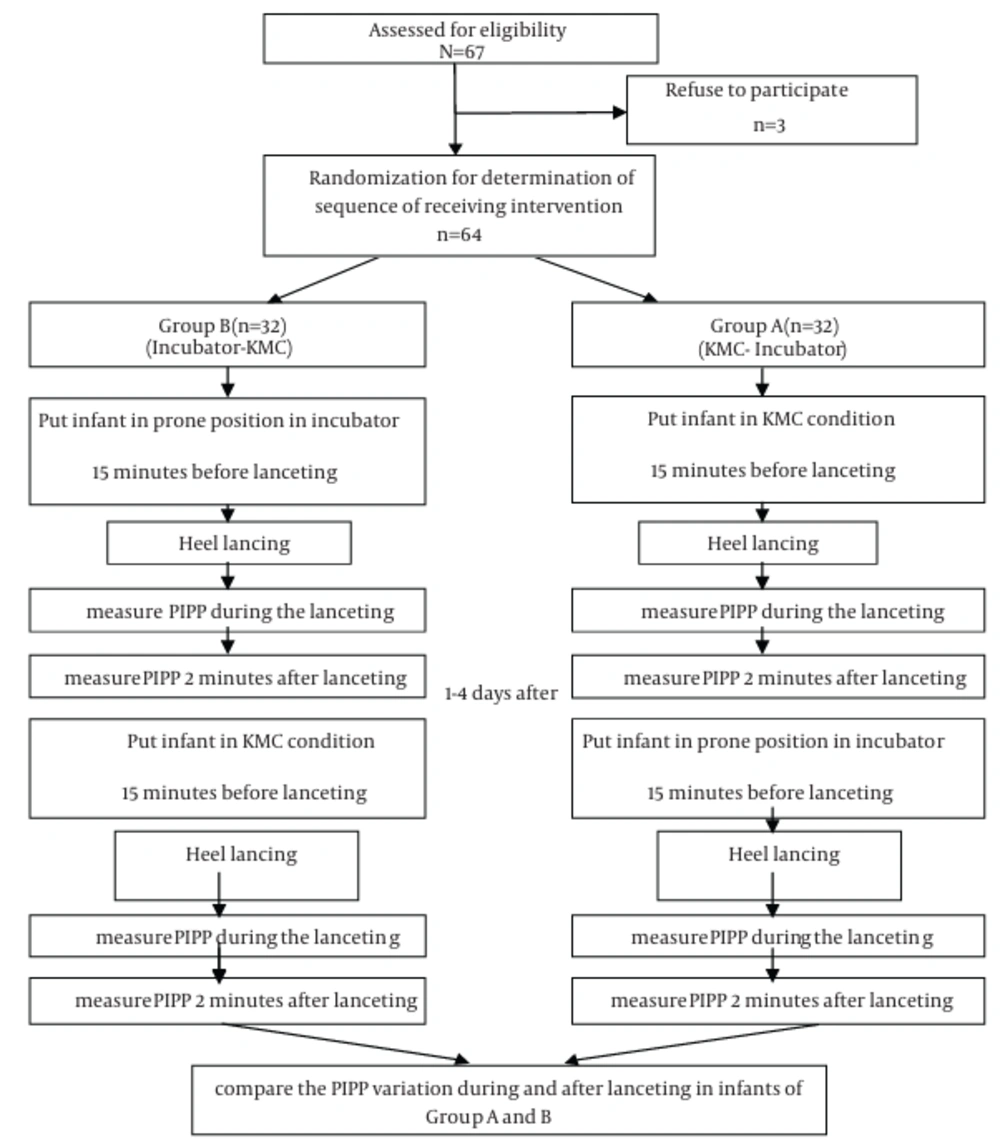
Figure 1.
CONSORT Diagram of Study
4. Results
The enrolled neonates consisted of 37 males (57.8%) and 27 females (42.2%). A total of 53 neonates (82.8%) were delivered via cesarean section and 11 (17.2%) through vaginal route. The gestational age of neonates was as follows: 30 to 32 weeks in 18.8%, 32 to 34 weeks in 26.6%, and 34 to 36 weeks in 54.7%. The mean gestational age was 33 ± 1.95 weeks. They had a mean birth weight of 2095.85 ± 672.27 g (range, 960-3580) and a mean age of 7.28 ± 3.65 days (range, 3-14). The basic characteristics of patients are shown in Table 1.
Among the KMC intervention group, 62.5% of neonates experienced mild pain (score, 0-6) while 26.2% of the incubator care neonates scored similarly. Two neonates (3.1%) of the KMC group demonstrated indicators of severe pain (13-21) whereas 15.6% of cases in incubator care group had indicators of severe pain during the heel stick procedure (Table 2).
The mean PIPP score was 5.81 ± 2.69 in KMC group and 9.12 ± 3.02 in incubator care condition. Pain was mild two minutes after the procedure in 100% of neonates who received KMC and in 96.9% of incubator care group. About 3% of incubator group experienced moderate pain. No severe pain was reported in study groups (Table 3). The mean PIPP score was 3.71 ± 1.1 in KMC group and 4.48 ± 1.24 in incubator care group. PIPP scores were significantly lower at each measurement point in neonates in the KMC than in incubator care group (P = 0.000). According to the results of this study, KMC markedly reduced the pain score during and after heel-lancing procedure.
Table 1.
Demographic Characteristics of Neonates Included in Study a
| Characteristic | No. (%) | Mean ± SD |
|---|---|---|
| Sex | - | |
| Female | 37 (57.8) | |
| Male | 27 (42.2) | |
| Gestational age, wk | 33 ± 1.95 | |
| 30-32 | 12 (18.8) | |
| 32-34 | 17 (26.6) | |
| 34-46 | 35 (54.7) | |
| Age at Day of Study, d | 7.28 ± 3.65 | |
| 3-6 | 30 (46.9) | |
| 7-10 | 19 (29.7) | |
| 11-14 | 15 (23.4) | |
| Birth Weight, g | 2095.85 ± 672.27 | |
| < 1000 | 1 (1.6) | |
| 1000-1499 | 16 (25) | |
| 1500-2499 | 30 (46.9) | |
| 2500-3500 | 15 (23.4) | |
| > 3500 | 2 (3.1) | |
| Labor | - | |
| NVD | 11 (17.2) | |
| CS | 53 (82.8) | |
| Total | 64 (100) | - |
a Abbreviations: NVD, normal vaginal delivery; and CS, caesarian section.
| PIPP Score | Condition | |
|---|---|---|
| Incubator | KMC | |
| Mild Pain | ||
| 0-6 | 17 (26.6) | 40 (62.5) |
| Moderate Pain | ||
| 7-12 | 37 (57.8) | 22 (34.4) |
| Severe Pain | ||
| 13-21 | 10 (15.6) | 2 (3.1) |
| Total | 64 (100) | 64 (100) |
| Mean ± SD | 9.12 ± 3.02 | 5.81 ± 2.69 |
a Data are presented as NO. (%).
b T = 9.664; df = 63; and P = 0.000.
c Abbreviations: PIPP, premature infants pain profile; and KMC, kangaroo mother care.
| PIPP Score | Condition | |
|---|---|---|
| Incubator | KMC | |
| Mild Pain | ||
| 0-6 | 62 (96.9) | 64 (100) |
| Moderate Pain | ||
| 7-12 | 2 (3.1) | 0 (0) |
| Severe Pain | ||
| 13-21 | 0 (0) | 0 (0) |
| Total | 64 (100) | 64 (100) |
| Mean ± SD | 4.48 ± 1.24 | 3.71 ± 1.10 |
a Data are presented as NO. (%).
b T = 6.102; df = 63; and P = 0.000.
c Abbreviations: PIPP, premature infant pain profile; and KMC, kangaroo mother care.
5. Discussion
Preterm and sick neonates experience numerous painful procedures as a part of the clinical care during their NICU stay. One of the most commonly performed painful procedures in NICUs are heel sticks for blood procurement (2, 3, 17, 23). Inadequate management of procedural pain is an important problem in most NICUs. Nonpharmacologic methods are used for pain relief in neonates with varying degrees of efficacy. Giving sucrose is the most frequently used nonpharmacologic intervention for pain relief in neonates; however, there was a correlation between the prolonged administration of sucrose during the first week of life and lower neurodevelopment score at the corrected age of 40 weeks in preterm neonates < 31 weeks (2, 22). The effects of using sucrose routinely on consecutive days need further investigation. Behavioral methods for pain control such as non-nutritive sucking was shown to be significantly effective very premature neonates (17, 22). Breastfeeding during painful procedures was found to be effective for pain control in full-term neonates. However, breastfeeding is not always feasible in preterm neonates (22).
KMC is a simple nonpharmacologic method with analgesic effects on neonates. This study showed starting KMC fifteen minutes before, during, and during two minutes of heel lancing was effective in diminishing pain response during and after the procedure in preterm neonates with 30 to 36 weeks of gestation. The effect of KC in reducing pain response in preterm neonates was first examined by Johnston et al. (23). Thirty minutes of KC before and during a heel stick was performed for 74 preterm neonates of 32 to 36 weeks of gestation and compared with incubator care before and during the procedure. Pain severity, as measured by the PIPP, was significantly lower after heel lance in KMC than in incubator care (P < 0.001). This reduction in pain severity was found at 30, 60, and 90 seconds after the procedure.
A similar crossover study was performed by Johnston et al on 61 very preterm neonates (28-31 weeks), who had two heel sticks, one after 15 minutes of receiving KC and the other while being cared for 15 minutes in incubator. The study showed that at 90 seconds after the heel stick, neonates who received KC experienced a less severe pain (22). Akcan et al. highlighted that starting KC 30 minutes prior to an invasive procedure and continuing it for an additional ten minutes after the end of the procedure could be effective for reducing pain severity during any invasive procedure in preterm neonates (25).
Ludington-Hoe et al. conducted a study on 24 premature neonates. They served as their own controls. One heel stick was performed after the neonate had three hours of KC and the other heel stick was administered after the neonate had been cared in incubator for three hours. This study revealed that during the procedure, 62% and 92% of neonates in respectively KMC and incubator groups cried. Crying time was shorter in the former group (5 vs. 41 seconds). In addition, HR was more stable in neonates of KMC group. The mean acceleration rates were 13 and 23 beats per minutes in KMC and incubator groups, respectively (26).
Kostandy et al. conducted a randomized crossover study on ten preterm neonates with gestational age of 30 to 32 weeks, utilizing either 30 minutes KC or incubator care as the first day intervention and switching to the other intervention on the second day. In this study, Andersen Behavioral Scoring System was used. During the heel stick and recovery phase, there were considerable differences between the two groups. Crying length during and after the lancing was shorter in KC group than in incubator care group (55 vs. 96.2 seconds during heel lance and 5.8 vs. 25.5 seconds after heel lance) (24).
In Castral et al. study, 59 preterm neonates born at 30 to 36 weeks of gestation were randomly allocated to receive 15 minutes KC before and during a heel stick or stay in their incubator for a heel stick. They used NFCS for pain assessment. Their results revealed less behavioral pain response in KC groups, which was determined by shorter duration of crying and lower peak HR. Neonates in incubator cried 2.3 minutes longer than neonates who received KC did. In incubator group, a four beat per minute greater increase in HR and a slower return to baseline HR after the heel lance had occurred (27).
The result from Gray et al. study showed that in neonates who had received 10 to 15 minutes KC before and during the heel stick, crying and grimacing were reduced by 82% and 65%, respectively, in comparison with neonates who were swaddled in crib (28). Diminished pain response during a KC heel stick in preterm neonates was supported by all these studies and ours; however, all of them varied considerably in the duration of neonate exposure to KMC, ranging from 15 minutes to three hours.
The needed time and existence of any lower and upper age limits for KC to be effective are not clear yet, and need to be determined. However, Kostandy et al. stated that for short-term procedures, KC might reduce the response to pain (24). We recommend further investigations to determine the optimal duration.
KC is effective in reducing pain in several ways. Continuous tactile stimulation in KC appears to be related to activation of the pain inhibition system through activating endogenous pain modulation system (17, 24). Even though animal studies suggest that preterm neonates with gestational age of < 32 weeks might not have the endogenous mechanism to decrease pain in comparison to older neonates, KC, as a nonpharmacologic intervention, could trigger some endogenous mechanism and have analgesic effects in premature neonates (22).
Maintaining the position for 20 minutes changes the blood cortisol level in the neonate and increases the release of beta-endorphin, which reduce stress (24, 29). Moreover, the analgesic effect of KC is due to the blockade of the nociceptive stimuli transmission via afferent fibers or the inhibition of descending fibers (24). During the skin-to-skin contact, oxytocin secretion increases in both mother and neonate. Oxytocin has short-term and long-term antinociceptive effects. Analgesic effect of KC might be mediated through oxytocin release (24, 30). KC might indirectly reduce neonatal pain by decreasing the total amount of environmental noxious stimuli to the neonates. Pain response is reduced in deeply sleeping preterm neonates (23), which is seen during KC. Finally, perceiving the mother’s scent and odor could control pain in neonates (23, 24).
Our study had some limitations. It was not possible to blind the person who conducts the heel-lance procedure. Some of the nursing staffs were not comfortable when the mothers were observing them during the procedure. A number of distressing events such as noise can influence the pain response; we were not able to control it properly. KMC is a natural, low-cost, and easy intervention that can be recommended as a nonpharmacologic method before and during painful procedures in preterm neonates.
The effect of KMC goes beyond the benefit to the neonate; KMC also benefits mother by increasing her confidence, bonding, and favoring breastfeeding. Further studies are needed to determine whether other surrogates such as fathers, unrelated women, or siblings could provide similar benefits. It remains unclear whether younger neonates, those on respiratory support, or infants would benefit from KC or whether it would be effective over several procedures.
Preterm neonates between 30 to 36 weeks of gestational age can benefit from a short 15-minute KMC before and during a heel-lance procedure to decrease pain. In addition, this method is consistent with the modern strategy of family-centered care in neonatal units.