
1. Background
First aids are immediate and temporary assistance given to injured persons. These aids must be offered before providing specialized assistance (1). Due to geographical, geological, and climatic conditions and other natural factors, Iran is exposed to natural disasters and is one of the 10 most disaster-prone countries in the world (2, 3). Studies have shown that teaching textbooks using mobile applications installed on smartphones significantly increases students’ learning and awareness when compared to traditional teaching methods (4-6). In Iran, the focus of the educational system has so far been on educating and teaching students using textbooks (6-10). Studies have shown that in Iran, not all the components of health are presented in high school textbooks (11).
Khatami et al. conducted a study to evaluate the education of the first aids provided by the Iranian Red Crescent Society to the volunteers from student centers. The sample of the study included 5626 students who were studying in five provinces including Mazandaran, Markazi, Qazvin, Khorasan Razavi, and Hormozgan. The results showed that only two-thirds of the students had prior knowledge of the first aids, and the awareness of only 11% of them was at a desirable level, while the majority of them had a positive attitude towards the need for first aid training for students (2).
Bakke et al. conducted a telephone survey of 1,000 Norwegian citizens and concluded that 90% of Norwegians, a large part of the population, had received first aid training, and interviewees had a tendency to receive more training in the field of first aids (12).
Banfai et al. performed an interventional study on 582 children aged 7 - 14 in Hungary. The students were initially given the necessary awareness of first aids theoretically and practically. After four months, they were asked to take a test. The results showed that the students' awareness increased; it was also reported that after four months, their knowledge maintenance was satisfactory (13).
Banfai et al. carried out a study to determine how Hungarian students aged 14 - 7 perform cardiovascular resuscitation correctly using the AMBU CPR software, and concluded that the school children were able to learn and do this procedure correctly (14).
Bollig et al. conducted an interventional study to examine the impact of educational, theoretical, and practical first aid programs on the ability of children aged 6 - 7 to learn and retain the awareness. The first aids were taught to 117 children and 111 other children who received no training were considered the control group. In this study, after a false incident, children were forced to unconsciously help a victim. The participants were retested after six months. The results showed that children aged 6 - 7 years could unconsciously provide the first aids for the needy patients. In total, this training program significantly increased the children’s awareness and skills of first aids and after six months, their knowledge retention was reported to be satisfactory (15).
Meissner et al. studied 132 German teenagers’ ability to do cardiopulmonary resuscitation (CPR) before and after training, as well as their knowledge retention after four months. The results showed that not only was the students' awareness significantly increased but also, after four months, their knowledge retention was satisfactory (16).
Calicchia et al. studied a first-aid training course called BLSD (basic life support and defibrillation) before and after training among 130 students aged 11 - 12 years in an elementary school in Italy. The results showed that the students’ knowledge and awareness in this field increased significantly, and they did the very difficult steps of first aids well (17).
Due to the various advantages and capabilities of smart cell phones and applications installed on them, they are very attractive to Iranian students providing them with more diverse opportunities to learn and enhance their knowledge than ever before (18, 19). First aids are not necessarily performed by doctors but in emergencies, the majority of laypersons save lives using first aids. Although doing first aids does not necessarily require prior knowledge and they are often performed extempore by non-specialists, if the helper does not have the knowledge of the first aids, it will be possible that it causes damage rather than help. For this reason, the International Federation of Red Crescent and Red Cross societies encourage people to attend first aids training courses held by Red Crescent and Red Cross societies around the world or at least, learn the first aids through any other reliable and available sources. This is such an important issue that the World First Aids Day (September 10th) was introduced in 2000 with the aim of raising awareness about the importance of learning these critical skills.
The first aids application, Khadem, designed by the Iranian Red Crescent Society is a multimedia application that provides critical and easy training for people, especially students, to be used in emergencies. Familiarity with the short-term training provided by this application is necessary since our country is among the riskiest countries; according to the statistics, Iran receives 8 out of 10 in terms of the frequency of risks. Despite this, the preparation factor of households with regard to emergencies is only 9.3%, which can be changed with such short-term training. Due to this, the Iranian Red Crescent Society has decided to develop the Khadem plan (which is a Persian acronym for “ready family in disaster”) to raise the awareness of 25 million households to cope with the crisis in a five-year plan. Designing the first aid application Khadem was one of the tasks performed as a subset of this plan.
2. Objectives
This study aimed to investigate how this educational mobile app could contribute to improving high school students’ awareness of first aids.
3. Methods
In this quasi-experimental study conducted in summer 2017, from among students who were studying in high schools of Ahvaz, a city in the southwest of Iran, and had a smartphone and knew how to work with it, 51 students were selected as the sample of the study by simple random sampling method. Before the intervention, their familiarity and mastery of the first aids were initially measured using a 50-item test. Then, the software was offered to them to be used. One month later, they were asked to take again the 50-question test. In order to motivate and encourage students to learn the educational content provided by the application, some incentives and treats were considered for those who had passed the test with the scores higher than 75 (of 100). Moreover, the validity of the test was confirmed by specialists of emergency medicine, forensic medicine, and the faculties of Ahvaz Jundishapur University of Medical Sciences (in the southwest of Iran). The reliability of the test was confirmed by the Cronbach’s alpha coefficient of 73%. In addition, the demographic information of the participants such as gender, academic year, type of cellphone, etc. was obtained. The students were also asked some questions on satisfaction with the appearance and content of the application and the provision of other educational materials, especially the content of the course in the form of mobile application and so on. Finally, their scores were evaluated before and after the intervention. Descriptive statistics (mean, standard deviation, minimum, and maximum values) and inferential statistics were used for data analysis. The data were subject to Spearman, Kruskal-Wallis, and Mann-Whitney tests using SPSS v.22.
Khadem is an application that educates first aids and increases awareness in critical situations such as natural disasters and emergencies. The software was designed in Persian in line with the Khadem plan (a Persian acronym for “ready family in disaster”) by the Iranian Red Crescent Society. This application can be installed on both Android and iOS operating systems. With brief tutorials provided, it can provide information that can even prevent certain deaths during a crisis. Khadem consists of five sections of training, preparation, emergency cases, exams, and the introduction of health centers. In each section, a person can be prepared to respond to specific situations using short educational videos and descriptions. This training section explains how a person responds when facing an accident. The most important injuries explained in this section are the stroke, pulmonary resuscitation, heart attack, child choking, bleeding, fractures, choking, burnings, poisoning, etc. The next section prepares the user for dealing with natural disasters. One part of the preparation section is related to pre-incident preparedness, and the other part concerns the training required for the times of incident, landslide, fire, flood, earthquake, etc. In the emergency cases, information is provided on essential first aids before the emergency medical technicians arrive. For example, in a few short sentences, it explains how to do the necessary actions when an individual suffers from choking before emergency medical technicians arrive. In the exam section, questions are raised about the training provided, which can be used to measure the user’s mastery of the training (Figures 1 and 2). This application can be downloaded free of charge easily from Google Play and Bazar applications or transferred through Bluetooth and Wi-Fi operating file exchange applications such as Share It, Zapya, etc. Meanwhile, all necessary ethical considerations including the respondents’ satisfaction and assurance about the confidentiality of their opinions were observed in this research.
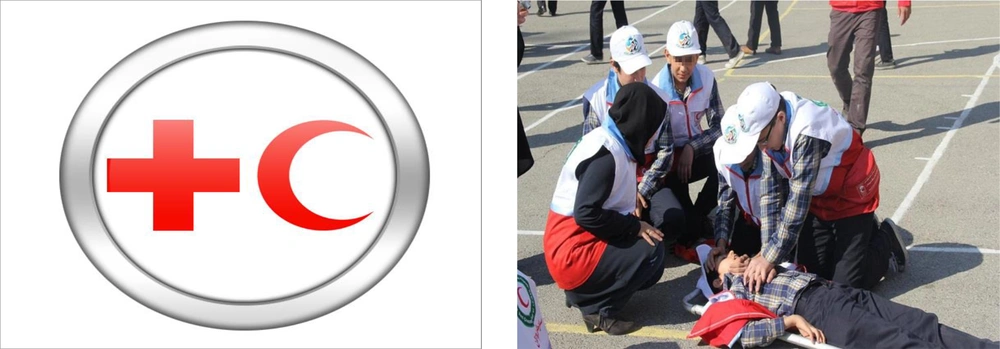
Figure 1.
The Iranian Red Crescent Society (first aids)
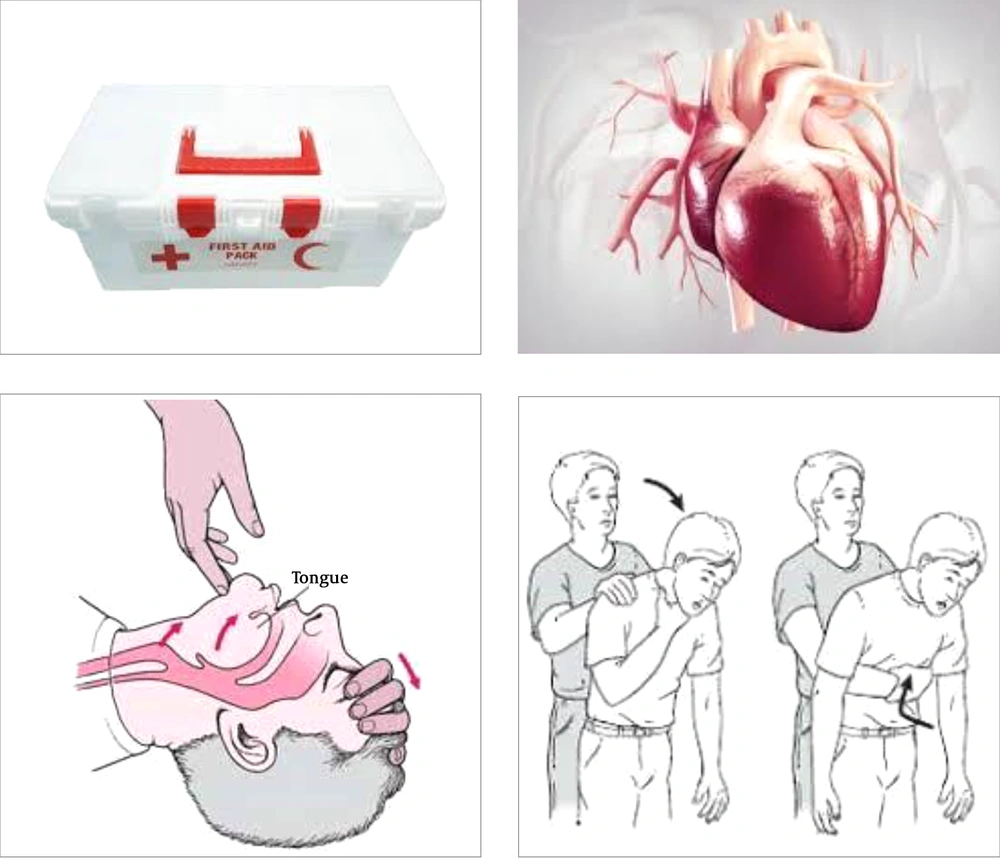
Figure 2.
Screenshots of the App
4. Results
A total number of 51 students aged between 9 and 11, including 30 boys and 21 girls, participated in this quasi-experimental study (Tables 1 - 3). The present study showed that students’ awareness of first aids was very low. According to the Wilcoxon test, the mean scores of knowledge of the students in the intervention group increased significantly after presenting the mobile application (P < 0.001). Spearman test showed that the increase in the level of knowledge about first aids due to the application use was not significantly correlated with the students’ age (P = 0.612). According to the Kruskal-Wallis test, there was no significant difference in the increased level of knowledge about first aids due to the mobile application between the ninth, tenth, and eleventh grade (school grades) students (P = 0.865). According to the Mann-Whitney test, there was no significant difference in the increased level of knowledge about first aids due to the mobile application use between girls and boys (P = 0.865). Moreover, 64.7% and 15.7% of the students assessed the application design as good and bad, respectively, while 19.6% of them had no idea about it. Table 4 presents the mean age and scores of students before and after using the application, as well as the difference in their scores (D) by gender and school grade.
Table 1.
Demographic Information of the Students
| Variables | Number and Percentage of Students |
|---|---|
| School grade (academic year) | |
| 9 | 4 (7.8) |
| 10 | 23 (45.1) |
| 11 | 24 (47.1) |
| Total | 51 (100) |
| Age | |
| Male | 30 (58.8) |
| Female | 21 (41.2) |
| Total | 51 (100) |
Table 2.
The Average Age of Students by Gender
| Gender | Mean ± SD | Minimum | Maximum |
|---|---|---|---|
| Male | 16.43 ± 0.63 | 15.00 | 17.00 |
| Female | 16.33 ± 0.66 | 15.00 | 17.00 |
Table 3.
Overall Age Information of Students
| Minimum | Maximum | Mean ± SD | |
|---|---|---|---|
| Age | 15.00 | 17.00 | 16.3922 ± 0.63493 |
Table 4.
The Average Age and Scores of Students Before and After Using the Application and the Difference in Their Scores (D) by Gender and School Grade
| School Grade | Mean ± SD | Min | Max |
|---|---|---|---|
| Male | |||
| 9 | |||
| Age | 15.00 ± 0.00 | 15.00 | 15.00 |
| D | 50.00 ± 4.24 | 53.00 | 47.00 |
| Before | 11.00 ± 2.83 | 13.00 | 9.00 |
| After | 61.00 ± 7.07 | 66.00 | 56.00 |
| 10 | |||
| Age | 16.00 ± 0.00 | 16.00 | 16.00 |
| D | 53.62 ± 12.84 | 72.00 | 23.00 |
| Before | 24.00 ± 15.29 | 66.00 | 5.00 |
| After | 77.62 ± 4.46 | 89.00 | 70.00 |
| 11 | |||
| Age | 17.00 ± 0.00 | 17.00 | 17.00 |
| D | 55.13 ± 15.91 | 72.00 | 25.00 |
| Before | 33.47 ± 20.32 | 70.00 | 12.00 |
| After | 88.60 ± 6.36 | 100.00 | 80.00 |
| Female | |||
| 9 | |||
| Age | 15.00 ± 0.00 | 15.00 | 15.00 |
| D | 58.50 ± 4.95 | 62.00 | 55.00 |
| Before | 10.50 ± 6.36 | 15.00 | 6.00 |
| After | 69.00 ± 11.31 | 77.00 | 61.00 |
| 10 | |||
| Age | 16.00 ± 0.00 | 16.00 | 16.00 |
| D | 55.40 ± 12.72 | 73.00 | 27.00 |
| Before | 24.70 ± 16.62 | 67.00 | 7.00 |
| After | 80.10 ± 5.07 | 94.00 | 76.00 |
| 11 | |||
| Age | 17.00 ± 0.00 | 17.00 | 17.00 |
| D | 53.00 ± 16.87 | 71.00 | 27.00 |
| Before | 37.22 ± 22.87 | 71.00 | 13.00 |
| After | 90.22 ± 6.87 | 100.00 | 81.00 |
5. Discussion
The present study showed that students’ awareness of first aids was very low, and the first aid application Khadem designed by the Iranian Red Crescent Society significantly increased the students’ awareness of the principles of first aids and relief supplies. In this regard, the results of this study are consistent with those of Bakke et al. (12), Banfai et al. (13), Banfai et al. (14), Bollig et al. (15), Meissner et al. (16), Calicchia et al. (17), Dute et al. (20), and Gavali et al. (21). More than 64.7% of the students expressed their satisfaction with the format and the content of this program, which is consistent with the results obtained by Albrecht et al. (4), Gilavand and Shooriabi (5), and Parhizkar et al. (6).
The majority of the students also believed that the first aid application improved their access to educational materials in the field of first aids and their preparedness to deal with incidents and natural disasters. In addition, they also believed that smartphones and their accessories would help them to have a more independent learning process. Lastly, the students thought that it behooves teachers to pay more attention to the use of smartphones in the class. In this regard, the results are consistent with those of Albrecht et al. (4), Gilavand and Shooriabi (5), Wu et al. (19), Jamal et al. (22), Schulz et al. (23), and Ozdalga et al. (24).
Due to various attractions, smartphones can be used to increase knowledge and awareness. Although this technology is not formally included in school curricula in Iran, it provides opportunities for students and teachers to use various learning methods.
5.1. Conclusions
Due to the geographical, geological, and climatic conditions and other natural factors, Iran is exposed to natural disasters and is one of the 10 most disaster-prone countries in the world. On the other hand, some unnatural disasters (e.g., accidents, fires, industrial and workplace incidents, etc.) annually threaten the lives of thousands of Iranians. Undoubtedly, the prevention of such disasters and accidents and observance of safety precautions are the most necessary measures that need to be taken in order to reduce the human and economic losses caused by them. However, the readiness of the relief organizations and ordinary people, especially students, and their familiarity with the methods and approaches of relief and assistance to the injured should always be paid attention to in order to help the injured at the earliest possible time with minimal financial costs and human losses. Due to the development of information technology, traditional teaching methods that are currently being implemented do not respond to educational needs alone. Although this technology is yet to be formally included in the curricula, due to its many advantages and capabilities, the use of smartphones in education is growing rapidly and provides an opportunity for students to use various learning methods, especially in the field of first aid training, and in the near future, the use of smartphones may completely eliminate the monopoly of traditional teaching methods (textbooks and lecture methods). Particularly, in areas such as medicine within the culture and value system governing the Iranian society, there may be ethical constraints for learning some special medical issues in real life. Therefore, providing first aid training according to the concerns of people in society, especially students, requires careful planning and new educational methods.
5.2. Suggestions
One can hardly claim to be able to completely learn first aids just by reading a book or educational materials on the Internet, newspapers, mobile educational applications, and other available resources. Providing both practical and theoretical training is of paramount importance. Although any first aid learning is quite valuable, practicing first aid techniques through scenarios, along with trainers, increases self-confidence in doing first aids. It is suggested that the same study be performed at a larger scale and on other age groups and education levels in order to draw a more accurate conclusion about the impact of this educational software on increasing other people’s awareness in the field of first aid and their preparation for coping with natural and unnatural incidents and disasters.
5.3. Limitations
The distribution of students and their low participation in this study were the major limitations of the study.