1. Background
In the field of work, the phenomenon of occupational stress is an inevitable part of professional life and originates from the experiences caused by the job (1). To some extent, this situation can be considered as a driving force for people to increase and improve actions. But to a large extent, it leaves the opposite consequences (2). Sauter et al. define occupational stress as follows: The interaction between working conditions and the characteristics of the working person in such a way that the demands of the working environment and as a result the related pressures are more than the individual can handle (3). Hui et al. considers occupational stress as an adaptive response to the external situation that leads to physical, psychological or behavioral abnormalities of the organization's members (4). The National Institute of Occupational Health and Safety states that occupational stress occurs when work requirements are not aligned with a person's abilities, capabilities and desires (5). In other words, when what is expected of a person in a job is not in harmony with what he likes and wants, occupational stress occurs (6).
Based on the approach of the National Institute of Occupational Safety and Health, occupational stress can be defined as disturbing emotional responses that occur when there is a mismatch between the demands and requirements of the job and the talent, resources, or needs of the job (7). According to the researchers of this institute, occupational stress and job challenge are used in the same sense and synonymous, while these two concepts are separate (8). Physically and psychologically, challenge energizes and motivates people to learn new skills in their jobs. When people face a challenge, they feel relaxed and satisfied, so challenge is an important and constructive factor for health and productivity (9). The importance of challenge in people's work life is perhaps what people say in the form of the sentence: “A little stress is good for you”. In another definition, it is stated that the stress caused by the job is the stress that a certain person suffers (10). Work-related stress has been described as a harmful response to excessive pressures and demands that people experience as a result of their jobs (11). Between 2014 and 2017, occupations related to healthcare delivery had the highest rates of absenteeism due to work-related stress in the UK (12). Work-related stress was also the most commonly reported reason for health care professionals, such as nurses, to leave their profession (13). It has also been found that alongside people working in protective services such as the police, professionals working in health/social care services have the highest incidence of workplace violence compared to employees working in other industrial sectors in the UK (14).
Today, one of the most stressful jobs is health and treatment jobs, and it has been found in previous studies that the amount of stress in medical professions and doctors is higher than other jobs (15). In the meantime, doctors and employees working in forensic medicine are exposed to many stressful factors due to the nature and type of their work. Some important stressful factors in this job are: A, The role of forensic doctors in determining the exact cause and time of death or accident and the effect of their work on judgment is not hidden from anyone. The feeling of such a heavy responsibility and the possibility of an error even years later can cause stress in the responsible physician (16); B, Stressful atmosphere when dealing with dangerous criminals and prisoners for specialized examinations; C, Dealing daily with a large number of people who have suffered many injuries in various ways, including family quarrels, sexual assault, bullying, etc. Employees working in different units of the forensic organization deal with stressful factors in their work environment that can overshadow their physical and mental health (17). Considering the position of the organization in helping to establish justice and people's rights, on the one hand, Occupational stress affects the quality of their work, and on the other hand, considering that the training of specialized staff is very expensive for the forensic organization, physical and mental damage Forensic medical personnel leads to wastage of national funds and subsequently reduces their productivity (18).
Therefore, in order to improve mental health and reduce occupational stress, forensic managers should be familiar with effective models of stress management in forensic medicine and pay more attention to the factors that cause mental health disorders of employees. Also, by establishing proper and optimal communication with employees and supporting them and creating a suitable platform for professional activities and by knowing the skills related to stress management, reduce the injuries caused by occupational tensions in forensic medicine (19).
The forensic medicine organization has a special place in the judicial system of the country due to its important effects in establishing justice in the society (20). On the other hand, forensic medical workers are placed in special working conditions due to facing different people who have suffered social harm in different ways, which are stressful factors themselves (21). Dealing with corpses and their anxious companions, people affected by family and street conflicts, marital disputes, mental patients, dangerous criminals, sexual assaults and being at crime scenes are some of the things that doctors, experts and forensic medical staff deal with on a daily basis, which results in creating a tense environment in forensic medicine (22). On the other hand, out of 14 million legal cases filed in a year, more than a third of them require the opinion of forensic experts, which shows the direct impact of forensic medicine on the health of society and people's rights. While the difficulty of working in forensic medicine is such that it not only does not attract new people to enter, but also creates repulsion in some cases (23). More than 7,300 organizational positions have been defined in the forensic medicine organization, of which less than 3,000 positions are occupied. On the other hand, due to the special conditions of work in forensic medicine, the recruitment tests of this organization have not been well received in recent years, so that in the recruitment test of 2018, only 140 people applied for employment out of the 200 required job positions. Resignation of employees from continuing service is another consequence of the stressful environment of forensic medicine, for example, in the forensic medicine of Tehran province in the last 3 years, more than 15 doctors with more than 10 years of experience have given up on continuing to work in forensic medicine for various reasons such as occupational diseases, burnout or job dissatisfaction. The demand to change the work environment is also one of the consequences of the stressful work environment in forensic medicine, so that a large number of employees of specialized departments want to change their career field and, as a result, change their work environment due to receiving a new university degree.
2. Objectives
The purpose of this research is to present a stress management model in the forensic organization based on the grounded theory approach.
3. Methods
The current research method is qualitative and its dominant paradigm is the interpretative-constructive paradigm. The research method is based on the grounded theory method. Grounded theory is a method whose purpose is to know and understand people's experiences of events in a specific context. Based on Strauss-Corbin's concepts, grounded theory means discovering a theory from data that is methodical (24). The statistical population of this research is the experts and managers of the forensic organization, which was sampled using the targeted snowball method.
After forming the operational headquarters and making decisions, experts were selected and sufficient explanations were given to them about the subject under investigation. Some of the main characteristics for selecting experts are as follows: They must be engaged with the topic under discussion, have ongoing knowledge of the topic to collaborate with, be motivated to participate in the analysis process, and feel that the information from the group consensus will be valuable to them. In this research, an expert is a person who has the following characteristics: Having a degree in organizational management, having at least a master's degree, having at least ten years of work experience in the field of organizational management, having at least 5 years of experience in forensic management.
The statistical population of the present study includes the managers of the forensic medicine organization. Sampling in foundation data theory method is done in two dimensions. In the first stage, sampling of interviewees is done, which is called purposive sampling. But in the second dimension we deal with theoretical sampling. In theoretical sampling, the researcher analyzes the data and uses the results of this analysis to decide on the next sampling location. In this research, the number of designated experts was 12. Also, by using the snowball method, the interviewees were asked to introduce people who are aware of the research topic in order to continue the interview. The basis for completing the interviews is to reach the theoretical saturation point. All the conducted interviews were recorded and the text of the interviews was implemented in MAXQDA (version 10) and each interview was immediately coded and analyzed.
Data analysis was done using the three-step coding approach of Strauss and Corbin (25). Coding is done line by line. The first step is open coding, which deals with analyzing, comparing, naming, conceptualizing and categorizing the data. In the axial coding stage, the goal is to communicate between the categories generated in the open coding stage. This coding is called axial because coding is centered around a central category. After defining the central category, by re-coding the data, various conditions affecting the central category, including causal conditions, context, intervention, background, strategies and consequences are counted. Selective coding is the main stage of theorizing. At this stage, the researcher connects the central category to other categories in a systematic way and clarifies the relationships between them in the framework of a narrative and story, and corrects the categories that need further improvement and development.
4. Results
In this research, 12 people were selected for interview. Their demographic information is shown in Table 1.
Table 1.
Participant Demographics
| Demographic and Demographic Subcategories | N |
|---|---|
| Province | |
| Tehran | 4 |
| Alborz | 1 |
| Gilan | 1 |
| Khouzestan | 1 |
| Esfehan | 1 |
| Azarbaijan sharghi | 1 |
| Kerman | 1 |
| Khorasan razavi | 2 |
| Age | |
| 25 - 34 | 2 |
| 35 - 44 | 4 |
| 45 - 54 | 6 |
| Years in current position (y) | |
| 1 - 4 | 2 |
| 5 - 10 | 3 |
| 11 - 15 | 5 |
| 16 - 20 | 2 |
| Education | |
| Master degree | 5 |
| PhD | 3 |
| Physician | 4 |
The average answers to participants' questions focusing on how to face stressful factors and related support in the forensic work environment are shown in Table 2.
Table 2.
Means and Standard Deviations for Ten Questions on Workplace Stress and Support
| Questions | M (SD) |
|---|---|
| 1. How often do you feel generally stressed? | 3.61 (1.26) |
| 2. How often do you feel stressed at work? | 3.85 (1.39) |
| 3. How often do you feel stressed because of management/supervisors? | 3.95 (1.47) |
| 4. Do you feel that your management is concerned with your wellbeing? | 3.85 (1.81) |
| 5. Do the employees feel good about their managers? | 3.98 (1.86) |
| 6. How often do you feel stressed from backlogs and the need to do many cases? | 3.43 (1.55) |
| 7. Was the source of stress related to the nature of cases (e.g. murder, rape)? | 1.87 (1.11) |
| 8. Was the source of stress related to high-profile cases (i.e., media coverage)? | 1.97 (1.31) |
| 9. Was the source of stress related to the circumstances at your work? | 2.88 (1.70) |
| 10. Was the source of stress related to personal reasons? | 2.70 (1.29) |
In the second part of the interview with the interviewees, questions were asked about the relationship between the stress of employees in forensic medicine and personal reasons such as family or financial problems, as well as the nature of stress in the workplace. At this stage, on a Likert scale, the participants were also asked the amount of stress express what they have experienced in the past and present. The results are shown in Figure 1.
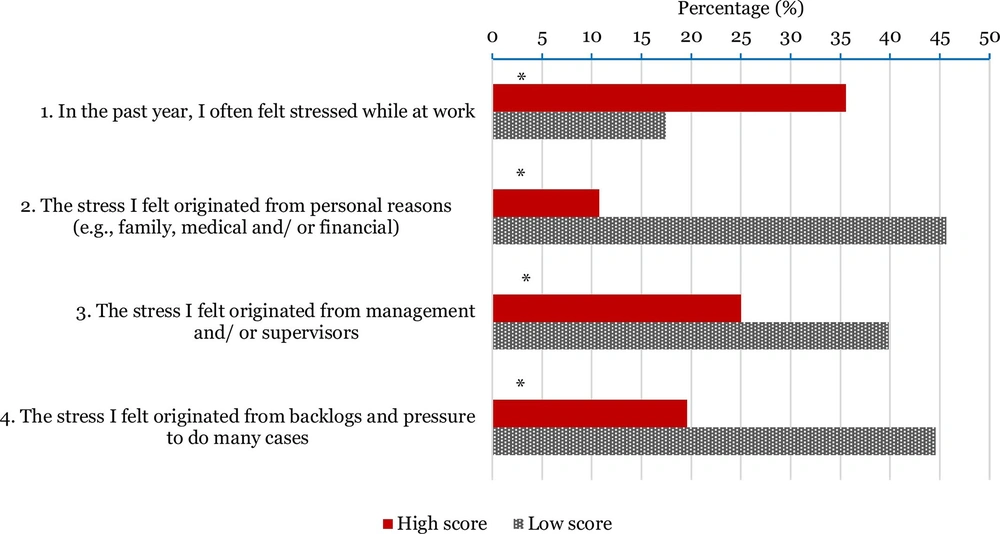
Figure 1.
Scores of stress levels
In open coding, the data obtained from the interviews were first studied, examined and analyzed in detail, then conceptualization was done and the data that were conceptually similar to each other were labeled with appropriate names. By analyzing the interviews, 151 concepts or open codes were identified and extracted. In the following, those extracted concepts which, according to the researcher, refer to a common topic or concept, were categorized under a more abstract title. Finally, 151 primary codes were placed in 23 categories. The frequency of concepts extracted in the text of the interviews is given in Table 3.
Table 3.
Frequency of Main Concepts of LMO Work Stress
| Order | Concepts | Frequency |
|---|---|---|
| 1 | Work environment | 55 |
| 2 | Job status | 53 |
| 3 | Difficulty of work | 53 |
| 4 | clients | 50 |
| 5 | Interpersonal relations | 44 |
| 6 | Ethical behavior in the workplace | 41 |
| 7 | Empowering employees and doctors | 39 |
| 8 | Financial stress | 39 |
| 9 | Grounding and stress management planning | 37 |
| 10 | Workload | 34 |
| 11 | Job rank | 31 |
| 12 | The reputation and credibility of the organization | 29 |
| 13 | Working time | 27 |
| 14 | Communication channels | 25 |
| 15 | Leadership styles | 22 |
| 16 | Assessment stress | 20 |
| 17 | Working modes | 20 |
| 18 | Family situation | 18 |
| 19 | Organizational Culture | 17 |
| 20 | Incentive system | 16 |
| 21 | Characteristics of colleagues | 16 |
| 22 | Job factors | 15 |
| 23 | Job attitude | 14 |
Axial coding is the third stage of data analysis in this research. The purpose of this step is to establish a relationship between the categories generated in the open coding step (Table 4). This coding is called central because the coding is based on a research category, namely “designing a stress management model in the forensic medical staff”. This category is selected as a central category and placed in the center of the model. Because the works are clearly seen in most of the data and quotes of the interviewees. Therefore, this category can be placed in the center of the model and other categories can be related to it. In this research, the paradigm model of Strauss and Corbin is used for the intersection of the central code. This model helps the theorist to have a general understanding of the theoretical process. The components of the paradigm model for axial coding are: Central category, causal conditions, governing context or context, intervening conditions, strategies, and consequences.
Table 4.
Corresponding Relationships Between the Core Categories and Main Categories
| Core Categories | Main Categories Concepts |
|---|---|
| Causal conditions | Social relations, physical conditions, work conditions, working conditions and family conditions |
| Contextual conditions | Individual characteristics of employees, organizational culture, ethical behavior, client status and colleagues' characteristics |
| Intervening conditions | Incentive system, job factors, job conditions, economic conditions, job attitude |
| Strategies | Grounding and planning stress management, training, empowering employees and doctors and re-engineering the organization's processes |
| Consequences | Increasing the performance of the organization, reputation and credibility of the organization and reducing job burnout |
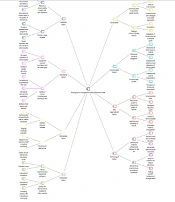
Considering the centrality of qualitative research, this research for the first time presented a stress management model in forensic medicine organization. Forensic medicine and the services provided by its units are among the professions that provide services to the injured and deceased people in the circumstances of the outcome. Obviously, any factor that disrupts this two-way relationship can create a background of occupational stress among forensic medical workers (Figure 2).
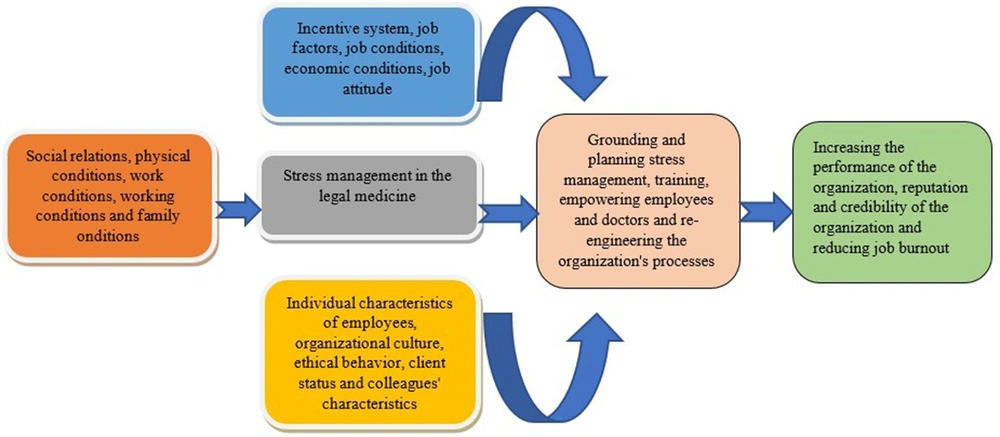
Figure 2.
Stress management model in forensic medicine organization
5. Discussion
In general, the pattern obtained in the present study can be discussed in comparison with the results of other studies from two aspects. First, the findings and the final achievement of the current research have presented a relatively comprehensive and complete model based on the conditions and characteristics of forensic medicine, and it is more suitable and comprehensive than other models presented by researchers for non-medical communities. Other models that have been presented for communities such as students, employees, nurses or other service and treatment institutions and administrative organizations are very brief and their comprehensiveness and generalizability are very low, and they cannot be presented as a suitable stress management model in forensic medicine. Second, compared to other models, the obtained model shows more comprehensiveness in terms of obtained dimensions, components and indicators. This issue has been compared with some domestic and foreign researches, which, while having the current research model, have most of the components and indicators limited to themselves, while in the current research model, a number of new components and indicators have been identified and calculated, which is a strength point for current research. The main achievement of the current research is the comprehensiveness of the model and its nativeness for stress management, based on the native characteristics of forensic medicine in Iran.
Similar to the results of the present research, in the study of Sharifian et al., the most stressful factor was mentioned in the work role and responsibility (26). Also, the results of Taghipour's research showed that components such as emotional exhaustion, individual performance, depersonalization and conflict have the greatest effect on the stress of forensic medical workers (27). The results of the present study showed that the stress factors are different in different departments of forensic medicine and their intensity in the field of dissection is different from other departments, which is consistent with the results of the research of Samadirad et al. (28). On the other hand, one of the most important factors affecting occupational stress in forensic medicine is personality and family factors, which were also emphasized in the research of Kinnunen et al. (29).
The results of the present study showed that the interference of work duties and the conflict of work and family interests not only cause occupational stress, but also cause symptoms of physical illness, depression, and deterioration. Obviously, this importance increases the amount of leave and absenteeism in the work environment, which is significant as a factor of job dissatisfaction. This category has been confirmed in the results of Tziner et al.'s research (30).
Coping with stressful factors is not mentioned in any of the 6 pattern groups obtained in the current research as a way to relieve the stress of forensic medical workers, while the results of Kazemipour and Mohd Amin's study show that they know “the exposure” is one of the most important stress strategies in the treatments environment (31).
In Randall and Altmayer's study, the most important factors of occupational stress are the personality type of people, while the results of the present study show that the stressful environment of forensic medicine is the most important element that creates stress among its employees (32). The results of this research showed that the stress caused by job responsibility and the stress of interpersonal relationships is one of the most important stress factors in forensic medicine. This shows that the existing organizational culture in forensic medicine can be in complete contrast with other similar work environments such as healthcare organizations. The results of this study show that most doctors and forensic medical staff feel that forensic administrators do not show much importance to their physical and mental health. Meanwhile, the results of Rezaei et al.'s study showed that positive managerial support is one of the most important ways to reduce occupational stress among health workers (33).
5.1. Conclusions
Considering all the discussed dimensions such as technological, social, political, cultural and economic developments, organizational stress management should be considered a dynamic phenomenon and appropriate to global conditions, and special attention should be paid to the cultural and social reproduction of this component. As a general rule, activities to manage occupational stress in the workplace should prioritize organizational changes to improve working conditions. Therefore, it is suggested to abandon the traditional view of the relationship between work and life, which leads to competition between work and life, and choose an approach in which the interests of the individual and the organization are considered simultaneously and in line with each other. Also, based on the results of this research, it is suggested to improve the training provided to the administrative forces in accordance with the assigned tasks, adjust the expectations from them (not expecting to do several tasks at the same time). It is also necessary to employ people in different responsibilities with great care and attention and use their expertise and professional knowledge to reduce and solve stressful issues. In this regard, any action can be taken to deal with occupational stress and implement occupational stress management programs based on the knowledge of the conditions, factors and fields of organizational, operational stress and cultural differences. Because in order to control any phenomenon, organizations must first identify the factors affecting it and plan to reduce or increase them.