
1. Background
Infertility, defined as the failure to achieve pregnancy after at least 12 months of regular, unprotected intercourse, is widely recognized as a global public health concern (1). In Iran, where childbearing is both culturally valued and politically encouraged, infertility represents a substantial challenge. National evidence indicates that infertility has remained a persistent concern over recent decades, further underscoring its relevance as a major public health issue (2, 3).
Beyond its biological impact, infertility imposes considerable psychosocial burdens. Affected individuals frequently experience diminished self-esteem, stigmatization, depression, anxiety, guilt, and reduced quality of life. These emotional challenges may strain marital relationships, intensify role conflicts, and undermine spousal identity. Such difficulties, which tend to be more pronounced among women, often stem from unfulfilled reproductive expectations and perceived threats to femininity or parental identity (4, 5). Given the high prevalence of infertility in Iran and its extensive psychosocial ramifications, strengthening family functioning is particularly critical (3).
These psychological pressures rarely remain confined to the individual and often affect the functioning of the entire family. Studies consistently show that infertile couples report poorer family functioning than fertile couples. Infertility can intensify stress, heighten marital tension, and disrupt emotional and role-related dynamics within the family, thereby increasing the risk of dysfunction (6). Understanding these relational patterns is therefore essential for developing effective educational and therapeutic strategies.
To evaluate family functioning with conceptual clarity, researchers commonly rely on the McMaster Model of Family Functioning and its associated Family Assessment Device (FAD). This model characterizes healthy families by clear roles, effective communication, and cohesive emotional relationships (7). Research applying this framework has documented notable impairments among infertile couples, particularly in domains such as problem-solving, communication, roles, and emotional responsiveness (8).
Given the wide-ranging psychosocial challenges associated with infertility and the consistent evidence of impaired family functioning across several McMaster dimensions, structured and theory-driven approaches are needed to support healthier family dynamics. Despite the relevance of the McMaster framework, few studies have examined its application among infertile couples in Iran. In response to these gaps, the present study was designed and conducted.
2. Objectives
The present study aimed to evaluate the effectiveness of an educational intervention based on the McMaster Model of Family Functioning in improving family functioning among infertile couples attending an infertility clinic in Kermanshah.
3. Methods
3.1. Study Design and Setting
A quasi experimental study with a pretest posttest design and random group allocation was conducted. The study population comprised all infertile couples attending the infertility center of Motazedi Hospital in Kermanshah. After infertility was diagnosed by a gynecologist, individuals were referred to the center, registered for therapeutic procedures, and received follow-up care at the facility. In total, 110 eligible couples were approached in person, of whom 56 consented to participate. These couples were then randomly allocated to the intervention group (n = 28) or the control group (n = 28).
3.2. Sampling Method and Random Allocation
Although participants were recruited through convenience sampling, after enrollment, they were randomly allocated to either the intervention or control group using a lottery method. Random allocation was performed by writing numbers 1 to 56 on separate sheets of paper and placing them in a container. Couples who selected even numbers were assigned to Group 1, and those who selected odd numbers were assigned to Group 2. To maintain equal group sizes, selected numbers were not returned to the container.
To determine which group would serve as the intervention or control, four separate sheets labeled "1-Intervention," "2-Intervention," "1-Control," and "2-Control" were placed in a separate container. The first participant to enter the study was asked to select one sheet. The sheet drawn was "2-Control"; accordingly, Group 2 was designated as the control group and Group 1 as the intervention group.
3.3. Sample Size Determination
The sample size was calculated based on the mean and standard deviation of the problem-solving domain reported in a previous study of two educational groups. With a 95% confidence level and 90% power, the minimum required sample size was 15 couples per group. To increase precision and account for anticipated attrition, we increased the sample size to 28 couples per group.
3.4. Inclusion and Exclusion Criteria
Participants were included if they had a specialist-confirmed diagnosis of infertility and no chronic physical illness. Individuals with no documented psychiatric disorders or history of substance abuse were eligible. A minimum educational level of completion of middle school was required, and all participants were required to have resided in Kermanshah for at least the previous five years. Participants were excluded if they chose to withdraw at any stage of the research, submitted incomplete questionnaires, or were absent for more than one training session.
3.5. Data Collection Tools
Data were collected using two instruments. The first was a researcher-developed Demographic and Fertility Information Questionnaire designed to obtain essential background data, including participants' age, spouses' age, duration of infertility, number of treatment attempts, educational attainment, length of marriage, and other pertinent characteristics.
The second instrument was the Family Assessment Device (FAD), developed by Epstein, Baldwin, and Bishop in 1983, which measures family functioning based on the McMaster Model. The FAD includes 60 items rated on a 4-point Likert scale, with total scores ranging from 60 to 240. It assesses seven core dimensions: problem-solving, roles, emotional involvement, communication, emotional responsiveness, behavioral control, and general functioning (9). Subscale scores are calculated as mean ratings, with lower scores indicating better family functioning and higher scores indicating greater dysfunction. Total scores range from 60 to 240, with lower scores reflecting healthy functioning and higher scores indicating severe impairment. The Persian version of the FAD has been psychometrically validated, demonstrating good internal consistency (Cronbach α = 0.82) and acceptable test-retest reliability.
3.6. Data Collection Procedure
The study was conducted from June 22 to November 22, 2017. After providing informed consent, participants were randomly assigned to the intervention or control groups. Both groups completed the demographic questionnaire and the FAD in approximately 10 minutes in the researcher's presence, using the provided folders. Follow-up questionnaires were collected via Telegram four weeks after the intervention, with a telephone reminder. Five couples per group withdrew, leaving 23 couples per group for the final analysis.
3.7. Intervention Implementation
The sessions were delivered by the first author (F.A.), a trained midwifery counselor with a Master's degree in Midwifery Counseling and five years of clinical experience in infertility counseling. The educational intervention was delivered to the intervention group in the well-equipped conference hall of Motazedi Hospital. To ensure a focused and comfortable learning environment, training was conducted separately for male and female participants. Participants in the intervention group were further divided into two equal subgroups (n = 14 each) to facilitate more interactive and individualized instruction.
Each subgroup received a structured program consisting of four weekly sessions, each lasting approximately 90 minutes. The content was designed based on the McMaster Model of Family Functioning and covered its seven core dimensions. A detailed educational manual was developed for the intervention and included session-by-session scripts, discussion guides, and activity protocols. The manual was reviewed and validated by three faculty members before implementation. All subgroups received identical content following the same structured protocol.
The sessions used an interactive, multimodal teaching approach integrating didactic lectures, guided group discussions, collaborative team exercises, and practical homework assignments to reinforce learning and promote real-world application. Attendance was recorded at each session. No participant missed more than one session, consistent with the exclusion criteria. Homework assignments were reviewed at the beginning of each subsequent session.
Detailed session content and instructional methods are outlined in Table 1.
Table 1.
Structure and Content of Educational Sessions
| Session | Core Content | Teaching Methods | Instructional Materials |
|---|---|---|---|
| 1 | Problem-solving: Definition of problems and problem-solving; coping strategies; the six-step problem-solving method (1. Define problem, 2. Analyze causes, 3. Generate solutions, 4. Select best solution(s), 5. Implement solution, 6. Evaluate outcome). | Lecture, group discussion, teamwork, homework (apply the six-step method to a real couple's issue). | PowerPoint, whiteboard, printed summaries |
| 2 | Communication: Definition and importance of communication; verbal vs nonverbal communication; communication styles; passive vs active listening; managing communication processes; identifying barriers to effective communication. | Lecture, group discussion, teamwork, homework (practice and record use of communication techniques in daily interactions). | PowerPoint, whiteboard, printed summaries |
| 3 | Emotional responsiveness and general functioning: Interpersonal effectiveness skills; conflict resolution styles; emotional intelligence concepts; strategies to enhance emotional intelligence; mindful communication; anger management techniques. | Lecture, group discussion, teamwork, homework (practice emotionally responsive behaviors in real situations). | PowerPoint, whiteboard, printed summaries |
| 4 | Roles, emotional involvement, and behavioral control: Defining family roles and their functions; types of emotional involvement; concepts of behavioral control; different control styles within family systems. | Lecture, group discussion, teamwork, homework (practice role flexibility, express affection, and apply adaptive family rules). | PowerPoint, whiteboard, printed summaries |
3.8. Statistical Analysis
Data were analyzed using SPSS software (version 22). The normality of the data distribution was confirmed using the Kolmogorov-Smirnov test (P > 0.05). Accordingly, independent-samples t tests were used to compare continuous variables between groups, and chi-square or Fisher exact tests were used for categorical comparisons. Analysis of covariance was also used where appropriate. A P value < 0.05 was considered statistically significant.
3.9. Ethical Considerations
This study received ethical approval from the Ethics Committee of Kermanshah University of Medical Sciences (Ethics Code: kums.rec.1396.82) and was registered in the Iranian Clinical Trials Registry (Registration ID: IRCT2017053014333N76). All participants provided written informed consent after receiving a full explanation of the study objectives, procedures, potential risks, and benefits. To uphold ethical standards and ensure equity, the educational booklet used in the intervention was provided to participants in the control group after completion of the post-intervention assessment.
4. Results
We first examined baseline demographic and fertility characteristics to confirm the comparability of the groups. We then evaluated the effect of the educational program on family functioning across the seven domains of the McMaster Model.
4.1. Demographic and Fertility Characteristics
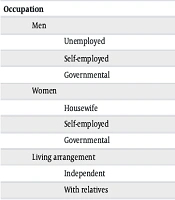
As shown in Tables 2 and 3, the intervention and control groups were comparable at baseline with respect to all demographic and fertility characteristics (all P > 0.05), confirming the effectiveness of random allocation.
Table 2.
Baseline Demographic Comparison of Groups a
| Variables | Intervention (n = 23) | Control (n = 23) | P-Value |
|---|---|---|---|
| Age (y) | |||
| Men | 34.30 ± 5.80 | 37.30 ± 6.51 | 0.135 |
| Women | 31.21 ± 5.73 | 33.73 ± 5.50 | 0.106 |
| Education | |||
| Men | 0.101 | ||
| Middle school | 4 (17.4) | 1 (4.3) | |
| Diploma | 14 (60.9) | 10 (43.5) | |
| University | 5 (21.7) | 12 (52.2) | |
| Women | 0.210 | ||
| Middle school | 5 (21.7) | 1 (4.3) | |
| Diploma | 10 (43.5) | 10 (43.5) | |
| University | 8 (34.8) | 12 (52.2) | |
| Occupation | |||
| Men | 0.314 | ||
| Unemployed | 1 (4.3) | 0 (0) | |
| Self-employed | 18 (78.3) | 15 (65.2) | |
| Governmental | 4 (17.4) | 8 (34.8) | |
| Women | 0.143 | ||
| Housewife | 17 (73.9) | 19 (82.6) | |
| Self-employed | 6 (26.1) | 2 (8.7) | |
| Governmental | 0 (0) | 2 (8.7) | |
| Living arrangement | 0.414 | ||
| Independent | 18 (78.3) | 21 (91.3) | |
| With relatives | 5 (21.7) | 2 (8.7) |
a Values are expressed as mean ± SD or No. (%). Comparisons were made using independent t tests for continuous variables and chi-square tests for categorical variables. Statistical significance was set at P < 0.05.
Table 3.
Fertility Characteristics at Baseline a
| Variables | Intervention (n = 23) | Control (n = 23) | P-Value |
|---|---|---|---|
| Infertile partner | 0.368 | ||
| Female | 6 (26.1) | 10 (43.5) | |
| Male | 10 (43.5) | 6 (26.1) | |
| Both | 7 (30.4) | 7 (30.4) | |
| Infertility type | 0.990 | ||
| Primary | 18 (78.3) | 18 (78.3) | |
| Secondary | 5 (21.7) | 5 (21.7) | |
| Infertility duration (y) | 4.93 ± 3.96 | 5.17 ± 3.92 | 0.838 |
a Values are expressed as No. (%) or mean ± SD. P from χ2 (categorical) or t test (continuous). Primary = no prior pregnancy; secondary = prior pregnancy achieved.
4.2. Post-Intervention Family Functioning
As detailed in Table 4, the educational program significantly improved five of the seven family functioning domains (P < 0.05), whereas affective responsiveness and affective involvement did not show significant changes.
Table 4.
Comparison of Post-Intervention Family Functioning Scores Between Groups a
| Domain | Intervention Group (n = 23) | Control Group (n = 23) | Mean Difference | P-Value |
|---|---|---|---|---|
| Problem-solving | 1.98 ± 0.32 | 1.83 ± 0.28 | 0.15 | 0.035 |
| Communication | 2.16 ± 0.43 | 1.99 ± 0.36 | 0.17 | < 0.001 |
| Roles | 2.28 ± 0.31 | 2.24 ± 0.30 | 0.04 | 0.045 |
| Affective responsiveness | 2.03 ± 0.41 | 1.91 ± 0.38 | 0.12 | 0.07 |
| Affective involvement | 1.06 ± 0.17 | 1.05 ± 0.25 | 0.01 | 0.474 |
| Behavioral control | 2.26 ± 0.27 | 2.19 ± 0.27 | 0.07 | < 0.001 |
| General functioning | 2.08 ± 0.30 | 2.03 ± 0.28 | 0.05 | 0.033 |
a Values are expressed as mean ± SD.
5. Discussion
The present study examined the effectiveness of a McMaster Model-based educational intervention on family functioning among infertile couples. The findings demonstrated significant improvements in several instrumental and structural domains of family functioning, including problem-solving, communication, roles, behavioral control, and overall general functioning, whereas no significant changes were observed in affective responsiveness or affective involvement.
Improvements in problem-solving and communication are consistent with the theoretical foundations of the McMaster Model, which emphasizes structured interaction patterns, clear communication, and effective problem-resolution processes. These results align with Pourmovahed et al. (10), who similarly reported the efficacy of McMaster-based interventions in strengthening couples' interpersonal functioning. Infertility inherently involves complex, multistep decision-making and emotionally demanding circumstances. Strengthening communication and problem-solving skills likely enabled couples to articulate concerns more clearly, collaboratively negotiate treatment decisions, and reduce relational misunderstandings, thereby fostering a more cohesive and adaptive partnership in the context of treatment-related stress.
Improvements in roles and behavioral control indicate that the intervention successfully guided couples in establishing clearer expectations, responsibilities, and behavioral regulation within the family system. This finding is consistent with that of Bibak and Bahrani (11), who highlighted the model's impact on relational intimacy through improved structural clarity. Infertility often disrupts conventional marital roles and increases emotional reactivity. Thus, clarifying roles and promoting adaptive behavioral regulation may reduce ambiguity, mitigate conflict, and enhance stability within couples' relational dynamics.
Strengthening these domains contributed to the observed improvements in general family functioning, reflecting the systemic interconnectedness emphasized by the McMaster Model. As supported by Qiu et al. (6), interventions that effectively enhance core functional dimensions can buffer the psychological impact of infertility and improve relational resilience.
The absence of significant improvements in affective responsiveness and affective involvement provides important insight. These emotional domains are closely linked to individual attachment histories, entrenched relational patterns, and long-standing emotional vulnerabilities. Unlike structural skills, emotional engagement and expression often require intensive, long-term, and experience-based therapeutic methods, such as emotion-focused therapy or attachment-oriented interventions (9, 12). The relatively short duration and primarily skill-based nature of the educational intervention likely limited its capacity to modify these deeper emotional constructs. Although the McMaster Model acknowledges emotional dimensions, it emphasizes the functional expression and regulation of emotions rather than altering the depth of emotional connection or intimacy. Therefore, durable emotional changes may require more prolonged or specialized therapeutic approaches beyond the scope of the present intervention.
Moreover, the intense emotional burden associated with infertility, characterized by grief, loss, shame, and chronic stress, may inhibit individuals' capacity for emotional openness within limited-session psychoeducational formats.
5.1. Study Limitations
Several limitations warrant consideration. First, reliance on self-report measures may have introduced response bias. Second, the relatively short duration of the intervention may have been insufficient to influence deep-seated emotional processes. Third, the absence of long-term follow-up limits conclusions regarding the sustainability of improvements. Additionally, the sample was drawn from a specific clinical population, potentially affecting generalizability to other cultural or demographic groups.
Future studies should incorporate longitudinal designs to evaluate the persistence of intervention effects over time. Investigating the effectiveness of integrated interventions that combine the McMaster Model with emotion-focused or attachment-based approaches may yield deeper improvements in affective functioning. Moreover, examining differential responses based on duration of infertility, cultural norms, or gender-specific experiences could provide nuanced insights into tailoring interventions for diverse infertile populations.
5.2. Conclusions
In summary, the McMaster Model-based educational intervention demonstrated strong efficacy in enhancing structural and instrumental domains of family functioning among infertile couples, highlighting its value as a supportive psychosocial tool within infertility care. Although the intervention did not substantially alter affective responsiveness or affective involvement, this finding underscores the need for complementary, emotionally oriented approaches when targeting deeper relational and emotional dynamics. Collectively, the findings affirm that strengthening the operational pillars of family functioning can significantly bolster couples' adaptability and resilience during the infertility experience.