
1. Context
Chronic wounds, particularly diabetic foot ulcers and pressure injuries, are persistent disruptions of skin integrity that fail to progress through the expected stages of repair. They commonly occur in individuals with diabetes, vascular disease, immobility, or neuropathy and are sustained by persistent inflammation, oxidative stress, impaired perfusion, infection, and defective extracellular-matrix remodeling (1). Their prevalence and recurrence impose substantial physical, psychosocial, and economic burdens on patients and health systems (2). Because wound assessment, dressing selection, infection surveillance, and continuity of care are central components of nursing practice, nurses are closely involved in the management of hard-to-heal wounds and in recognizing changes that require treatment modification (3).
The wound microenvironment is increasingly recognized as a determinant of healing. Intact skin is mildly acidic, whereas chronic or infected wounds frequently become more alkaline, with reported values commonly ranging from approximately pH 7.5 to 9 (4). Alkalinization can alter protease activity, oxygen release, microbial growth, collagen synthesis, keratinocyte migration, and angiogenesis. These observations have generated interest in wound pH as an indicator of local biological change and as a trigger for responsive treatment. Nevertheless, pH should not be interpreted as a stand-alone diagnostic marker because wound type, exudate, bacterial burden, treatment, and healing stage can influence measured values.
Stimuli-responsive biomaterials have been developed to interact with these microenvironmental changes. Smart hydrogels, polymeric films, nanofibers, and composite dressings can be engineered to swell, degrade, change permeability, alter color, conduct electrical signals, or release therapeutic agents under defined pH conditions (5-8). Chitosan, alginate, gelatin, cellulose derivatives, and poly(vinyl alcohol) are frequently investigated because they provide moisture retention, biocompatibility, structural support, and matrices for localized delivery. Electrospun PVA nanofibers containing antimicrobial compounds illustrate the broader potential of polymer-based wound platforms, although not all such systems are pH-responsive (9).
Nano-enabled components may further modify the biological and functional performance of responsive dressings. Silver, copper, zinc oxide, graphene-based materials, and nanozyme systems have been studied for antimicrobial, catalytic, antioxidant, and angiogenesis-related effects. Experimental studies have reported improved bacterial control, granulation, vascular responses, or tissue repair with nanoparticle-containing dressings and scaffolds (10-13). When nanoparticles or therapeutic cargos are incorporated into pH-sensitive polymer matrices, release can be conditioned by the wound environment. Colorimetric, optical, electrochemical, and fluorescent elements have also been incorporated into prototype dressings to convert pH changes into visible or measurable signals (5, 7).
Despite rapid development, the evidence base remains difficult to interpret. Many publications are laboratory studies, animal experiments, narrative reviews, or proof-of-concept reports, and materials, wound models, comparators, pH ranges, outcomes, and follow-up periods differ considerably. Reviews addressing hydrogels, conductive polymers, or nanotechnology in wound care provide useful context (8, 14), while broader nursing literature discusses evidence implementation, community wound management, and emerging digital technologies (15-17). However, these sources do not demonstrate that nurses currently use pH-responsive polymer-nanoparticle dressings in routine practice. Nursing implications must therefore be framed as prospective considerations dependent on clinical validation, usability testing, education, workflow integration, and regulatory approval.
A further methodological concern is that not every smart dressing, nanoparticle formulation, or wound-care paper is eligible for a focused review of pH-responsive polymeric wound systems. Some studies investigate pH-responsive polymer films without nanoparticles, whereas others evaluate nanoparticles without a pH-responsive polymeric mechanism. Both types are relevant to the broader field, but only pH-responsive polymeric platforms and true pH-responsive hybrid systems fall within the scope of this review. Review articles and general nursing studies may inform the background but should not be synthesized as primary intervention evidence. Recent work on pH-sensitive chitosan films, chitosan-coated silver nanocomposites, and functional chitosan materials demonstrates the breadth of related research while highlighting the need for explicit eligibility criteria and design-appropriate appraisal (18-20).
Accordingly, this systematic review aimed to identify and synthesize primary preclinical studies that directly evaluated pH-responsive polymeric or polymer-nanoparticle wound systems and reported therapeutic, antimicrobial, sensing, or wound-repair outcomes. It also examined methodological quality using tools matched to the experimental design and considered the potential relevance of findings to future nursing assessment and wound-care research. Nursing implications were treated as future-oriented interpretations rather than evidence of established clinical effectiveness.
2. Evidence Acquisition
This systematic review was conducted and reported in accordance with PRISMA 2020 (21). The review process comprised formulation of the research question, database searching, duplicate removal, title/abstract screening, full-text eligibility assessment, design-specific quality appraisal, data extraction, thematic coding, and narrative synthesis.
The review question was structured using a PICO framework adapted for preclinical wound research. The population comprised in vitro wound-relevant systems and in vivo models of diabetic, infected, ischemic, pressure-related, or full-thickness wounds. Eligible interventions were pH-responsive polymeric wound systems, including hydrogels, films, nanofibers, and polymer-nanoparticle or nanozyme composites. Nano-enabled systems were included when the nanoscale component was integral to the responsive therapeutic or sensing platform. Comparators included untreated controls, blank or non-responsive matrices, conventional dressings, or other experimental controls. Eligible outcomes included pH-triggered release, antimicrobial activity, bacterial reduction, oxidative-stress or inflammatory modulation, angiogenesis, granulation, epithelialization, wound closure, biocompatibility, and pH-sensing performance. Potential nursing relevance was considered only during interpretation and was not an eligibility outcome.
A comprehensive search was conducted in the Cochrane Library, PubMed/MEDLINE, Scopus, Embase, Web of Science, ProQuest, SID, the Ovid platform, and Google Scholar for records published from January 2017 through January 31, 2026. Controlled vocabulary and free-text terms covered chronic wounds, diabetic foot ulcers, pressure injuries, pH-responsive or pH-sensitive systems, smart polymers, hydrogels, wound dressings, nanocomposites, nanoparticles, nanosilver, zinc oxide, copper nanoparticles, nanocarriers, nanogels, and nanofibers. The electronic strategy intentionally emphasized the interface between responsive polymers and nano-enabled wound care; reference-list searching supplemented retrieval of otherwise eligible pH-responsive polymeric systems that were not explicitly indexed with nano-related terms. Database syntax was adapted to each platform, and no full-text filter was applied during retrieval. Table 1 presents the database-specific strategies, and Table 2 summarizes the search yield.
Table 1.
Systematic Search Strategy
| Database-specific systematic search strategies used for study identification | ||
|---|---|---|
| Database/source | Database-specific search strategy | Search limits and notes |
| PubMed/MEDLINE | (("Wound Healing"[Mesh] OR "Diabetic Foot"[Mesh] OR "Pressure Ulcer"[Mesh] OR "chronic wound"[Title/Abstract] OR "chronic wounds"[Title/Abstract] OR "diabetic foot ulcer"[Title/Abstract] OR "diabetic foot ulcers"[Title/Abstract] OR "diabetic wound"[Title/Abstract] OR "diabetic wounds"[Title/Abstract] OR "pressure ulcer"[Title/Abstract] OR "pressure ulcers"[Title/Abstract] OR "pressure injury"[Title/Abstract] OR "pressure injuries"[Title/Abstract] OR "ischemic wound"[Title/Abstract] OR "ischemic wounds"[Title/Abstract] OR "infected wound"[Title/Abstract] OR "infected wounds"[Title/Abstract] OR "full-thickness wound"[Title/Abstract] OR "full-thickness wounds"[Title/Abstract] OR ("wound healing"[Title/Abstract] AND chronic[Title/Abstract])) AND ("pH-responsive"[Title/Abstract] OR "pH responsive"[Title/Abstract] OR "pH-sensitive"[Title/Abstract] OR "pH sensitive"[Title/Abstract] OR "pH-triggered"[Title/Abstract] OR "pH triggered"[Title/Abstract] OR "pH-activated"[Title/Abstract] OR "pH activated"[Title/Abstract] OR "pH-dependent"[Title/Abstract] OR "pH dependent"[Title/Abstract] OR "pH-mediated"[Title/Abstract] OR "pH mediated"[Title/Abstract] OR "acid-responsive"[Title/Abstract] OR "acid responsive"[Title/Abstract] OR "acid-sensitive"[Title/Abstract] OR "acid sensitive"[Title/Abstract] OR ("stimuli-responsive"[Title/Abstract] AND "pH"[Title/Abstract])) AND ("Polymers"[Mesh] OR "Hydrogels"[Mesh] OR polymer[Title/Abstract] OR polymers[Title/Abstract] OR hydrogel[Title/Abstract] OR hydrogels[Title/Abstract] OR "smart polymer"[Title/Abstract] OR "smart polymers"[Title/Abstract] OR "intelligent hydrogel"[Title/Abstract] OR "intelligent hydrogels"[Title/Abstract] OR "wound dressing"[Title/Abstract] OR "wound dressings"[Title/Abstract] OR scaffold[Title/Abstract] OR scaffolds[Title/Abstract] OR nanocomposite[Title/Abstract] OR nanocomposites[Title/Abstract]) AND ("Nanoparticles"[Mesh] OR nanoparticle[Title/Abstract] OR nanoparticles[Title/Abstract] OR nanosilver[Title/Abstract] OR "silver nanoparticle"[Title/Abstract] OR "silver nanoparticles"[Title/Abstract] OR nanozinc[Title/Abstract] OR "zinc oxide nanoparticle"[Title/Abstract] OR "zinc oxide nanoparticles"[Title/Abstract] OR "copper nanoparticle"[Title/Abstract] OR "copper nanoparticles"[Title/Abstract] OR "metallic nanoparticle"[Title/Abstract] OR "metallic nanoparticles"[Title/Abstract] OR "ceramic nanoparticle"[Title/Abstract] OR "ceramic nanoparticles"[Title/Abstract] OR nanocarrier[Title/Abstract] OR nanocarriers[Title/Abstract] OR nanogel[Title/Abstract] OR nanogels[Title/Abstract] OR nanofiber[Title/Abstract] OR nanofibers[Title/Abstract] OR nanofibrous[Title/Abstract] OR nanoformulation[Title/Abstract] OR nanoformulations[Title/Abstract] OR nanosystem[Title/Abstract] OR nanosystems[Title/Abstract])) | Search period: January 2017 to January 31, 2026. PubMed/MEDLINE was searched using MeSH and title/abstract terms. |
| Scopus | TITLE-ABS-KEY(("chronic wound*" OR "diabetic foot ulcer*" OR "diabetic wound*" OR "pressure ulcer*" OR "pressure injur*" OR "ischemic wound*" OR "infected wound*" OR "full-thickness wound*" OR ("wound healing" AND chronic)) AND ("pH-responsive" OR "pH responsive" OR "pH-sensitive" OR "pH sensitive" OR "pH-triggered" OR "pH triggered" OR "pH-activated" OR "pH activated" OR "pH-dependent" OR "pH dependent" OR "pH-mediated" OR "pH mediated" OR "acid-responsive" OR "acid responsive" OR "acid-sensitive" OR "acid sensitive" OR ("stimuli-responsive" AND pH)) AND (polymer* OR hydrogel* OR "smart polymer*" OR "intelligent hydrogel*" OR "wound dressing*" OR scaffold* OR nanocomposite*) AND (nanoparticle* OR nanosilver OR "silver nanoparticle*" OR nanozinc OR "zinc oxide nanoparticle*" OR "copper nanoparticle*" OR "metallic nanoparticle*" OR "ceramic nanoparticle*" OR nanocarrier* OR nanogel* OR nanofiber* OR nanofibrous OR nanoformulation* OR nanosystem*)) | Search period: January 2017 to January 31, 2026. Records were screened by title/abstract, followed by full-text eligibility assessment. |
| Web of Science | TS=(("chronic wound*" OR "diabetic foot ulcer*" OR "diabetic wound*" OR "pressure ulcer*" OR "pressure injur*" OR "ischemic wound*" OR "infected wound*" OR "full-thickness wound*" OR ("wound healing" AND chronic)) AND ("pH-responsive" OR "pH responsive" OR "pH-sensitive" OR "pH sensitive" OR "pH-triggered" OR "pH triggered" OR "pH-activated" OR "pH activated" OR "pH-dependent" OR "pH dependent" OR "pH-mediated" OR "pH mediated" OR "acid-responsive" OR "acid responsive" OR "acid-sensitive" OR "acid sensitive" OR ("stimuli-responsive" AND pH)) AND (polymer* OR hydrogel* OR "smart polymer*" OR "intelligent hydrogel*" OR "wound dressing*" OR scaffold* OR nanocomposite*) AND (nanoparticle* OR nanosilver OR "silver nanoparticle*" OR nanozinc OR "zinc oxide nanoparticle*" OR "copper nanoparticle*" OR "metallic nanoparticle*" OR "ceramic nanoparticle*" OR nanocarrier* OR nanogel* OR nanofiber* OR nanofibrous OR nanoformulation* OR nanosystem*)) | Search period: January 2017 to January 31, 2026. The topic field included title, abstract, author keywords, and Keywords Plus. |
| Embase via Elsevier | ('chronic wound*':ti,ab,kw OR 'diabetic foot ulcer*':ti,ab,kw OR 'diabetic wound*':ti,ab,kw OR 'pressure ulcer*':ti,ab,kw OR 'pressure injur*':ti,ab,kw OR 'ischemic wound*':ti,ab,kw OR 'infected wound*':ti,ab,kw OR 'full-thickness wound*':ti,ab,kw OR ('wound healing':ti,ab,kw AND chronic:ti,ab,kw)) AND ('pH-responsive':ti,ab,kw OR 'pH responsive':ti,ab,kw OR 'pH-sensitive':ti,ab,kw OR 'pH sensitive':ti,ab,kw OR 'pH-triggered':ti,ab,kw OR 'pH triggered':ti,ab,kw OR 'pH-activated':ti,ab,kw OR 'pH activated':ti,ab,kw OR 'pH-dependent':ti,ab,kw OR 'pH dependent':ti,ab,kw OR 'pH-mediated':ti,ab,kw OR 'pH mediated':ti,ab,kw OR 'acid-responsive':ti,ab,kw OR 'acid responsive':ti,ab,kw OR 'acid-sensitive':ti,ab,kw OR 'acid sensitive':ti,ab,kw OR ('stimuli-responsive':ti,ab,kw AND pH:ti,ab,kw)) AND (polymer*:ti,ab,kw OR hydrogel*:ti,ab,kw OR 'smart polymer*':ti,ab,kw OR 'intelligent hydrogel*':ti,ab,kw OR 'wound dressing*':ti,ab,kw OR scaffold*:ti,ab,kw OR nanocomposite*:ti,ab,kw) AND (nanoparticle*:ti,ab,kw OR nanosilver:ti,ab,kw OR 'silver nanoparticle*':ti,ab,kw OR nanozinc:ti,ab,kw OR 'zinc oxide nanoparticle*':ti,ab,kw OR 'copper nanoparticle*':ti,ab,kw OR 'metallic nanoparticle*':ti,ab,kw OR 'ceramic nanoparticle*':ti,ab,kw OR nanocarrier*:ti,ab,kw OR nanogel*:ti,ab,kw OR nanofiber*:ti,ab,kw OR nanofibrous:ti,ab,kw OR nanoformulation*:ti,ab,kw OR nanosystem*:ti,ab,kw) | Search period: January 2017 to January 31, 2026. Embase via Elsevier was searched using title, abstract, and keyword fields. Records were screened by title/abstract, followed by full-text eligibility assessment. |
| ProQuest | ("chronic wound*" OR "diabetic foot ulcer*" OR "diabetic wound*" OR "pressure ulcer*" OR "pressure injur*" OR "ischemic wound*" OR "infected wound*" OR "full-thickness wound*" OR ("wound healing" AND chronic)) AND ("pH-responsive" OR "pH responsive" OR "pH-sensitive" OR "pH sensitive" OR "pH-triggered" OR "pH triggered" OR "pH-activated" OR "pH activated" OR "pH-dependent" OR "pH dependent" OR "pH-mediated" OR "pH mediated" OR "acid-responsive" OR "acid responsive" OR "acid-sensitive" OR "acid sensitive" OR ("stimuli-responsive" AND pH)) AND (polymer* OR hydrogel* OR "smart polymer*" OR "intelligent hydrogel*" OR "wound dressing*" OR scaffold* OR nanocomposite*) AND (nanoparticle* OR nanosilver OR "silver nanoparticle*" OR nanozinc OR "zinc oxide nanoparticle*" OR "copper nanoparticle*" OR "metallic nanoparticle*" OR "ceramic nanoparticle*" OR nanocarrier* OR nanogel* OR nanofiber* OR nanofibrous OR nanoformulation* OR nanosystem*) | Search period: January 2017 to January 31, 2026. The query was applied using the advanced search interface across title, abstract, and subject fields where available. |
| Cochrane Library | ("chronic wound*" OR "diabetic foot ulcer*" OR "diabetic wound*" OR "pressure ulcer*" OR "pressure injur*" OR ("wound healing" AND chronic)) AND ("pH-responsive" OR "pH responsive" OR "pH-sensitive" OR "pH sensitive" OR "pH-triggered" OR "pH triggered" OR "pH-activated" OR "pH activated" OR "pH-dependent" OR "pH dependent" OR "pH-mediated" OR "pH mediated" OR "acid-responsive" OR "acid responsive" OR "acid-sensitive" OR "acid sensitive" OR ("stimuli-responsive" AND pH)) AND (polymer* OR hydrogel* OR "wound dressing*" OR scaffold* OR nanocomposite*) AND (nanoparticle* OR nanosilver OR "silver nanoparticle*" OR "zinc oxide nanoparticle*" OR "copper nanoparticle*" OR nanocarrier* OR nanogel* OR nanofiber*) | Search period: January 2017 to January 31, 2026. The Cochrane Library was searched as a supplementary source to identify potentially relevant trials, reviews, and reference lists. Only primary studies meeting the predefined eligibility criteria were considered for inclusion in the evidence synthesis. |
| SID | pH-sensitive hydrogel" AND "wound healing"; "pH-responsive" AND "nanoparticle" AND "wound"; "smart wound dressing" AND "nanoparticle". | Search period: January 2017 to January 31, 2026. Persian and English records were screened where supported by the database interface. |
| Google Scholar | Simplified keyword combinations were used because Google Scholar does not reliably support complex reproducible Boolean strings. The following combinations were searched separately: "pH-responsive hydrogel" AND "chronic wound"; "pH-sensitive hydrogel" AND "diabetic foot ulcer"; "pH-responsive wound dressing" AND nanoparticle; "smart wound dressing" AND "silver nanoparticle"; "nanocomposite hydrogel" AND "wound healing" AND pH; "zinc oxide nanoparticle" AND "wound healing" AND hydrogel; "copper nanoparticle" AND "wound healing" AND hydrogel; "acid-responsive hydrogel" AND "wound healing"; "pH-dependent release" AND hydrogel AND wound. | Search period: January 2017 to January 31, 2026. For each keyword combination, the first 100 results sorted by relevance were screened. |
| Ovid platform | (exp Wound Healing/ OR exp Diabetic Foot/ OR exp Pressure Ulcer/ OR "chronic wound*".ti,ab,kw OR "diabetic foot ulcer*".ti,ab,kw OR "diabetic wound*".ti,ab,kw OR "pressure ulcer*".ti,ab,kw OR "pressure injur*".ti,ab,kw OR "ischemic wound*".ti,ab,kw OR "infected wound*".ti,ab,kw OR "full-thickness wound*".ti,ab,kw OR ("wound healing".ti,ab,kw AND chronic.ti,ab,kw)) AND ("pH-responsive".ti,ab,kw OR "pH responsive".ti,ab,kw OR "pH-sensitive".ti,ab,kw OR "pH sensitive".ti,ab,kw OR "pH-triggered".ti,ab,kw OR "pH triggered".ti,ab,kw OR "pH-activated".ti,ab,kw OR "pH activated".ti,ab,kw OR "pH-dependent".ti,ab,kw OR "pH dependent".ti,ab,kw OR "pH-mediated".ti,ab,kw OR "pH mediated".ti,ab,kw OR "acid-responsive".ti,ab,kw OR "acid responsive".ti,ab,kw OR "acid-sensitive".ti,ab,kw OR "acid sensitive".ti,ab,kw OR ("stimuli-responsive".ti,ab,kw AND pH.ti,ab,kw)) AND (exp Polymers/ OR exp Hydrogels/ OR polymer*.ti,ab,kw OR hydrogel*.ti,ab,kw OR "smart polymer*".ti,ab,kw OR "intelligent hydrogel*".ti,ab,kw OR "wound dressing*".ti,ab,kw OR scaffold*.ti,ab,kw OR nanocomposite*.ti,ab,kw) AND (exp Nanoparticles/ OR nanoparticle*.ti,ab,kw OR nanosilver.ti,ab,kw OR "silver nanoparticle*".ti,ab,kw OR nanozinc.ti,ab,kw OR "zinc oxide nanoparticle*".ti,ab,kw OR "copper nanoparticle*".ti,ab,kw OR "metallic nanoparticle*".ti,ab,kw OR "ceramic nanoparticle*".ti,ab,kw OR nanocarrier*.ti,ab,kw OR nanogel*.ti,ab,kw OR nanofiber*.ti,ab,kw OR nanofibrous.ti,ab,kw OR nanoformulation*.ti,ab,kw OR nanosystem*.ti,ab,kw) | Search period: January 2017 to January 31, 2026. Ovid was used as a supplementary platform search with controlled-vocabulary mapping where available; overlapping records were managed during deduplication. |
| Reference-list searching | Reference lists of eligible articles and relevant background reviews were manually screened to identify additional primary studies directly evaluating pH-responsive polymeric or nano-enabled wound systems. | Same eligibility criteria as database searches. |
Table 2.
Summary of Search Results Across Databases
| Databases | Results |
|---|---|
| Cochrane Library | 95 |
| PubMed/Medline | 245 |
| Embase | 210 |
| Web of Science | 195 |
| Scopus | 230 |
| ProQuest | 160 |
| Ovid platform | 110 |
| SID | 90 |
| Google Scholar | 320 |
| Total | 1655 |
Screening was performed in two stages: title/abstract screening followed by full-text assessment. Studies were included if they were primary experimental reports, published in English or Persian within the specified period, directly evaluated a pH-responsive polymeric wound platform with or without an integrated nano-enabled component, and reported at least one eligible therapeutic, biological, release, or sensing outcome. Review articles, conceptual papers, conference abstracts, nursing studies without direct technology evaluation, non-wound studies, systems without an explicit pH-responsive mechanism, and studies lacking an eligible polymeric wound platform were excluded.
The search identified 1,655 database records and 20 additional records, yielding 1,675 records. After removal of 694 duplicates, 981 records underwent title/abstract screening; 864 were excluded. A total of 117 reports were assessed for eligibility. Of these, 103 were excluded: conference abstracts, posters, or clearly unrelated reports (n = 74); no explicit pH-responsive mechanism (n = 8); no eligible polymeric wound platform (n = 6); review or non-primary publication (n = 5); wrong wound model or indication (n = 4); no eligible therapeutic, biological, release, or sensing outcome (n = 3); and insufficient data or duplicate cohort (n = 3). Fourteen primary preclinical studies were included (Figure 1). Two reviewers independently screened records and extracted data; disagreements were resolved by consensus and, when necessary, through consultation with a third reviewer. Inter-rater agreement was Cohen's kappa = 0.86 (95% CI, 0.82 - 0.89).
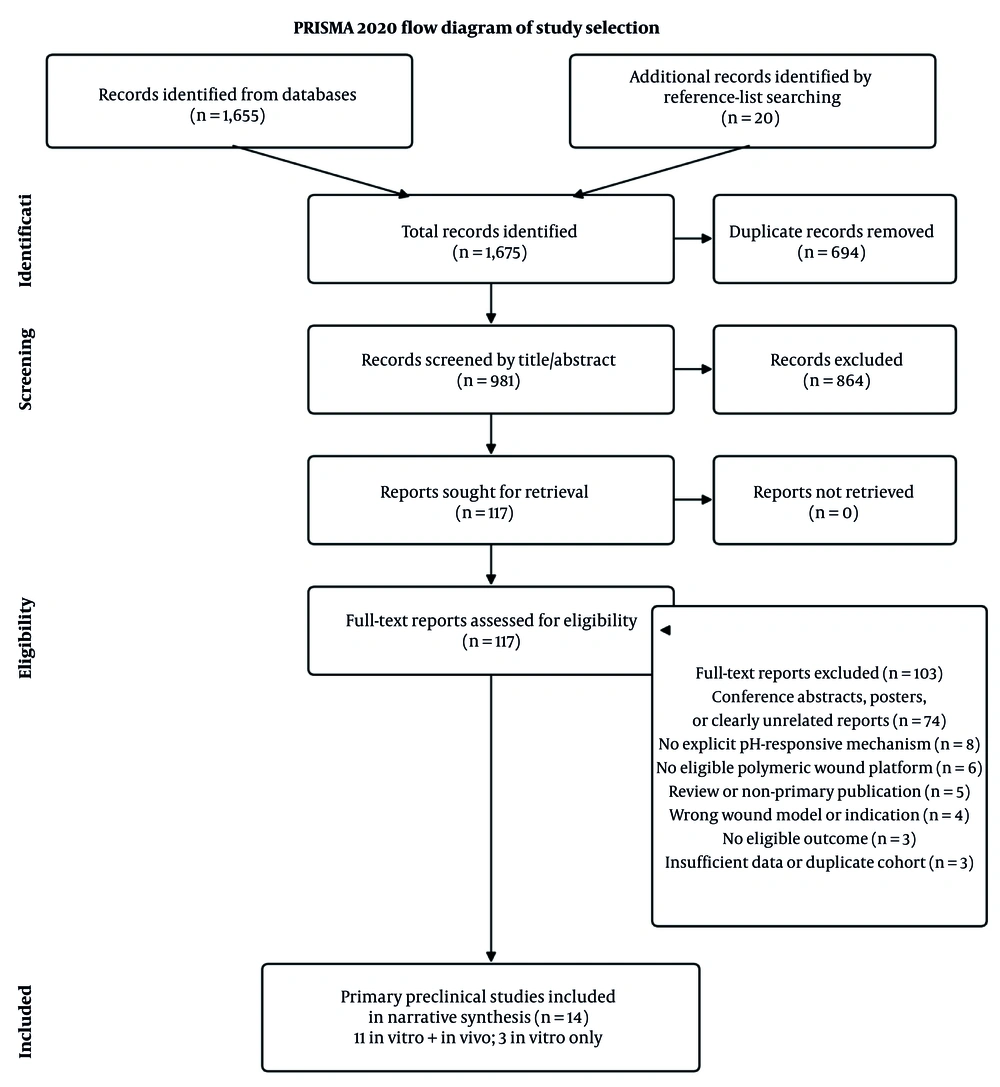
Figure 1.
PRISMA 2020 flow diagram of study selection.
Methodological appraisal was matched to study design. Animal-study components were assessed using the 10-domain SYRCLE risk-of-bias tool, with each domain judged as low, high, or unclear risk (22). ARRIVE 2.0 Essential 10 was used only to describe reporting completeness in animal experiments and was not treated as a risk-of-bias score (23). In vitro components were assessed with the 12-item QUIN tool; adequately reported items received 2 points, inadequately reported items 1 point, and unreported items 0 points, with the percentage calculated from the maximum applicable score (24 points when all items were applicable) (24). Because no universally accepted risk-of-bias instrument exists for heterogeneous in vitro wound-biomaterial studies, QUIN was used as a structured appraisal framework, and this adaptation was considered during interpretation. QUIN percentages above 70% were interpreted as low risk of bias, 50%-70% as medium risk, and below 50% as high risk. For eligibility, studies with low or medium QUIN risk were retained. Animal studies were retained when no critical concern was identified in outcome assessment or selective reporting and when fewer than three SYRCLE domains were judged high risk. The term 'some concerns' was used as a prespecified review-level descriptive synthesis rather than as an official SYRCLE category. Table 3 summarizes the study-level tool-specific appraisal results.
Table 3.
Design-Specific Methodological Appraisal of Included Studies a
| Reference No. | Study/design | Appraisal tool(s) | Tool-specific result | Overall appraisal | Eligibility decision |
|---|---|---|---|---|---|
| (33) | Tang et al., 2025; in vitro + in vivo | SYRCLE; QUIN; ARRIVE 2.0 | SYRCLE 4 L/5U/1H; QUIN 20/24 (83.3%); ARRIVE 8/10 | Some concerns; in vitro low risk | Included |
| (5) | Zhu et al., 2025; in vitro + in vivo | SYRCLE; QUIN; ARRIVE 2.0 | SYRCLE 4 L/5U/1H; QUIN 19/24 (79.2%); ARRIVE 8/10 | Some concerns; in vitro low risk | Included |
| (12) | Zhou et al., 2025; in vitro + in vivo | SYRCLE; QUIN; ARRIVE 2.0 | SYRCLE 5 L/4U/1H; QUIN 21/24 (87.5%); ARRIVE 9/10 | Some concerns; in vitro low risk | Included |
| (13) | Huang et al., 2024; in vitro only | QUIN | 19/24 (79.2%) | Low risk of bias | Included |
| (25) | Haidari et al., 2021; in vitro only | QUIN | 18/24 (75.0%) | Low risk of bias | Included |
| (26) | Rahmani et al., 2022; in vitro only | QUIN | 18/24 (75.0%) | Low risk of bias | Included |
| (32) | Hu et al., 2021; in vitro + in vivo | SYRCLE; QUIN; ARRIVE 2.0 | SYRCLE 5 L/4U/1H; QUIN 20/24 (83.3%); ARRIVE 8/10 | Some concerns; in vitro low risk | Included |
| (27) | Li Z et al., 2024; in vitro + in vivo | SYRCLE; QUIN; ARRIVE 2.0 | SYRCLE 6 L/3U/1H; QUIN 21/24 (87.5%); ARRIVE 9/10 | Some concerns; in vitro low risk | Included |
| (35) | Li Z et al., 2021; in vitro + in vivo | SYRCLE; QUIN; ARRIVE 2.0 | SYRCLE 5 L/4U/1H; QUIN 20/24 (83.3%); ARRIVE 8/10 | Some concerns; in vitro low risk | Included |
| (28) | Li Q et al., 2024; in vitro + in vivo | SYRCLE; QUIN; ARRIVE 2.0 | SYRCLE 5 L/4U/1H; QUIN 20/24 (83.3%); ARRIVE 8/10 | Some concerns; in vitro low risk | Included |
| (31) | Cheng et al., 2026; in vitro + in vivo | SYRCLE; QUIN; ARRIVE 2.0 | SYRCLE 5 L/4U/1H; QUIN 20/24 (83.3%); ARRIVE 8/10 | Some concerns; in vitro low risk | Included |
| (29) | Du et al., 2022; in vitro + in vivo | SYRCLE; QUIN; ARRIVE 2.0 | SYRCLE 4 L/5U/1H; QUIN 18/24 (75.0%); ARRIVE 7/10 | Some concerns; in vitro low risk | Included |
| (30) | Zhang et al., 2023; in vitro + in vivo | SYRCLE; QUIN; ARRIVE 2.0 | SYRCLE 4 L/5U/1H; QUIN 18/24 (75.0%); ARRIVE 7/10 | Some concerns; in vitro low risk | Included |
| (7) | Hoveizavi et al., 2025; in vitro only | QUIN | 19/24 (79.2%) | Low risk of bias | Included |
a Only primary experimental studies directly evaluating an eligible pH-responsive polymeric wound platform were synthesized. Review articles, conceptual papers, and nursing studies without direct technology evaluation were excluded. The limitations shown are review-level interpretations of constraints evident in the published reports. A published corrigendum accompanies reference 28 (37).
Note. SYRCLE results are reported as counts of low/unclear/high-risk domains. 'Some concerns' is a prespecified review-level descriptive synthesis, not an official SYRCLE category. QUIN scores are expressed as obtained points/maximum applicable points and percentage; >70% indicates low risk, 50%-70% medium risk, and < 50% high risk. QUIN was adapted as a structured framework for the heterogeneous in vitro biomaterial studies. ARRIVE 2.0 Essential 10 is reported only as completeness of reporting, not as a risk-of-bias score.
A standardized extraction form captured author, year, country, study design, wound model, polymeric and nano-enabled components, responsiveness mechanism, comparator, outcome measures, and main findings. Two reviewers independently coded the extracted findings and developed preliminary categories. Codes were compared during consensus meetings, refined, and organized into four themes. Unresolved disagreements were referred to a third reviewer. Publication records were also checked for correction or retraction notices during final verification; a corrigendum associated with one included report was identified and documented in Table 4. Meta-analysis was not undertaken because materials, wound models, comparators, outcome definitions, and reporting formats were substantially heterogeneous.
Table 4.
Characteristics, Responsiveness, and Preclinical Findings of Included Studies
| Ref./study | Design and wound model | Responsive platform/material | Responsiveness and intended function | Key preclinical findings | Main limitation |
|---|---|---|---|---|---|
| Tang et al., 2025; China (33) | in vitro + in vivo; experimental wound model | Hydrogel-nanofiber composite smart dressing | pH-responsive; synchronized monitoring and treatment | Real-time monitoring, controlled delivery, and improved wound-repair indicators | Not evaluated in clinically heterogeneous chronic wounds |
| Zhu et al., 2025; China (5) | in vitro sensor evaluation + in vivo wound model | Polymeric pH-sensing electrotherapeutic platform | pH-responsive; infection monitoring and adaptive electrotherapy | Continuous pH sensing, dynamic electrotherapy, and accelerated healing indicators | Integrated sensing/therapy may complicate implementation |
| Zhou et al., 2025; China (12) | in vitro + STZ-induced diabetic mouse wound model | Phenylboronic acid-modified multifunctional hydrogel | Dual pH/glucose response; microenvironment modulation | Reduced inflammatory/oxidative-stress indicators, enhanced angiogenesis, and wound closure | Single diabetic animal model |
| Huang et al., 2024; Australia (13) | in vitro biomaterial and release study | 3D-printed alginate dressing with nanoparticle/drug-release capability | pH-responsive; controlled antimicrobial/reparative delivery | pH-triggered release and improved experimental antimicrobial performance | Long-term durability and biocompatibility not evaluated |
| Haidari et al., 2021; Australia (25) | in vitro release, antibacterial, and cytocompatibility study | Silver nanoparticle-loaded hydrogel | Alkaline-triggered release; on-demand infection control | Restricted Ag release at acidic pH, increased release at alkaline pH, antibacterial activity, and no cytotoxicity at the effective dose | No in vivo wound-healing evaluation |
| Rahmani et al., 2022; Iran (26) | in vitro biomaterial characterization | PVA/graphene oxide nanofibers containing Ag nanoparticles | pH-responsive; controlled release and antimicrobial support | pH-responsive release, antibacterial activity, and favorable dressing properties | No in vivo wound-healing evaluation |
| Hu et al., 2021; China (32) | in vitro + chronic infected diabetic wound model | Dual-crosslinked mussel-inspired polymeric hydrogel | pH-responsive rapid cargo release; antibacterial/angiogenic support | Antibacterial activity, angiogenesis-related responses, and tissue regeneration | Human wound-microenvironment relevance not assessed |
| Li Z et al., 2024; China (27) | in vitro + infected diabetic foot-ulcer model | Functional dual-responsive polymeric hydrogel | Dual pH/glucose response; infection and microenvironment regulation | ROS scavenging, angiogenesis promotion, infection control, and accelerated closure | Advanced or ischemic ulcers not examined |
| Li Z et al., 2021; China (35) | in vitro + diabetic wound model | Insulin-loaded polymeric hydrogel dressing | pH-responsive; sustained local insulin delivery | Sustained release, granulation-tissue formation, and improved wound closure | Systemic metabolic effects not evaluated |
| Li Q et al., 2024; China (28) | in vitro + diabetic wound model | Multifunctional nanozyme-containing hydrogel | pH-switchable cascade activity; antibacterial, antioxidative, and oxygen-generating support | Oxygen self-supply, ROS modulation, bacterial suppression, and enhanced regeneration | Scale-up and manufacturing reproducibility not addressed |
| Cheng et al., 2026; China (31) | in vitro + diabetic wound model | Injectable silk-fibroin hydrogel with ZnS nanoparticles | pH-responsive nanoparticle release; wound-repair support | Angiogenesis-related responses, antibacterial activity, tissue regeneration, and closure | Long-term nanoparticle fate and biodegradation not investigated |
| Du et al., 2022; China (29) | in vitro + diabetic wound model | pH-switchable nanozyme cascade system | pH-dependent catalysis; microenvironment modulation and infection control | Reduced oxidative-stress indicators and accelerated repair | No comparison with established wound-care treatments |
| Zhang et al., 2023; China (30) | in vitro + full-thickness wound model | Cyclodextrin-cellulose hydrogel | Dual pH/temperature response; tissue-repair support | Improved wound closure, tissue regeneration, and healing quality | Chronic wound conditions not specifically evaluated |
| Hoveizavi et al., 2025; Iran/Austria (7) | in vitro infected-wound simulation and sensor validation | Colorimetric nanofibrous hydrogel sensor | pH-responsive; visual infection-related monitoring | Visual detection of infection-associated pH changes | Diagnostic accuracy in living wounds remains unverified |
The thematic synthesis focused on: 1) pH-responsive behavior and controlled release; 2) antimicrobial, antioxidative, angiogenic, and regenerative effects of nano-enabled components; 3) experimental sensing and self-monitoring functions; and 4) prospective translational relevance to future wound-care and nursing research.
Potential publication bias, language restriction, design heterogeneity, material variability, incomplete reporting, and selective outcome reporting were considered during interpretation. Statistical assessment of publication bias was not appropriate because no meta-analysis was performed and the included studies were few and methodologically diverse.
Ethical approval and informed consent were not required because this systematic review analyzed data from previously published studies and did not involve the direct participation of humans or animals.
OpenAI ChatGPT was used during manuscript revision for English-language editing, improving clarity and conciseness, reorganizing selected text and tables, and assisting in drafting the point-by-point response to reviewers. It was not used to generate or alter the original data, search results, PRISMA counts, inter-rater agreement statistics, or study findings. All AI-assisted content was reviewed and verified by the authors, who take full responsibility for the final manuscript.
3. Results
Fourteen primary preclinical studies met the eligibility criteria: 10 combined in vitro/in vivo studies and four in vitro-only investigations. No human trial of a pH-responsive wound platform met the eligibility criteria. The included studies evaluated pH-responsive hydrogels, nanofibers, nanozyme systems, nanoparticle-loaded matrices, electrotherapeutic sensing platforms, and colorimetric sensors in wound-relevant laboratory or animal models (Table 4).
Controlled or stimuli-responsive release was a central feature across multiple platforms. A silver nanoparticle-loaded hydrogel demonstrated alkaline-triggered release, in vitro antibacterial activity, and acceptable cytocompatibility at the effective antibacterial dose, whereas PVA/graphene oxide-silver nanofibers showed pH-responsive release and antibacterial performance (25, 26). Dual pH/glucose-responsive hydrogels and nanozyme systems supported infection control, redox modulation, angiogenesis-related responses, and wound repair in diabetic models (12, 27-29). These findings remained preclinical and varied considerably in material composition, pH trigger, comparator, and outcome measurements.
Other approaches included a dual pH/temperature-responsive cyclodextrin-cellulose hydrogel (30), an injectable silk-fibroin hydrogel containing ZnS nanoparticles (31), a dual-crosslinked mussel-inspired hydrogel (32), and a synchronized hydrogel-nanofiber diagnostic/therapeutic platform (33). A recent review provides broader context for intelligent hydrogel dressings while emphasizing their predominantly preclinical status (34). An insulin-loaded pH-responsive hydrogel represented an additional therapeutic approach (35). Experimental sensing and release platforms included a pH-sensing electrotherapeutic dressing (5), a colorimetric nanofibrous sensor (7), and a 3D-printed alginate system (13). These technologies should be interpreted as individual experimental examples rather than as evidence of established clinical effectiveness (Table 4).
All 14 studies met the prespecified design-specific appraisal threshold. Across the 10 studies with animal components, the review-level SYRCLE interpretation was 'some concerns', primarily because random sequence generation, allocation concealment, random housing, and blinding were often incompletely reported. QUIN scores for the in vitro components ranged from 18/24 to 21/24 (75.0%-87.5%), corresponding to a low risk of bias. ARRIVE Essential 10 reporting completeness ranged from 7/10 to 9/10 (Table 3).
4. Conclusions
4.1. Interpretation of the Evidence
This review found that pH-responsive polymeric and nano-enabled wound systems have produced promising results in laboratory and animal models, particularly regarding controlled release, antimicrobial activity, oxidative-stress modulation, angiogenesis-related responses, tissue repair, and prototype sensing. However, the absence of eligible human trials precludes conclusions about clinical effectiveness, safety, comparative benefit, or implementation in nursing practice.
The included systems used different mechanisms to interact with wound-relevant pH conditions. Responsiveness was not uniform in direction: some platforms released cargo under infection-associated alkaline conditions, whereas catalytic systems exploited localized acidification generated by bacterial metabolism or glucose oxidation (25, 28, 29). Other materials altered swelling, degradation, charge, or permeability to release silver, insulin, antimicrobial agents, or other cargos (12, 26, 27, 30, 32, 35). Although several studies reported improved wound closure, granulation, epithelialization, vascularization, or bacterial reduction, heterogeneous preclinical models precluded a single estimate of effect.
The nano-enabled materials were also diverse. Silver-containing systems primarily supported controlled antimicrobial release (25, 26), whereas ZnS nanoparticles, multifunctional nanozymes, graphene-based components, and hybrid structures were used for redox modulation, catalytic activity, mechanical performance, or tissue regeneration (28, 29, 31). This diversity complicates comparisons because particle composition, dose, degradation, biosafety, and long-term retention were not evaluated using standardized methods.
Clinical experience with nano-enabled dressings is not entirely absent, but it does not yet validate the pH-responsive platforms reviewed here. A small open-label randomized trial involving 31 participants with diabetic foot ulcers reported greater ulcer-size reduction with a nanocrystalline silver alginate dressing than with Manuka honey or conventional dressing; however, the intervention was not pH responsive and the pilot sample limits generalizability (36).
Experimental monitoring functions were reported in a limited subset of studies. The colorimetric nanofibrous hydrogel, pH-sensing electrotherapeutic platform, and synchronized diagnostic/therapeutic dressing are specific proof-of-concept examples rather than a consensus across the evidence base (5, 7, 33). Their ability to detect clinically meaningful infection, predict healing, function reliably in complex exudate, or improve patient outcomes has not been established. The "clinic-in-a-dressing" concept should therefore be regarded as a future technological direction rather than a clinically available standard of care.
From a nursing perspective, the implications are theoretical and future oriented. If these devices are validated in human studies, nurses may contribute to sensor interpretation, dressing surveillance, patient education, adherence support, and escalation of care. Broader wound-care and nursing literature supports the importance of evidence implementation, community-based management, and careful integration of emerging technologies (14-17, 34), but it does not provide direct evidence that pH-responsive polymer-nanoparticle systems currently improve nursing or patient outcomes. Future nursing research should therefore focus on usability, training needs, workflow burden, interpretability of sensor outputs, and patient acceptability.
The quality appraisal identified recurrent limitations in reporting randomization, allocation concealment, housing, blinding, and outcome-assessor procedures. In vitro reports generally described material characterization, responsiveness, and outcome measurement more completely than sample-size justification, operator details, randomization, and blinding. These limitations do not negate the experimental findings but reduce confidence in the effect magnitude and reproducibility.
Formal economic evaluations were absent; therefore, potential reductions in infection, dressing changes, antibiotic use, delayed healing, or nursing workload remain unconfirmed. Clinical and health-economic studies should compare device costs with healing time, complications, resource use, workload, and patient-reported outcomes.
Overall, the evidence supports continued translational investigation rather than immediate adoption. Standardized material characterization, reproducible pH-response testing, appropriate controls, transparent reporting, long-term biosafety assessment, and clinically relevant wound models are needed before human evaluation.
This review separates eligible primary preclinical evidence from contextual reviews and general nursing literature and applies design-specific appraisal. This distinction reduces overgeneralization and clarifies that potential nursing applications depend on future clinical validation.
4.2. Limitations and Future Directions
This review was limited by heterogeneity in polymers, nano-enabled components, responsiveness mechanisms, wound models, comparators, outcomes, and follow-up periods. The evidence was entirely preclinical, and several reports incompletely described methods intended to reduce bias. QUIN was adapted as a structured framework for heterogeneous in vitro biomaterial studies rather than used in its original dental context. Language restriction, possible omission of grey literature, and the inability to statistically assess publication bias may also have influenced the synthesis. Long-term stability, nanoparticle fate, biosafety, reproducibility, and comparative effectiveness were inconsistently reported.
4.3. Future Implementation Considerations
Potential implementation barriers include device complexity, calibration and infection-control requirements, interpretation of sensor outputs, usability, staff training, workflow burden, data governance, regulatory approval, and cost. These are prospective implementation considerations rather than limitations measured in the included studies.
4.4. Future Research Directions
Research should progress through standardized in vitro testing, well-reported animal studies, long-term biosafety assessment, manufacturing reproducibility, usability testing, and phased clinical evaluation. Human studies should assess healing, infection, safety, device failure, comfort, nursing workload, acceptability, and cost-effectiveness; nursing roles should be evaluated empirically rather than inferred from material performance.
4.5. Conclusions
pH-responsive polymeric and nano-enabled wound systems demonstrate promising antimicrobial, controlled-release, regenerative, and sensing functions in preclinical models. The current evidence does not establish clinical effectiveness or routine nursing applicability. Translation will require standardized and reproducible preclinical validation followed by rigorous human studies addressing safety, efficacy, usability, implementation, and economic value.