1. Background
Chronic diseases including thalassemia, are important challenges of healthcare systems (1, 2). Iran is among the countries located on the thalassemia belt (3). Currently, about 25000 patients with major thalassemia have been identified in the country (4), ranking the first place in the world for the ratio of patients with thalassemia to the total population (5). In addition, as Bushehr province has a large number of patients with major thalassemia and carriers, it is necessary to perform researches in this area (3). Like other chronic diseases, major thalassemia is accompanied with some psychosocial and physical complications for patients (6). In patients with thalassemia, it is difficult to move from the stage of puberty and adolescence, because it affects their psychosocial and environmental aspects (7). Independence from parents, decisions about high-risk behaviors, uncovering the identity, and adapting to physical and psychosocial effects of the disease and medication side effects occur together in adolescents (8). Despite extensive efforts to provide healthcare services to patients with chronic diseases, there are still some deficiencies in the quality of care provided to these patients (1), and it seems necessary to make fundamental changes and new strategies in this regard. This strategy should be able to improve patient's quality of life and reduce his or her dependence on healthcare systems, and in addition to cost savings and reducing the disease burden on individuals and society, it must provide a solution to patients so that they empower to assume more responsibility for their care (9). It is necessary to reassess the standards of care quality with a patient-centered approach, adopt measures to enhance communication between patients and nurses, and pay attention to psychosocial needs of patients (10). Client education is important because it allows people to take better care of themselves, and causes informed decisions about continuing to take care of their health (11). If self-management is trained based on the needs of patients, it would be helpful (12). Todays, patient’s participation in care activities is considered as a legal right and an international gold standard for health care systems (13). Nurse and patient both play essential role in empowerment. Patient education is a major component of nursing (14). It involves patient to enhance problem-solving ability, communication skills and knowledge of health values and empowers them to manage health problems (15). Education program of self-management for chronic diseases has shifted from the traditional approach to the empowerment model, because patient education is effective in improving clinical outcomes, at least in short term (16). Traditional therapy or social work approach often ignores the nonmedical aspects (emotional, social and cognitive). Empowerment is a response solution to access comprehensive personnel-patient communication. Empowerment is defined as helping people to discover their innate ability to control their disease and situation (17). In the area of healthcare, patient empowerment is inevitable, and due to increased number of patients with chronic diseases and lack of physical space in medical fields, it is necessary to pay attention to patient empowerment (18). Results of intervention to encourage self-management empowerment, which was made by Tang et al. in 2010, showed that empowerment interventions have promising effects, and the principles of nonphysical empowerment in interventions may be useful to support self-management efforts for other chronic patients in the real world (19). A study conducted on patients with heart failure by Shearer et al. showed that health in patients with heart failure could be increased by increasing patient empowerment, self-management and health care decisions (20). These results highlight the importance of training empowerment in self-management and improving quality of life of patients. In addition, patient, not the researcher, is the foundation of the empowerment process (21). Heidari examined the impact of empowerment model on quality of life in adolescents with diabetes (22), and Allahyari studied the effect of family-centered empowerment model on quality of life of school-age children with thalassemia. Both studies showed the impact of model on quality of life of patients (23). Such studies improved mental health of patients and their quality of life. To help patients and educate empowerment, challenges and problems of patients must be first identified, and then appropriate interventions should be made to solve the problems and needs. As stated by Ford et al, potential obstacles for patients must be first identified to examine the barriers to empowerment (24). Provision of training programs to meet the needs, experiences and interests of patients is still a major challenge (25). Improved patient care requires giving information from patients and supporting his or her psychological needs (26). Education is a key element of patient care and rights. In our country, more attention should be given to the problems and needs of patients. Nonetheless, studies have more reported premarital diagnosis (27-29) or have performed descriptive studies on physical and psychosocial problems of thalassemia patients based on predesigned themes (30-33), and challenges of empowerment education and problems of managing the disease have been less studied from the perspective of patients themselves.
2. Objectives
This study was performed to explore problems facing adolescents and youths with major thalassemia in the field of self-management empowerment education.
3. Materials and Methods
This was a descriptive-exploratory study aimed to examine the problems of educating self-management empowerment in adolescents and youths with major thalassemia. Exploratory method was used to identify new perspectives, insights and understandings and to explore factors related to the subject under study. The results of exploratory studies are no generalized to a larger population, but it provides a better understanding of examined samples. Descriptive design is used to develop a theory, identify common problems, justify the action and judge or determine the extent of feeling that others experience in similar situations (34). Exploratory and descriptive designs provide new information in the case that there is a little knowledge of the study population or variable (35). This method was used in this study because we did not have enough information to the study questions. This study had qualitative and quantitative aspects. It is important to know that the descriptive-exploratory study is a starting point and does not seek generalizability to the real world (34). The study population was adolescents and youths with thalassemia who had medical records in the thalassemia center of Fatemeh Zahra (SA) Hospital, Bushehr, Iran. Inclusion criteria were adolescents and youths aged 15 to 25, negative results for HIV, non-mental illness or chronic diseases other than thalassemia and the ability to complete the questionnaire. Exclusion criteria were the incidence of a specific disease during the study period, which could prevent the subject to participate in this study, and having sickle thalassemia. Subjects were selected by purposive sampling method based on the inclusion criteria. Semistructured interviews included a number of open questions to identify problems facing adolescents with the empowerment to practice self-care. The project was approved by the Research Council of Bushehr University of Medical Sciences, Iran. To collect data, we first explained the objectives of the study, the confidentiality of all information and the issue that merely small portion of their speech would be reflected in the project report. Then, a written consent was obtained from all participants to participate in the research and recording their voice during the interview. Time and place of interview were determined as proposed by participants. On the intended day, the interview began after introducing and re-explaining the study objectives. Then, more and more specific questions were asked based on the answers to fully clarify the views of the participants. After each interview, recorded data was carefully listened several times, in the shortest possible time. After listening, interviews were transferred into verbatim transcripts. Qualitative data obtained from interviews were coded and analyzed using the content analysis method, receiving help from supervisors. The goal of content analysis was to provide knowledge and understanding of the phenomenon under study as a subjective interpretation, through the systematic process of classifying codes and identifying themes or patterns. Research design and data analysis techniques were formed and determined according to the objective followed by the researcher in the research process (36). Steps of the analysis were as follows: focusing and summarizing data, coding, classifying and determining themes (37). Therefore, each transcript was read several times so that the researcher was immersed in the data. After all data coding and classification according to the above themes, each theme was analyzed and compared to reach a saturation status (38). The meaning units were first determined in the content analysis. Then, relevant codes were extracted and placed in categories based on similarities, and finally, the themes would be determined if the findings were at a high degree of abstraction. Supplementary interviews were made in case of ambiguity. Data collection continued until saturation, so that there was no new finding at the end of the interview. In total, 15 people were interviewed. The duration of each interview was approximately 60-90 minutes. Instrument for collecting quantitative data was the closed-ended questionnaire of self-management empowerment and demographic information. The closed-ended questions, designed based on the study of relevant literature about the themes of self-management empowerment model based on the grounded theory of "power" concept and developing empowerment model (39) as well as qualitative findings from interviews, were evaluated for face and content validity and reliability using the split-half approach. To determine the content validity, the questionnaire was given to 10 university professors and professionals as well as 10 patients with thalassemia. The qualitative validity of the questionnaire was evaluated and revised with the opinions of professors and patients with thalassemia for clarity and punctuation. Quantitative content validity was found to be 0.82 (CVI) and 0.67 (CVR). The reliability of the self-management empowerment questionnaire was calculated as 0.89 using the split-half approach. According to the figures obtained, the self-management empowerment questionnaire had sufficient validity and reliability. After determining the validity and reliability, the questionnaires were given to the participants. Estimated time to complete the questionnaire was 15 to 20 minutes. According to the complete enumeration of all qualified adolescents and youths who had a medical records in the thalassemia center affiliated with Fatemeh Zahra (SA) Hospital in Bushehr, 35 questionnaires were completed and analyzed with descriptive and analytical statistics (T-test, ANOVA and Pearson’s correlation coefficient). The researcher-made questionnaire of self-management empowerment contained 34 questions on five themes as awareness of personal changes (5 questions), need for adaptation (6 questions), maintaining independence and self-management (11 questions), uncovering the identity and role playing (5 questions), and sense of control and satisfaction (7 questions). The questions were scored on a Likert scale, and the total score of the questionnaire ranged from 34 to 149. Minimum and maximum of each theme was scored as 5-16 for "awareness of personal changes", 6-30 for "need for adaptation", 11-43 for "maintaining independence and self-management", 5-25 for "uncovering the identity and role playing", and 7-35 for "sense of control and satisfaction". If the participant’s answer had a score higher than the average, it was considered good.
4. Results
The average age of participants in the qualitative interviews was 20 years with a standard deviation of 3. These 15 patients included 7 (46.7%) men and 8 (53.3%) women. 40% of participants had a patient with thalassemia, of which 33.3% sisters and 6.7% had brothers with the disease. In total, 53.3% lived in cities and 7.46% in rural areas. Education levels of the participants were elementary and guidance schools (46.7%), high school, diploma and pre-university (46.6%) and student (6.7%). In the study qualitative part, coding and summarizing data from semistructured in-depth interviews with participants on problems in empowerment education were found in five themes including
- awareness of personal changes;
- need for adaptation;
- maintaining independence and self-management;
- uncovering the identity and role playing; and
- sense of control and satisfaction.
4.1. Awareness of Personal Changes
Awareness of personal changes means that adolescents and youths with major thalassemia are aware of the changes occurred in their bodies due to the disease. Many participants had little information on the cause and effects of the disease on their bodies. For example, most participants did not know the reasons for changing their faces and enlarging the bones. A 20-year-old boy said, "I do not know why my face is like that and teeth are projected. It may be because the diet is not adhered to". An 18-year-old girl believed "my face has changed maybe because I have not taken Desferal on time." A 15-year-old girl said "I know nothing about the disease and its impact on my growth and puberty."
4.2. Need for Adaptation
From the perspective of adolescents and youths participating in this study, it is necessary to accept changes and disabilities, and actively or non-actively try to find solutions for being empowered and better managing living conditions with the disease. Indeed, adaptation is a strategy for empowerment. It seemed that people with thalassemia are somewhat accustomed to their disease because they are involved in the disease early in life. An 18-year-old adolescent said, "I cannot do anything to prevent the disease from interfering with my life. The disease had an impact on my life." A 20-year-old boy said: "I have to admit that I have a disease, and I have coped with treatment and pain I experience." Another adolescent said, "Since my appearance has not changed, I hide the disease from others, because I do not want to lose people around me or feel the pity of others."
4.3. Maintaining Independence and Self-Management
Independence and self-management are the signs of empowerment of patients with major thalassemia. According to participants, ability to think and make decisions for the entire life and even stages of their treatment were the most important issues for empowerment. Many adolescents aged 11 to 12 years have tried independently to refer to thalassemia centers for blood work and check up and reduce their dependence on their parents. However, in some cases, because of the limitation caused by the disease, unfortunately, their physical conditions would not allow an independent life, and caused stress in individuals. For example, a 20-year-old boy said, "Because of the inability to perform certain activities, I am not able to do the job I like. I have to do light work, and it is not consistent with interests and expectations I have from myself." or it seemed that, on occasion, they refuse to pursue treatment, to counter these limitations and to demonstrate their independence. Successful self-management of patients with major thalassemia goes back to the understanding and effort to increase and improve their ability to identify all their resources and capacities and those of the environment, targeting, proper planning and pursuing to achieve the objectives. An adolescent said, "I cannot do my work alone. I am dependent on my family, especially my mother." Another patient said, "I do not adhere to the medication regimen and diet. I eat whatever I like. Despite the emphasis by physicians, I do not use Desferal because I am tired of needles at all." A 22-year-old boy said, "I've come to university and studied to work independently and make money, but because of illness, I am afraid there is no suitable job for me."
4.4. Uncovering the Identity and Role Playing
Besides the chronic degenerative disease, the crisis of puberty was more severe in adolescence and youth. Most adolescents had depression, low self-confidence and fear of pity and attitude of people in the society. According to them, reaction of their family, especially their parents, seemed to be a very important factor influencing uncovering and understanding of the identity and functions that they were showing. Sometimes these reactions and roles had a further growth due to much attention from parents, and sometimes led to a suppression of the role and identity, because of pity. A teenage boy said, "I am the eldest child of the family, but unfortunately, because of the disease, they give too much pity and I have no role in decision making." In addition, the role of peer group and close friends was clear in interview with them. For example, a 24-year-old girl said, "I have a lot of friends, but I do not tell them the truth, because I fear my friends pity me or I lose them." A teenage boy said, "I spend all my time with my friends “I have good friends, and they all know about my illness” and it has had no impact on our relationship." During the conversation, girls seemed to more hide their disease from others than boys. Adolescents and youths with thalassemia major were trying to play a significant role in the family and among friends. In particular, because of their age and considering their chronic disease, they were seeking uncovering their identity and role playing. In this regard, a teenage girl said, "I actively participate in treatment decisions. I do not like to be treated like children or to be unaware of my own problems." A 22-year-old boy said, "It is important for me that I am a valuable person among friends and family and my opinion is also asked, because otherwise, I feel empty and worthless inside." Another girl said, "I do not talk with others about my work. I just talk with my sister about my concerns. I do not have many friends."
4.5. Sense of Control and Satisfaction
From the perspective of adolescents and youths with major thalassemia, they can control their conditions to maintain or gain the objectives of higher critical value, if they have independence and awareness of personal changes, and as a result, satisfaction, which is a subjective concept and outcome, would emerge as a positive outcome in the person. A teenage girl said, "I do not feel I have control over my illness. The disease has hindered my education." A teenage boy said, "I cannot control my illness without relying on others." A 16-year-old girl said, "I am the top student and have decided to become a physician in the future. I am satisfied that I am studying and I am more successful than many healthy people." A 20-year-old boy said, "I do not see why I am not healthy. Blessed are healthy people, I wish I was healthy." The quantitative part of the study was calculated using descriptive and analytical statistics. The results were showed in Table 1 - 3.
Table 1.
Demographic Characteristics of Adolescents and Youths With Major Thalassemia a
| Characteristics | Values |
|---|---|
| Age | 19.92 ± 2.99 |
| Age at diagnosis | 2 ± 2.2 |
| Gender | |
| Female | 18 (51.4) |
| Male | 17 (48.6) |
| Person with the disease in family | |
| Yes | 10 (28.6) |
| No | 25 (71.4) |
| Person with the disease | |
| Sister | 4 (40) |
| Brother | 6 (60) |
| Location | |
| City | 27 (77.1) |
| Village | 8 (22.9) |
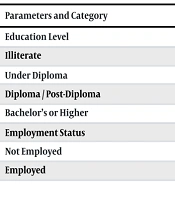
| Education | |
| Illiterate | 3 (8.6) |
| Elementary | 3 (8.6) |
| Guidance | 10 (28.6) |
| High School | 10 (28.6) |
| Diploma and pre-university | 7 (20) |
| Student | 2 (5.7) |
| Father's education | |
| Illiterate and less than diploma | 20 (57.1) |
| Diploma and above | 15 (42.9) |
| Mother's education | |
| Illiterate and less than diploma | 30 (85.7) |
| Diploma and above | 5 (14.3) |
| Father's occupation | |
| Self-employed | 12 (34) |
| Employee | 13 (37.1) |
| Other | 10 (28.6) |
| Mother's occupation | |
| Housewife | 33 (94.3) |
| Employee | 2 (5.7) |
a Data are Presented as Mean ± SD or No. (%).
Table 2 .
Average (SD) of Five Themes Specified For Empowerment a
| Five themes specified for empowerment | Values |
|---|---|
| Awareness of personal changes | 9.89 ± 2.62 |
| Need for adaptation | 19.17 ± 5.07 |
| Maintaining independence and self-management | 27 ± 5.19 |
| Uncovering the identity and role playing | 14.97 ± 4.38 |
| Sense of control and satisfaction | 21.43 ± 5.47 |
| Total score | 92.46 ± 17 |
a Data are Presented as Mean ± SD.
Table 3 .
The Association Between Demographic Characteristics and the Five Themes Specified For Empowerment a
| Five Themes Specified for empowerment | Age | Gender, Female/Male | Age at Diagnosis | Person With the Disease in the Family, No/Yes | Education | Father's Education | Mother's Education | Father’s Occupation | Mother’s Occupation |
|---|---|---|---|---|---|---|---|---|---|
| Awareness of personal changes | 0.57 | 0.52/0.7 | 0.13 | 0.51/0.85 | 0.26 | 0.69 | 0.34 | 0.69 | 0.3 |
| Need for adaptation | 0.13 | 0.97/1.41 | -0.01 a | 0.87/2.01 | 0.87 a | 0.9 | 0.05 a | 0.91 | 0.7 |
| Maintaining independence and self-management | 0.03 a | 1.22/1.43 | 0.53 | 0.97/1.85 | 0.39 | 0.23 | 0.49 | 0.81 | 0.68 |
| Uncovering the identity and role playing | 0.02a | 1.56/0.94 | 0.99 | 0.75/1.82 | 0.91 | 0.8 | 0.38 | 0.35 | 0.73 |
| Sense of control and satisfaction | 0.03a | 1.22/1.43 | 0.77 | 1.32/0.25 | 0.38 | 0.25 | 0.38 | 0.33 | 0.36 |
| Total score | 0.01 a | 0.16/0.21 | 0.23 | 0.54/0.41 | 0.99 | 0.41 | 0.99 | 0.72 | 0.7 |
aData are Presented as percent.
5. Discussion
Results of the qualitative part of the study were examined from different aspects. Major challenges emphasized by participants in the interviews were their limited information about the disease. For example, they were aware of the signs and symptoms of the disease. For example, they were aware of the signs and symptoms of the disease and they knew implications of the situation if they do not refer to thalassemia centers to follow up their disease. Some patients did not use deferoxamine and did not know the symptoms of not using the drug. Awareness of personal changes affects the themes of independence, role playing and adaptation of the individual. If people are aware of these changes, they can maintain their ability by implementing some strategies and make optimal use of their abilities (39, 40). In a qualitative study, Sapountzi-Krepia concluded that patients with thalassemia and their families need information and support (41). If patients are aware of their condition and disease, they can better understand the condition and health problems through empowerment. Empowerment improves quality of life of patients (17). Regarding the need for adaptation to the disease, some participants in the study were referred to as "implementing measures and different ways to cope with the disease for a normal life". Indeed, they stated in such a way that they have been accustomed, either bad or good, with the disease developed from childhood. Patients without change in their appearance hid the disease from others, due to fear from others' pity and losing their friends. However, "the fear of deteriorating physical conditions in the future and the disease complications" worried them. Nevertheless, constructive adaptability can lead to a better management of programs and follow-up to achieve the objectives as well as better performance in the roles (40). Quoted from Lau, Ansari argued that in most cases, patients are tired of iron overload treatment and are less inclined towards this treatment in puberty when they are in the peak of mental problems (12). Support and increased knowledge of family members about self-care needs of patients with chronic diseases is the best source for supporting patients, strengthening their ability to adapt to existing conditions and maintaining their quality of life (18). Some needs of families with chronic diseases include knowledge and practical skills for adapting to disease, dissatisfaction with lack of information, need for empathy and consultation with other families, and overcoming family’s isolation (42). Increased attention to the diagnosis and treatment of psychological disorders can greatly improve the adaptability process (3). Regarding "independent control of their disease", some adolescents are heavily dependent on their family because of too much attention, and need to be emphasized and remembered, besides referring to the family for drugs. If the family and the healthcare system staff allow adolescents to take the responsibility of self-care and maintaining independence, it would improve mental conditions of patients; also, they grow independently, compared to their healthy peers, because of their responsibility for their own works. Adolescents should be independent when visiting their physician, referring to blood transfusions, injecting or using iron chelating drugs, and even handling financial matters (43). Some problems of adolescents with chronic diseases include fear of rejection, difficulty in communicating with peers, and fear of independence and concern for self-sufficiency (44). Much attention to patients with the disease is a problem resulting in dependency on others and reduces their self-confidence (45). Self-management means having the ability to target and prioritize tasks until achieving the goals explained in life and feeling of satisfaction and sense of empowerment resulting from satisfaction and sense of control (40). Self-management is an active operational process driven by the patient (46). Some participants stated, "I do not adhere to my medication regimen and diet. I eat whatever I like. Despite emphasis by physicians, I do not use Desferal because I'm tired of needles at all." Regarding the theme of "uncovering the identity and role playing", as said by some adolescents, attitude and behaviors of others have had an impact on the role and how to find social identity. Since the individual is involved in a chronic and lifelong disease, his or her condition can affect his or her mental image, so that personal identity and self-confidence may be affected (44). Families of patients with thalassemia may hide their child’s disease from others or prevent him or her from establishing relationship with the community and peers, because they fear of isolation of their child from society or shame about their child's illness (43). In addition, family assigns no task to them because of pity, while adolescents demanded a more active role in the family and society. In children with thalassemia, especially those with low hemoglobin in the blood, the disease affects social interaction and cognitive development and increases the tendency to isolation and loneliness (40). Adolescents with thalassemia should have an active role in the family and society so that, as adults, they have the ability and sense of accepting community for their future communication (43). Adolescents may both need help of parents and show a negative reaction to their help. Because of this contradiction and the constant reminder of their chronic disease, adolescents may feel to be different and be less fit than their peers (8). Achieving satisfaction is a sign of power. People’s notion of performance and success achieved in their lives can lead to a sense of self-satisfaction (40). Most people said that they have accustomed to the disease. They said, "We have no choice but to do this". The cases stated; "comparing themselves with others, being ashamed of themselves and the disease, and being the envy of healthy people." Patients must have a sense of control and satisfaction with their disease and living conditions, so that they can better manage the disease. In addition, as the results of the quantitative part confirm, the rate of disease control and satisfaction can increase with increasing age. Increased sense of control could be due to a greater understanding of the disease, and satisfaction could be due to adaptation with current conditions. The findings of the quantitative part including demographic data (Table 1), score of each theme, total score of the questionnaire (Table 2), and evaluation of the association of demographic data and each of the themes (Table 3) are presented. If participants' scores were above the average, it was considered as desirable empowerment. The scores showed that answers to the questionnaire were moderate. Comparison of the entire questionnaire and demographic data only showed a significant correlation with age. The answers of patients represent a moderate status on the themes of "awareness of personal changes", "adaptation", "maintaining independence and self-management", "control and satisfaction" and "uncovering the identity and role playing". Scores from the "awareness of personal changes" part were not statistically significant compared to demographic data. This contrast with the qualitative part can be due to the small sample size of the quantitative part. Regarding the theme of "adaptation", demographic data showed an inverse association (-0.019) with age at diagnosis, and a direct association with maternal education (0.05). This means that younger age at diagnosis and more maternal education lead to more adaptation of patient. Only age had a statistically significant association in the three themes of "maintaining independence and self-management", "uncovering the identity and role playing", and "sense of control and satisfaction". The above themes ("maintaining independence and self-management", "sense of control and satisfaction", and "uncovering the identity and role playing") can increase with increasing age of the patient. Tol et al, performed a study on patients with diabetes and showed that those with higher levels of education and better understanding of the disease can more adopt self-management behaviors (16). Although in our study, education had no significant correlation in the quantitative part, it was clear in the interviews that people with higher level of understanding and education had a better self-management. This difference may be due to the use of different evaluation tools, or the disease type in the two studies. The non-significant nature of the study parts could be due to the small sample size of the quantitative part. Although, according to Table 2, the awareness of personal changes obtained satisfactory scores, analysis of the qualitative part of the study showed that individuals had no profound information about the cause of disease complications and consequences of not following the treatment, which is perhaps a reason for unwillingness to follow-up the treatment. Although the theme of "need for adaptation" had a moderate score in the quantitative part, the qualitative findings showed that over the years, patients were able to have a normal life using different methods and solutions to the disease. In addition, fear of deteriorating the patient's physical condition affected the adaptability of patients. Regarding the theme of "maintaining independence and self-management in adolescents and youths with thalassemia major", although they need independence and self-management, the patients gained a high score on the need for independence, for attitude, in the quantitative part of the study. However, in detailed insight analysis of the qualitative part, the role of health problems and financial problems caused by suitable job was clear. Due to age and influence of peer group pressure, adolescents and youths tend to perform the treatment process independently. However, due to limitations of the disease and physical conditions, evolution of independence and self-management had been faced with problems, which consequently created some stress. Lack of suitable job and salary opportunities was a crisis, especially for boys. In addition, the scores were reported to be at normal level on the theme of "uncovering the identity and role playing ". However, analysis of the qualitative part found that patients need to be treated like everyone else and to have an active role in family and community. Regarding the theme of "control and satisfaction", although the scores were higher than the average, it was found that they were satisfied by the questions related to current processes, but they did not answer questions about the future. The study results showed that people have poor information about their disease. Over the years, patients were able to have a normal life using different methods and solutions to the disease. However, fear of deteriorating the patient's physical condition was clear. Due to the patient's physical condition, financial problems due to not having a suitable job were observed in patients, especially boys. It is better for patients with major thalassemia to play an active role and treated like other children in their family. In case of providing good treatment conditions, and if patients are justified about the importance of follow-up, they can surely complete the process of gaining independence. Finally, given the importance of self-management and mental conditions of these patients in critical years of adolescence and youth, it would be essential to make educational interventions appropriate to their educational needs in the obtained dimensions and to modify self-management patterns in these patients.
5.1. Limitations
This study was performed in the only thalassemia center in Bushehr. Limitations of the study included its small sample size and moderate to low health literacy. The study was performed with complete enumeration of all samples having the general characteristics of study, and after explaining the objectives of the study to them. It is suggested to increase internal and external validity of the study by performing similar studies on larger sample size in larger centers and other provinces using random sampling techniques. In addition, the impact of these interventions on their empowerment should be assessed using interventions based on the findings from the perspective of adolescents and youths with major thalassemia about the challenges of empowerment education. Since mother's education is positively associated with adolescents' awareness and better adaptation, it is recommended to initiate the empowerment process of patients from childhood and at early times of diagnosis by mothers, because it can create a better compliance in children even until adolescence and youth. Although adaptation to current conditions of the disease is one of the most important issues among adolescents and youths with major thalassemia, considering the major concerns stated about their future, the main objective of health planners is to increase life expectancy and quality of life of patients with major thalassemia.