


1. Background
2. Objectives
3. Methods
3.1. Materials
3.2. Cell Culture
3.3. Treatment of LX-2 Cells with Different Cholesterol Concentrations
3.4. Treatment of Cholesterol-Activated HSCs with FGF21
3.5. MTT Assay Technique
3.6. Quantitative Real-time PCR
3.7. Statistical Analysis
4. Results
4.1. Effect of Different Cholesterol Concentrations on the Survival of HSCs
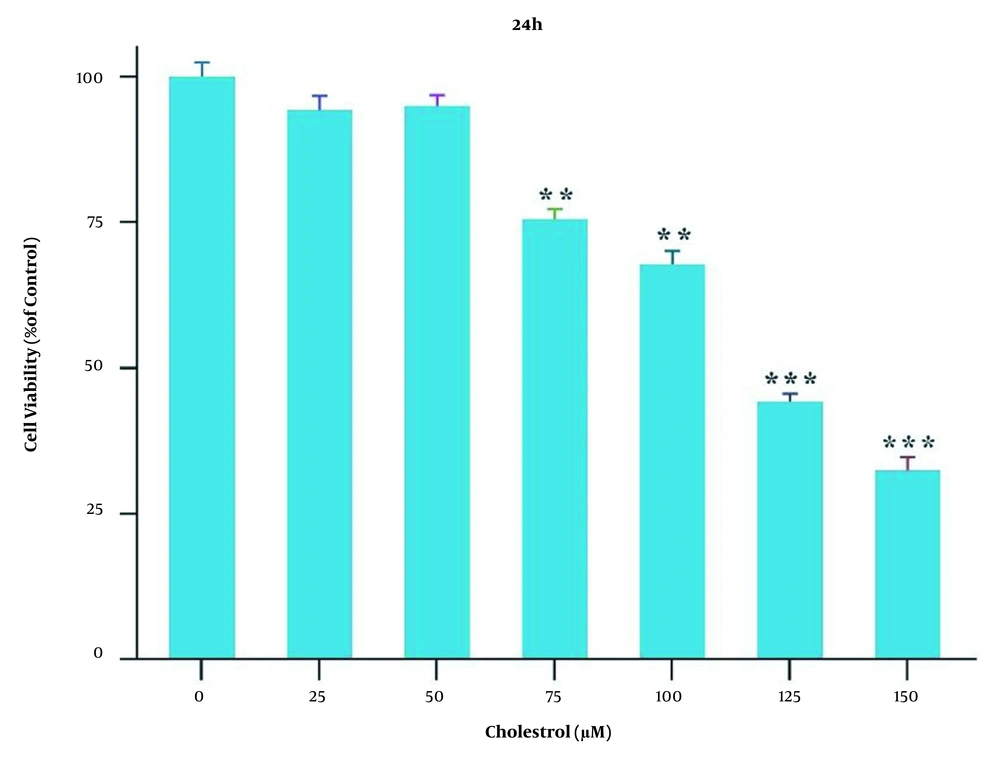
The 3-(4,5-dimethylthiazol-2-yl)-2,5-diphenyl-2H-tetrazolium bromide assay results showing cell viability under different cholesterol concentrations over 24 h. Results are shown as mean ± standard error of the mean. Statistical analyses were performed using GraphPad Prism software (version 9.0.1), one-way analysis of variance, and Tukey’s test. Statistical significance was considered < 0.05 (** P < 0.01 and *** P < 0.001).
4.2. mRNA Expression of TLR4 and BAMBI Genes in the Presence of Cholesterol and FGF21
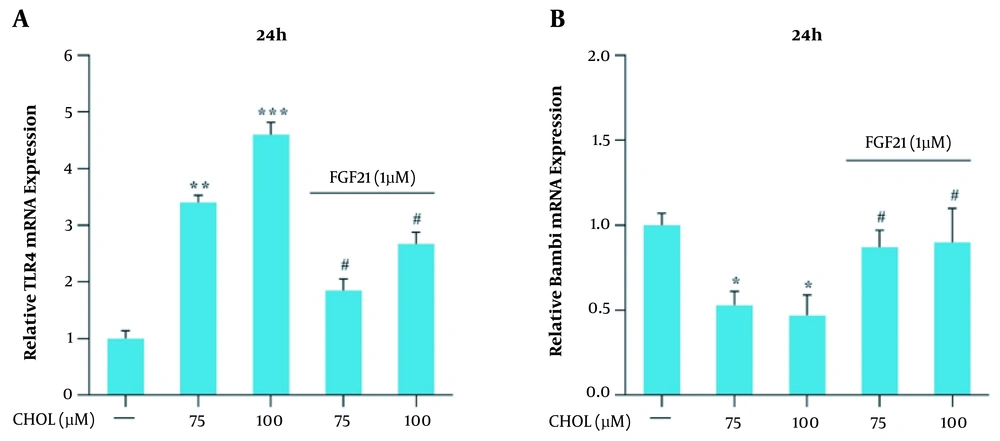
Toll-like receptor 4 (TLR4) and BMP and activin membrane-bound inhibitor (BAMBI) messenger ribonucleic acid (mRNA) expression in the presence of cholesterol and fibroblast growth factor 21 (FGF21) in LX-2 cell line. A, TLR4 mRNA expression in the presence of cholesterol and FGF21 in LX-2 cells. B, BAMBI mRNA expression in the presence of cholesterol and FGF21 in LX-2 cells. The results of three replications (mean ± standard error of the mean) and changes in TLR4 and BAMBI mRNA expression were compared to those of the control group. The significance level was considered < 0.05. Glyceraldehyde 3-phosphate dehydrogenase was used as the reference gene (* P < 0.05, ** P < 0.01, and *** P < 0.001; # P < 0.05).
4.3. mRNA Expression of TGF-β and Collagen1α Genes in the Presence of Cholesterol and FGF21
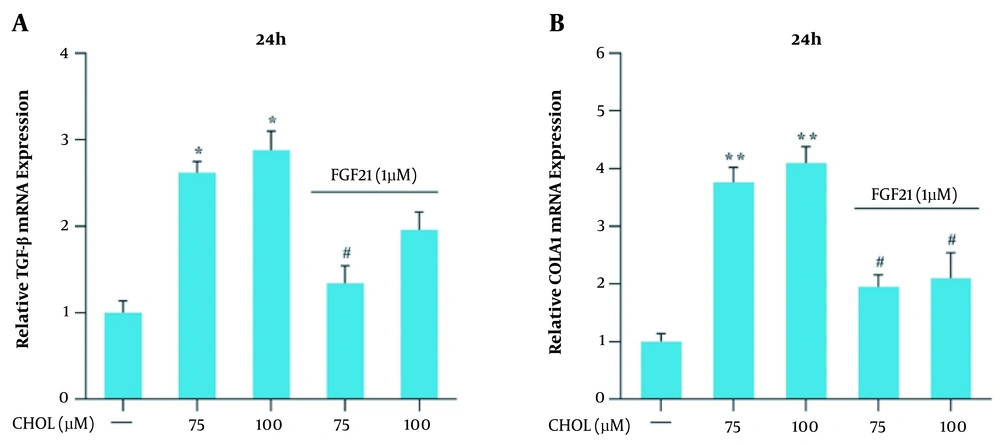
Transforming growth factor-beta (TGF-β) and collagen, type I, alpha 1 (collagen1α) messenger ribonucleic acid (mRNA) expression in the presence of cholesterol and fibroblast growth factor 21 (FGF21) in LX-2 cell line. A, TGF-β mRNA expression in the presence of cholesterol and FGF21 in LX-2 cells. B, collagen1α mRNA expression in the presence of cholesterol and FGF21 in LX-2 cells. The results of three replications (mean ± standard error of the mean) and changes in TGF-β and collagen1α mRNA expression were compared to those of the control group. The significance level was considered < 0.05. Glyceraldehyde 3-phosphate dehydrogenase was used as the reference gene (* P < 0.05 and ** P < 0.01; # P < 0.05).


