Patients with IBD experience dysbiosis of the GM and metabolism (
10,
26,
27). However, transgenes and their metabolites in IBD patients are influenced by individual differences, disease, diet, and time of day. Clarifying causal relationships through observational studies and traditional epidemiological methods is challenging. The MR is based on genetic variants associated with exposure factors and assesses the association between these genetic variants and outcomes, thus avoiding bias due to environmental factors in observational studies. This approach provides a new perspective for studying the mechanisms of IBD.
Previous studies have used MR to explore the causal relationship between GM and IBD. Zhuang et al.’s study confirmed that OTU10032-unclassified Enterobacteriaceae was associated with a high risk of IBD (OR, 1.03; 95% CI, 1.00 - 1.06; P = 0.033) (
28). Taurine, a related metabolite of
Enterobacteriaceae, was positively correlated with the risk of IBD (OR, 1.04; 95% CI, 1.01 - 1.08; P = 0.016). Liu et al.’s study (
29) found that six genera of bacteria were associated with the risk of IBD, UC, or CD.
Eubacterium ventriosum had a lower risk of IBD, whereas Coprococcus 2 had a higher risk. Moreover,
f_Verrucomicrobiaceae,
g_Akkermansia, and
g_Dorea were confirmed to have a causal relationship with IBD (
30).
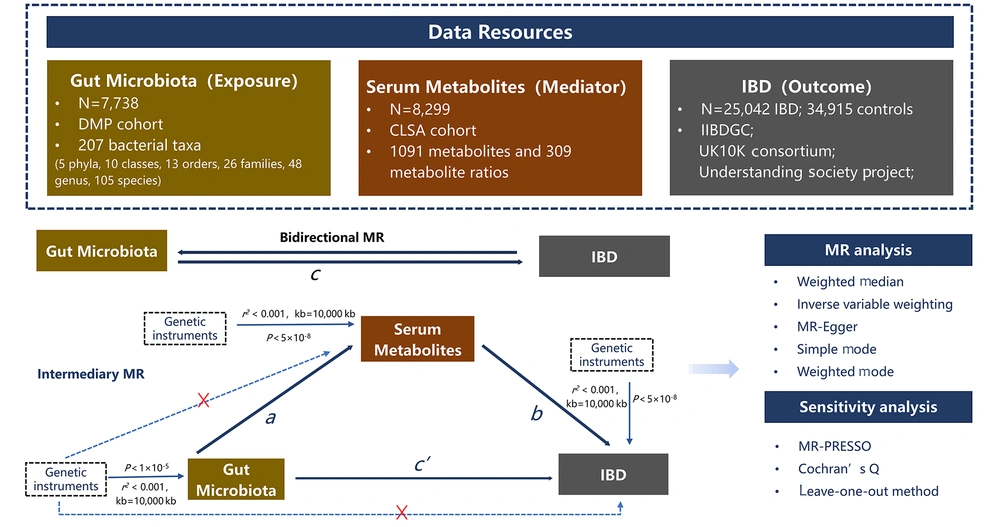
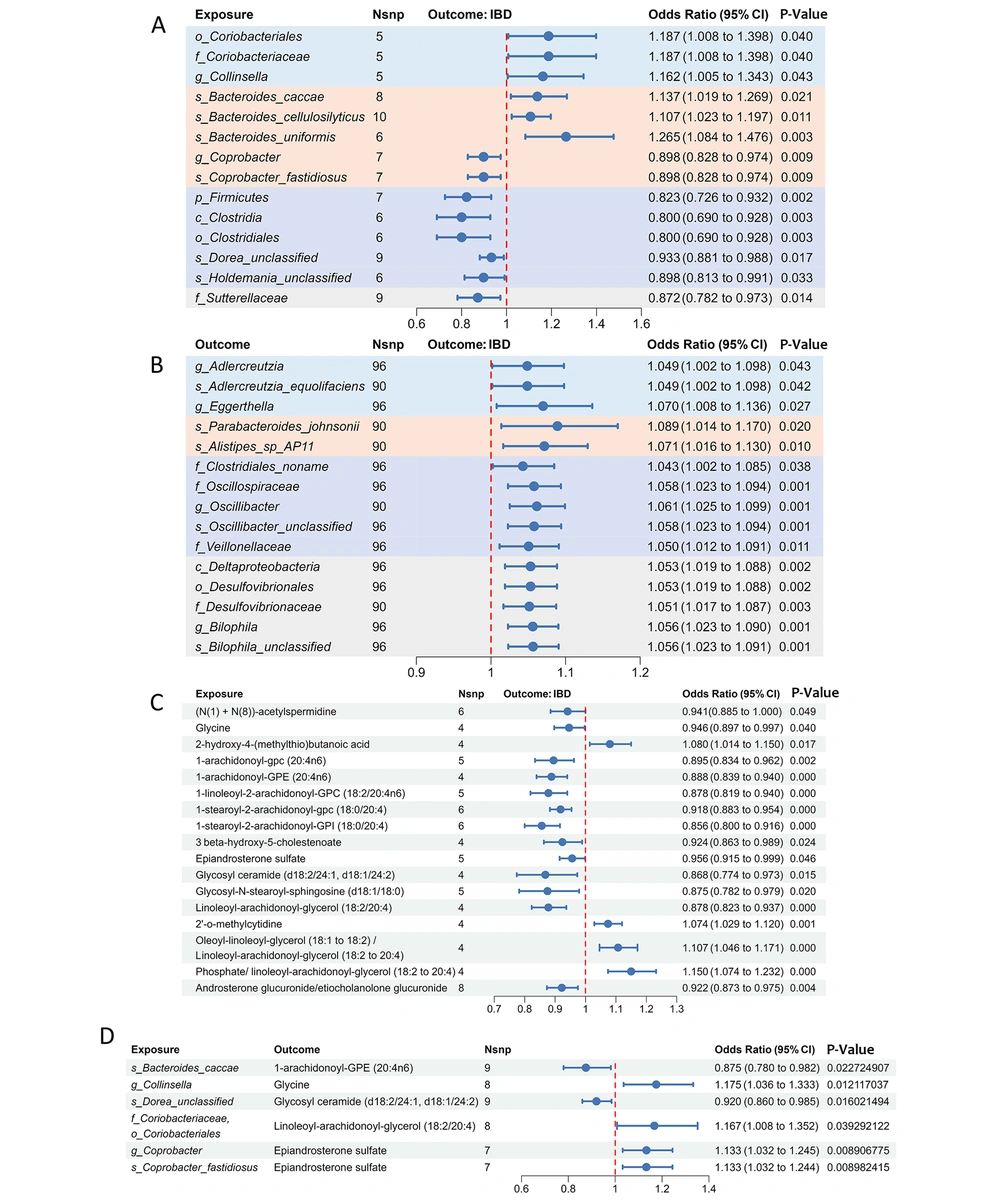
The innovation of this study is the use of GWAS data, which contained species-level GM, and the most comprehensive metabolite GWAS data as an intermediary variable to explore the causal relationship between GM and IBD. This study found that 14 taxa were causally associated with IBD. The results of the reverse MR analysis suggested an increase in the abundance of 15 bacteria in patients with IBD.
o_Coriobacteriales (OR = 1.187, 95% CI: 1.008 - 1.398, P = 0.040),
f_Coriobacteriaceae (OR = 1.187, 95% CI: 1.008 - 1.398, P = 0.040), and
g_Collinsella (OR = 1.162, 95% CI: 1.005 - 1.343, P = 0.042) were risk factors for IBD. Alam et al. sequenced the feces of 20 patients with IBD (11 with CD and 9 with UC) and 10 healthy volunteers. Compared to healthy individuals, the abundance of
Burkholderiaceae and
Coriobacteriaceae in IBD patients increased, confirming the conclusions of our study (
31). The
g_Collinsella, derived from
Coriobacteriaceae, is a ubiquitous bacterium in the human intestine that can produce hydrogen, SCFAs, and lactic acid. A high abundance of
Collinsella correlated with a positive response to anti-tumor necrosis factor therapy, implying a connection between these bacteria and the pathological innate inflammatory pathway (
32). The increase in
Collinsella was uniquely associated with the likelihood of severe penetrating disease in a pediatric CD cohort (
33).
Further mediated MR results confirmed that
g_Collinsella increased serum glycine levels, while
o_Coriobacteriales and
f_Coriobacteriaceae increased serum linoleoyl-arachidonoyl-glycerol (18:2/20:4) levels. After multivariate MR analysis, the causal relationship between
g_Collinsella,
o_Coriobacteriales, and
f_Coriobacteriaceae and IBD disappeared, whereas a causal relationship between metabolites and IBD still existed. This suggests that the risk effect of bacteria on IBD may be caused by other genetic-related pathways, but the increase in serum glycine and linoleoyl-arachidonoyl-glycerol (18:2/20:4) has a protective effect on IBD. Glycine has antioxidant properties that scavenge free radicals and attenuate oxidative stress damage. In IBD, intestinal inflammation may lead to elevated levels of oxidative stress, and the antioxidant effect of glycine may help mitigate this damage (
34). Additionally, glycine may reduce the production of inflammatory mediators by affecting cyclooxygenase activity in the arachidonic acid metabolic pathway, thereby alleviating IBD symptoms to some extent (
35).
Metabolites generated by arachidonic acid metabolism via the cyclooxygenase and lipoxygenase pathways, such as prostaglandins and leukotrienes, play an important role in regulating the inflammatory response in the intestine (
36). Arachidonic acid metabolites are involved in regulating innate immune function in the gut, influencing the development and differentiation of immune cells in the intestinal epithelial barrier and lamina propria (
37). Studies suggest that the mechanism of arachidonic acid metabolites in intestinal inflammation may involve interactions with endogenous cannabinoid metabolism. COX-2 metabolizes not only arachidonic acid but also endogenous cannabinoids to produce biologically active lipids such as prostaglandin glycerol esters and prostaglandin ethanol amides (
38,
39). Therefore, the specific mechanisms linking these metabolites to inflammation in IBD may involve inflammatory responses, oxidative stress, immune dysregulation, and the intestinal barrier.
Bacteroides are the most common and abundant members of human intestinal microflora. Several metabolic activities are performed by
Bacteroides in the human colon, including carbohydrate fermentation, nitrogen oxidation, and bile acid metabolism (
40). In addition to preventing infection by potential pathogens,
Bacteroides can produce SCFAs (
41). Studies have shown that
s_Bacteroides_uniformis can reshape the composition of colon intestinal flora, regulate the metabolism of colon lipids and bile acids, and regulate the NF-κB and mitogen-activated protein kinase (MAPK) signaling pathways by inhibiting the IL-17 signaling pathway, thus improving the development of DSS-induced colitis. The
s_Bacteroides_uniformis or bile acid supplementation has proven to be a potential therapy for colitis and other diseases associated with intestinal barrier dysfunction (
42).
Our study found that the causal effects of p_Bacteroidetes on IBD varied depending on the bacterial genus. s_Bacteroides_cellulosilyticus, s_Bacteroides_caccae, and s_Bacteroides_uniformis in g_Bacteroides were risk factors for IBD. Bacteroides_uniformis had a pronounced effect on IBD risk (OR = 1.265, 95% CI: 1.083 - 1.476, P = 0.003). The s_Bacteroides_caccae could reduce the level of 1-arachidonoyl-GPE (20:4n6), thereby increasing the risk of IBD (OR = 1.137, 95% CI 1.019 - 1.269, P = 0.021). However, g_Coprobacter and s_Coprobacter_fastidiosus were protective factors against IBD, increasing the level of epiandrosterone sulfate and playing a protective role in the occurrence of IBD. Reverse MR analysis confirmed that IBD increased the abundance of s_Alistipes_sp_AP11 and s_Parabacteroides_johnsonii.
Enterococcus faecalis, as a probiotic, is considered to have a potential protective effect against IBD. This is due to its ability to stimulate the secretion of the anti-inflammatory cytokine IL-10 from dendritic cells, an important anti-inflammatory mediator that inhibits the production of other pro-inflammatory cytokines in the gut, such as IL-12 and INF-γ (
43). Additionally,
E. faecalis can enhance intestinal barrier function and modulate the immune response by producing SCFAs such as butyrate (
44).
Enterococcus faecalis may also indirectly influence the development and progression of IBD by affecting the gut-hepatic axis and regulating bile acid metabolism (
45). The metabolite of
E. faecalis, epiandrosterone sulfate, may exert a protective effect by modulating the host’s immune system. Epiandrosterone sulfate is known to have anti-inflammatory and immunomodulatory effects, capable of attenuating the inflammatory response in IBD by inhibiting the production of pro-inflammatory cytokines and promoting the release of anti-inflammatory cytokines (
46).
Various probiotics in the phylum
Firmicutes, such as lactobacilli,
Eubacterium, and
Ruminococcus, have been shown to improve intestinal inflammation through various pathways. Selenium-enriched
Lactobacillus has been found to significantly alleviate colitis and liver inflammation induced by DSS. It reduces oxidative stress in colon tissue and exerts its therapeutic effect by regulating the NF-κB-P65 signaling pathway and the structure of the intestinal microflora (
47).
Ruminococcus abundance increases with active IBD, from an average of 0.1% in healthy controls to 69% in IBD patients (
48). Sequencing of the colonic tissues of patients with CD and healthy controls revealed that the enrichment degree of
Ruminococcus in patients was significantly improved (
49).
This study confirmed that
s_Dorea_unclassified and
s_Holdemania_unclassified belonging to
Firmicutes were protective factors against IBD.
s_Dorea_unclassified may affect the occurrence of IBD by regulating the level of glycosyl ceramide (d18:2/24:1, d18:1/24:2); however, this protective effect disappeared after adjusting for mediator metabolites in MVMR, suggesting the existence of other potential pathways. Wang et al. suggested that Dorea is highly expressed in patients with IBD, has pro-inflammatory effects, and is positively correlated with waist circumference, body mass, and diastolic blood pressure (
50). However, Bajaj et al. confirmed a decrease in the abundance of Dorea in IBD patients (
51). Additionally, the role of
s_Holdemania_unclassified in the pathogenesis of IBD has not yet been identified and may be a potential focus for follow-up studies.
In recent years, there has been an increase in research on the role of GM in diseases. However, the study of GM is a dynamic and long-term process, and interactions among hosts, diseases, and microbiota can lead to differences in research results, affecting the progress of disease research. The clinical efficacy of probiotic supplementation and fecal microbiota transplantation did not meet expectations. A MR study that explored the causal relationship between GM and disease based on genetic variation has provided new insights. When studying the pathogenesis of IBD, attention should be paid to the GM and microbial metabolites that cause the onset of IBD, rather than the microbiota affected by IBD, which may yield more meaningful results.
Nevertheless, our study has some limitations. First, both the patients and controls were Europeans. Rehman’s study (
52) found that the microbiota associated with IBD is shared among populations, as well as privately owned, revealing that the GM associated with IBD is influenced by disease status and geographical factors. Thus, our study may have limitations when extended to other ethnic groups (
31). Second, owing to the large amount of data, we did not analyze GM and specific subtypes of IBD, which requires further research. Third, to obtain sufficient GM, we selected IVs (P < 1 × 10
-5) from GM that were significantly higher than the traditional whole-genome levels (P < 5 × 10
-8).
5.1. Conclusions
In summary, this study assessed the potential causal role of the GM in IBD, as well as the mediating role of metabolites. These findings provide new insights into possible therapies for IBD and offer valuable clues for pathogenesis studies.