
1. Background
Urinary tract infections (UTIs) are among the most common bacterial infections, affecting millions of individuals worldwide annually. Escherichia coli is the most common etiological agent of UTIs, both in hospital and community-acquired infections, with other common pathogens including Klebsiella pneumoniae, Enterococcus faecalis, and Proteus mirabilis (1). The increasing antimicrobial resistance among the bacteria responsible for UTIs, such as extended-spectrum beta-lactamase (ESBL)-producing Enterobacterales, is a significant concern for public health, as it complicates treatment strategies, leading to increased treatment costs, adverse drug effects, and higher morbidity rates (2)
Multiple studies have identified various risk factors contributing to the development of UTIs. These factors include sex, age, previous UTI history, low socio-economic status, diabetes mellitus, recurrent UTIs, invasive urological procedures, prior antibiotic use, history of catheterization, and hospitalization (3). The antimicrobial resistance profiles of UTI pathogens have been shown to vary according to patient demographics, such as age and sex, with higher resistance generally observed in male patients and an overall increase in bacterial resistance with the age of the patients (4).
Identifying risk factors for antimicrobial resistance can aid in improving empirical treatment strategies for UTIs (5). The resistance patterns of UTI pathogens have been observed to change over time, highlighting the importance of periodic monitoring of microbial resistance to select the best empirical antibiotic therapy (6). The genotypic diversity of beta-lactamase genes, such as blaTEM, blaSHV, blaCTX-M, and blaCMY, among ESBL producer bacteria, has been extensively analyzed, suggesting a flow of genes among strains from different clinical backgrounds and the need for close monitoring of these resistant strains (7).
The antimicrobial resistance patterns of uropathogens vary across different countries, primarily due to variations in antibiotic prescription practices. In some countries, unregulated antibiotic prescriptions have developed significant resistance among uropathogens (8). Studies have also highlighted the importance of understanding local antibiograms and pathogen characteristics to prescribe appropriate antibiotics (9). In summary, the antimicrobial resistance profiles of UTI bacteria are a dynamic and concerning issue that necessitates ongoing surveillance and research to inform treatment strategies.
2. Objectives
A comprehensive understanding of the various factors contributing to UTIs, their prevalence, and drug resistance status in uropathogens can assist healthcare planners and policymakers in developing appropriate management and control plans in the specific study area (10). Thus, the present research aimed to study risk factors associated with UTIs, antimicrobial susceptibility patterns, and the genotyping of beta-lactamase-producing bacteria to inform treatment decisions and combat the rise of antibiotic resistance.
3. Methods
3.1. Study Design and Data Collection
This cross-sectional study included 274 patients with culture-positive UTIs admitted to Ganjavian Hospital, Dezful (April 2021 - March 2022). Demographic and clinical data were extracted from medical records, including age, gender, comorbidities, recent antibiotic use, prior UTI history, catheterization, urological procedures, and nosocomial infection status. By recent antibiotic use, we mean any antibiotic or antifungal medication taken within 72 hours before the patient's admission, with particular emphasis on commonly used antibiotics for UTIs such as cephalosporins, carbapenems, quinolones, aminoglycosides, and nitrofurantoin.
3.2. Inclusion and Exclusion Criteria
Patients with a single bacterial strain isolated from urine culture were included. Cases with polymicrobial cultures, fungal growth, or incomplete data were excluded.
3.3. Microbiological Examination
All urine samples were inoculated on blood agar and MacConkey agar and then incubated at 37°C for 24 hours. The positive cultures were then characterized using various methods, including colony characteristics, gram stain, oxidase, and catalase tests, as well as standard biochemical tests such as triple sugar iron, indole, citrate, urea, lysine decarboxylase, motility, coagulase test, bile esculin, and CAMP test.
3.4. Antibiotic Resistance Pattern
Antibiotic susceptibility testing (AST) was performed using the disk diffusion method per CLSI guidelines (11). The antibiotic discs (BD, USA) and their concentrations were: Penicillin (10 U), gentamicin (10 μg), tetracycline (30 μg), amikacin (30 μg), ciprofloxacin (5 μg), cefoxitin (30 μg), trimethoprim/sulfamethoxazole (1.25/23.75 μg), piperacillin/tazobactam (100/10 μg), ceftriaxone (30 μg), imipenem (10 μg), meropenem (10 μg), ertapenem (10 μg), cefotaxime (30 μg), vancomycin (30 μg), and ceftazidime (30 μg). Colistin susceptibility was assessed using colistin broth disk elution (CBDE) for Enterobacterales and Pseudomonas aeruginosa, and MIC for Acinetobacter baumannii. Quality control strains included E. coli ATCC 25922, P. aeruginosa ATCC 27853, Staphylococcus aureus ATCC 25923, and E. faecalis ATCC 29212.
3.5. Phenotypic Detection of Extended-Spectrum Beta-lactamases, Carbapenemase, and Metallobetalactamase Production
The ESBL production was detected using the combined disk method as per the guidelines provided by CLSI (11). Carbapenemase production was confirmed by the modified carbapenem inactivation method (mCIM), and metallo-β-lactamase (MBL) activity was evaluated using the EDTA-modified carbapenem inactivation method (eCIM) (9).
3.6. Molecular Detection of Extended-Spectrum Beta-lactamases and Carbapenemase Genes
Bacterial genomic DNA was isolated from bacterial cells using the boiling method. Approximately 30 mg of bacterial colonies were suspended thoroughly in 500 μL sterile distilled water. The suspension was then boiled at 95°C for 10 minutes to lyse the cells. Cellular debris was removed by centrifugation at 15,000 × g for 15 minutes. The supernatant containing the genomic DNA was carefully collected and stored at -20°C for subsequent polymerase chain reaction (PCR) analysis.
The specific primers for uni gene (12) as PCR control, ESBL genes (blaSHV, blaTEM, blaCTX-M) (13), and carbapenemase genes (blaNDM, blaKPC, blaAmpC) (14-16) were synthesized by Meta Bion (Germany). The PCR was conducted in a 25 μL volume containing primer F, primer R, DNA template, and Taq DNA polymerase Amplicon Red Dye master mix. Fragments were amplified under specific conditions using a Bio-Rad T100 thermal cycler. Positive controls were obtained from previously confirmed resistant strains, and negative controls were PCR mixtures without DNA templates. All PCR products were visualized using agarose gel electrophoresis stained with DNA-safe dye.
3.7. Statistical Analysis
Data were entered in Microsoft Excel 2016 and analyzed using SPSS version 21. Antibiotic resistance patterns were evaluated with WHONET 5.6 (WHO, Geneva, Switzerland). Descriptive statistics included frequencies and percentages. Associations between categorical variables were assessed using the chi-square or Fisher’s exact test, and the Mann-Whitney test was used for continuous data. A P-value < 0.05 was considered statistically significant.
4. Results
4.1. Demographic Characteristics and Risk Factors
This study investigated 274 positive urine cultures and their associated UTI risk factors. The mean age of the participants was 56 ± 25.29, with a range of < 1 - 92 years. Of the total participants, 152 (55.5%) were female. Escherichia coli was the most commonly isolated species (48.9%), followed by Klebsiella spp. (23.7%), Enterococcus spp. (9.5%), P. aeruginosa (6.6%), and other bacteria (Enterobacter spp., Citrobacter spp., Acinetobacter spp., Proteus spp., S. aureus, and group B Streptococcus). The frequency distribution of bacteria isolated from UTIs was investigated regarding demographics and UTI risk factors. The results are shown in Table 1.
Table 1.
Characteristics of Patients and Risk Factors Associated with Bacterial Etiology of Urinary Tract Infection, Extended-Spectrum Beta-lactamase, and Carbapenemase Producer Bacteria a
| Characteristics And Risk Factors (Clinical Data) | Bacteria | ESBL (Klebsiella spp., Escherichia coli, and Proteus) | Carbapenemase (Enterobacterales and Pseudomonasaeruginosa) | |||||||||
|---|---|---|---|---|---|---|---|---|---|---|---|---|
| E. coli | Klebsiella spp. | Enterococcus spp. | P. aeruginosa | Others b | P-Value c | Positive | Negative | P-Value c | Positive | Negative | P-Value c | |
| Frequency | 134 (48.9) | 65 (23.7) | 26 (9.5) | 18 (6.6) | 31 (11.3) | - | 73.201 | 128.201 | - | 29.233 | 204.233 | - |
| Gender of patients | 0.031 d | 0.752 | < 0.001 | |||||||||
| Male | 49 (36.6) | 31 (47.7) | 12 (46.2) | 13 (72.2) | 17 (54.8) | 28 (38.4) | 52 (40.6) | 21 (72.4) | 80 (39) | |||
| Female | 85 (63.4) | 34 (52.3) | 14 (53.8) | 5 (27.8) | 14 (45.2) | 45 (61.6) | 76 (59.4) | 8 (27.6) | 125 (61) | |||
| Mean age of patients (y) | 56 | 60 | 52 | 50 | 60 | 0.522 | 56 | 58 | 0.589 | 59 | 56 | 0.856 |
| Mean length of hospital stays (d) | 5 | 9 | 16 | 6 | 7 | 0.004 | 6 | 6 | 0.263 | 11 | 6 | 0.001 |
| History of urinary catheterization | 38 (28.4) | 28 (43.1) | 13 (50) | 6 (33.3) | 12 (38.7) | 0.126 | 17 (23.3) | 50 (39.1) | 0.023 | 18 (62.1) | 62 (30.2) | < 0.001 |
| History of urological intervention | 20 (14.9) | 13 (20) | 4 (15.4) | 4 (22.2) | 5 (16.1) | 0.836 d | 16 (21.9) | 19 (14.8) | 0.203 | 9 (31) | 33 (16.1) | 0.050 |
| History of UTI | 64 (48.5) | 33 (50.8) | 12 (46.2) | 11 (61.1) | 13 (41.9) | 0.763 | 35 (47.9) | 64 (50.8) | 0.699 | 18 (62.1) | 102 (50.2) | 0.233 |
| History of kidney stones | 29 (21.6) | 15 (23.1) | 8 (30.8) | 6 (33.3) | 6 (19.4) | 0.653 d | 16 (21.9) | 29 (22.7) | 0.904 | 10 (34.5) | 19 (65.5) | 0.104 |
| History of benign prostatic hyperplasia | 29 (21.6) | 11 (16.9) | 1 (3.8) | 6 (33.3) | 4 (12.9) | 0.084 d | 17 (23.3) | 23 (18) | 0.364 | 6 (20.7) | 43 (21) | 0.972 |
| Nosocomial infection | 21 (15.7) | 18 (28.1) | 9 (34.6) | 4 (23.5) | 8 (25.8) | 0.102 d | 8 (11) | 31 (24.4) | 0.021 | 15 (51.7) | 32 (15.8) | < 0.001 |
| Underlying diseases e | 67 (50) | 38 (58.5) | 13 (50) | 9 (50) | 17 (54.8) | 0.837 | 45 (61.6) | 62 (48.4) | 0.071 | 17 (58.6) | 108 (52.7) | 0.549 |
| Pregnancy | 11 (8.2) | 2 (3.1) | 1 (3.8) | 0 (0) | 1 (3.2) | 0.568 d | 3 (4.1) | 10 (7.8) | 0.382 d | 0 (0) | 13 (6.3) | 0.170 d |
| Previous antibiotic use f | 22 (16.4) | 18 (27.7) | 11 (42.3) | 5 (27.8) | 8 (25.8) | 0.040 d | 13 (17.8) | 27 (21.1) | 0.575 | 14 (48.3) | 36 (17.6) | < 0.001 |
Abbreviations: ESBL, extended-spectrum beta-lactamase; UTI, urinary tract infection.
a Values are expressed as No. (%).
b Others: Enterobacter spp. (7, 2.7), Citrobacter spp. (7, 2.7), Acinetobacter spp. (6, 2.2), Proteus spp. (2, 0.7), Staphylococcus aureus (7, 2.7), and group B Streptococcus (2, 0.7).
c Pearson chi-square was used (no expected count less than 5).
d Fisher’s exact test was used (at least one expected count less than 5).
e Underlying diseases: Cardiac disease, liver disease, pulmonary disease, kidney disease, cancer, diabetes mellitus, immunodeficiency, hypertension, smoking, etc.
f Previous antibiotic use: History of antibiotic use within 72 hours before sampling.
There is a significant difference between males and females in contracting various bacterial agents (P = 0.031). The analysis showed that the length of hospital stay is longer in patients with enterococcal urinary infections (P = 0.004). The frequency of different bacteria and age, underlying diseases, history of UTI, history of urinary catheterization, history of urological intervention, history of kidney stones, history of benign prostatic hyperplasia, pregnancy, and nosocomial infection did not differ significantly (P > 0.05). The impact of recent antibiotic use (within 72 hours before sampling) on bacterial species isolation differs significantly (P < 0.05).
4.2. Antibiotic Resistance Pattern
Fifty-eight E. coli isolates (43%), fourteen Klebsiella spp. isolates (21.5%), and one Proteus spp. isolate (50%), totaling 73.231 (36.3%), were phenotypically positive for ESBL production. The results showed no significant association between the different risk factors and the ESBL producer bacteria (P > 0.05), except for a history of urinary catheterization (P = 0.023) and nosocomial infection (P = 0.021).
Among the 233 isolated strains of Enterobacterales and P. aeruginosa, 12.5% (n = 29) were identified as carbapenemase producers. Of these, the majority were Klebsiella spp. (n = 21), accounting for 32.3% of all Klebsiella isolates. Among the Enterobacter spp., 4 out of 7 isolates (57.1%) were carbapenemase-positive. Additionally, 3 (2.2%) of the 134 E. coli isolates and 1 (5.5%) of the 18 P. aeruginosa isolates produced carbapenemase. Regarding the types of carbapenemase, 20 isolates (8.6%) were found to produce MBLs.
Furthermore, statistical analysis revealed that several clinical factors were significantly associated with carbapenemase-producing bacteria (P < 0.05), including male gender, prolonged hospital stay, recent antibiotic use (within 72 hours before sampling), history of urinary catheterization, history of urological intervention, and nosocomial infection. According to the results of the AST, E. coli showed the highest resistance to nalidixic acid (68.8%), trimethoprim/sulfamethoxazole (64.9%), and ceftriaxone (61.9%), and the least resistance to nitrofurantoin (1.4%) and colistin (0.74%). Additionally, Klebsiella spp. showed the highest resistance to trimethoprim/sulfamethoxazole (58.4%), ciprofloxacin (53.8%), and nalidixic acid (52.3%), with the lowest resistance to colistin (10.7%). The antibiotic resistance patterns of other bacteria are shown in Table 2.
| Antibiotic | Escherichia coli (N = 134) | Klebsiella spp. (N = 65) | Citrobacter spp. (N = 7) | Enterobacter spp. (N = 7) | Proteus spp. (N = 2) | Pseudomonas aeruginosa (N = 18) | Acinetobacter spp. (N = 6) | Enterococcus spp. (N = 26) | Staphylococcus aureus (N = 7) |
|---|---|---|---|---|---|---|---|---|---|
| Ceftriaxone | 83 (61.9) | 34 (52.3) | 4 (57.1) | 4 (57.1) | 2 (100) | NT | 4 (66.6) | NT | NT |
| Ceftazidime | 70 (52.2) | 25 (38.4) | NT | NT | 1 (50) | NT | 4 (66.6) | NT | NT |
| Cefotaxime | 68 (50.7) | 20 (30.7) | NT | 3 (42.8) | 1 (50) | NT | NT | NT | NT |
| Imipenem | 4 (2.9) | 24 (36.9) | 1 (14.2) | 5 (71.4) | 1 (50) | 4 (22.2) | 4 (66.6) | NT | NT |
| Meropenem | 5 (3.7) | 23 (35.3) | 0 (0) | 4 (57.1) | 1 (50) | 4 (22.2) | 4 (66.6) | NT | NT |
| Gentamycin | 28 (20.8) | 25 (38.4) | 1 (14.2) | 4 (57.1) | 1 (50) | 8 (44.4) | 4 (66.6) | NT | NT |
| Amikacin | 7 (5.2) | 20 (30.7) | 1 (14.2) | 3 (42.8) | 0 (0) | 8 (44.4) | 4 (66.6) | NT | NT |
| Nalidixic acid | 92 (68.6) | 34 (52.3) | 3 (42.8) | 4 (57.1) | 2 (100) | NT | NT | NT | NT |
| Ciprofloxacin | 72 (53.7) | 35 (53.8) | 3 (42.8) | 4 (57.1) | 0 (0) | 6 (33.3) | 4 (66.6) | 23 (88.4) | 3 (42.8) |
| Trimethoprim/sulfamethoxazole | 87 (64.9) | 38 (58.4) | 3 (42.8) | 3 (42.8) | 2 (100) | NT | 5 (83.3) | NT | 3 (42.8) |
| Piperacillin/tazobactam | NT | NT | NT | NT | NT | 1 (5.5) | 4 (66.6) | NT | NT |
| Nitrofurantoin | 2 (1.4) | 22 (33.8) | 0 (0) | 4 (57.1) | 1 (50) | NT | NT | 2 (7.6) | 0 (0) |
| Colistin | 1 (0.74) | 7 (10.7) | 0 (0) | 0 (0) | 0 (0) | 1 (5.5) | 1 (16.6) | NT | NT |
| Penicillin | NT | NT | NT | NT | NT | NT | NT | 18 (69.2) | NT |
| Tetracycline | NT | NT | NT | NT | NT | NT | NT | 18 (69.2) | NT |
| Vancomycin | NT | NT | NT | NT | NT | NT | NT | 13 (50) | NT |
| Ampicillin | NT | NT | NT | NT | NT | NT | NT | 15 (57.6) | NT |
| Cefoxitin | NT | NT | NT | NT | NT | NT | NT | NT | 2 (28.5) |
Abbreviation: NT, not tested.
a Values are expressed as No. (%).
b Zero indicates no antibiotic resistance (100 sensitive).
4.3. Distribution of Extended-Spectrum Beta-lactamase and Carbapenemase Genes
In ESBL-positive bacteria, the most common gene detected was blaCTX-M (n = 67.73, 91.7%), with 91% in E. coli and 92.8% in Klebsiella. In E. coli, blaTEM was detected in 36.2% and blaSHV in 17.2%. However, in Klebsiella, blaTEM and blaSHV were detected in 85.7%.
Among the 29 phenotypically identified MBL producers, Klebsiella showed the presence of the blaNDM gene in 11 (52.3%) isolates. Similarly, the blaNDM gene was observed in 3 (75%) Enterobacter spp. and 2 (66.7%) E. coli isolates. However, the blaKPC gene was only detected in one (33.3%) E. coli isolate. The AmpC β-lactamase gene (blaAmpC) was found in 86.2% of E. coli and 42.8% of Klebsiella isolates (Figure 1).
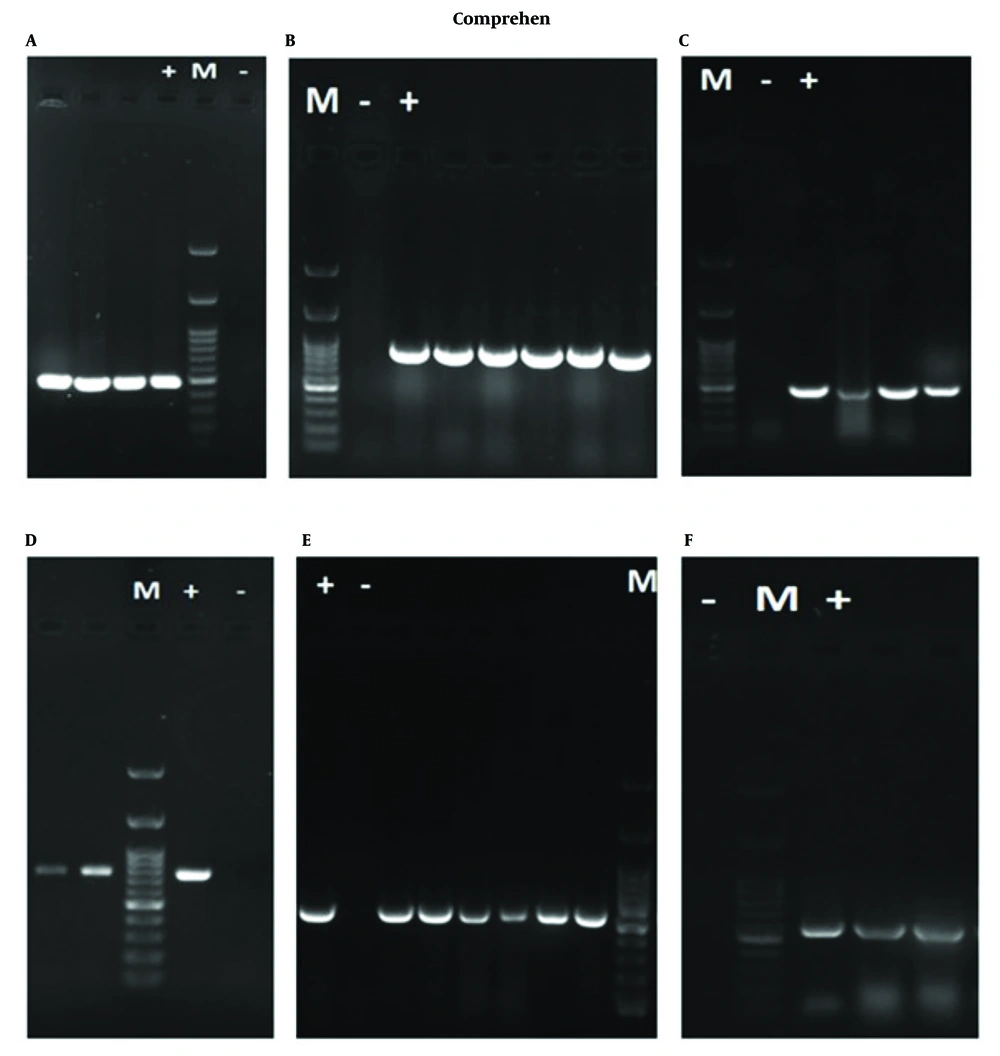
Figure 1.
Gel electrophoresis images of polymerase chain reaction (PCR)-amplified resistance genes with 100 bp DNA ladder (M = marker), positive (+), and negative (-) controls: A, gel image of blaNDM gene (512bp) and 100 bp DNA ladder; B, gel image of blaKPC gene (916 bp) and 100 bp DNA ladder; C, gel image of of blaSHV gene (471 bp) and 100 bp DNA ladder; D, gel image of blaTEM gene (848 bp) and 100 bp DNA ladder; E, gel image of blaCTX-M gene (544 bp) and 100 bp DNA ladder; F, gel image of blaAmpC gene (550 bp) and 100 bp DNA ladder.
5. Discussion
Due to the increase in antibiotic resistance among urinary pathogens, it is necessary to identify effective treatment regimens for UTIs. In this study, we aimed to investigate probable clinical and genetic factors in the occurrence of microbial resistance in common urinary pathogens. The most common cause of UTIs in our research aligns with other studies, with E. coli being the most prevalent organism. Compared to other studies, it seems that the prevalence of some other organisms, such as Klebsiella, Pseudomonas, and Enterococcus, has been on the rise (17, 18).
Different factors may play a role in the development of UTI, especially drug-resistant UTIs; we evaluated some of them, but it seems that long-term catheterization, nosocomial UTI, and previous antibiotic use are more related to the occurrence of resistant UTI than other factors (P < 0.05). In the meta-analysis conducted by Bhojani et al., it was shown that urological intervention for the treatment of kidney stones was the most significant risk factor in the occurrence of urosepsis (19).
In recent years, previous and improper use of antibiotics, especially broad-spectrum antibiotics, has played a major role in the development of multidrug-resistant (MDR) pathogens, making the treatment of some cases of UTI challenging and complicated (20). Because of the association between prior antibiotic use and the etiology of UTI and the occurrence of MDR organisms in this study, we believe good antibiotic stewardship is necessary for correctly managing this issue (21).
Length of hospital stay has always been considered one of the important factors in increasing the risk of nosocomial infections and UTI (direct relationship), especially when combined with diagnostic-therapeutic interventions (22). The chance of UTI increases by 3 - 6% per day of catheterization, and according to some studies, up to 7% (22, 23).
Other studies show that 4 - 50% of nosocomial infections are UTIs, with urinary catheterization being the most important predisposing factor (24). In our study, there was no significant relationship between the history of catheterization and the causative pathogen (P = 0.12), but a significant relationship was found with the length of hospitalization (P = 0.004). All cases in this study had a history of hospital stays lasting more than 5 days. In some species, including Enterococcus, the mean duration of hospitalization was more than 16 days. For this reason, the length of hospital stay should be shortened, and the insertion of a urinary catheter without indication should be avoided.
Today, resistant infections have become a public health threat, but the microbial susceptibility pattern is often a local issue. An increase in the prevalence of MDR organisms usually causes long-term hospitalization, more difficult treatment, and more deaths (25). Quinolones have always been considered one of the most important drugs to start the empirical treatment of UTI. The results of different studies show that excessive and sometimes incorrect use of quinolones has led to increased resistance to this drug category (26, 27). In our study, relatively high resistance to quinolones was seen, with more than 53% of cases of UTI due to E. coli being resistant to ciprofloxacin. It is recommended to consider the AST results when selecting the best treatment.
In a study conducted by Sultana et al., about 33% resistance to quinolones was reported in E. coli strains (28). In another study conducted in Iraq on preschool-age children, quinolones and carbapenems were found to be the most effective drugs for the treatment of UTI (29). It seems that the susceptibility of E. coli strains to quinolones is different in communities, but overall, the evidence indicates an increase in resistance to this class of antibiotics (30). Therefore, we think that more caution should be used when choosing quinolones as the first line of UTI treatment, especially in this medical center. Instead, nitrofurantoin seems a good choice for the short-term outpatient treatment of UTIs.
Despite the increased resistance of urinary pathogens, different studies also recommend nitrofurantoin for the empirical treatment of uncomplicated UTIs (27, 31). In this study, similar to other research, we observed low resistance to nitrofurantoin (31). Out of the 201 strains examined, more than 36% can produce broad-spectrum beta-lactamase enzymes, with most of these cases being related to E. coli strains. In Ahn's study on UTIs caused by ESBL-producing Enterobacteriaceae, a history of recurrent UTIs was identified as a risk factor, whereas in our study, no significant association was found with previous UTIs (32).
We found that the strains with the ability to produce ESBL and carbapenemase were more prevalent in people with a history of catheterization (P = 0.02 and < 0.001) and nosocomial UTI (P = 0.02 and < 0.001), making this difference significant. This result emphasizes avoiding unnecessary catheterization as well as trying to prevent nosocomial UTIs. Receiving prior antibiotics for any reason may also affect the development of disease caused by carbapenemase-producing strains.
12.5% of the Enterobacterales and Pseudomonas isolates carried carbapenemase genes (MBL and serine carbapenemase). The highest frequency of these genes was observed in Klebsiella and Enterobacter strains. Treating infections caused by carbapenemase-producing strains is typically challenging, with limited therapeutic options and sometimes unfavorable outcomes (33). Due to the increasing prevalence of resistant strains in Enterobacterales, it seems necessary to use newer antibiotics to treat complicated infections caused by them. Some studies have suggested the use of meropenem-vaborbactam for these types of infections (34).
The prevalence of Klebsiella pneumoniae carbapenemase (KPC) strains varies in different studies, with in vitro susceptibility patterns often showing significant resistance of KPC strains to carbapenems like meropenem (over 90% of cases). In such cases, adding vaborbactam to meropenem has been suggested to reduce resistance (35). It should be noted that access to these new-generation antibiotics is not always possible. Therefore, continuous monitoring of these strains for the prevalence of carbapenem resistance and carbapenemase gene expression is advised.
In our study, Klebsiella species showed over 35% resistance to imipenem and meropenem, which is expected considering the prevalence of carbapenemase genes (metallo-beta-lactamase and serine carbapenemase) in over 41% of these strains. These findings raise concerns about the potential for encountering urinary infections resistant to this particular organism. Healthcare policymakers need to explore enhancing the availability of new antibiotics to help mitigate potential difficulties in treating these patients down the line. Studies suggest that new drugs such as ceftazidime-avibactam or meropenem-vaborbactam can be a suitable option for treating infections caused by resistant gram-negative bacteria, especially in cases of complicated UTIs (36-39).
The observation of relatively high resistance among Enterococcus strains to vancomycin, ampicillin, and penicillin, at rates of 50%, 57%, and 69%, respectively, has raised significant concern. In recent years, there have been reports of increased vancomycin-resistant enterococci (VRE) cases in most countries, including Asia. In a meta-analysis that was conducted on 39 studies, a prevalence of about 8% VRE was reported in Asia (40). Enterococcus is among the organisms that play a significant role in severe infections such as bacteremia, endocarditis, and complicated UTI, especially in hospital settings or in patients with intravenous or urinary catheters, sometimes with high mortality rates, for example, up to 20% for enterococcal bacteremia (41). Due to the high resistance of Enterococcus strains to vancomycin, it seems that in some cases, other drugs, such as linezolid, will be needed (41).
Low resistance to nitrofurantoin was indeed observed in this study, but it should be noted that due to the low active concentrations in the kidney parenchyma, it is not a good choice for upper UTI (pyelonephritis), but it can be used in lower UTI without complications due to Enterococcus (42). When choosing this medication, attention should be paid to the set of side effects and contraindications. Prescribing this drug is not recommended when creatinine clearance is below 60 mL/minute or in late pregnancy (weeks 38 - 42), due to the possibility of hemolytic anemia (43). Although other serious adverse effects, including pulmonary complications, are also possible with long-term use of this drug, significant complications are usually rare in short-course regimens (44).
The study results of Mahdizade et al. indicated that nitrofurantoin could be one of the best options for the treatment or prophylaxis of lower UTI, especially with Enterococcal organisms resistant to vancomycin, quinolones, and aminopenicillins (31). Overall, we believe nitrofurantoin could be a suitable option for empirically treating UTIs within this healthcare setting.
Our research unveiled that E. coli (43%) exhibited the highest prevalence as an ESBL-producing organism, followed by species of Klebsiella (21.5%). This discovery was substantiated by various researchers who documented that E. coli and Klebsiella species stood out as the most predominant ESBL-producing organisms (45, 46). Cephalosporins and fluoroquinolones, which were advised and frequently used to treat infections caused by ESBL-producing bacteria, are gradually suffering setbacks due to the steady rise in penicillin-resistant strains. For community and clinical settings, this is concerning as well as serious. This highlights the need for sensible antibiotic treatment, limiting the spread of these strains in medical environments, and raising knowledge of the various ESBL types' clinical manifestations. Additionally, evolutionary history from gene sequencing can help prevent the spread of ESBL-corresponding genes in the future (47).
After screening the ESBL genes in ESBL-positive isolates for the current investigation, blaCTX-Mwas found in 91.7% of the isolates, blaTEM in 46.5%, and blaSHV in 30%. Contrarily, in a different study, the prevalence of CTX-M, TEM, and SHV genes was reported as 70%, 63.7%, and 35%, respectively (48). Riyahi Zaniani et al. reported 78.3% for the blaCTX-M, 64.8% for blaSHV, and 54% for the blaTEM gene (13). Studies carried out in Iraq and surrounding nations have revealed that the blaCTX-M gene was the predominant gene type in K. pneumoniae and E. coli (29, 45).
The prevalence of the NDM1 gene in MBL-producer bacteria was approximately 55.1% in the current investigation. This rate differs from previous studies, which reported a lower prevalence of NDM at 30% (48, 49). Additionally, the presence of AmpC β-lactamase was identified in 86.2% of ESBL-positive isolates in this study, aligning with findings from earlier research studies (48, 50).
The study's limitations stem from its single-center design at Ganjavian Hospital Dezful, potentially constraining the generalizability of findings to other healthcare settings characterized by different patient demographics, antibiotic utilization practices, and microbial compositions. Data collection relied on patient records and self-reported information, raising concerns about recall bias or incomplete data, particularly regarding past medical history and antibiotic usage. Although the study encompassed 274 patients, a larger sample size would have bolstered insights into antimicrobial resistance prevalence and the distribution of resistance genes, potentially mitigating the impact of sample size constraints on statistical power and uncovering more significant associations between risk factors and antimicrobial resistance patterns. Moreover, while the study delved into molecular detection of specific resistance genes such as blaCTX-M and blaNDM, conducting further genotypic analyses could deepen comprehension of resistance mechanisms and genetic diversity among uropathogens.
5.1. Conclusions
This study highlights the growing challenge of antimicrobial resistance in UTIs, particularly among beta-lactamase-producing bacteria. Key findings reveal significant associations between resistant strains and factors like recent antibiotic use, urinary catheterization, and nosocomial infections. Understanding resistance patterns and genetic determinants is crucial for guiding treatment strategies and underscores the urgent need for robust antimicrobial stewardship and infection control measures in UTI management. The blaCTX-M emerged as the predominant gene responsible for encoding ESBL production in E. coli and Klebsiella species. Clinical microbiology laboratories must consistently employ ESBL-identification tools for the surveillance of MDR isolates and utilize antibiograms to assist physicians and clinical personnel in the empirical treatment of infections. Implementing infection prevention and control measures, along with antibiotic stewardship programs, within hospital settings is crucial in curtailing the dissemination of resistant isolates.