
1. Background
Salmonella is a highly diverse genus of gram-negative, facultatively anaerobic bacteria belonging to the Enterobacteriaceae family. It continues to be one of the leading causes of foodborne illness worldwide. According to the World Health Organization, salmonellosis affects tens of millions of people each year, resulting in considerable economic losses and major public health challenges (1, 2). Food products of animal origin, particularly poultry meat and eggs, are major reservoirs for transmission, highlighting an ongoing critical need for robust surveillance and detection systems along the food supply chain (3). While most salmonellosis cases are self-limiting, invasive infections can be life-threatening, especially for immunocompromised individuals, the elderly, and young children, underscoring the importance of timely diagnosis and intervention (1).
The host-pathogen interaction between Salmonella and its avian hosts is complex, involving a multitude of molecular mechanisms that dictate the outcome of infection and the ensuing inflammatory response (4, 5). Beyond genetic factors, epigenetic elements — heritable changes in gene expression that do not involve alterations to the underlying DNA sequence — have emerged as critical regulators of these interactions (6, 7). Among these, microRNAs (miRNAs) have garnered significant attention. The miRNAs are short (~ 22 nucleotide), non-coding RNA molecules that post-transcriptionally regulate gene expression by binding to complementary sequences on target mRNAs, typically leading to their degradation or translational repression. Their role extends beyond the host genome, as they can be involved in cross-kingdom communication, influencing the pathogen's viability and the host's immune response (8).
In recent years, the role of miRNAs in immune modulation has been extensively documented. They act as fine-tuners of the immune response, ensuring its appropriate magnitude and duration to prevent both insufficient defense and excessive inflammation (9-11). This modulation occurs through the targeted suppression of key immune-related genes, such as those encoding cytokines, chemokines, and signaling adaptors (12, 13). For example, recent research highlights that miRNA can regulate the nucleotide-binding domain, leucine-rich-containing family, pyrin domain-containing-3 (NLRP3) inflammasome, a critical component of the innate immune system, thereby modulating the release of pro-inflammatory cytokines like interleukin-1 beta (IL-1β) during bacterial infection (14).
In chickens, miRNAs are recognized as principal epigenetic regulators of immune responses, influencing both innate and adaptive immunity (15). For instance, gga-miR-126-5p has been identified as a key modulator of innate immune cell function. It directly targets tumor necrosis factor receptor-associated factor 3 (TRAF3), a critical signaling molecule in the antiviral pathway, thereby acting as a negative feedback regulator to prevent excessive inflammation (16). Its upregulation has also been observed in response to viral challenges like H5N1 avian influenza and Marek's disease virus, suggesting a conserved role in anti-pathogen responses (16). Another pivotal miRNA, gga-miR-148a-3p, is involved in a wide array of physiological and pathological processes, including the regulation of skeletal muscle satellite cell (SMSC) differentiation and apoptosis by targeting genes like Meox2 and DYNLL2 (17, 18). Its functions extend to follicular development, inflammation control, and the body's defense against parasitic infections such as Eimeria (19, 20). The pleiotropic nature of these miRNAs positions them as potential sentinels of cellular state and immune status (21).
Conventional diagnostic methods for Salmonella, including culture-based techniques and polymerase chain reaction (PCR), while reliable, can be time-consuming and may not reflect past infections or the host's physiological response. This has spurred the development of non-culture-based diagnostic tools, particularly those leveraging molecular biomarkers like miRNAs. The stability of miRNAs in tissues and biofluids, coupled with their dynamic expression in response to disease, makes them exceptionally promising candidates for biomarker development (22). Their application is already advancing rapidly, with novel analytical methods being developed to detect miRNA biomarkers for various diseases, showcasing their high specificity and clinical potential (23). This approach is now being explored for infectious diseases and food safety, offering the potential for rapid, sensitive, and specific detection of contamination (24). Despite this progress, the expression profiles of gga-miR-126-5p and gga-miR-148a-3p in chicken tissues infected with Salmonella remain unexplored. This study is therefore designed to quantify the expression levels of these two immune-related miRNAs in the muscle of Salmonella-infected chickens compared to uninfected controls, evaluating their potential as novel diagnostic biomarkers for food safety.
2. Objectives
The objective of this investigation was to evaluate the expression patterns of two immune-related miRNAs, gga-miR-126-5p and gga-miR-148a-3p, in tissues infected with Salmonella, to investigate their potential as diagnostic biomarkers. By comparing their expression levels in infected and non-infected samples using real-time polymerase chain reaction (RT-PCR), this research seeks to provide insight into their role in host immune responses and their applicability in food safety monitoring.
3. Methods
3.1. Sampling and Study Design
This cross-sectional study was conducted in two sequential phases to first assess the prevalence of Salmonella in retail chicken meat and subsequently investigate the expression profiles of specific miRNAs in relation to contamination status. In the initial screening phase, a total of 250 fresh chicken meat samples were randomly collected from various retail outlets across Kerman province, Iran, to ensure geographic and market representativeness. The presence of Salmonella in these samples was determined using standard microbiological culture methods followed by confirmatory RT-PCR, as detailed in section 3.2. Based on the screening results, the study proceeded to the analytical phase, wherein a subset of 75 samples was selected for miRNA expression analysis. To ensure a robust and unbiased case-control design, all 50 samples that tested positive for Salmonella were included as cases, while 25 Salmonella-negative samples were randomly selected from the remaining 200 negative samples to serve as controls. This selection strategy, incorporating all available positive cases alongside a randomly chosen subset of negatives, was implemented to maximize statistical power for detecting differential miRNA expression while ensuring that the control group remained representative of the uncontaminated chicken meat population and was not influenced by convenience or selection bias.
3.2. Detection of Salmonella spp.
Microbial detection was conducted using a dual approach: Conventional culture techniques and RT-PCR. First, 25 g of each homogenized sample were blended with 225 mL of 2% buffered peptone water and incubated at 37°C. After incubation, aliquots were cultured in tetrathionate broth for 24 hours under the same conditions. Following enrichment, selective isolation was performed using bismuth sulfite agar (BSA) and xylose lysine deoxycholate (XLD) agar. Colonies with morphologies consistent with Salmonella were subjected to biochemical tests for preliminary identification. Confirmed isolates were cultured in brain heart infusion broth (Merck, Germany) supplemented with glycerol and stored at -70°C for subsequent use. Molecular validation was performed using RT-PCR with Salmonella-specific primers (Table 1), following genomic DNA extraction using a commercial purification kit (KPG, Iran). The primers were designed using Primer3 online software. The PCR reactions (20 μL final volume) were carried out under the following thermal cycling conditions: Initial denaturation at 95°C for 2 min; 40 amplification cycles of denaturation at 95°C for 20 s, annealing at 60°C for 20 s, and extension at 72°C for 1 min; and a final melting curve analysis from 50 to 95°C.
Table 1.
The Sequences of the Primers
| Genes | Primer Sequences (5' - 3') |
|---|---|
| RU | |
| Forward | ATTACTTGTGCCGAAGAGCC |
| Reverse | GATGCTGTTATCGTCCAGGC |
| gga-miR-126-5p | |
| RT | GTCGTATGCAGTGCAGGGTCCGAGGTATTCGCACTGCATACGACCGCGTA |
| Forward | AGCCGCATTATTACTTTTG |
| gga-miR-148a-3p | |
| RT | GTCGTATGCAGTGCAGGGTCCGAGGTATTCGCACTGCATACGACTCTTTG |
| Forward | CGCATCAGTGCACTACAGA |
| Universal reverse | GAGCAGGGTCCGAGGT |
| β-Actin | |
| Forward | ACTCTGTCTGGATTGGAGGC |
| Reverse | TTGCGGTGGACAATGGAGG |
3.3. Purification of MicroRNAs
The miRNAs were isolated from the homogenized chicken tissues using a commercial extraction kit (KPG, Iran). In brief, 200 μL of homogenate was lysed with buffer solution, and the lysate was applied to a high-absorbance silica column. Following sequential washes with buffer 1 and buffer 2, the bound miRNAs were obtained in a final volume of 50 μL using elution buffer. To ensure the quality and integrity of the isolated RNA, which is critical for reliable downstream RT-PCR analysis, all samples underwent rigorous quality control. The concentration and purity of the total RNA extracts were assessed spectrophotometrically using a NanoDrop™ instrument. Samples with an A260/A280 ratio between 1.8 and 2.1 and an A260/A230 ratio greater than 2.0 were considered pure, indicating minimal protein, phenol, or solvent contamination.
3.4. Expression Analysis of gga-miR-126-5p and gga-miR-148a-3p
Complementary DNA (cDNA) was synthesized from the extracted miRNAs using stem-loop primers specific to gga-miR-126-5p and gga-miR-148a-3p (KPG kits, Iran). The RT-PCR was employed to measure the expression profiles of gga-miR-126 and gga-miR-148a-3p. The reaction mixture was prepared in 0.1 mL RotorGene microtubes containing 3 μL of cDNA, 10 μL of SYBR Green master mix (Biosystem, England), 1 μL of primer solution (including both forward and reverse primers), and 6 μL of nuclease-free water. Amplification was conducted using a dual-channel RotorGene system, simultaneously targeting the gene of interest and beta-actin as the internal control gene. The thermal cycling conditions were as follows: An initial denaturation at 95°C for 2 min; followed by 35 cycles of denaturation at 95°C for 20 s, annealing at 60°C for 20 s, and extension at 72°C for 20 s. Gene expression was calculated using the 2-ΔΔCt method.
3.5. Data Analysis Methods
All statistical evaluations were performed using Statistical Package for the Social Sciences (SPSS) version 21. The normality of the distribution for the relative expression data (2-ΔΔCt values) of both gga-miR-126-5p and gga-miR-148a-3p was formally assessed using the One-Sample Kolmogorov-Smirnov test. This test is used to determine if a sample's distribution significantly deviates from a theoretical normal distribution. The null hypothesis for this test is that the data are normally distributed. In our dataset, the test yielded statistically significant results (P < 0.001) for both miRNAs in the infected and control groups, leading us to reject the null hypothesis. This confirmed that the expression data for both miRNAs followed a non-Gaussian (non-normal) distribution. The identification of non-normality is critical as it violates a key assumption of parametric tests, such as the independent t-test.
Using parametric tests on non-normally distributed data can increase the risk of type I errors (false positives). Therefore, to ensure the robustness and validity of our comparisons, we employed non-parametric tests, which do not assume a normal distribution. Specifically, comparisons of miRNA expression levels between the Salmonella-infected and control groups were conducted using the Mann-Whitney U test. This test is the non-parametric equivalent of the independent t-test and is used to compare differences between two independent groups when the dependent variable is either ordinal or continuous but not normally distributed. The fold change in miRNA expression between the Salmonella-infected and control groups was calculated using the 2-ΔΔCt method. To account for the non-normal distribution of the underlying data, the 95% confidence intervals (95% CIs) for the fold changes were determined using bootstrap resampling with 5000 iterations. Quantitative results are reported as medians and interquartile ranges (IQR) within the text, as these are the most appropriate measures of central tendency and statistical dispersion for non-parametric data. For graphical representation, data are presented as means ± standard errors (SE) to provide a visual estimate of the mean expression levels, in line with common practice in the field.
4. Results
Among the 250 samples examined, Salmonella species were detected in 50 instances, representing a contamination rate of 20%. The presence of the bacteria was first indicated by biochemical assays and subsequently validated through molecular diagnostic techniques. The identity of the isolated bacterial strains as Salmonella spp. was initially established through culture-based methods and subsequently validated via RT-PCR analysis. Furthermore, the One-Sample Kolmogorov-Smirnov test indicated that the distribution of raw data in both Salmonella-infected and uninfected tissue groups deviated from normality.
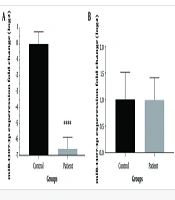
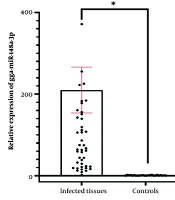
The Mann-Whitney test revealed that the median expression of gga-miR-148a-3p was 0.55 (IQR: 0.21 - 1.96) in the control group and 81.00 (IQR: 28.06 - 183.40) in the Salmonella-infected tissues, which was significantly different between the groups (P < 0.001, Figure 1). The relative quantification by the 2-∆∆Ct approach indicated that gga-miR-148a-3p expression was elevated by approximately 97.4-fold in Salmonella-exposed tissues compared to the control group.
![Relative expression of gga-miR-148a-3p is significantly upregulated in <i>Salmonella</i>-infected chicken meat. Relative expression levels of gga-miR-148a-3p were quantified by stem-loop real-time quantitative-polymerase chain reaction (RT-qPCR) in chicken meat samples [n = 50 <i>Salmonella</i>-positive (white column), n = 25 <i>Salmonella</i>-negative controls (black column)] and normalized to the beta-actin reference gene. Data were analyzed using the 2<sup>-ΔΔCt</sup> method. The box plots show the median for each group. The Mann-Whitney test revealed that the relative expression of gga-miR-148a-3p was significantly increased in <i>Salmonella</i>-infected poultry meat samples (P < 0.001). Using the 2<sup>-∆∆Ct</sup> method revealed that gga-miR-148a-3p was 97.41-fold (95% CI: 45.2 to 215.1) higher in the <i>Salmonella</i>-infected tissues compared to the non-infected controls.](https://brieflands.com/journals/jjm/articles/164844/figures/jjm-18-10-164844-i001-preview.webp "Relative expression of gga-miR-148a-3p is significantly upregulated in <i>Salmonella</i>-infected chicken meat. Relative expression levels of gga-miR-148a-3p were quantified by stem-loop real-time quantitative-polymerase chain reaction (RT-qPCR) in chicken meat samples [n = 50 <i>Salmonella</i>-positive (white column), n = 25 <i>Salmonella</i>-negative controls (black column)] and normalized to the beta-actin reference gene. Data were analyzed using the 2<sup>-ΔΔCt</sup> method. The box plots show the median for each group. The Mann-Whitney test revealed that the relative expression of gga-miR-148a-3p was significantly increased in <i>Salmonella</i>-infected poultry meat samples (P < 0.001). Using the 2<sup>-∆∆Ct</sup> method revealed that gga-miR-148a-3p was 97.41-fold (95% CI: 45.2 to 215.1) higher in the <i>Salmonella</i>-infected tissues compared to the non-infected controls.")
Figure 1.
Relative expression of gga-miR-148a-3p is significantly upregulated in Salmonella-infected chicken meat. Relative expression levels of gga-miR-148a-3p were quantified by stem-loop real-time quantitative-polymerase chain reaction (RT-qPCR) in chicken meat samples [n = 50 Salmonella-positive (white column), n = 25 Salmonella-negative controls (black column)] and normalized to the beta-actin reference gene. Data were analyzed using the 2-ΔΔCt method. The box plots show the median for each group. The Mann-Whitney test revealed that the relative expression of gga-miR-148a-3p was significantly increased in Salmonella-infected poultry meat samples (P < 0.001). Using the 2-∆∆Ct method revealed that gga-miR-148a-3p was 97.41-fold (95% CI: 45.2 to 215.1) higher in the Salmonella-infected tissues compared to the non-infected controls.
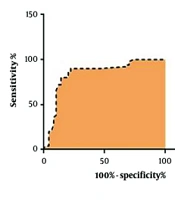
To evaluate the diagnostic utility of gga-miR-148a-3p in discriminating Salmonella-infected from non-infected meat samples, a receiver operating characteristic (ROC) curve analysis was performed. The relative expression values (2-∆∆Ct) were used as the test variable. The analysis demonstrated perfect diagnostic accuracy for gga-miR-148a-3p, with an area under the curve (AUC) of 1.000 (95% CI: 1.000 to 1.000, P < 0.001). This indicates a flawless ability to distinguish between contaminated and uncontaminated samples in our cohort. The optimal cut-off value was determined to be 2.37, at which both sensitivity and specificity were 100%.
Similarly, the median expression of gga-miR-126-5p was 0.73 (IQR: 0.46 - 1.07) in the control group and 7.35 (IQR: 3.64 - 14.84) in the Salmonella-infected tissues, which was also significantly different between the groups (P < 0.001; Figure 2). Using the 2-∆∆Ct method revealed that gga-miR-126-5p was 10.88-fold higher in the Salmonella-infected chicken tissues compared to the non-infected controls.
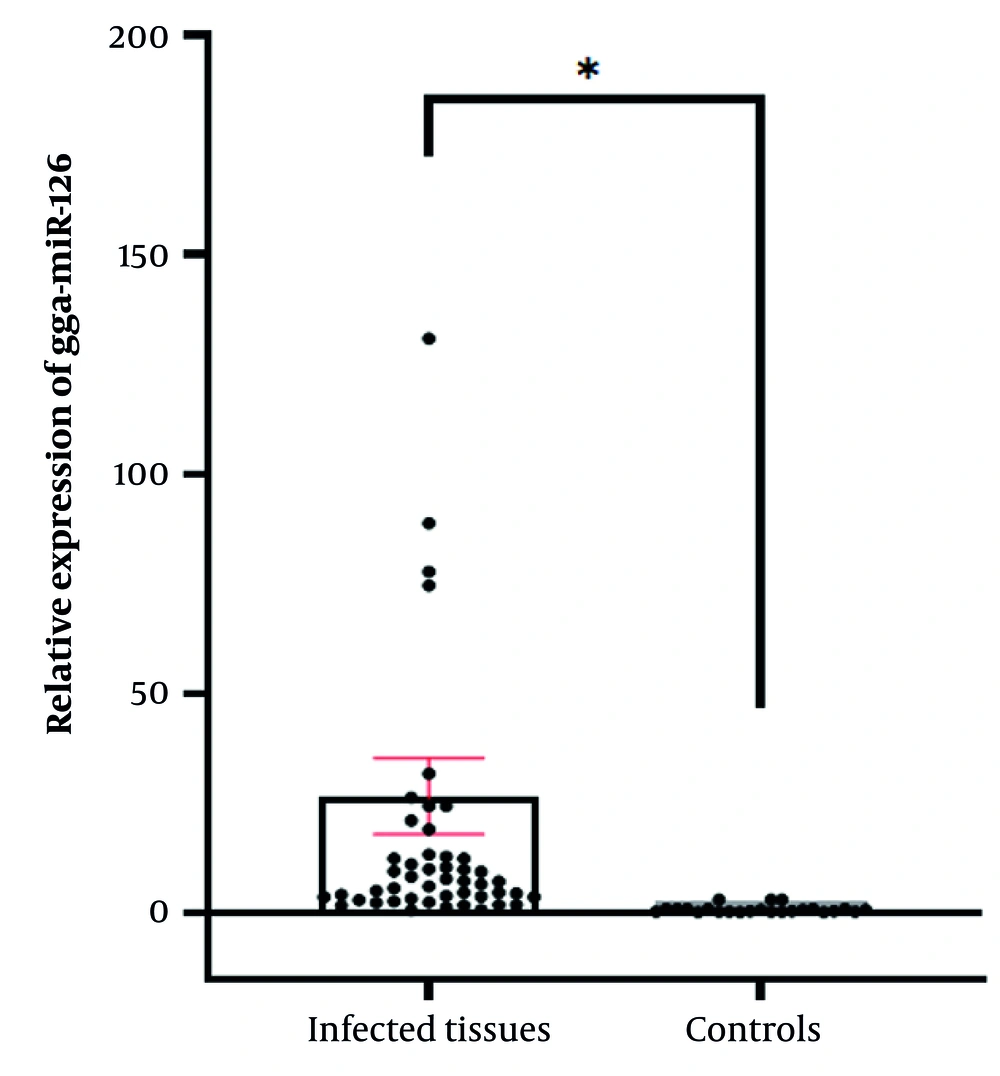
Figure 2.
Relative expression of gga-miR-126-5p is significantly increased in Salmonella-infected chicken meat. Relative expression of gga-miR-126-5p was measured via stem-loop real-time quantitative-polymerase chain reaction (RT-qPCR) in Salmonella-infected (n = 50, white column) and control (n = 25, black column) chicken meat samples, with beta-actin as an endogenous control. Gene expression was calculated using the 2-ΔΔCt method. The box plots show the median for each group. The Mann-Whitney test revealed that the relative expression of gga-miR-126-5p was significantly increased in Salmonella-infected tissues (P < 0.001). Using the 2-∆∆Ct method revealed that gga-miR-126-5p was 10.88-fold (95% CI: 6.5 to 18.3) higher in the Salmonella-infected tissues compared to the non-infected controls.
To evaluate the diagnostic utility of gga-miR-126-5p and gga-miR-148a-3p in discriminating Salmonella-infected from non-infected meat samples, a ROC curve analysis was performed. The relative expression values (2-∆∆Ct) for each miRNA were used as the test variables. The analysis revealed outstanding diagnostic accuracy for gga-miR-148a-3p, with an AUC of 0.998 (95% CI: 0.993 - 1.000). At an optimal cut-off value of 21.50, gga-miR-148a-3p demonstrated a sensitivity of 94.0% and a specificity of 100.0% in identifying Salmonella contamination. Similarly, gga-miR-126-5p also showed excellent diagnostic capability, with an AUC of 0.920 (95% CI: 0.859 - 0.980). The optimal cut-off point for gga-miR-126-5p was 2.48, which yielded a sensitivity of 86.0% and a specificity of 88.0%.
5. Discussion
The outcomes derived from this research indicated that around one-fifth of the chicken meat samples analyzed were contaminated with Salmonella species, emphasizing the urgent need for routine screening of meat products in food supply chains. Given the zoonotic potential and economic burden of Salmonella infections, the implementation of reliable detection strategies such as molecular diagnostics is critical for safeguarding public health. Our study supports the hypothesis that specific miRNAs are differentially expressed in Salmonella-infected poultry, thereby offering promise as novel biomarkers. In particular, the significant upregulation of gga-miR-126-5p and gga-miR-148a-3p in infected tissues highlights their potential role not only in immune response regulation but also in the development of rapid, non-culture-based diagnostic tools.
The significant upregulation of gga-miR-126-5p and gga-miR-148a-3p and their outstanding performance in ROC analysis strongly suggest their utility as biomarkers for Salmonella contamination. However, an important consideration for the diagnostic specificity of these miRNAs is the potential influence of other common poultry pathogens or environmental stressors. It is plausible that infections with other bacteria (e.g., Campylobacter jejuni, Escherichia coli), viruses (e.g., Avian influenza, Marek's disease virus), or even non-infectious stressors could also modulate the expression of these immune-related miRNAs (16). For instance, the upregulation of gga-miR-126-5p has been previously documented in response to viral challenges (16), indicating its role is not exclusive to Salmonella. Therefore, while our data robustly demonstrate that these miRNAs are powerful indicators of a pathological state in chicken meat, their absolute specificity to Salmonella within a complex farm or processing environment requires further validation.
The miRNA signature we identified is likely a reflection of a host immune response to infection and inflammation, which could be triggered by multiple agents. Future studies are essential to create a more comprehensive biomarker panel. This would involve profiling these and other miRNAs in chickens experimentally infected with a range of common pathogens to identify unique, pathogen-specific miRNA "fingerprints". The development of a multiplex assay detecting a combination of several miRNAs, rather than relying on a single marker, would be a promising strategy to achieve the high specificity required for a definitive diagnostic test. Despite this, the remarkably high AUC, sensitivity, and specificity values reported here confirm that gga-miR-126-5p and especially gga-miR-148a-3p are exceptionally strong candidate biomarkers for screening purposes, where identifying potentially contaminated or compromised meat is the primary goal, even if the specific etiological agent requires subsequent confirmation.
The significant upregulation of gga-miR-126-5p and gga-miR-148a-3p in Salmonella-infected tissues suggests their active involvement in the host's post-transcriptional immune reprogramming. The observed overexpression of gga-miR-126-5p is consistent with its established role as a negative feedback regulator of innate immunity. The compelling diagnostic power of gga-miR-148a-3p was further confirmed by ROC curve analysis. The perfect AUC value of 1.000, along with 100% sensitivity and specificity at the identified cut-off, underscores its exceptional potential as a diagnostic biomarker. This indicates that in our study, the expression level of gga-miR-148a-3p could be used to classify samples with complete accuracy. A test with such high sensitivity is crucial for food safety screening to ensure all contaminated samples are identified, while perfect specificity prevents the unnecessary rejection of safe products. These quantitative performance metrics strongly bolster the argument that gga-miR-148a-3p possesses the robust discriminatory capacity required for practical diagnostic applications in food safety monitoring.
The compelling diagnostic power of these miRNAs was further confirmed by ROC curve analysis, which is the benchmark for evaluating biomarker performance. The exceptional AUC value for gga-miR-148a-3p (0.998) indicates a near-perfect ability to distinguish between infected and control samples. With 94% sensitivity and 100% specificity at its optimal cut-off, this miRNA could form the basis of a highly reliable screening test, correctly identifying almost all contaminated samples while ensuring safe products are never incorrectly rejected. Although slightly less powerful, gga-miR-126-5p also demonstrated excellent diagnostic performance (AUC = 0.920), with high sensitivity and specificity. These quantitative performance metrics strongly bolster the argument that gga-miR-126-5p and gga-miR-148a-3p are not merely differentially expressed but possess the robust discriminatory capacity required for practical diagnostic and food safety monitoring applications.
The gga-miR-148a-3p directly targets TRAF3, a critical adaptor protein in the toll-like receptor (TLR) and RIG-I-like receptor (RLR) pathways that drive the production of type I interferons (IFNs) and pro-inflammatory cytokines (15, 16). By dampening TRAF3-mediated signaling, gga-miR-126-5p likely serves to fine-tune the immune response, preventing excessive inflammation and potential tissue damage during Salmonella infection. This mechanism represents a crucial checkpoint in pathogen recognition, ensuring a balanced response that combats the infection without causing immunopathology. Similarly, the profound upregulation of gga-miR-148a-3p points to its role in modulating cellular fate and immune signaling in infected tissues. While its best-characterized targets include genes like Meox2 and DYNLL2, which regulate SMSC differentiation and apoptosis (17, 18), its involvement likely extends to the immune landscape. The induction of apoptosis in infected cells is a key host defense strategy to limit pathogen replication and spread. Therefore, the upregulation of gga-miR-148a-3p may facilitate the clearance of Salmonella-infected cells by promoting apoptotic pathways, thereby acting as an indirect antimicrobial mechanism. Collectively, the dysregulation of these two miRNAs highlights a coordinated epigenetic strategy to manage both the inflammatory signaling (via gga-miR-126-5p) and the cellular integrity (via gga-miR-148a-3p) in response to bacterial invasion.
Supporting the results of the current research, previous studies have shown that the expression level of gga-miR-126-5p was significantly elevated in the muscle tissue of Ross 308 broilers (fast-growing genotype) compared to that of the Ranger Gold line (slow-growing genotype) (25). Bioinformatic predictions using the miRDB database identified over 870 putative gene targets for gga-miR-126-5p, including several involved in inflammation and immune regulation, such as interleukin-17A (IL-17A). This further supports the notion that miRNA expression profiles can reflect host-pathogen dynamics and potentially guide the development of predictive models for disease status and meat quality.
Beyond their diagnostic potential, the practical implementation of miRNA-based detection in commercial poultry processing warrants consideration. Regarding feasibility, the methodology described here — RNA extraction followed by real-time quantitative-polymerase chain reaction (RT-qPCR) — is already a cornerstone of molecular biology laboratories. The high stability of miRNAs in tissue samples, even under suboptimal conditions, is a significant advantage over labile mRNA or proteins, making them robust candidates for the variable environments of processing plants. However, the current protocol requires specialized equipment and technical expertise, which may be a barrier for some facilities. The cost-effectiveness of this approach is currently higher than traditional culture methods but is competitive with, and often faster than, standard molecular techniques like PCR for pathogen DNA. The primary costs are associated with RNA extraction kits and RT-qPCR reagents. As high-throughput, automated nucleic acid extraction systems become more widespread and reagent costs continue to decline, the economic viability of miRNA profiling is expected to improve significantly.
For scalability, the transition from a research setting to a high-throughput processing line presents the biggest challenge. Future development should focus on streamlining the process, potentially by creating multiplex RT-qPCR assays that simultaneously detect several miRNA biomarkers and internal controls in a single reaction, or by adapting the technology to faster, point-of-need platforms like lateral flow devices. While not without its hurdles, the trajectory of molecular diagnostics suggests that miRNA-based detection is a scalable technology. Its integration could initially be most valuable at critical control points for premium product lines or for periodic surveillance, providing a rapid and mechanistically informative assessment of meat quality and safety that complements existing microbial tests.
Therefore, it seems that upregulation of gga-miR-126-5p can be associated with defective immune responses against Salmonella infection. Consistent with the present study, a study reported that gga-miR-148a-3p has several targets in chicken. For example, this miRNA can target the molecules that participate in cell survival of SMSCs and induction of apoptosis (17). The analysis revealed a marked upregulation of gga-miR-148a-3p expression in chicken meat samples contaminated with Salmonella. This suggests that the upregulation of gga-miR-148a-3p may play a role in inducing apoptosis in these infected samples. The increased levels of gga-miR-148a-3p in the infected meat samples may indicate an immune response to the presence of Salmonella, leading to the activation of apoptosis pathways. To the best of our knowledge, this is the primary investigation that assesses the expression of gga-miR-126-5p and gga-miR-148a-3p in Salmonella-infected chicken meat.
Collectively, the significant upregulation of gga-miR-126-5p and gga-miR-148a-3p in Salmonella-contaminated samples suggests their potential as biomarkers not only for infection but also for indicating a probable decline in meat quality. This connection is justified through several logical pathways.
5.1. Link to Apoptosis and Tissue Degradation
The observed upregulation of gga-miR-148a-3p, a known regulator of SMSC apoptosis (17, 18), indicates the activation of programmed cell death pathways in the muscle tissue. In the context of infection, widespread apoptosis in muscle fibers can lead to a loss of structural integrity, potentially resulting in softer texture, reduced water-holding capacity, and increased drip loss, all key parameters of meat quality deterioration.
5.2. Association with Inflammatory Response
The upregulation of gga-miR-126-5p, a key modulator of innate immunity (15, 16), reflects an active and potentially excessive inflammatory response to Salmonella infection. A robust inflammatory state within muscle tissue is characterized by the infiltration of immune cells and the release of proteolytic enzymes and reactive oxygen species. This biochemical environment can promote protein degradation, lipid oxidation, and overall spoilage, negatively impacting the sensory attributes, shelf-life, and nutritional value of the meat.
5.3. Correlation with Microbial Load and Spoilage
The presence of Salmonella itself, confirmed in our contaminated samples, is a direct indicator of compromised hygiene and safety. A high microbial load often correlates with the presence of other spoilage microorganisms.
5.4. Conclusions
The specific miRNA signature we identified may therefore serve as a molecular proxy for this microbiological contamination, which inherently leads to quality defects such as off-odors, discoloration, and slime formation. Therefore, while these miRNAs are direct markers of the host's immune and cellular response to Salmonella, their expression profiles are intrinsically linked to the physiological processes that underlie meat quality. Their upregulation signals a tissue under pathological stress, which is highly likely to manifest in qualities deemed inferior by industry standards and consumers.
Studying the expression of these miRNAs is crucial for understanding the molecular mechanisms of bacterial infections in chicken meat. This knowledge can aid in developing strategies to ensure food safety and prevent the spread of foodborne illnesses. Specifically, miRNAs such as gga-miR-126-5p and gga-miR-148a-3p show significant potential as biomarkers for assessing meat quality, as their expression levels can indicate both bacterial infection and compromised quality. Their integration as diagnostic tools could revolutionize the monitoring of chicken meat products within the food industry. To this end, further investigations are recommended to validate these miRNAs in larger cohorts and explore their expression dynamics under various stress and infection models. Establishing a standardized protocol for miRNA-based detection may pave the way for their integration into food industry monitoring systems and veterinary public health programs.