
1. Background
Staphylococcus aureus is a common commensal of humans as well as an important cause of infectious diseases such as skin and soft tissue infections, blood stream infections, pneumonia, osteomyelitis, and endocarditis (1, 2). Staphylococcus aureus colonizes in various parts of healthy humans’ bodies such as the nares, skin and vagina, but studies have shown that the anterior nasal region is the most consistent area in which this organism can be isolated (2, 3). Nasal colonization is an important stage in the pathogenesis of S. aureus infection and is a risk factor for infections in both hospitals and the community (4). Longitudinal studies have distinguished three S. aureus nasal carriage patterns in healthy individuals, which includes persistent carriers, intermittent carriers, and noncarriers (3). Persistent carrier is a person whose nose culture is positive within a one-week interval or contains 103 colony forming units; if only one of the cultures is positive or the colony-forming unit (CFU) is less than 103, the person will be considered an intermediate carrier. A noncarrier is a person whose nasal cultures are all negative for S. aureus (5, 6).
The prevalence of S. aureus nasal carriage varies and is higher in young children (7), hospitalized patients, males (8), and a number of patients including patients with diabetes mellitus (9), chronic ambulatory diseases, those with S. aureus skin infection (10), and HIV-infected patients (6, 11). There is evidence that certain individuals may carry their resident strain for long periods, sometimes even for years (11). Besides, von Eiff and colleagues have shown that 80% of S. aureus infections in bacteria carriers are attributable to an endogenous source (12). The statistics used to identify these carriage patterns have been opposed. Approximately, 10% to 35% of healthy individuals are almost always persistent carriers and intermittent carriers are between 20% and 75%; eventually, 5 - 50% of healthy individuals become noncarriers (3, 6, 13-15). The ability of S. aureus strains to produce a diverse range of diseases depends on the expression of several virulence factors.
Panton–Valentine leukocidin (PVL) is considered as one of the most important virulence determinants of S. aureus and community-acquired methicillin-resistant S. aureus (CA-MRSA). PVL is a bicomponent toxin that forms polymeric pores in leukocyte membranes and plays an important role in the pathogenesis of necrotizing pneumonia and clinical syndromes of necrotic skin lesions (furuncles) (5, 16, 17). Arginine catabolic mobile element (ACME) is a proposed virulence gene and the survival factor of S. aureus, which was discovered by whole genome sequencing of USA300 (ST-8). Acquisition of ACME by S. aureus, a transient colonizer of the skin, may allow CA-MRSA to colonize the skin on a permanent basis, thereby enhancing the likelihood of skin infection (18, 19). There is no study to determine the pattern of S. aureus nasal carriage in Iranian healthy carriers.
2. Objectives
The aim of this study was to determine the dynamic of S. aureus nasal carriage and explore the frequency of PVL and ACME virulence genes among healthy carriers in central Iran.
3. Patients and Methods
3.1. Isolation and Characterization of Staphylococcus aureus
A cross-sectional study was performed on 813 volunteers from November 2011 to May 2012 and was approved by the Ethics Committee of Arak University of Medical Sciences campus after institutional ethical approval (No. 3-143-1392). Students without symptoms or signs of clinical illnesses and antibiotic consumption were enrolled in the study.
Sampling was performed twice within a week on volunteers. The anterior nasal swabs were collected using Transwab (Medical Wire and Equipment Company, Corsham, UK) and were immediately transported to the laboratory. The nasal swabs were enriched with 7.5% salt nutrient broth (Merck, Germany) at 37°C for 2 - 4 hours, then were plated on a Columbia blood agar (Merck, Germany) medium plate and incubated at 37°C for 24 hours. Identification of S. aureus was based on colony morphology and results of Gram staining. The isolated colony was inoculated on sterilized phenol-red mannitol salt agar (MSA) (Merck, Germany) plates and incubated at 37°C for 24 hours. Isolates positive for catalase test, MSA plate, slide coagulase and tube coagulase with human plasma and DNase test and thermostable nuclease, were considered as S. aureus in this study. In addition, all the isolates were checked for the presence of the sa442 gene by PCR (4) (Table 1).
3.2. Detection of Arginine Catabolic Mobile Element (ACME) and Panton-Valentine Leukocidin (PVL) Virulence Genes by Polymerase Chain Reaction
DNA extraction kit (BioFlux, Bioer, Korea) was used for the extraction of genomic DNA from all the S. aureus strains, according to the manufacturer’s instructions. PCR was performed for amplification of genes encoding PVL and ACME-arcA (20) (Table 1). Each of the PCR products were sent for sequencing (Gene Fanavaran, Iran) and confirmed through the basic local alignment search tool (BLAST) search before the final results were analyzed.
Table 1.
Profile Primers and Polymerase Chain Reaction Conditions a
| Gene, Primer/Sequence | PCR Product Size | Reference |
|---|---|---|
| Sa442 | 108 bp | (4) |
| F: AATCTTTGTCGGTACACGATATTCTTCACG | ||
| R: CGTAATGAGATTTCAGTAGATAATACAACA | ||
| PVL | 433 bp | (4) |
| F: ATCATTAGGTAAAATGTCTGGACATGATCCA | ||
| R: GCATCAATGTATTGGATAGCAAAAGC | ||
| ACME | 770 bp | (21) |
| F: CACGTAACTTGCTAGAACGAG | ||
| R: GAGCCAGAAGTACGCGAG |
a The PCR condition was 30 seconds in 95°C, 30 seconds in 55°C and 45 seconds in 72°C.
4. Results
Of 813 participants, 83 (10.2%) and 86 (10.6%) were persistent and transient carriers, respectively; the population of the overall nasal carriers of S. aureus was 20.8% (169/813). None of the carriers were ever hospitalized or ever experienced fever during the last two weeks. These comprised 61 males (36%) and 108 females (64%), 18 to 44 years old (mean age: 23.5 ± 5.5). Out of 813 candidates, 644 (79.2%) were noncarriers. All the isolates showed positive results for the amplification of Sa442 identification marker (Figure 1).
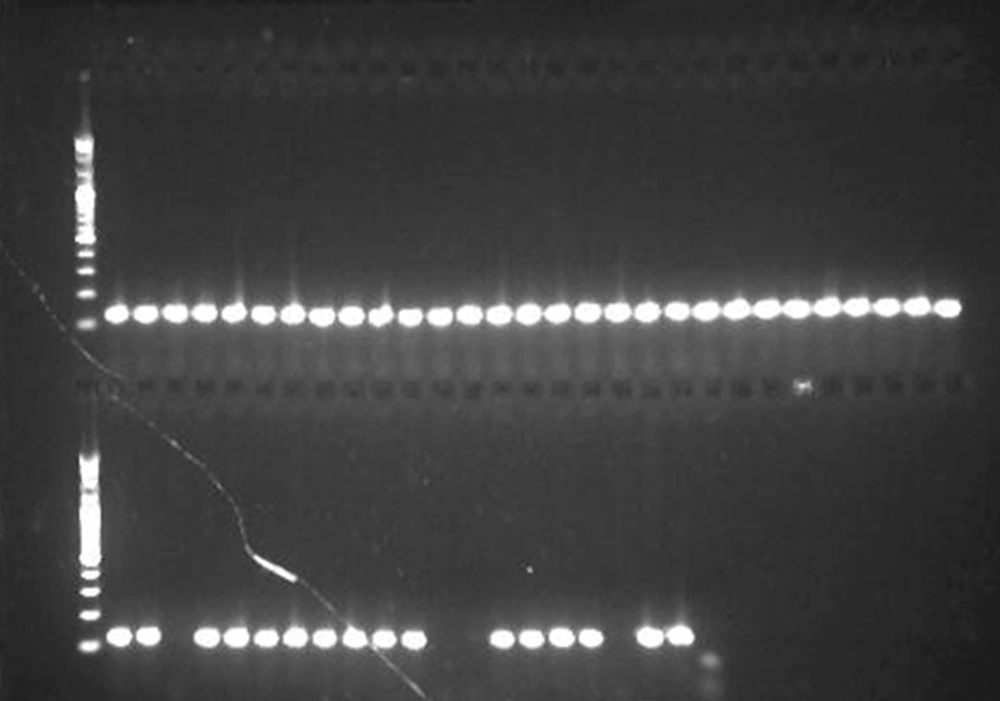
Figure 1.
The left lane is weight marker.
Surprisingly, a high frequency of PVL gene among the S. aureus isolates was found, which was 34 (20%) (Figure 2). In addition, 29 (17%) were positive for ACME–arc A gene (Figure 3).
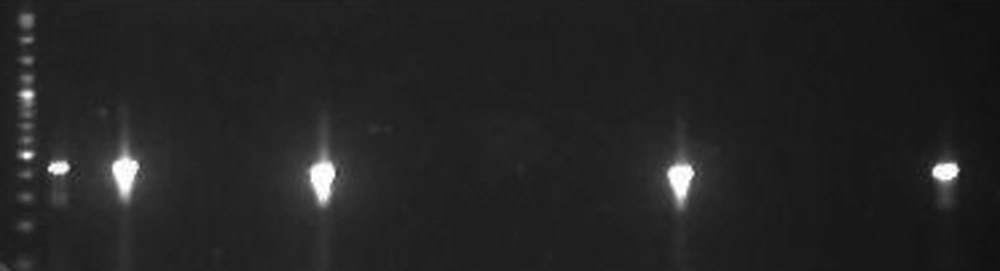
Figure 2.
Product size of the PVL gene was 433 bp.
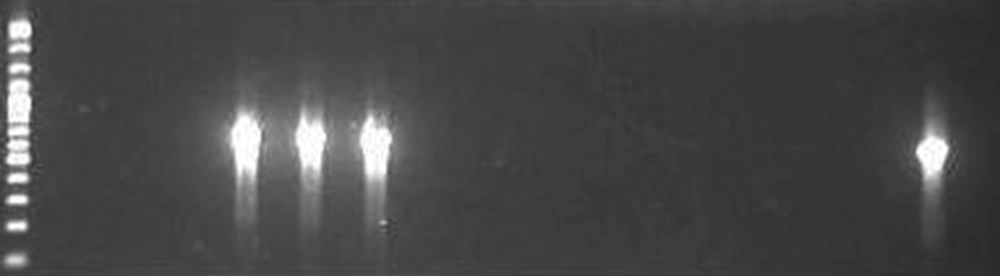
Figure 3.
The product size was 770 pb.
5. Discussion
This study was designed, because most of the studies have been conducted in Iran concerning the carriage of S. aureus in healthcare workers and no information exists about the dynamics and even the frequency of S. aureus carriage in the healthy population. Therefore, a decision was made to study the dynamics of S. aureus carriers in center of Iran and to evaluate the potential risks such as the presence of PVL and ACME genes. The results indicated that generally (20.8%), healthy people who are in this region are frequent carriers of S. aureus. The rate of nasal carriage of S. aureus was 31.1% in Brazil (21) and in a study performed in Hamedan (Iran), this rate was 25.2% (22). In another study in Iran, the frequency of nasal carriage at the admission time in pediatrics hospital was 20.7% (23).
In a study by Seng Choi et al. in Malaysia, the carriers’ rate was 23.4% (24). In general, the colonization rate of S. aureus in healthy individuals has been reported 10 - 70% in most parts of the world (6). Nevertheless, factors such as age, gender, alcoholism, smoking and taking pregnancy medicines as well as some chronic diseases such as diabetes and skin diseases are considered to increase S. aureus nasal carriage (9, 25). In this study, the rate of S. aureus carriers among healthy individuals was 20.8%, which was in agreement with the above studies. However, this rate cannot be generalized, as the recent study was performed in a small scale among university students and the number of persons who carry nasal S. aureus may depend on the population under the study. Surprisingly, 83 (49%) of our healthy carriers were persistence carriers. The explanation could be that persistent carriers are the high-risk group for S. aureus infection. This finding in our region must be taken seriously; however, longitudinal follow-up would enable the assessment of the infection frequency in this group.
Although knowledge regarding the host and bacterial factors affecting Staphylococcus colonization is increasing, the reason why some individuals are persistent carriers and others are intermittent carriers or noncarriers is still unclear. However, persistent and intermittent carriers are at a higher risk of exposure to S. aureus infections compared to noncarriers (12, 26). In addition, differences in procedures of nasal swabbing and isolation of S. aureus may account for some variations in carriage rates. For instance, transmission medium and the incubation period are considerable; it has been documented that swabs from the anterior nares (i.e. the vestibulum nasi) yield higher carriage rates than swabs taken from sites beyond this region (27). In the current study, the main pattern of S. aureus carriers belonged to noncarriers, the rate of which is compatible to studies performed by Vasantha Kumari in Malaysia (28). In the study of Eriksen et al. the rate of carriers was high (84%) and the rate of S. aureus carriers in males was higher than females; this proportion was in contrast with our observations (13).
The frequencies of two important virulence genes, PVL and ACME, were determined in the recent study. In our study, PVL was found in 20.8% of isolates, while in different studies in Turkey, the PVL gene was detected in 0 - 12.7% of the isolates (29-33). Around 10% of S. aureus isolates reported in both the USA and Indonesia have been PVL positive (34, 35). Higher prevalence of the PVL gene was found 19.4% in Malaysia , 19.7% in Iran and 31% in New Zealand (36-38). In this study, it was 20%. Generally, PVL-positive S. aureus exists in children and young adults (35). Generally, PVL gene represents a stable marker for CA-MRSA and very seldom in HA-MRSA. In Iran, the frequency of PVL gene in HA-MRSA has been found as 4.57%, which is high compared with other parts of the word (39, 40). However, only 1 (14.3) out of seven CA-MRSA isolates from healthy carriers harbors the PVL leukocidin gene (20). Increase in PVL rate is becoming critical and requires more attention. The transmission of S. aureus in universities and other crowded places where people are more often in close physical contact with each other can make an endogenous supply for infections, or can help in transmitting and spreading the strain among people. A future research is needed to obtain information about the gene spread of this dangerous isolate among nasal carriers.
Regarding the ACME virulence gene, the study of Francois Barbier et al. found that in Istanbul, the rate of ACME was 65.4% (41). In another study by Shore et al. 23 of 238 ACME isolated S. aureus were positive (42). In studies by Ellington et al. and Montgomery et al. the rates of ACME was 34.5% and 75.44%, respectively (43, 44). In this study, the frequency of the ACME-arc gene was 17%, which was the less than other studies. Although it is believed that ACME enhances the pathogenicity of the S. aureus strains through unknown mechanism, some studies have mentioned that the presence of this gene metabolically alters the local pH on the skin, hence, increases the ability of this microorganism to persist on intact skin (18).
In conclusion, the high prevalence of persistent S. aureus carriers and the considerable frequency of the PVL leukocidin gene in our region are worrisome and must be considered as major concerns. Further study is needed to investigate the relationship between S. aureus nasal colonization and infection, through molecular epidemiology of S. aureus isolated from carriers and infection sites.