1. Background
Biofilm formation is considered as a main problem in infection control (1, 2). Due to recent investigations, there is strong evidence that Pseudomonas aeruginosa strains form multicellular seeds within sites of infection, e.g. in the lungs of patients with cystic fibrosis or on the surfaces of infected catheters or burn infections (3). Pseudomonas aeruginosa is a prototype organism for studying biofilm formation. The persistence of long-lasting infections caused by biofilm-forming P. aeruginosa isolates has created serious problems in burn hospitals and related infections are difficult to treat, even in individuals with normal immune responses (1).
Biofilm formation demonstrates a protective mode of growth which allows the bacterium to survive in different environments. (4, 5). In some studies, it has been shown that the P. aeruginosa strains that produce biofilm, tolerate ceftazidime, ciprofloxacin, and tobramycin antibiotics at concentrations more than those necessary to kill planktonic bacteria (6, 7). This antibiotic resistance may be due to a variety of bacterial populations which are protected from treatment in biofilm structure (8, 9). In vitro susceptibility tests with bacterial biofilm models have shown that after treatment with antibiotics, bacteria in biofilm survive at concentrations hundreds or even a thousand times greater than the minimum inhibitory concentration of the planktonic bacteria (10).
The biofilm matrix of bacteria is composed of diverse biomolecules including polysaccharide, proteins, and even DNA (11, 12). Different types of polysaccharides can be found within the matrix: alginate, polysaccharide encoding locus (Pel), and polysaccharide synthesis locus (Psl) (13). Psl that is encoded by the pslA gene is a neutral-charge exopolysaccharide, comprised of D-mannose, D-glucose, and L-rhamnose, arranged in pentasaccharide repeats and provides structural support during biofilm formation, playing a role in both cell-to-cell and cell-to-substrate attachment (14). Some previous investigations showed an important role of the pslA gene in primary stages of biofilm formation among P. aeruginosa isolates (15). The expression of the pslA gene restores the biofilm forming phenotype among mutant strains; so, it indicates that the pslA gene is required for biofilm formation by P. aeruginosa (16). Finally, since reporting antibiotic resistance is a common phenomenon among biofilm-producing bacteria, it was interesting to determine the probable association of this event and the presence of the pslA gene among multidrug-resistant isolates of P. aeruginosa.
2. Objectives
The aim of the present study was to assess biofilm formation and antibiotic resistance and identify their probable correlation with the presence of the pslA gene among P. aeruginosa isolates obtained from waste water in a new burn centre in Guilan, Iran.
3. Materials and Methods
3.1. Study Area and Bacterial Strains
This cross-sectional study was conducted from October 2012 to April 2013 on 50 isolates of P. aeruginosa which were collected from waste water samples from a new burn center (Velayat Burn Center, Rasht) in Guilan, Iran. The biofilm-positive and negative strains of Staphylococcus epidermidis (RP62A and RP62NA, respectively) were used as controls for the biofilm formation test.
3.2. Antibacterial Susceptibility Tests
Antibacterial susceptibility was determined by disc diffusion, as recommended by the Clinical and Laboratory Standards Institute (CLSI), using the following antibiotic discs (MAST, UK): amikacin (AK), gentamicin (GM), tobramycin (TN) ceftazidime (CAZ), cefazolin (CZ), ciprofloxacin (CIP), carbenicillin (CB), imipenem (IPM), and piperacillin (PRL) (17).
3.3. Biofilm Formation Assay
Biofilm formation was determined in vitro using microtiter plate assay. In brief, overnight cultures (24 hours, 37°C) were adjusted to an OD600 of 0.8 and were diluted 100 folds in tryptic soy broth. Aliquots (200 μL) of each isolate suspension were then inoculated into four wells of a 96-well flat-bottomed polystyrene plate and incubated overnight at 37°C. The content of each well was washed two times with 250 μL of sterile physiological saline; the plates were severely shaken to remove all non-adherent bacteria. Then, the plate was dried with heat which helps with the fixation of the attached biofilm. Then, each well was stained with 200 μL of safranin 0.1% v/v for 15 minutes. After washing and drying the plate, the dye bound to the adherent cells was dissolved with 200 μL of ethanol 95% per well. The optical density of the biofilms was measured at 492 nm using an ELISA reader (Stat Fax 2100, Awareness Tech Inc., USA) (18). The cut-off optical density (ODc) for the microtiter plate was defined as three standard deviations plus the mean OD of the negative control. The isolates were classified as follows (19): biofilm-negative (OD < 0.625) and biofilm-positive (OD > 0.625).
3.4. DNA Extraction and Molecular Assay
The genomes of all the isolates were extracted by boiling method. Previously described primers were used to check the presence of the pslA gene: F, 5'-CACTGGACGTCTACTCCGACGATAT-3'; R, 5'- GTTTCTTGATCTTGTGCAGGGTGTC-3', which amplify an 1119 base-pair (bp) amplicon (20). The used primers were manufactured by Bioneer, Korea. P. aeruginosa PAO1 was used as positive control for the pslA gene. PCR assay was performed in 25 μL using the specific primers with the following time and thermal program (initial denaturation: 95°C five minutes, followed by 30 cycles of denaturation at 94°C for 30 seconds, annealing at 55°C for 30 seconds, extension at 72°C for one minute, and a final extension of 10 minutes at 72°C) in a thermocycler device (Eppendorf Mastercycler Gradient, Germany).
3.5. Statistical Analysis
Statistical analysis was performed using SPSSTM software, version 19.0. Chi squared and t test were used to analyze the results whenever needed. P < 0.05 was considered as the significance level.
4. Results
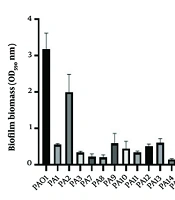
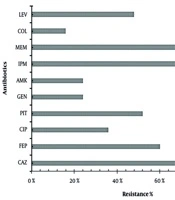
Of the 50 isolates, 35 (70%) were biofilm producers and 15 (30%) were non-biofilm producers. All the isolates were resistant to cefazolin and carbenicillin followed by 82% resistance to carbenicillin, 40% to ceftazidime, 30% to gentamicin, 28% to tobramycin, 22% to piperacillin and imipenem, 20% to ciprofloxacin, and 10% to amikacin. The comparison between the two groups of strains, biofilm and non-biofilm producers, was shown in Table 1. Biofilm producers have been more resistance to most antibiotics than non-producer groups. On the other hand, resistance to gentamicin, imipenem, tobramycin, and piperacillin was significantly higher among the biofilm-producing isolates than the non-producing ones (P < 0.05). The PCR results showed that the pslA gene was present in 15 isolates of biofilm producers.
| Antibiotics | Biofilm Producer (n = 35) | Biofilm Non-producer (n = 15) | P Value |
|---|---|---|---|
| Gentamicin | 13 (37.1) | 2 (13.3) | 0.046c |
| Imipenem | 10 (28.6) | 1 (6.7) | 0.043c |
| Ceftazidime | 16 (45.7) | 4 (26.7) | 0.10 |
| Amikacin | 5 (14.3) | 0 | 0.61 |
| Ciprofloxacin | 7 (20) | 3 (20) | 1.0 |
| Piperacillin | 11 (31.4) | 0 | 0.007c |
| Tobramycin | 13 (37.1) | 1 (6.7) | 0.014c |
| pslA gene presentation | 15 (42.9) | 0 | 0.001 |
aThe two groups of biofilm producers were compared with the biofilm negative group.
bData are presented as No. (%).
cP < 0.05.
Interestingly, none of the biofilm-negative isolates contained the pslA gene. The differences in the presence of the pslA gene between the two groups were statically significant (P < 0.001). The results of PCR reaction for the pslA gene are presented in Figure 1.

Figure 1.
Lane 1, 50 bp DNA marker; lane 2, negative control; lane 3, positive control; lane 4, 6, 8, and 9, positive samples; lane 5 and 7, negative samples.
5. Discussion
In recent years, despite offering a variety of antibiotics with anti-Pseudomonas activity, this organism with the acquisition of drug resistance genes still causes severe infections in burns (11). Bacterial biofilm communities are introduced as one of the important ways for the acquisition of resistance genes (21).
We found that the majority of our P. aeruginosa isolates were capable to produce biofilm (70%) and subsequently showed high level of antibiotic resistance. Previously, closest to our findings, Gottaslo et al. in a hospital survey from Tabriz, Iran, reported that 79% of their clinical P. aeruginosa strains were biofilm producers (22). Jabalameli et al. from capital of Iran, Tehran, documented biofilm formation in more than 96% of the P. aeruginosa isolates collected from burn patients (23). Biofilm-related infections of P. aeruginosa are of particular clinical importance in skin burns and lead to chronic wounds with long healing time (24, 25).
One of the most important characteristics of bacterial biofilm is tolerance to antibiotics and the host immune system components. Therefore, the possibility of infection recurrence is an important clinical consequence of biofilm-related infections (15, 26). Multidrug resistance correlates with the ability to form biofilm on abiotic and biological surfaces (27). In our investigation, drug-resistant isolates existed in both biofilm-positive and negative groups, but most of them were significantly associated with the biofilm group. In support of our findings, Drenkard et al. found that the antibiotic-resistant variants of P. aeruginosa had high ability to form biofilm both in vivo and in vitro (28). In some similar studies it was documented that isolates recovered from waste waters had notable antibiotic resistance (29, 30). The transferring of such high-resistance isolates can occur in environments such as groundwater or somehow in healthcare centers, where it becomes a potential risk for the human health (29).We found that the pslA gene only existed in biofilm-producing isolates; it seems that this gene is one of the most critical factors for biofilm formation in P. aeruginosa. To best of our knowledge, the present study was the first report from Iran showing the association of the pslA gene with the ability of biofilm formation in P. aeruginosa isolates recovered from waste water. To evaluate the essential role of pslA in biofilm formation, Overhage et al. generated a nonpolar isogenic pslA knockout mutant of P. aeruginosa. They found that this pslA knockout mutant was impaired in attachment and biofilm formation and the mutant showed about 30% less attachment to tissue culture plates than the respective wild type (16). In another study by Ghafoor et al. they found that pslA mutant was still able to form biofilm, but this biofilm was flat and much more compact than the biofilm formed by all other studied mutants, and both live and dead cells were present in this biofilm (31). These results showed that the pslA gene was an important factor to form biofilm. However, since this gene was not found in all of our biofilm-producing isolates, it seems there might be other genes or factors that played role in biofilm formation.
As a preliminary study to determinate the role of the pslA gene in biofilm formation of P. aeruginosa, our work had a number of limitations. Apart from the limited sample size, generalizing the results of waste water isolates as clinical isolates can be doubtful. This requires a separate sampling of clinical isolates from hospital and investigates the molecular relationship between the isolates in future studies. Bedside the limitations, the present study showed that the P. aeruginosa biofilm producing isolates were more resistance to antibiotics, especially to tobramycin, piperacillin, gentamicin, and imipenem. In addition, it seems that the pslA gene had association with biofilm formation, since it was widely distributed among the biofilm-producing isolates. However, since this gene was not found in all the biofilm producers, perhaps there were other genes or factors that played role in forming biofilm. Therefore, we should consider other genetic and phenotypic factors as well, which afford for future studies.