
1. Background
Meat and meat products have a unique potential for providing essential nutrients like high-quality proteins, as well as some minerals and fat-soluble vitamins with a high degree of bioavailability in the human diet. Moreover, it has been shown that many compounds advantageous to human health are generated during the processing of meat and meat products (1). However, despite the fact that processed meat products have generally higher shelf life than fresh meats, several factors like microbial spoilage and loss of sensory quality limit the shelf stability of those processed products (2).
Nowadays, the incorporation of dietary fibers to various meat products is in practice for different reasons, including their health-promoting, technological, and functional effects (3). Dietary fibers are non-digestible carbohydrates (plus lignin) that are not digested in the small intestine and pass into the large intestine. They are generally classified into less-fermented insoluble fibers (lignin, cellulose, and part of hemicelluloses) and soluble well-fermented dietary fibers (gums, mucilages, pectins, and pentosans) (3). These materials have always been considered as an important ingredient for developing and modifying different food products like baked goods, beverages, confectionery, dairy, and meat products (4).
The improvement of the technological properties of meat products containing dietary fibers has been well demonstrated. In this regard, dietary fibers can increase the water-holding capacity of grind meat, improve emulsion stability, decrease cooking losses, and improve the texture and rheological properties of meat products (2). On the other hand, dietary fibers can have a significant positive impact on human health via attenuating cholesterol levels and the risk of hyperlipidemia and hypertension, improving insulin response and glucose tolerance, as well as contributing to gastrointestinal health (5). Consequently, the incorporation of complex carbohydrates (like dietary fibers) in meat and processed meats has been introduced by food scientists as an approach to amend the nutritional quality and technological properties of the products (5). Among different dietary fibers regularly incorporated into foods to enhance the functional and technological properties of the products, orange fiber (OF), carrot fiber (CF), wheat fiber (WF), and bamboo fiber (BF) are valued fibers that could add some beneficial properties to different food products (5-8). However, they are obtained from different sources, and their physicochemical and technological properties are different.
To date, considerable research has been performed on the effects of dietary fibers on the techno-functional characteristics of meat products (3, 9). However, limited studies have been carried out on the effects of different dietary fibers on the shelf life of meat products. Indeed, the shelf life of a food product is a central factor limiting the application of many additives and ingredients. Moreover, food industries should provide scientific evidence such as sensory and microbiological properties of newly-developed food products to verify the shelf life.
Nevertheless, to the best of our knowledge, no comprehensive study has compared the effects of frequently used dietary fibers on the shelf life of cooked emulsified sausages.
2. Objectives
The present study aimed to compare the effects of four important dietary fibers (OF, WF, BF, and CF) on microbiological (total viable count, psychrotrophic count, and lactic acid bacteria) and sensory properties of cooked emulsion-type sausages during 60 days storage at 4°C.
3. Methods
3.1. Materials
The studied fibers were supplied from Pouya Faravaran Kamyab Co. (Isfahan, Iran). The proximate compositions of the used fibers are presented in Table 1. All media and diluents used for microbiological examinations were obtained from Merck (Merck, Darmstadt, Germany). All chemicals, reagents, and solvents were of analytical grade.
Table 1.
| Microorganisms and Samples | Storage Time (Day) | ||||
|---|---|---|---|---|---|
| 0 | 10 | 20 | 40 | 60 | |
| Total mesophilic viable count | |||||
| Control | ND | ND | 2.36 ± 0.04 AD | 4.41 ± 0.02 BE | 6.76 ± 0.06 CF |
| OF | ND | ND | 2.19 ± 0.04 AG | 3.91 ± 0.06 BG | 5.95 ± 0.06 CG |
| WF | ND | ND | 2.28 ± 0.03 ADG | 4.32 ± 0.08 BE | 6.63 ± 0.07 CF |
| BF | ND | ND | 2.34 ± 0.05 AD | 4.10 ± 0.03 BD | 6.44 ± 0.06 CE |
| CF | ND | ND | 2.26 ± 0.08 ADG | 4.15 ± 0.05 BD | 6.23 ± 0.06 CD |
| Lactic acid bacteria | |||||
| Control | ND | ND | 2.46 ± 0.06 AD | 4.25 ± 0.06 BE | 6.31 ± 0.06 CE |
| OF | ND | ND | 2.19 ± 0.03 AG | 3.59 ± 0.05 BG | 5.27 ± 0.06 CG |
| WF | ND | ND | 2.37 ± 0.03 AD | 3.88 ± 0.03 BD | 5.87 ± 0.09 CD |
| BF | ND | ND | 2.41 ± 0.05 AD | 3.81 ± 0.05 BD | 5.75 ± 0.03 CD |
| CF | ND | ND | 2.37 ± 0.05 AD | 3.80 ± 0.05 BD | 5.73 ± 0.03 CD |
| Total psychrotrophic viable count | |||||
| Control | ND | ND | 2.20 ± 0.04 AG | 3.75 ± 0.05 BE | 5.49 ± 0.04 CE |
| OF | ND | ND | ND | 3.17 ± 0.06 G | 4.78 ± 0.05 G |
| WF | ND | ND | 2.17 ± 0.03 AG | 3.72 ± 0.05 BE | 5.27 ± 0.04 CD |
| BF | ND | ND | 2.15 ± 0.04 AG | 3.55 ± 0.05 BD | 5.21 ± 0.07 CD |
| CF | ND | ND | ND | 3.46 ± 0.04 D | 5.16 ± 0.04 D |
Abbreviations: OF, orange fiber; WF, wheat fiber; BF, bamboo fiber; CF, carrot fiber; ND, Not detected by the method used.
a Values are expressed as mean ± SD.
b The different uppercase letters (A – C) in the same row indicate significant differences (P ≤ 0.05).
c The different uppercase letters (D – G) in the same column of each microbial group indicate significant differences (P ≤ 0.05).
3.2. Sausage Production
The emulsion-type sausage was prepared according to the traditional formula for Iranian-style sausage in the Dara Meat Products Factory, Shahriar County, Iran. Sausage formulation was carried out using chicken meat (50%), ice (18%), vegetable oil (16%), flour (10%), potato starch (3%), sodium chloride (1.2%), garlic (0.7%), spice mix (0.6% containing black pepper, nutmeg, and ginger), sodium tripolyphosphate (0.5%), sodium ascorbate (0.05%), and sodium nitrate (0.012%). They were then subjected to a cutter and homogenized thoroughly. The batter was then divided into five equal portions, and experimental groups were prepared using 1% (w/w) OF, WF, BF, or CF. The portion with no dietary fiber was considered as the control group. Subsequently, they were stuffed into polyamide bags (IranNavid, Tehran, Iran, 50 mm caliber) weighing 50 ± 1 g, clipped at both ends, cooked in a cooking room, and checked by a thermocouple probe (Omega Engineering, Inc., Stamford, CT) until the coldest point (center) of each sausage reached to 75°C. Finally, the products were cooled in a water bath (to room temperature) and stored in a controlled chamber at 4°C until analyzed at 0, 10, 20, 40, and 60 days after production.
3.3. Microbiological Assessment
Using sterile forceps and scalpel, 10 g of each sausage was aseptically excised from the interior parts. Then, the samples were homogenized in 90 mL of sterile peptone water (0.1%) in a sterile bag and homogenized using a lab blender 400 (Stomacher 400, Interscience, France) with 400 strokes/min at room temperature for 1.5 min. Afterward, serial dilutions (decimal) were prepared using the same diluent, and 0.1 mL of appropriate dilutions were spread on the related agar plates. Total mesophilic viable counts (TMVC) and total psychrotrophic viable counts (TPVC) were determined on plate count agar at 30°C (for 24 - 48 h) and 7°C (for 10 days). Lactic acid bacteria (LAB) were determined by De Man, Rogosa, and Sharpe (MRS) agar incubated at 30°C for 72 days under anaerobic conditions (anaerobic jars with GasPak system type C). All counts were reported as log10 CFU/g.
3.4. Sensory Evaluation
The sensory examinations were carried out by a trained sensory panelist on day 0 of storage. A group of 20 trained panels was selected using the following criteria: ages between 20 and 30, non-smoker, and consuming cooked sausages regularly. Three introductory sessions were held before the examination so that each panel could clarify and discuss each sensory attribute to be evaluated in the sausage samples. Rectangular pieces were excised from the center of samples and served to the panelist on white dishes. The panelists were asked to clean their palate with tap water between samples. Each sausage was assessed in terms of flavor, taste, texture, and overall acceptability. The mentioned attributes were evaluated using a 9-point descriptive scale (1 = extremely undesirable, 9 = extremely desirable).
3.5. Statistical Analysis
All experiments were conducted in triplicate for each individually prepared sausage. All data were expressed as mean and standard deviation (mean ± SD). SPSS software (version 16.0 for Windows; SPSS Inc.) was used for statistical analysis. All the obtained data were analyzed statistically by one-way analysis of variance (ANOVA), and multiple comparisons were done by Tukey's tests. In all examinations, P ≤ 0.05 was considered statically significant.
4. Results
4.1. Microbiological Analysis
The evaluation of different bacterial groups (TMVC, TPVC, and LAB) in the formulated cooked sausages is presented in Table 2. Regarding the tested bacteria, until day 20 no microorganism could be detected in the samples. On day 20, TMVC values were 2.19 - 2.36 CFU/g, and only the value of OF group was significantly lower than the control (P ≤ 0.05). After that, all the tested microorganisms, including TMVC started to rise exponentially (P ≤ 0.05). At the end of storage, the lowest value was recorded for OF sample (5.95 log CFU/g), while the CF, BF, WF, and control samples ranked after that, respectively (P ≤ 0.05).
Table 2.
Proximate Composition of Dietary Fibers
| Fibers | Composition (g/100g) | |||||
|---|---|---|---|---|---|---|
| Insoluble Dietary Fiber | Soluble Dietary Fiber | Moisture | Protein | Fat | Ash | |
| Orange fiber (OF) | 75.2 | 14.1 | 4.9 | 2.1 | 0.6 | 3.1 |
| Wheat fiber (WF) | 82 | 3.2 | 8 | 3.4 | 0.2 | 3.2 |
| Bamboo fiber (BF) | 79.8 | 7.2 | 6.2 | 1.9 | 0.4 | 4.5 |
| Carrot fiber (CF) | 70.7 | 15.5 | 5.3 | 3.2 | 0.4 | 4.9 |
The pattern of LAB growth in the studied sausages was similar to TMVC. The LAB count on day 20 was 2.19 - 2.46 CFU/g, and only the incorporation of OF could significantly lower the value compared to the control (P ≤ 0.05). Again, since day 20, a significant increase of LAB numbers was observed in all the samples, and they reached 5.27 - 6.31 CFU/g on the final day.
On day 60, about 2 log differences between the maximum (control) and minimum (OF) of LAB was recorded, and the other treatments, including WF, BF, and CF had lower LAB values compared to the control (P ≤ 0.05).
The growth pattern of psychotropic bacteria was different from the two mentioned groups of microorganisms. The starting point of TPVC growth was different between the treatments, where the first growth for the control group and samples containing WF and BF was recorded on day 20, and for the other treatments, it was day 40. On day 60, TPVC values ranged between 4.78 and 5.49 CFU/g, and the best microbiological quality was related to OF sample (P ≤ 0.05). Moreover, while the TPVCs of BF, CF, and WF samples were significantly lower than the control (P ≤ 0.05), the differences between those treatments were not significant (P ≥ 0.05).
4.2. Sensory Analysis
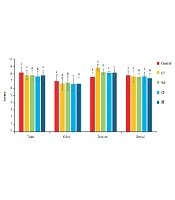
Figure 1 depicts the three important sensory attributes (taste, odor, and texture) in the cooked sausages formulated with the fibers, and the relevant score ranges were 7.6 - 8.1 for taste, 6.5 - 6.9 for odor, and 7.5 - 8.8 for texture. Although the addition of fibers lowered the scores of taste, odor, and overall acceptability parameters compared to the control, these reductions were not significant (P ≥ 0.05). Regarding the texture of the samples, all the treatments scored better than the control, and the best score (8.8) was recorded for the OF sample (P ≤ 0.05).
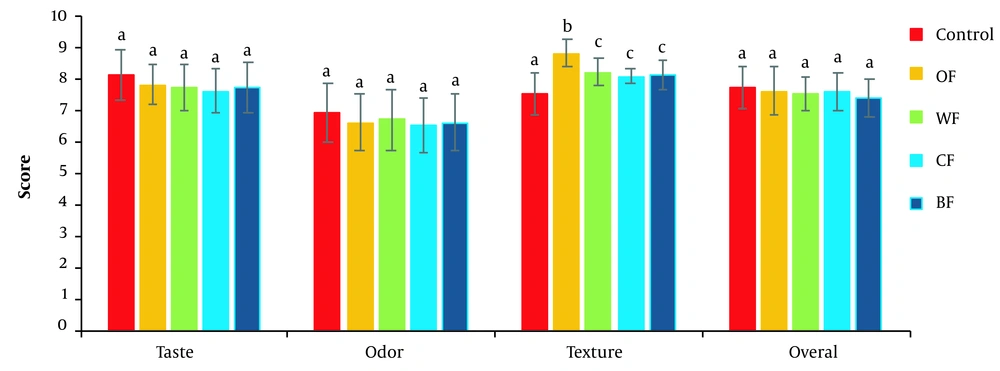
Figure 1.
The three important sensory attributes (taste, odor, and texture) in the cooked sausages formulated with the fibers.
5. Discussion
Regarding the addition of dietary fibers into meat products, most studies stated that the presence of the fibers had no negative effects on the microbiological quality of the products. For instance, incorporation of citrus fiber (2%) into bologna (10), or OF (1 and 2%) into a Spanish dry-fermented sausage (Salchichon) (11) had no significant effects on the evolution of aerobic mesophilic and lactic acid bacteria (P ≤ 0.05).
Based on the Iranian national standard (12), the upper limit of acceptability for TMVC in cooked sausages is 5 log CFU/g. In this concern, since day 40, all the treatment and control samples must be considered as microbiologically unacceptable for consumption.
In general, besides the meat components, sausages have additional sources of microorganisms in the formulation ingredients and seasonings that are usually added in the production steps, and many of these compounds have high microbial contamination. Therefore, sausages usually contain a high variety of biota compared to most processed meats. It has been well demonstrated that LABs, especially their psychrotrophic strains, are responsible for many cases of refrigerated cooked meat product spoilage (13). One factor that inhibits most psychrotrophs from contaminating meat products after heat processing is the presence of nitrite. Nevertheless, even with the presence of nitrite, psychrotrophic LABs can still grow and ultimately cause spoilage. In the present study, it seems that the main part of the enumerated TPVC belongs to LAB population, and all the tested fibers could efficiently inhibit the growth of them and reduce the chance of spoilage during refrigeration storage.
Both positive and detrimental effects of various dietary fibers on sensory properties of various meat products have been reported in the literature (3). For example, Bis-Souza et al. reported that scores for color and texture attributes of low-fat beef burgers decreased by the incorporation of insoluble wheat and oat fibers (at 6% level), while Gore et al. showed that the addition of oat fiber in minced fish sausages resulted in good textural quality (14, 15).
With regards to the addition of fibers into meat products, the most discussed sensory attributes were texture, flavor, and taste. Ktari et al. evaluated the effects of three formulas containing powdered cellulose (PC), barely beta-glucan concentrate (BBGC), and potato fiber (PF) on the sensory properties of Tunisian beef sausage (16). Based on their findings, the samples contained each of the fibers, and the samples with PC and BBGC received lower flavor and higher texture scores, respectively, compared to the control. From the sensory point of view, the addition concentration of a fiber to sausages is generally considered a dose-limiting factor, which means that the higher concentrations usually result in lower organoleptic perceptions (17). For instance, the addition of different concentrations of tomato (0, 1.5, and 3%) and flaxseed (0, 3, and 6%) powder to beef sausages was studied by Ghafouri-Oskuei et al. (18). They concluded that adding the high-fiber supplement powders up to 3% had no negative sensory effects, while higher doses reduced the organoleptic acceptability. Therefore, in the present study, it seems that the incorporation of higher percentages of the tested fibers might threaten the sensory quality of the resultant sausages.
Besides the interactions that occur between the different components of a product during production, the primary color of a food additive or ingredient can definitely affect the final visual quality of the finished product. For instance, high content of white components of lemon albedo was proposed as the probable cause of higher lightness of the related bologna sausages compared to the fiber-free samples (19). In the present study, all the tested fibers had special color properties and coloring agents. Therefore, the original color and coloring properties of the added fibers must be considered for predicting the color of the final product. However, Kılınççeker et al. mentioned that the concentration of an added fiber may limit its dyeing effects (20).
Textural characteristics of the food products, which are incorporated with dietary fibers, are always expected to be improved. In fact, those improvements were extensively reported in the literature for different meat products like sausages and for different dietary fibers such as OF, fruit fibers, and CF (4). Regardless of the type of fibers tested in this study, the sensory results were in accordance with those reports. Actually, the texture of the newly formulated cooked sausages was the sole sensory attribute that scored better compared to the other characteristics. Based on the previous studies, among the main textural parameters, hardness, gumminess, and chewiness have been repeatedly reported as the parameters enhanced by the addition of dietary fibers into different meat products, particularly sausages (3). The greater gel strength of those products was introduced as one of the main factors that could enhance the overall textural qualities.
5.1. Conclusions
In this paper, we evaluated and compared the shelf life of cooked emulsion-type sausages incorporated with four dietary fibers from different origins during 60 days at 4°C. The results showed that all the fibers could hinder the growth of spoilage bacteria, while most sensory parameters of the treated sausages were not significantly affected by the fibers. Among the examined fibers, OF was more efficient in extending the shelf life of the product and is recommended to the meat industry to improve the stability of cooked sausages.