
1. Context
Essential oils are utilized in a wide variety of consumer products, such as dishwashers, detergents, hygiene products, skincare products, medicinal products, fragrances, pantries, soft drinks, processed liquor, and pesticides (1). They are generally known as volatile aromatic oils derived from natural sources, such as leaves, exfoliates, twigs, flowers, petals, and pods (2). Essential oils are commonly produced from different plant species, among which notably are the aromatic plants varying in color and aroma (2). Based on the type and quantity of bioactive components in the oil, they have been frequently used as culinary fragrances. Furthermore, the quantity of essential oil from various plants varies, which invariably determines their prices in the international market (3). Antioxidant and antibacterial properties have been discovered in essential oils, making them valuable as natural additives in a variety of foods (1). They differ in their actions depending on the source, bioactive characteristics, and extraction techniques.
Numerous functional and therapeutic species of plants possess volatile chemical components that are often recovered as essential oils using a suitable extracting solvent. It is important to know that essential oils are only a minor part of a plant’s makeup, yet they offer distinctive qualities useful in the culinary, pharmaceutical, and cosmetic industries (4). Essential oils exhibit complex molecular structures with a myriad of bioactive constituents with hydrocarbons and oxygenated compounds inclusive (5). Numerous systems are employed to extract essential oils from various plant parts. Although these methods appear to be a simplistic process, the selection of appropriate extraction conditions and the solvent is very crucial to preserving the thermally sensitive volatile constituents (6). Moreover, the stability and purity of these essential oils are significant considerations when deciding which extraction method to utilize, which is a key issue to consider.
2. Evidence Acquisition
2.1. Overview of Extraction Techniques of Essential Oils
The composition of essential oil might differ greatly depending on the utilized extraction techniques. Conventional methods have been used for a variety of plant species and agricultural waste products, namely hydrodistillation, cold pressing, Soxhlet apparatus, and maceration. However, conventional extraction procedures have several drawbacks, including high costs, higher solvent consumption, longer extraction times, higher energy consumption, poorer degree of selectivity, and low-quality extracts (7, 8). Given the long extraction duration of most conventional extraction techniques, the degradation of bioactive components in the plant material is unavoidably expected (9, 10). Extreme heat might induce changes in the constituents of essential oils and eventual degradation of volatile compounds during the steam distillation and hydrodistillation extraction process (11, 12). Moreover, a trace amount of solvent and impurities is usually present in the resultant extract when using the conventional extraction method (13). Nevertheless, the use of advanced nonconventional extraction methods helps in the production of high-quality essential oils that are solvent-free. However, the technical requirements for the utilization of modern extraction technologies are often exorbitantly expensive, thereby limiting their utilization.
The extraction method determined to a larger extent operating cost, energy consumption, composition, degree of product purity, and targeted bioactive compounds (3). Microwave assisted extraction (MAE) is an example of a nonconventional extraction method with countless scientific investigations affirming its capacity to produce essential oils without contaminants. Microwave extraction is a newer technology that integrates electromagnetic radiation and multidirectional conventional solvent treatment (14, 15). The rates of conduction and convection are incredibly quick in seconds in MAE and are often disregarded and believed to be negligible. This issue provides the prospect of a reduced extraction time, minimized energy usage, reduced solvent usage, increased bioactive selectivity, and better extraction rates (16, 17).
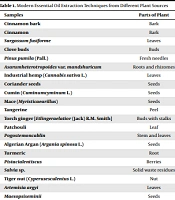
Furthermore, in recent times, more investigation into essential oil has increasingly shown the capacity of supercritical fluid in extracting pure essential oil from plant-based natural products (18). The absence of highly harmful solvents in supercritical extraction demonstrates its environmental friendliness. Ultrasonic assisted extraction (UAE) is another perspective extraction technique that is gaining attention due to its numerous advantages (19). The UAE is an extraction technology developed to overcome the limitations of conventional extraction techniques. Compared to traditional extraction technologies, UAE achieves higher selectivity, high oil recovery (yield), low energy consumption and reduced emissions, low (or no) solvent requirement, reduced extraction time, and superior essential oil qualities (20). Additionally, when compared to other extraction techniques for essential oil recoveries, such as supercritical fluid extraction (SFE) and MAE, UAE is a simple, efficient, and inexpensive technology (19). In theory, UAE achieves its high effectiveness in essential oil extraction through the acoustic cavitation effect, which is introduced by the passage of ultrasonic waves and, in turn, causes cell disruptions and mass and heat transfer (21). Table 1 shows a list of current studies on essential oils extraction using nonconventional techniques.
Table 1.
Modern Essential Oil Extraction Techniques from Different Plant Sources
| Samples | Parts of Plant | Extraction Methods | References |
|---|---|---|---|
| Cinnamon bark | Bark | Ultrasonic pretreatment | (19) |
| Cinnamon | Bark | Ultrasonic-enhanced subcritical water extraction | (19) |
| Sargassum fusiforme | Leaves | Ultrasonic-assisted extraction | (21) |
| Clove buds | Buds | In situ microwave-assisted extraction | (22) |
| Pinus pumila (Pall.) | Fresh needles | Solvent-free microwave-assisted extraction | (23) |
| Asarumheterotropoides var. mandshuricum | Roots and rhizomes | Microwave-assisted steam distillation | (24) |
| Industrial hemp (Cannabis sativa L.) | Leaves | Optimized microwave-assisted extraction | (25) |
| Coriander seeds | Seeds | Microwave-assisted hydrodistillation extraction | (26) |
| Cumin (Cuminumcyminum L.) | Seeds | Three-stage microwave extraction | (27) |
| Mace (Myristicaearillus) | Seeds | Microwave-assisted hydrodistillation | (28) |
| Tangerine | Peel | Supercritical extraction | (29) |
| Torch ginger [Etlingeraelatior (Jack) R.M. Smith] | Buds with stalks | Optimized supercritical CO2 extraction | (30) |
| Patchouli | Leaf | Optimized supercritical CO2 extraction | (18) |
| Pogostemoncablin | Stem and leaves | Optimized supercritical CO2 extraction | (31) |
| Algerian Argan (Argania spinosa L.) | Seeds | Optimized supercritical CO2 extraction | (32) |
| Turmeric | Root | Optimized supercritical CO2 extraction | (33) |
| Pistacialentiscus | Berries | Optimized ultrasonic extraction | (34) |
| Salvia sp. | Solid waste residues | Ultrasonic extraction | (35) |
| Tiger nut (Cyperusesculentus L.) | Nut | Microwave-ultrasonic assisted aqueous enzymatic method | (36) |
| Artemisia argyi | Leaves | Aqueous enzyme-ultrasonic pretreatment | (37) |
| Maesopsiseminii | Seeds | Optimized ultrasonic-assisted extraction | (38) |
2.2. Upscaling Extraction Process of Essential Oils
The implementation of upscaling methodologies and the consideration of suitable parameter settings are critical for any extraction technique to meet increasing sustainable industrial requirements (39). Scaling up extraction techniques is not an easy process and is not as simple as raising the number of solvents and the quantity of plant material; it is an approach that is more scientific and analytical (40). Additionally, the terms “upscaling”, “laboratory scale”, and “pilot scale” have been used for a wide variety of extraction capacities; therefore, upscaling levels should be interpreted with caution. In recent studies, the factors, such as instrumentation, batch/flow process, kinetics, economics, and energy usage, are a few of the numerous variables that have been explored while scaling up extraction technologies from the laboratory to the industrial size (41). For every scale-up operation to succeed or fail, the factors, such as energy consumption, design of extraction system (instrumentation), and parameter settings, should be considered. Depending on the extraction method, the energy utilization methods change. For example, in SFE, the solvent pump and separator heaters use a considerable amount of energy (42).
Moreover, the overall extraction duration and energy consumption might be affected by the dissipation factor of the solvent used in MAE, which determines how much heat is generated (43). In addition, Belwal et al. (42) noted that UAE on its own promotes energy efficiency, resulting in lower overall operating costs for high-quality extracts. In part, this is since the UAE line comprises preparation, extraction, separation, concentration, and drying units. The essential oil extraction unit operations are typically less expensive, except for the solid-liquid separation units and dryers, which tend to be more energy-consuming than the rest (42).
Another factor that is of special importance is the type of instrumentation or design of the extraction units. Currently, numerous firms around the globe provide a wide variety of technologies, from the science laboratory to pilot and industrial sizes, for modern essential oil extraction processes. In contrast, serial manufacturing is used for small laboratory and high-capacity pilot equipment, often having extractors units up to 15 liters in throughput (42). Higher-capacity pilot and industrial extraction units are usually manufactured according to customized designs to meet the demands of the end-users. As an extra validation of the accuracy of upscale system design, the pilot-scale evaluation might be incorporated once laboratory investigations have been completed (42).
A large number of analytical and empirical results can be utilized to eliminate the necessity of costly and time-consuming experiments and pre-testing processes, which are often expensive and complex. In addition, parameter settings or extraction criteria are important factors that determine the success or failure of any scale-up operation (44). In numerous instances, the experts have explored varieties of quality characteristics and parameter settings that could be associated with a range of natural product resources to obtain high-quality essential oils. The effectiveness of scale-up operations is determined by a variety of variables utilized in the extraction techniques (45, 46). For example, in the MAE of essential oils, the parameters, such as dielectric property/solvent type, energy density, microwave power level, sample particle size, and microwave irradiation time, affect the basic electromagnetic mechanism of upscaling the microwave technologies to a larger extent (47).
Additionally, most studies on the SFE of essential oils examined the influence of temperature, pressure, fluid flow rate, sample size, modifiers, and fractionation on extraction yield. In addition to improving essential oil yield, the appropriate adjustment of these parameters can reduce sample losses, save time and operating cost, and ensure high-quality essential oils (48). Scale-up in UAE is substantially influenced by the factors, such as ultrasonic density, vessel shape, batch/flow mode temperature, ultrasound duration, sample-solvent ratio, and ultrasonic power, as reported by Marhamati et al. (49).
Ultimately, the scaling up principle requires ensuring that the extract’s economic and quality standards are satisfied. Although lab-scale extractions use small amounts of sample/extracting solvent and have comparatively shorter extraction durations, pilot or industrial scale extractions necessitate careful technological and economic analysis, as discussed in the next section of this review.
3. Results
3.1. Techno-economical Analysis of Essential Oil Production
The techno-economic analysis should be evaluated in any extraction facility, as it is the key to deciding on the potential large-scale production of essential oil. The approach proposed by Douglas (50) uses flow sheeting and input-output data as a valuable tool for simplifying the conceptual design of any essential oil extraction process. This approach has been used by techno-economic experts to estimate the profitability of modern technologies for numerous unit operations (51). The techno-economic study includes extractor flow sheets, equipment sizing, price of equipment units, and profitability analysis (52). In addition to Turton et al.’s (51) cost of manufacture technique, industrial units’ economic viability for essential oil extraction from natural products can also be determined using this strategy. Industrial process simulators, such as the SuperPro Designer® (version 8.5), have been used to assess the total cost of production, taking into account the operating expenses, operative labor, utility expenses, waste disposal, and materials procurement (53-55). It is important to know that nonconventional reactors have higher running costs than conventional reactors when estimating capital investment costs. This issue is partly due to the need for fewer extraction steps than traditional methods, resulting in a tenfold reduction in pollution, as reported by Belwal et al. (42). On the other hand, nontraditional extraction technologies promote energy savings and lower the cost of producing high-quality essential oils industrially. It also requires a multistep procedure since it needs additional auxiliary equipment for processing and purification, making it more costly to operate.
Each extraction technique has its own set of benefits and drawbacks. Essential oil production from diverse plant sources has been previously evaluated from a technological and economic perspective. There are certain research gaps to address in terms of the comprehensive cost analysis of essential oil production, designed for industrial purposes (56). Understanding the operation mechanism of different processing technologies is fundamental to deciding the expenses and market capitalization of essential oil production; however, the yield of oil-bearing plants and quality and the purity of their oil might have a major influence on the market price (3). The industrial viability of essential oils produced from various plant material sources using different technologies has been carried out to determine the involved technical and economic parameters (3). The process simulators, such as Aspen Plus and Superpro Designer software, have been reported for the base case designs and upscaling of proposed processes. Preliminary process designs have been proposed using different plant configurations and operation modes (i.e., continuous, semi-continuous, or batch) (3). Generally, a typical plant for essential oil production is dependent on the technology of extraction integrated with other adjoining equipment (57).
The techno-economic analyses of essential oil production from Rosmarinus officinalis leaves, Foeniculum vulgareL seeds, Pimpinella anisumL. seeds, Origanum vulgare, and Rosmarinus officinalis (56), Cymbopogon winteriana and Cymbopogon citrus (57), and Eucalyptus citriodoraleaves (58) have been documented. A typical simplified flow sheet for the extraction of essential oil using SFE technology consists of a plant material grinder, fluid pump, heat exchanger, depressurization vessel, dryer, and extraction vessel (59). Frequently, technical parameters relating to the extraction of essential oils and some other adjoining equipment that is used for the building of the process flow-sheet are obtained from optimum laboratory data. The material and energy requirements of each process equipment and entire process are obtained and subsequently used for equipment sizing and specifications.
The process of economic analysis of essential oil production from plant materials involves the determination of production costs (i.e., total annual operating and capital investment costs) and profitability parameters (e.g., pay-back time, return on investment, and internal rate of returns) of the production process (3, 56, 57). It is a sum of the direct fixed capital costs (i.e., total plant direct and indirect costs and additional expenses), working capital, and start-up/validation expenses. Materials, facilities, labor expenditures, and laboratory quality control and quality assurance charges make up the total yearly operating expenses. A thorough techno-economic analysis of essential oil extraction from three plant samples (i.e., Rosmarinus officinalis, Foeniculum vulgare, and Pimpinella anisum) utilizing SFE and steam distillation technologies indicated that SFE is more economically sustainable than steam distillation production technologies in lower energy consumption and higher essential oil yield (59). On the other hand, the expenses of essential oil extraction are determined by the plant material (i.e., total oil extractible) and the sophistication of the involved technique.
Although extensive techno-economic analyses of essential oil production from plant materials have been documented for numerous extraction technologies, such as supercritical fluid and solvent, steam, and water distillation, other novel technologies, such as microwave and UAE, have no or limited documentation. Likewise, the economic and technical feasibility information about the process integration of novel technologies’ pretreatment steps (e.g., ultrasound-assisted hydrodistillation) for the production of essential oils from plant materials has not been well evaluated and documented. Although these emerging technologies have been reported to be efficient at the laboratory scale, their techno-economic analyses are necessary for the proper scaling up and industrial feasibility.
4. Conclusions
Essential oils are volatile hydrophobic concentrated liquids that are usually derived from natural sources, such as leaves, exfoliates, twigs, flowers, petals, and pods. They are widely used for different medicinal and therapeutic applications due to their bioactive constituents. The quality or quantity characteristics of essential oil differ greatly depending on the utilized extraction techniques. Industrial demands have led to a continual quest for a novel method of extracting high-quality essential oil from natural sources at reduced costs. Numerous studies have shown the need to assess essential oil quality, production costs, and energy efficiency and examine the close relationship between essential oil supplies and the availability of different natural product sources. It is important to know that the quality of essential oils, operating costs, and energy consumption are significant considerations when selecting a suitable extraction method. This review critically examined the implications of upscaling nonconventional extraction methods while taking into consideration their techno-economic benefits. This study will undoubtedly assist researchers and industrial experts make an informed decision on the suitable extraction methods with maximum yield and quality characteristics.