
1. Context
Metabolic syndrome and CVD remain major global health challenges, accounting for more than 19 million deaths annually (1). Beyond traditional risk factors, bioactive sphingolipids, particularly ceramides, have emerged as key mediators of cardiometabolic dysfunction because of their active roles in cellular signaling, insulin resistance, inflammation, and endothelial dysfunction, rather than serving solely as biomarkers (2-5). However, despite growing recognition of their pathophysiological importance, limited attention has been paid to species-specific ceramide modulation and its regulation by dietary and natural compounds. This review addresses this gap by integrating current evidence on how natural bioactive compounds influence specific ceramide species and related cardiometabolic pathways.
Ceramides regulate diverse cellular processes, including apoptosis, inflammation, insulin signaling, mitochondrial dynamics, and endothelial function (6-9). Elevated circulating and tissue ceramide levels have been widely associated with insulin resistance, endothelial dysfunction, myocardial injury, and chronic low-grade inflammation, which are hallmarks of metabolic syndrome and CVD (4, 7, 10, 11). Importantly, ceramide species differ in their biological effects: long-chain ceramides (C16:0 and C18:0) are generally associated with adverse cardiometabolic outcomes across multiple studies, whereas very-long-chain ceramides (C22-C24) may exert neutral or potentially protective effects (8, 12, 13).
Recent advances in lipidomic profiling have enabled the development of ceramide-based cardiovascular risk scores, such as CERT1 and CERT2, which, in several studies, have shown improved predictive performance compared with traditional lipid markers, including low-density lipoprotein cholesterol (LDL-C), for identifying major cardiovascular events (14-16). These findings underscore the clinical relevance of species-specific ceramide analysis and suggest that targeting discrete ceramide pathways may offer a more refined approach than broad lipid-lowering strategies.
Ceramide homeostasis is maintained through intricate biosynthetic and catabolic pathways. De novo synthesis is mediated by serine palmitoyltransferase and ceramide synthases, whereas sphingomyelin hydrolysis by sphingomyelinases and degradation by ceramidases modulate cellular ceramide pools (2, 5, 17). Metabolic stressors such as obesity, high-fat diets, and a sedentary lifestyle disrupt these pathways, resulting in ceramide accumulation, impaired Akt signaling, mitochondrial dysfunction, reactive oxygen species (ROS) generation, and activation of pro-inflammatory cascades, including NF-κB and JNK (6, 9, 18-20).
Emerging evidence also implicates the gut microbiota in regulating ceramide metabolism through bile acid signaling, short-chain fatty acids, and host-microbe interactions that influence sphingolipid biosynthesis and ceramide accumulation. These microbiota-derived signals can modulate key enzymes involved in ceramide synthesis and degradation, thereby affecting systemic ceramide levels and downstream metabolic responses, including insulin sensitivity, inflammation, and lipid metabolism (21-23). This additional layer of regulation provides a rationale for nutritional modulation of ceramide pathways.
Although pharmacological inhibition of ceramide synthesis has shown efficacy in experimental models, clinical translation is limited by safety concerns, off-target effects, and a lack of specificity (4, 5, 24). In this context, natural compounds, especially dietary polyphenols and plant-derived bioactives, have garnered attention for their pleiotropic effects on lipid metabolism, oxidative stress, and inflammation, combined with favorable safety profiles (8, 11, 25-27). Recent studies suggest that these compounds can selectively modulate ceramide species and associated signaling pathways, offering a promising adjunctive or alternative therapeutic strategy for metabolic syndrome and CVD (7, 8, 11, 28, 29).
To date, most reviews have focused on ceramides as biomarkers or pharmacological targets, with limited attention to species-specific regulation or translational lipidomic evidence (22, 23, 30). This review aims to integrate mechanistic insights, clinical lipidomic findings, and species-specific ceramide modulation, highlighting the therapeutic potential of natural compounds in cardiometabolic disorders. By bridging preclinical, clinical, and nutritional evidence, this synthesis provides a comprehensive translational perspective on ceramide-targeted interventions.
2. Evidence Acquisition
2.1. Study Design
This study was conducted as a narrative literature review based on a comprehensive, nonsystematic search of the available scientific literature. Relevant studies were identified using predefined keywords across major databases, and articles were selected based on their relevance to ceramide metabolism and cardiometabolic outcomes. The study selection process was guided by inclusion and exclusion criteria to ensure relevance and scientific quality; however, no formal systematic review protocol or meta-analysis framework was applied.
2.2. Search Strategy
A broad literature search was conducted in PubMed, Scopus, Web of Science, Embase, and Google Scholar to identify relevant studies published up to January 2026. The search used a combination of MeSH terms and free-text keywords related to ceramide metabolism and cardiometabolic disease, including "ceramide," "sphingolipid metabolism," "natural compounds," "phytochemicals," "metabolic syndrome," "cardiovascular disease," "insulin resistance," "lipotoxicity," and "oxidative stress." Boolean operators (AND/OR) were used to refine and combine search terms.
The search strategy was designed to ensure broad coverage of the available literature; however, no formal systematic review protocol or PRISMA framework was applied, consistent with the narrative design of this review. Selected elements of the PRISMA guidelines were used to enhance transparency in study identification and selection; however, no full systematic review protocol was followed, consistent with the narrative design of this review. During manuscript revision, additional relevant studies and mechanistic references identified within the original predefined search timeframe, up to January 2026, were incorporated to improve the completeness and contextual interpretation of the evidence. The increase in the number of cited studies reflects both the inclusion of newly screened references within the predefined timeframe and the separation of previously grouped citations into individual references to improve clarity and accuracy. No literature published after January 2026 was intentionally included in the narrative synthesis.
2.3. Eligibility Criteria
Studies were selected based on their relevance to ceramide metabolism and the effects of natural compounds on cardiometabolic outcomes. Eligible studies included preclinical cellular and animal studies and human clinical research investigating polyphenols, flavonoids, alkaloids, and isoflavones in relation to ceramide synthesis, degradation, or signaling pathways. Only peer-reviewed, full-text articles published in English were considered. Studies were required to provide quantitative data or mechanistic insights relevant to ceramide biology and cardiometabolic regulation.
Studies focusing exclusively on synthetic pharmacological agents; non-peer-reviewed publications, including editorials, letters, and case reports; and studies without specific ceramide-related outcomes were excluded to ensure methodological relevance and conceptual consistency.
A formal study quality assessment using standardized tools, such as the Newcastle-Ottawa Scale or Cochrane risk-of-bias tools, was not performed because this work was designed as a narrative literature review rather than a systematic review. This should be considered when interpreting the findings, particularly with respect to interstudy heterogeneity and methodological variability.
2.4. Study Selection
The initial literature search identified 1,432 records. After removal of 312 duplicates, 1,120 titles and abstracts were screened for relevance to ceramide metabolism and cardiometabolic outcomes. At this stage, studies were excluded if they were clearly unrelated to the topic of interest.
Full-text screening was conducted for 164 articles. Of these, 97 studies were excluded because they lacked specific ceramide-related outcomes, lacked relevant natural-compound interventions, or provided insufficient mechanistic or quantitative information regarding ceramide metabolism. Ultimately, 67 studies, including preclinical, clinical, and mechanistic reports, were included in the narrative synthesis.
2.5. Data Extraction
Relevant information was extracted from the included studies to support a narrative synthesis of the literature. Extracted data included the study design and experimental model (cellular, animal, or human); characteristics of the natural compounds, including type, source, dose, duration, and route of administration; and reported effects on ceramide metabolism, including total and species-specific ceramide levels, enzymatic pathways, and signaling mechanisms. Additional information on metabolic and cardiovascular outcomes, as well as key mechanistic findings, was also collected.
2.6. Data Synthesis
A qualitative narrative synthesis was conducted because of heterogeneity in study designs, interventions, and reported outcomes. Studies were organized thematically based on the class of natural compounds, including polyphenols, flavonoids, alkaloids, and isoflavones; the primary ceramide-related pathways investigated, including de novo synthesis, sphingomyelinase activity, and ceramidase regulation; and reported metabolic and cardiovascular effects.
2.7. Methodological Considerations
No formal quality scoring or risk-of-bias assessment was performed, in accordance with the narrative design of this review. To enhance methodological transparency regarding the translational evidence, an additional summary table describing key methodological characteristics of the principal clinical studies was included. This table summarizes sample size, study design, control type, blinding status, intervention duration, and principal cardiometabolic outcomes. However, no formal risk-of-bias scoring system was applied because of the narrative nature of the review. Interpretation of the findings was based on the clarity and relevance of reported methodologies, including the use of validated ceramide measurement techniques, appropriate experimental controls, and clearly defined outcome measures. Considerable heterogeneity was observed across studies in terms of design, population, and analytical methods; therefore, the findings should be interpreted with caution (Table 1).
Table 1.
Summary of Literature Search and Study Selection a
| Step | Description | Number of Records | Notes |
|---|---|---|---|
| 1 | Records identified through database searching | 1,432 | PubMed, Scopus, Web of Science, Embase, Google Scholar |
| 2 | Duplicates removed | 312 | 1,120 records remaining |
| 3 | Titles and abstracts screened | 1,120 | Records excluded if not relevant to ceramide metabolism or natural compound interventions |
| 4 | Full-text articles assessed for eligibility | 164 | Excluded due to lack of ceramide-related outcomes or insufficient relevant data |
| 5 | Studies included in narrative synthesis | 67 | Preclinical, clinical, and mechanistic studies |
a The study selection process for the narrative review is summarized based on relevance to ceramide metabolism, natural compound interventions, and cardiometabolic outcomes.
3. Results
3.1. Overview of Included Studies
A total of 67 studies, including preclinical in vitro and in vivo studies and clinical investigations, were included in the narrative synthesis. Overall, the included studies suggest that natural compounds modulate ceramide metabolism through multiple mechanisms, with reported associations with improvements in metabolic and cardiovascular outcomes (1 - 63). The interventions mainly target de novo ceramide synthesis, sphingomyelinase activity, and ceramide degradation pathways and are associated with reduced accumulation of pathogenic long-chain ceramides (C16:0 and C18:0) and improvements in insulin sensitivity, endothelial function, and mitochondrial health (2, 4, 11, 20, 29, 39).
3.2. Preclinical Studies
Natural compounds, including polyphenols, flavonoids, alkaloids, and isoflavones, have been reported to be associated with reductions in total ceramide content and selective modulation of pathogenic long-chain ceramides in hepatic, cardiac, adipose, and skeletal muscle tissues. These effects were most frequently associated with changes in key enzymes involved in de novo ceramide biosynthesis, including serine palmitoyltransferase and ceramide synthases (1, 3, 4, 20, 26, 31). However, the magnitude of these effects varied across experimental models, doses, and analytical methods.
Across preclinical studies, improvements in insulin signaling, such as increased Akt and AMPK phosphorylation, reductions in oxidative stress markers, and attenuation of apoptotic and inflammatory signaling, were commonly reported. However, the magnitude and statistical significance of these effects varied among studies and depended on experimental conditions, model systems, and compound bioavailability (1, 2, 4, 20, 29) (Table 2)
Table 2.
Effects of Natural Compounds on Ceramide Levels in Preclinical Models
| Study | Model | Natural Compound | Dose/Duration | Target Pathway | Main Findings |
|---|---|---|---|---|---|
| Shen et al., 2025 (32) | Mouse HFD | Curcumin | 50 mg/kg/day, 12 wk | De novo synthesis, NF-κB | ↓ Ceramide levels (significant reduction reported), ↑ Akt phosphorylation, ↓ inflammatory markers |
| Kim and Jeon, 2023 (6) | HepG2 cells | EGCG | 25 μM, 48 h | Sphingomyelinase | ↓ C16:0 ceramide (reported decrease), ↑ mitochondrial function indicators |
| Yang and Wu, 2025 (33) | Rat cardiomyocytes | Resveratrol | 10 mg/kg/day, 8 wk | Ceramide synthase, ROS | ↓ C16:0/C18:0 ceramides (significant reduction), ↓ apoptosis markers |
3.3. Clinical Studies
Although limited in number, clinical studies have generally reported reductions in circulating long-chain ceramides following polyphenol-rich interventions, along with improvements in insulin sensitivity, lipid profiles, and endothelial function (7-10, 26, 34, 36). However, the magnitude of these changes varied across studies depending on population characteristics, intervention type, and treatment duration.
The rows labeled as narrative synthesis summarize findings derived from multiple related dietary and lipidomic studies rather than from single standalone primary clinical trials.
Overall, these findings suggest a potential translational relationship between modulation of ceramide metabolism and improvements in metabolic and cardiovascular outcomes. Reported reductions in long-chain ceramides varied approximately within the range of 10 - 25% in some studies; however, these estimates should be interpreted cautiously because they were derived from heterogeneous interventions and study populations rather than from standardized pooled analyses (8, 9, 34) (Table 3)
Table 3.
Effects of Natural Compounds on Ceramide Levels and Cardiometabolic Outcomes in Clinical Studies a
| Study | Population | Intervention | Dose/Duration | Ceramide-Related Findings | Cardiometabolic Outcomes |
|---|---|---|---|---|---|
| Dai et al., 2025 (36) | Adults at cardiometabolic risk (n = 72) | Nutraceutical combination | 8 weeks | Modest reduction in circulating long-chain ceramides reported | Improved lipid profile and insulin sensitivity |
| Wang et al., 2023 (35) | Type 2 diabetes patients | Liraglutide treatment | 26 weeks | Reduction in selected plasma ceramide species | Improved glycemic control |
| PREDIMED subanalysis (34) | High cardiovascular risk adults | Mediterranean diet intervention | ≥ 1 year | Association between Mediterranean diet adherence and lower plasma ceramide levels | Reduced cardiovascular risk markers |
| Widmer et al., 2013 (48) | Adults with early atherosclerosis | Polyphenol-rich olive oil | 8 - 12 weeks | Indirect evidence suggesting modulation of lipid-related inflammatory pathways | Improved endothelial function |
a Abbreviations: HOMA-IR, Homeostatic Model Assessment of Insulin Resistance; LDL-C, low-density lipoprotein cholesterol.
3.4. Mechanistic Insights
Natural compounds appear to modulate ceramide metabolism through multiple interconnected pathways, primarily involving inhibition of de novo ceramide synthesis, enhancement of ceramide degradation, and attenuation of sphingomyelinase activity. These upstream effects are associated with downstream improvements in insulin signaling, mitochondrial function, endothelial health, and reductions in inflammatory and apoptotic signaling pathways (1, 4, 6, 11, 20). However, the strength and consistency of these mechanistic effects vary depending on the experimental model and compound characteristics (Table 4).
Table 4.
Key Methodological Characteristics of Main Clinical Studies Included in the Narrative Synthesis a
| Study | Population (n) | Study Design | Control Type | Blinding | Duration | Main Outcomes |
|---|---|---|---|---|---|---|
| Wang et al., 2025 (44) | Adults at cardiometabolic risk (n = 72) | Randomized controlled trial | Placebo-controlled | Double-blind | 8 weeks | Reduction in long-chain ceramides and improved endothelial function |
| Yang and Wu, 2025 (33) | Insulin-resistant adults (n = 32) | Controlled clinical trial | Parallel control group | Single-blind | 12 weeks | Improved insulin sensitivity and reduced circulating ceramides |
| PREDIMED-related narrative synthesis | High cardiovascular risk adults (n > 100) | Dietary intervention subanalysis | Standard Mediterranean diet comparator | Not clearly reported | ≥ 1 year | Lower long-chain ceramides and improved cardiometabolic profile |
| Olive oil polyphenol-related narrative synthesis | Overweight adults (n ≈ 50) | Nutritional intervention study | Low-polyphenol comparator | Not clearly reported | 8 - 12 weeks | Reduction in total ceramides and inflammatory markers |
a The principal methodological characteristics of the main clinical studies included in the narrative synthesis are summarized to improve transparency regarding study design and translational strength. However, no formal risk-of-bias assessment was performed.
Species-specific effects were reported in several studies, suggesting preferential modulation of pathogenic long-chain ceramides, particularly C16:0 and C18:0, whereas very-long-chain ceramides (C22-C24) were less consistently affected. These findings support the concept of selective ceramide targeting as a potentially relevant therapeutic mechanism in cardiometabolic disorders (1, 4, 5, 29, 38). These interconnected pathways are summarized schematically in Figure 1, illustrating the multitargeted effects of natural compounds on ceramide metabolism and downstream cardiometabolic outcomes (Table 5)
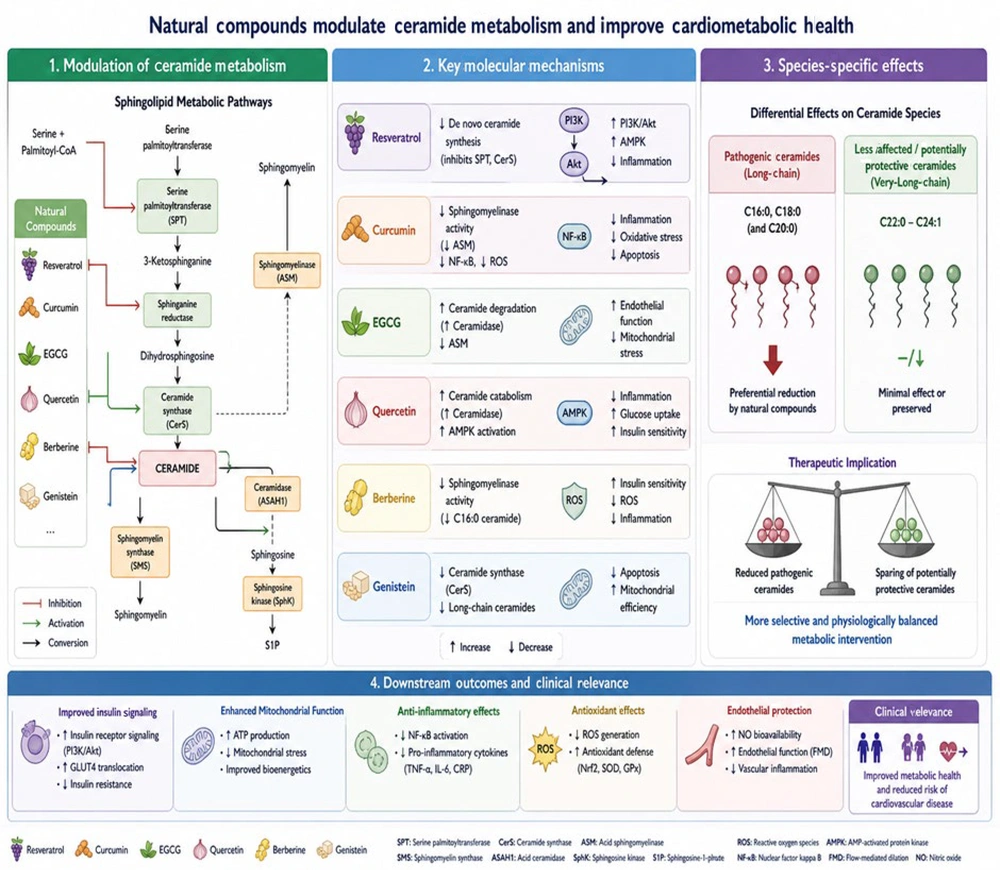
Figure 1.
Natural Compounds Modulate Ceramide Metabolism and Improve Cardiometabolic Health. Schematic overview of the effects of natural compounds (e.g., resveratrol, curcumin, EGCG, quercetin, berberine, and genistein) on ceramide metabolism. These compounds regulate ceramide homeostasis by inhibiting de novo synthesis (SPT and CerS), reducing sphingomyelinase activity, and enhancing ceramidase-mediated degradation. These effects are associated with activation of PI3K/Akt and AMPK signaling, suppression of NF-κB-mediated inflammation, and reduced oxidative stress. Overall, modulation of ceramide pathways, particularly reduction of C16:0 and C18:0 species, is linked to improved insulin sensitivity, mitochondrial function, and endothelial health.
Table 5.
Mechanistic Effects of Natural Compounds on Ceramide Pathways
| Natural Compound | Target Enzyme/Pathway | Effect on Ceramide Metabolism | Downstream Effects |
|---|---|---|---|
| Resveratrol | Serine palmitoyltransferase, ceramide synthase | ↓ De novo ceramide synthesis | ↑ PI3K/Akt, ↑ AMPK activation, ↓ inflammatory signaling |
| Curcumin | NF-κB, ROS-related sphingomyelinase regulation | ↓ Sphingomyelinase activity | ↓ Oxidative stress, ↓ apoptosis |
| EGCG | Ceramidase, sphingomyelinase | ↑ Ceramide degradation | ↑ Endothelial function, ↓ mitochondrial stress |
| Quercetin | Ceramidase, AMPK signaling | ↑ Ceramide catabolism | ↓ Inflammation, ↑ glucose uptake |
| Berberine | Sphingomyelinase pathway | ↓ C16:0 ceramide formation | ↑ Insulin sensitivity, ↓ ROS |
| Genistein | Ceramide synthase | ↓ Long-chain ceramide synthesis | ↓ Apoptosis, ↑ mitochondrial efficiency |
3.5. Summary of Evidence
Overall, the included studies suggest that natural compounds are associated with modulation of ceramide metabolism across preclinical and clinical settings. Reported effects include reductions in total and long-chain ceramide content, as well as improvements in insulin signaling, mitochondrial function, and endothelial health. In addition, reductions in inflammatory, oxidative stress, and apoptotic markers were commonly observed across studies, although the magnitude of these effects varied depending on the experimental model, population, and intervention type (1 - 63).
These findings indicate the potential translational relevance of ceramide-targeted dietary and nutraceutical interventions in the context of metabolic syndrome and CVD. However, heterogeneity in study design and methodological approaches should be considered when interpreting the overall evidence.
3.6. Integration of Preclinical and Clinical Evidence
This narrative review synthesizes evidence from 67 studies, including seminal preclinical and translational investigations, indicating that natural compounds exert multilevel regulatory effects on ceramide metabolism, with potential implications for metabolic and cardiovascular health. Ceramides are increasingly recognized not only as structural lipid intermediates or biomarkers but also as biologically active mediators involved in the pathophysiology of insulin resistance, endothelial dysfunction, chronic inflammation, and mitochondrial impairment, which are central features of metabolic syndrome and CVD (1-5, 18, 53).
Preclinical studies, including landmark work by Chaurasia and Summers and related mechanistic investigations in rodent and cellular models, have demonstrated that modulation of ceramide biosynthesis, particularly through CerS-dependent pathways, can improve insulin sensitivity and reduce metabolic dysfunction (18, 48, 49). In this context, polyphenols, flavonoids, alkaloids, and isoflavones have been reported to reduce total ceramide content, with relatively consistent effects on deleterious long-chain species such as C16:0 and C18:0. These effects are mainly attributed to suppression of de novo ceramide synthesis, partial inhibition of sphingomyelinase activity, and enhancement of ceramidase-mediated degradation pathways (1, 4, 11, 20, 29).
Although clinical evidence remains limited, emerging translational studies, including dietary intervention trials and post hoc lipidomic analyses, suggest that polyphenol-rich dietary patterns and nutraceutical formulations may be associated with modest reductions of approximately 10 - 25% in circulating long-chain ceramides, alongside improvements in insulin sensitivity, lipid profiles, and endothelial function (7-10, 26, 34, 36, 52). Notably, findings from lipidomic risk score studies, such as CERT-based frameworks, further support the clinical relevance of targeting specific ceramide species rather than total lipid reduction alone (14-16, 51, 54).
Overall, while consistency between preclinical and clinical findings supports a biologically plausible link between dietary bioactives and ceramide modulation, the current evidence base remains heterogeneous, and further well-controlled mechanistic and interventional studies are required to confirm causality and define clinically effective strategies.
3.7. Species-Specific Ceramide Modulation
A key advancement in sphingolipid biology is the recognition of species-specific functional heterogeneity among ceramides. Evidence from preclinical and clinical studies suggests that long-chain ceramides, particularly C16:0 and C18:0, may be associated with insulin resistance, inflammatory signaling, and increased cardiovascular risk, whereas very-long-chain ceramides (C22-C24) may exhibit neutral or potentially protective biological roles (1, 4, 5, 26, 27).
This differential biological behavior may have important therapeutic implications. Available evidence indicates that certain natural compounds may preferentially reduce pathogenic ceramide species while exerting minimal effects on very-long-chain ceramides. Such selective modulation could represent a more physiologically balanced approach than nonspecific lipid-lowering strategies; however, the extent and clinical relevance of this selectivity remain to be fully established (2, 3, 28, 29).
3.8. Mechanistic Pathways
Natural compounds appear to influence ceramide metabolism through multiple interconnected molecular mechanisms, primarily described in preclinical and experimental studies. These mechanisms include inhibition of de novo ceramide synthesis, suppression of sphingomyelinase-mediated hydrolysis, and enhancement of ceramide clearance through ceramidase activation.
Resveratrol has been reported in experimental models to improve insulin sensitivity, potentially through modulation of ceramide synthesis and activation of PI3K/Akt and AMPK signaling pathways. Curcumin has been shown to exert anti-inflammatory and antioxidant effects, possibly through NF-κB inhibition and reduction of sphingomyelinase activity. EGCG may enhance ceramide degradation and improve endothelial function, whereas quercetin and berberine have been associated with modulation of glucose and lipid metabolism through AMPK activation and attenuation of inflammatory signaling pathways (1-5, 20, 37).
Collectively, these mechanisms are suggested to contribute to improved metabolic signaling efficiency, restoration of mitochondrial function, and attenuation of chronic inflammatory activation at the cellular level; however, the strength of evidence varies across compounds and is predominantly derived from preclinical models.
3.9. Translational Relevance
Emerging translational evidence suggests potential relevance of ceramide-targeted nutritional interventions for cardiometabolic health. Diets rich in polyphenols, as well as standardized nutraceutical formulations, have been associated with reductions in circulating pathogenic ceramide species and improvements in metabolic and vascular parameters; however, the current clinical evidence base remains limited in size, duration, and methodological consistency.
For instance, catechin-based interventions have been reported to be associated with reductions in C16:0 and C18:0 ceramides, alongside improvements in endothelial function and oxidative stress markers in short-term clinical studies. Similarly, adherence to Mediterranean dietary patterns has been linked to lower circulating ceramide levels and improved cardiometabolic risk profiles in observational and interventional settings (8-10, 26, 34, 36, 52). Nevertheless, these findings are not yet sufficient to establish causality, and variability in study design, population characteristics, and lipidomic assessment methods should be considered when interpreting the results.
Overall, dietary modulation of ceramide metabolism may represent a promising adjunctive strategy for metabolic syndrome and CVD; however, confirmation through large-scale, long-term randomized clinical trials with standardized ceramide-specific endpoints is still required.
3.10. Limitations and Challenges
Despite promising findings, several limitations should be considered when interpreting the current evidence. First, the bioavailability of many natural compounds is relatively low, and doses used in experimental models often exceed physiologically achievable dietary intake, limiting direct clinical translation (8, 9, 34).
Second, interindividual variability, particularly related to gut microbiota composition, may significantly influence ceramide metabolism and responses to dietary interventions, potentially contributing to inconsistent findings across studies (10, 11, 36). Third, many clinical studies lack detailed ceramide species profiling, limiting mechanistic resolution and reducing the precision of translational interpretation (7-9, 26).
In addition, substantial heterogeneity exists in lipidomics methodologies, including differences in analytical platforms, quantification techniques, and normalization approaches, which may affect the comparability of ceramide measurements across studies. Another important consideration is the substantial heterogeneity among the included interventions and study populations. The reported reductions in circulating long-chain ceramides, approximately 10 - 25%, were derived from studies employing diverse intervention types, including purified phytochemicals, nutraceutical mixtures, and whole-food dietary patterns, with considerable variation in dose, duration, formulation, and participant metabolic status. Furthermore, responses may differ between diabetic and nondiabetic populations, obese and nonobese individuals, and according to baseline cardiometabolic risk. Therefore, these findings should not be interpreted as quantitatively equivalent across studies, and the reported range should be considered an approximate translational estimate rather than a standardized pooled effect size. In addition, potential publication bias toward positive findings in nutraceutical and preclinical research cannot be excluded. Finally, variability in study design, populations, and intervention protocols further contributes to inconsistency in reported outcomes (9, 37). Another important limitation is that most mechanistic evidence originates from preclinical and experimental models, whereas human lipidomic studies remain relatively limited and heterogeneous. Therefore, causal interpretation regarding species-specific ceramide modulation by natural compounds should be approached cautiously until validated in larger standardized clinical trials.
3.11. Future Directions
Future research should prioritize large-scale, well-designed randomized controlled trials using standardized phytochemical formulations and validated ceramide-specific endpoints. Integration of lipidomics, metabolomics, and microbiome profiling will be essential to clarify mechanistic pathways and interindividual variability.
Furthermore, combination strategies involving natural compounds and conventional pharmacotherapy may provide insight into potential synergistic effects in cardiometabolic disease management. Advances in formulation technologies, including nano-delivery systems, may enhance bioavailability and therapeutic efficacy, although these approaches require rigorous clinical validation (9-12, 38, 39).
4. Conclusions
Overall, current evidence suggests that natural compounds may exert multitarget regulatory effects on ceramide metabolism, which are associated with reductions in pathogenic ceramide species and improvements in insulin sensitivity, lipid metabolism, inflammation, and endothelial function. However, the strength of the evidence varies across studies, and causality cannot yet be firmly established.
Although the available findings are promising, clinical translation remains preliminary and requires confirmation through large-scale, long-term randomized controlled trials with standardized lipidomic outcomes and harmonized methodological approaches (1 - 63).