
1. Background
Acute Respiratory Coronary Syndrome (COVID-19) virus outbreak has been started in November/ December 2019 as a series of pneumonia cases of unknown cause in Wuhan, China (1). The World Health Organization (WHO) declared the disease a global epidemic on March 11, 2020 (2). At this time, health workers were potential victims of the disease and the spreader. Protecting healthcare workers against SARS-CoV-2 infection was very critical (3). According to the World Health Organization, as of February 2021, more than 108 million COVID-19 confirmed cases and 2.3 million deaths have been reported across 219 countries and regions (4). In addition to mortality, the epidemic has significantly impacted public health and the global economy and has caused the most significant recession in history, including rising unemployment (5). Efforts to reduce the COVID-19 epidemic relied heavily on non-pharmacological interventions (NPIs), including physical distance, hand hygiene, and mask use (6). The world needed vaccines to stop the COVID-19 epidemic, reopen the economy, and prevent a resumption of the epidemic (7). Vaccination is one of the most cost-effective ways to prevent the spread of the disease (8), and scientists have worked with at an unprecedented rate since the beginning of the COVID-19 epidemic. More than 200 vaccines have been tested, preventing 2 - 3 million deaths a year worldwide (9). Following the clinical development of COVID-19 vaccination, it is essential to understand the goals, motivations, and barriers affecting future vaccine acceptance, and factors influencing acceptance of the coronavirus vaccine may be as crucial as vaccine discovery (10). Vaccine acceptance is an essential step in the success of vaccination programs to achieve high vaccination rates in the general population. Many studies on the acceptance and safety of vaccines, especially for emerging infectious diseases, have shown inadequate acceptance rates. For example, during the 2009 H1N1 epidemic, vaccine acceptance was shown to be 17% in France, 49.6% in the United States, 43.9% in Australia, 56.1% in the United Kingdom, and 63.1% in Greece were reported. A global survey of 19 countries reported that approximately 71.5% of participants received the COVID-19 vaccine (4).
2. Objectives
Due to the epidemic of this disease, the high mortality rate, and the importance of vaccine acceptance in limiting this epidemic, this study was performed to evaluate the vaccination status of COVID-19 in the healthcare staff of Imam Reza-Kermanshah Hospital.
3. Methods
3.1. Study Design
This descriptive-analytical cross-sectional study was conducted to evaluate the status of COVID-19 vaccination in the healthcare staff of Imam Reza Kermanshah Hospital in April and May 2021.
3.2. Sample Size and Sampling Method
According to the following formula, the minimum sample size with the prevalence of vaccine acceptance in Keshmiri et al. (11) was P = 0.60, the probability of measurement error was d = 0.06, the likelihood of type 1 error was α = 0.05, and sample dropout was 315 people.
The possibility of dropping samples =315
3.3. Data Collection Tools
A checklist was used to collect information about this research. This checklist comprises 18 questions, which are compiled in four sections. The first part has seven questions about demographic information such as age, gender, marital status, education, occupation, work history, and underlying illness. The second part includes five questions about COVID-19 disease, including COVID-19 disease, test and diagnosis of COVID-19 disease, vaccine receiving and type of vaccine received, and time of receiving the vaccine, and the third part includes complications after receiving the vaccine (fatigue and myalgia). Section four contains questions about the factors that motivate people to get the vaccine (fear of the disease, being in high-risk places, death of loved ones, confidence in the vaccine, and other factors). Factors that prevent people from being vaccinated were media advertising, having symptoms of the common cold or COVID-19 reported side effects including blood clots, pain, cardiac arrest, nature of the vaccine, vaccine rumors (placebo), long-term safety, and fear of injections.
3.4. Data Collection
The participants were assured that their information would remain confidential after explaining the research objectives. Hospital staff responded to the questionnaire in about 10 minutes.
3.5. Data Analysis
Finally, the raw data were analyzed using SPSS software version 24 and descriptive and inferential statistics. Frequency and percentage were used in descriptive statistics. The chi-square test was also used for inferential statistics in data analysis. The significance level in the trials was considered 0.05.
4. Results
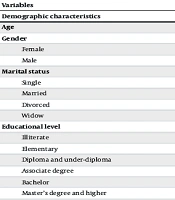
In this study, the number of subjects was 315 health workers of Imam Reza Hospital, of whom 71.4% (n = 225) of the samples were female, 231 (73.3%) had a bachelor's degree, and lower, 52.4% (n = 164) were less than 35 years, 60.6% (n = 191) were married, respectively. About 83.1% (n = 187), 194% (84.0), 85.4% (n = 140), and (n = 113) 81.3% were willing to be vaccinated. In addition, 49.8% of these people had COVID disease, of whom 89.2% received the vaccine. However, there was no significant relationship between variables and vaccine injection or non-injection (P > 0.05) (Table 1).
| Variables | Total | Vaccine - | Vaccine + | Result Test | |
|---|---|---|---|---|---|
| Value | P | ||||
| Sex | 0.609 | 0.435 | |||
| Male | 90 (28.6) | 12 (13.3) | 78 (86.7) | ||
| Female | 225 (71.4) | 38 (16.9) | 187 (83.1) | ||
| Age (y) | 0.272 | 0.602 | |||
| 35 > | 164 (52.4) | 24 (14.6) | 140 (85.4) | ||
| > 35 | 149 (47.6) | 25 (16.8) | 124 (83.2) | ||
| Education | 0.014 | 0.907 | |||
| Master and less | 231 (73.3) | 37 (16.0) | 194 (84.0) | ||
| Upper | 84 (26.7) | 13 (15.5) | 71 (84.5) | ||
| Job | 5.427 | 0.066 | |||
| Doctor | 51 (16.2) | 6 (11.8) | 45 (88.2) | ||
| Nurse | 152 (48.3) | 19 (12.5) | 133 (87.5) | ||
| Others | 112 (35.6) | 25 (22.3) | 87 (77.7) | ||
| Marital Status | 0.046 | 0.829 | |||
| Married | 191 (60.6) | 31 (16.2) | 160 (83.8) | ||
| Single | 124 (39.4) | 19 (15.3) | 105 (84.7) | ||
| Work Experience (y) | 1.075 | 0.300 | |||
| ≤ 13 | 139 (53.3) | 26 (18.7) | 113 (81.3) | ||
| 13 < | 122 (46.7) | 17 (13.9) | 105 (86.1) | ||
| Underlying disease | 0.002 | 0.968 | |||
| Yes | 51 (16.2) | 8 (15.7) | 43 (84.3) | ||
| No | 264 (83.8) | 42 (15.9) | 222 (84.1) | ||
| COVID-19 | 0.351 | 0.554 | |||
| Yes | 157 (49.8) | 27 (17.1) | 131 (82.9) | ||
| No | 158 (50.2) | 23 (14.6) | 134 (85.4) | ||
| Test | 0.198 | 0.906 | |||
| Positive | 128 (40.6) | 19 (14.8) | 109 (85.2) | ||
| Negative | 105 (33.3) | 17 (16.2) | 88 (83.8) | ||
| No test | 82 (26.0) | 14 (17.1) | 68 (82.9) | ||
a Values are presented as No. (%).
b Chi-square test significance level of 0.05 was considered.
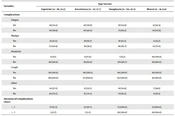
Sinofarm (n = 112, 42.3%) and Sputnik (n = 88, 33.2%) were hospital staff's most commonly injected vaccines. People who received the Sinofarm vaccine received 34.8% (n = 39) of the feeling of fatigue and other symptoms, 14.3% (n = 16) of the body felt pain, and those who received the Sputnik vaccine received 34.2% (n = 38) of the feeling of fatigue and 35.2% (n = 31) of myalgia sensation that all people felt these symptoms for less than a week (Table 2).
Table 2.
Frequency of Complications due to Vaccine Injection (n = 266) a
| Variables | Type Vaccine | |||
|---|---|---|---|---|
| Espotenic (n = 88, 33.2) | AstraZeneca (n = 47, 17.7) | Sinopharm (n = 112, 42.3) | Bharat (n = 18, 6.8) | |
| Complications | ||||
| Fatigue | ||||
| Yes | 38 (43.2) | 28 (59.6) | 39 (34.8) | 8 (44.4) |
| No | 50 (56.8) | 19 (40.4) | 73 (65.2) | 10 (55.6) |
| Myalgia | ||||
| Yes | 31 (35.2) | 29 (61.7) | 16 (14.3) | 4 (22.2) |
| No | 57 (64.8) | 18 (38.3) | 96 (85.7) | 14 (77.8) |
| Headache | ||||
| Yes | 8 (9.1) | 8 (17.0) | 7 (6.3) | 00 (00.0) |
| No | 80 (90.9) | 39 (83.0) | 105 (93.7) | 18 (100.0) |
| Cough | ||||
| Yes | 00 (00.0) | 00 (00.0) | 00 (00.0) | 00 (00.0) |
| No | 88 (100.0) | 47 (100.0) | 112 (100.0) | 18 (100.0) |
| Other | ||||
| Yes | 24 (27.3) | 12 (25.5) | 39 (34.8) | 7 (38.9) |
| No | 64 (72.7) | 35 (74.5) | 73 (65.2) | 11 (61.1) |
| Duration of complications (days) | ||||
| < 7 | 71 (97.3) | 42 (97.7) | 72 (100.0) | 12 (100.0) |
| > 7 | 2 (2.7) | 1 (2.3) | 00 (00.0) | 00 (00.0) |
a Values are presented as No. (%).
About 266 participants in the study received the vaccine. The essential reasons for encouraging vaccination among personnel were presence in a dangerous place (n = 200, 75.2%) and fear of COVID-19 disease (n = 89, 33.5), respectively. However, 49 staff members did not receive the vaccine. In addition, 36.7% (n = 18) of the staff stated thromboembolic events and (n = 13, 26.5) cardiac arrest, short-term vaccine safety, and lack of trust in the vaccine as the most important factors for not receiving the vaccine (Table 3).
Table 3.
Motivation Factors and Non-motivation of Vaccine a
| Factors | Yes | No |
|---|---|---|
| Motivating factors (n = 266) | ||
| Fear of disease | 89 (33.5) | 177 (66.5) |
| Presence in a risky place | 200 (75.2) | 66 (24.8) |
| Death of relatives | 21 (7.9) | 245 (92.1) |
| Trust the vaccine | 21 (7.9) | 245 (92.1) |
| Factors of non-persuasion (n = 49) | ||
| Media advertising | 6 (12.2) | 43 (87.8) |
| Coryza | 3 (6.1) | 46 (93.9) |
| Clot | 18 (36.7) | 31 (63.3) |
| Pain | 8 (16.3) | 41 (83.7) |
| Heart failure | 13 (26.5) | 36 (73.5) |
| Placebo | 8 (16.3) | 41 (83.7) |
| Short-term safety | 13 (26.5) | 36 (73.5) |
| Fear of injection | 2 (4.1) | 47 (95.9) |
| Distrust | 13 (26.5) | 36 (73.5) |
a Values are presented as No. (%).
5. Discussion
COVID-19 has played a significant role in public health, the global economy, and epidemics and mortality. The world needs a vaccine to stop the COVID-19 epidemic and prevent a relapse, and vaccination is one of the most cost-effective ways to prevent the spread of the disease. Following the clinical development of COVID-19 vaccination, it is essential to understand the goals, motivations, and barriers to future vaccine acceptance. In addition, the factors influencing the acceptance of the Corona vaccine may be as important as the vaccine discovery.
The present study showed that men (86.7%) and women (83.1%) tend to be vaccinated. However, there was no significant relationship between sex and vaccine injection. The present study was consistent with Scully et al. (12) and Mesele (13) and a meta-analysis study (14) that showed that men are more likely than women to be vaccinated. Other studies have indicated that women are more likely to receive the vaccine because of medical issues related to their health care and families (15).
People under 35 were more likely to be vaccinated, but there was no significant relationship between age and vaccine acceptance. Harapan Harapan's study in Indonesia showed that 51.4% of people were between 20 - 30 years old, and 94.6% were willing to be vaccinated (16). A study of health workers in France found that most people who received the vaccine were under 30 (3). A study in the United States (17) and by Karlsson et al. found that older people were more likely to be vaccinated than younger people. There was also no significant relationship between age and vaccine acceptance (18). Studying different populations with different age groups is the reason for the difference in results.
The present study showed no significant relationship between education and vaccine injection; undergraduate and graduate students were more willing to receive the vaccine. A study conducted in Kuwait showed that higher education was more inclined to be vaccinated, and there was no significant relationship between education and vaccination (19). A study by Malik et al. found that most college students were vaccinated. There was no significant relationship between education and vaccine injection (17). A cross-sectional study in Saudi Arabia found that most vaccine recipients had a bachelor's degree or lower (4). Studies have shown no significant relationship between education and vaccine injection (17, 20). Such different findings may have been made in populations with different perceptions and beliefs about vaccination in other regions.
The present study showed that single people were more likely to be vaccinated than married people, and there is no significant relationship between marital status and vaccine acceptance. A Southeast Asian study showed that singles were more likely to be vaccinated than married people, and there was no significant relationship between marital status and vaccine acceptance (16).
The most common side effects of COVID-19 vaccine injection were fatigue and myalgia, which were more common than other side effects. A survey by Riad et al. Healthcare workers in Turkey showed that injection site pain, fatigue, and headache were among the complications reported by staff (21). A study of Japanese health workers found that people who received the Sinofarm and AstraZeneca vaccines experience fatigue, fever, and headache, respectively (22). A study in the United Arab Emirates found that fatigue, headache, and myalgia were the most common side effects of the Sinofarm vaccine, respectively (23). A study conducted in Iraq showed that fever and fatigue were the most common side effects of the Sputnik vaccine, and injection site reaction and fatigue were side effects of the Sinofarm vaccine (24).
The results of the present study showed that the motivating factors for the vaccine in personnel were being in a high-risk place and protecting themselves from COVID-19 disease and fear of the disease, and factors such as fear of blood clotting, cardiac arrest, short-term safety, and lack of confidence in the vaccine made staff reluctant to get the vaccine.
A study conducted in Uganda found that being in a high-risk place and protecting oneself were among the factors that motivate health workers and concerns about the short-term safety of the vaccine. Fear of injections was among the factors that discouraged them from Vaccine injections (25). Detoc et al. showed that healthcare workers may be at higher risk for SARS-CoV-2 than others, making them more likely to receive the COVID-19 vaccine (26). Ahamed et al. in the UAE showed that vaccine safety and efficacy emerged as the primary stimulus for vaccination (27). A UK study on vaccination demonstrated that the primary motivation for getting vaccinated was to be in a high-risk place and to protect oneself against COVID-19 (28).
Vaccination is one of the most prominent public health inventions of the 21st century. However, different factors affect acceptance and non-acceptance of vaccine injection, including time, place, and type of vaccine. Therefore, it is necessary to evaluate the acceptance of the COVID-19 vaccine and its factors affecting each region, including demographic factors, attitudes, and beliefs about COVID-19 infection and vaccination, to plan educational activities to increase vaccine acceptance. As healthcare workers have more comprehensive information about COVID-19, this relatively high awareness may force them to protect themselves, prevent virus transmission to family members, and make them more willing to accept the vaccine.
The limitations of this study included the following: In the present study, the samples may not be fully representative of health workers in the province. Second, most responses may be collected at the peak of COVID-19 disease and may affect COVID-19 vaccination intent.
5.1. Conclusions
Based on the results, more than half of the health workers in Imam Reza Hospital were willing to accept the vaccine. However, a small percentage of the employees did not want to inject the vaccine due to the fear of blood clots, complications caused by the injection of the vaccine, and negative news. Therefore, it is suggested to form strong educational and awareness forums to correct advertisements and misinformation and increase employees' knowledge of the COVID-19 vaccine. In addition, holding educational and research workshops and advertisements in health centers and hospitals can be helpful.