
1. Background
Laterality has been defined as the set of characteristics and states of the functional asymmetries observed at the level of the corporeal elements (hand, eye, foot) (1). The term of laterality is pertinent in the context of motor skills utilization (2), It encompasses not only an individual's preference for one side of their body, showing prevalence in hands, feet, senses, etc., but also extends to how one uses and orients their body in space (3). Around the age of 12 years, asymmetry tends to stabilize, and the lateralization profile of children becomes well-established (4). Furthermore, sports activities play a crucial role in building a strong psychomotor foundation, contributing to the stabilization of laterality in children (5). Nevertheless, laterality is developed progressively against the background of cerebral and bodily asymmetry, influenced by factors such as age and exercise (6). The development of inter-manual asymmetry has been observed to progress throughout childhood, reaching its peak when young and middle-aged adults attain their highest level of skill (7). Certain studies have reported that older adults exhibit reduced manual asymmetry compared to young adults, particularly in tasks that are highly lateralized (8), such as button pressing (9), reaching tasks (10), and manually tracing lines (7). The role of bilateral practice is a topic of research investigated by several studies to examine laterality linked to soccer performance (11). Certainly, if soccer performance depends on one side of the body it can therefore leave the player stuck in particular game scenarios. This becomes particularly evident at the elite level, where a higher prevalence of mixed-footed players is observed among professionals compared to students. In elite soccer, the ability to proficiently execute skills with either limb is considered a crucial competence to meet the demands of the game (12). The impact of unilateral training on the performance of both preferred and non-preferred kicks has been extensively documented in the literature (13). Additionally, podal performance is influenced by various factors, including "strength," "precision," "speed," and the regularity of the task (14). Another study focused specifically on the performance of the preferred foot among amateur soccer players (15). Earlier research in soccer performance has suggested that professionals in strength training and conditioning should prioritize training the non-preferred leg, as it appears to contribute to the development of mixed-footed players (13). Moreover, mixed-footedness is widely acknowledged as an advantage in soccer, and there is a growing emphasis on bilateral practice (16). Drawing from an investigation into footedness within the general population, emphasized the significant influence of laterality on soccer performance (17). Their findings indicated that the categorization of the best players often aligns with those who exhibit mixed footedness. In particular, Teixeira et al. (18) reported enhancements in the performance of the dominant leg following the training of the non-dominant leg. The study assessed the performance of both legs before and after a 4-month training period on three motor tasks kicking for force, kicking for accuracy, and speed of dribbling among young players aged 12-14 years. Certainly, the study observed a reduction in performance asymmetry after the bilateral training period, specifically in the speed of dribbling within the experimental group. This improvement was notable in tasks requiring a high degree of dynamic bilateral cooperation, where constant interaction between both legs is involved in advancing the ball through an obstacle course. However, the study indicated that the performance difference remained unchanged across the tests for kicking tasks. It's worth noting that the bilateral training program resulted in an improvement in performance for both the preferred and non-preferred legs. Importantly, there is a scarcity of studies that have investigated the impact of the preferred and non-preferred foot on soccer skills in young players (11). To the best of our knowledge, there are no longitudinal studies that have explored the impact of bilateral training on the performance of lateral asymmetries between the two legs in young soccer players.
2. Objectives
In this study, we investigated the impact of a longitudinal program of bilateral soccer practice on (1) performance asymmetry, (2) age, and (3) whether the bilateral training influences the lateral asymmetries between the two legs in soccer skills among young players.
3. Methods
3.1. Subjects
Fifteen young male elite-level field soccer players, all right-footed, participated in this study (mean age: 13.9 ± 0.6 years; height: 1.65 ± 4.9 cm; body mass: 53.8 ± 6.1 kg; body fat: 10.1 ± 2.1%). These players were part of a first division Tunisian team competing in the 12 years old (U12), 14 years old (U14), and 15 years old (U15) categories. All participants were volunteers, and they engaged in 10-hour training sessions per week, along with participating in an official national match every Sunday.
All procedures were conducted during the competitive season (19). Subjects and their parents were informed about the experimental procedure, and familiarization procedures for testing were carried out one week before the start of the protocol for all players. During this familiarization session, participants were given a brief explanation of the tests and allowed attempts to ensure full familiarity with the procedures (20). The study adhered to the principles of the Declaration of Helsinki, and the protocol received approval from the local Ethics Committee.
3.2. Procedure
All players were invited to assess their podal preference through a foot preference questionnaire. The classification of Dellatolas et al. (21) was employed to identify the frequencies of right-footed, mixed right-footed, left-footed, and mixed left-footed individuals. The initial test evaluated performance on three tasks, utilizing the following procedures. Participants arrived one hour before the start of the test. Subsequently, following a standardized warm-up involving dynamic stretching lasting 10 - 15 minutes, all players had a 3-minute rest before commencing the tests (22). Subjects performed the following tests: Ball control with the body (using the right foot, left foot, and alternating between both), lob pass, and kicking accuracy (with both the right and left foot). Three stations were arranged on a soccer field, and the performance on the three tasks was evaluated, with each task conducted at a different station. Subjects completed two trials of the ball control test with the body by the right foot, left foot and by alternance, with a 3-minute interval between trials. The best performances from each condition were selected for analysis.
In each trial, participants were tasked with completing a total of 10 shots with five taken with each foot. Participants performed the tests initially with their preferred leg and then, after a 3-minute interval, with their non-preferred leg. A 5-minute rest session separated the tests. All assessments took place on a 4th generation synthetic grass soccer field simultaneously, conducted within the same time window (9:00 am to 11: 00 am), to eliminate potential effects of circadian rhythms or time-of-day variations. The ambient temperature varied between 21 - 23°C, humidity between 50 - 60% without rain or wind conditions (wind speed under 10 km/h). A standard soccer ball, weighing approximately 430 g with a circumference of 70 cm, was utilized. Players were instructed to wear sports shorts, t-shirts, and football boots tailored for use on grass, ensuring proper ground adaptation. Participants were required to use the same football boots throughout all tests. The experiment was conducted over a period of three years.
3.3. Apparatus and Tasks
3.3.1. Ball Control with the Body
Within a 9 × 9 m square, the player's task was to keep the ball in the air without using the arms or hands. The recorded score was the number of ball contacts before it fell to the floor. Counting ceased when the ball hit the floor, the participant stepped out of the square, or used their arms or hands to touch the ball. One trial was recorded, and the participant could restart the trial if they failed to make contact with the ball three times in the initial attempt (23).
3.3.2. Lob Pass
In the lob pass test, athletes kicked a soccer ball from a distance of 20 m into an area divided into three concentric circles with diameters of 3, 6, and 9.15 m. Each kick was scored based on the circle in which the ball landed, earning 3, 2, or 1 point, respectively. Participants were allowed ten attempts (five with each foot), with a maximum possible score of 30 points (24).
3.3.3. Shooting Accuracy
The kicking accuracy test was conducted from 20 meters, with the player aiming to kick the ball at a target measuring 16 meters wide. The goal was subdivided into five parallel sections: A central 2 m-wide area (worth 3 points), two 3 m-wide areas on each side of the center (2 points each), and two 4 m-wide areas at each extreme (1 point each). Participants were given ten shots (five with each foot), with a maximum achievable score of 30 points (24).
3.3.4. Training Session
The experiment was divided into three phases: The first test (T1) at U12, a training session, the second test (T2) at U14, another training session, and the third test (T3) at U15. The training phase spanned three years and took place after the first test. The training regimen involved five days per week (Monday to Friday), with two hours dedicated each day. The schedule included: (a) 15 minutes of general warm-up, and (b) 45 minutes of training focusing on all fundamental skills related to soccer. During the initial phase of this period, players engaged in individual drills as well as drills with pairs or groups of three players per ball. Intensive practice of skills such as passing, juggling, shooting, and receiving was emphasized. In the latter part, the training period transitioned to small games with a higher number of participants, necessitating the application of skills honed in the preceding drills. Over the course of three years of longitudinal training, the complexity of tasks was heightened. This involved a progressive demand for accuracy in kicks, control, and speed in juggling tasks, which inherently included a significant level of dynamic bilateral interaction. Additionally, participants faced various combinations of fundamental soccer skills integrated into serial motor tasks. Finally, as part of the training regimen, participants engaged in a 60-minute soccer game, during which they received instruction in the team's tactics (18).
3.4. Data Analysis
The statistical analysis was performed using the Statistica software (Stat Soft, France). Data are expressed as mean ± standard deviation (M ± SD) in the text and mean ± standard error (M±SE) in the figures. The Normality of the distribution was checked and confirmed using the Shapiro-wilk test. Data were analyzed using two-way repeated measures ANOVA (2 Leg (Right vs. Left) × 3 Age (U12, U14, and U15)). When ANOVA displayed a significant effect, Bonferroni Post-hoc test was applied for pairwise comparison. When necessary, one way repeated measure ANOVA was performed. Effect sizes were calculated as partial eta-squared (ηp2) to estimate the meaningfulness of significant findings. Values of partial eta squared at 0.20, 0.50, and 0.80 are indicative of small, moderate, and large effect sizes, respectively. All differences were deemed statistically significant at a probability level P ≤ 0.05.
4. Results
Descriptive and inferential statistics for soccer skills tests in each leg and age (Mean ± SD) are summarized in Table 1.
Table 1.
Descriptive and Inferential Statistics for Soccer Skills Tests in Each Leg and Age a
| Parameters | Mean ± SD | Main effects | Interaction | |||||||||
|---|---|---|---|---|---|---|---|---|---|---|---|---|
| Leg | Age | Leg × Age | ||||||||||
| U12 | U14 | U15 | F (1, 22) | P | F (1, 22) | P | F (2, 44) | P | ||||
| Lob pass | ||||||||||||
| RL | 2.47 ± 1.19 | 3.47 ± 0.99 ## | 4.2 ± 1.01 ##$ | 13.7 | 0.002 | 0.49 | 75.17 | < 0.001 | 0.84 | 0.10 | 0.901 | 0.01 |
| LL | 1.27 ± 1.28 *** | 2.4 ± 1.55 ***## | 3.07 ± 1.33 ***##$ | |||||||||
| Shooting accuracy | ||||||||||||
| RL | 2.33 ± 1.18 | 3.53 ± 1.06# | 4.2 ± 0.77 ## | 4.09 | 0.063 | 0.23 | 65.60 | < 0.001 | 0.82 | 1.09 | 0.349 | 0.07 |
| LL | 1.87 ± 1.96 | 2.47 ± 1.51 * | 3.33 ± 1.23 ## | |||||||||
| Ball control with the body | ||||||||||||
| RL | 11.53 ± 9.06 | 20.13 ± 18.03 | 34.07 ± 35.63 ##$ | 4.36 | .056 | 0.24 | 10.24 | < 0.001 | 0.42 | 3.55 | 0.042 | 0.20 |
| LL | 7.67 ± 6.1 | 12.27 ± 11.27 | 14.93 ± 12.81 ** | |||||||||
Abbreviations: RL, right leg, LL, left leg.
a *, **, ***: Significantly different from Right leg at P < 0.05, P < 0.01 and P < 0.001 respectively; #, ##: Significantly different from U12 at P < 0.01 and P < 0.001 respectively; $: Significantly different from U14 at P < 0.05.
4.1. Lob Pass
Regarding the lob pass test, the two-way repeated measures ANOVA indicated a significant effect of leg (F (1, 14) = 13.6; P = 0.002; ηp2 = 0.494). Post hoc tests revealed that lob pass performance with both the right and left leg was better in U14 and U15 compared to U12 (P < 0.01, respectively). Age significantly influenced lob pass performance (F (2, 28) = 75.17; P < 0.001; ηp2 = 0.843), with post hoc comparisons showing better performance in U15 compared to U14 (P < 0.01). The interaction effect of Leg * Age (F (2, 28) = 0.1; P = 0.901; ηp2= 0.007) was not significant (Figure 1).
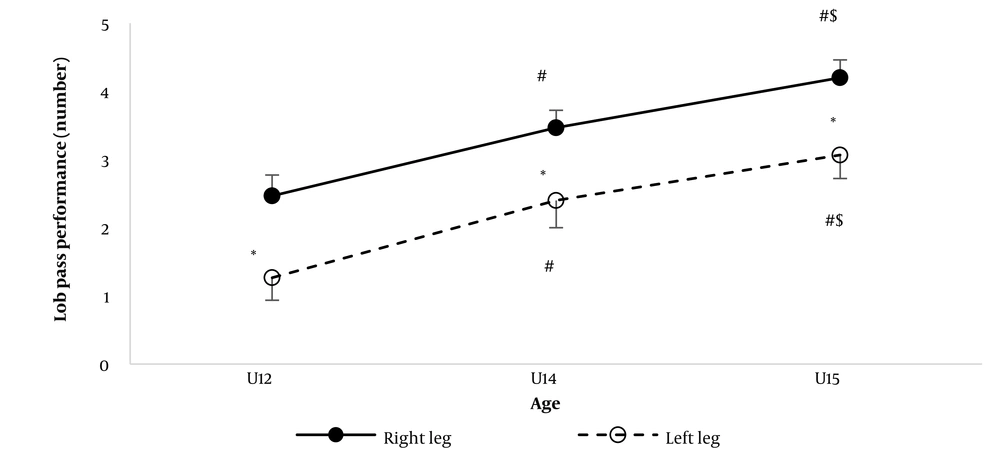
Figure 1.
Lob passes performance in each leg and age*: Significant difference between legs at P < 0.001; #: Significantly different from U12 at P<0.01; $: Significantly different from U14 at P < 0.05.
4.2. Shooting Accuracy
During the shooting accuracy performance test, the two-way repeated measures ANOVA indicated no significant effect for Leg (F (1, 14) = 4.09; P = 0.063; ηp2 = 0.226). However, age had a significant effect (F (2, 28) = 65.6; P < 0.001; ηp2 = 0.824). Post-hoc tests revealed that shooting accuracy was better in U15 and U14 compared to U12 (P < 0.01 and P < 0.05, respectively) (see Figure 2). The interaction of Leg × Age for podal performance was not significant across our longitudinal study (F (2, 28) = 1.09; P = 0.349; ηp2 = 0.072).
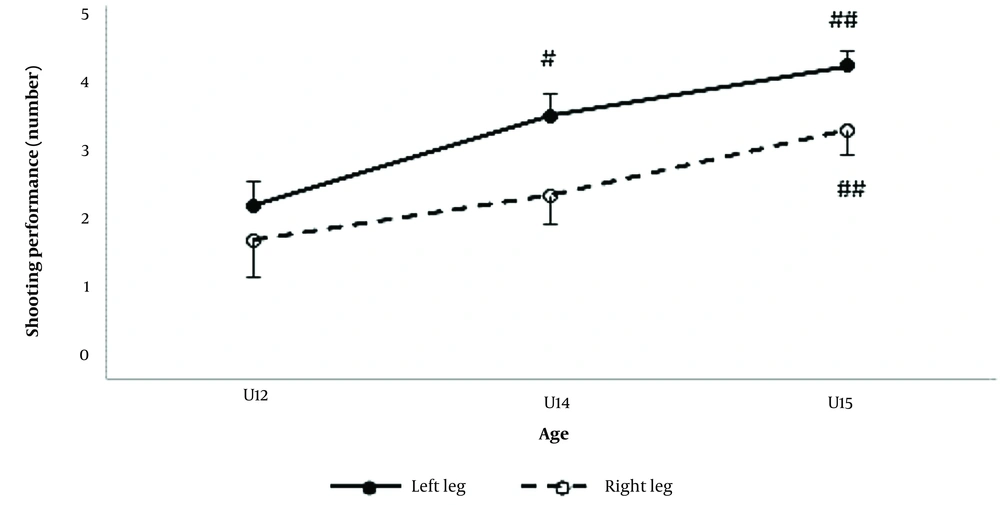
Figure 2.
Shooting accuracy in each leg and age; #, ##: Significantly different from U12 at P < 0.05 and P < 0.01 respectively.
4.3. Ball Control with the Body (Right Foot, Left Foot)
Regarding the test of Ball control with the body using both the right (BCR) and left (BCL) leg, the two-way repeated measures ANOVA indicated no significant effect of Leg (F (1, 14) = 4.36; P = 0.056; ηp2 = 0.237). However, there was a significant effect of age (F (2, 28) = 10.24; P < 0.001; ηp2 = 0.422). Post hoc tests revealed that Ball control performance was better in U15 compared to U14 and U12 (P < 0.01). Additionally, there was a significant interaction of Leg × Age (F (2, 28) = 3.55; P = 0.042; ηp2 = 0.202). Post-hoc tests showed that BCR and BCL leg performance was better in U15 and U14 compared to U12 (P < 0.05, respectively) (Figure 3).
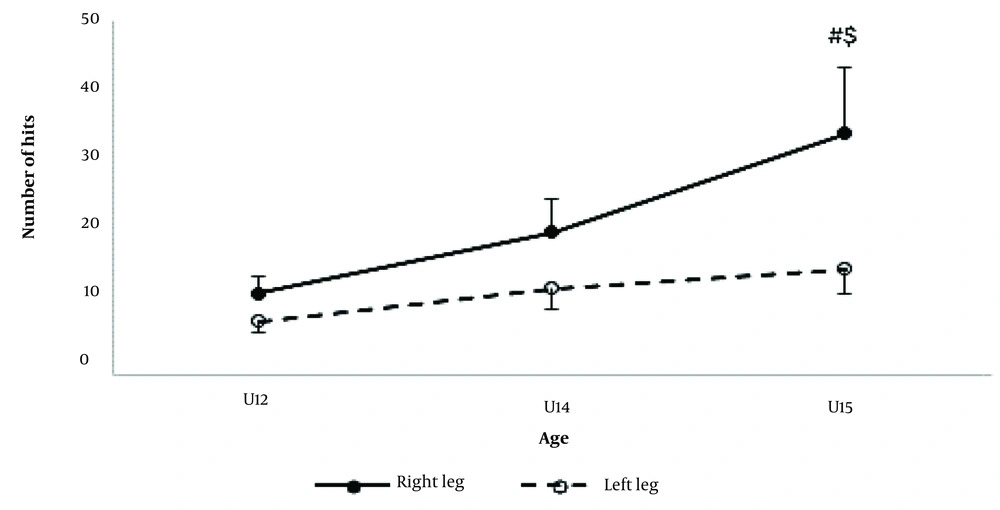
Figure 3.
Ball control with the body in each leg and age; #: Significantly different from U12 at P < 0.01; $: Significantly different from U14 at P < 0.05.
4.4. Ball control with the Body (by Alternance)
Regarding the statistical analysis for the Ball control with the body by alternate test (BCAlt), the one-way repeated measures ANOVA indicated a significant effect of age (F (2, 28) = 16.29; P < 0.001; ηp2 = 0.538). Post-hoc tests revealed that ball control with BCAlt was better in U15 and U14 compared to U12 (P < 0.01 and P < 0.001, respectively) (Figure 4).
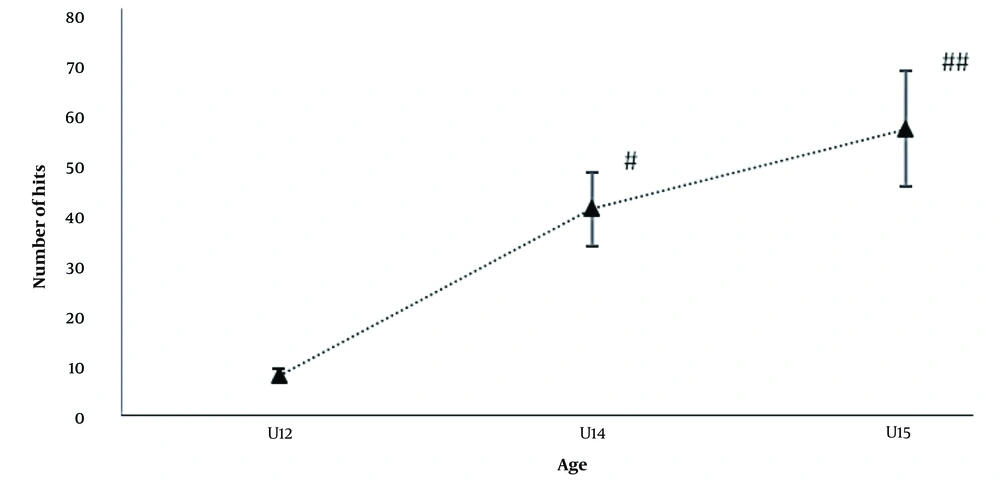
Figure 4.
Ball control with the body by alternance according to age; #, ##: Significantly different from U12 at P < 0.01 and P < 0.001 respectively.
5. Discussion
Three main findings emerged from this study. First, we observed no effects of longitudinal practice on the reduction of lateral asymmetries in lob pass and shooting accuracy in U12 (T1), U14 (T2), and U15 (T3), even when the use of the preferred and non-preferred leg was emphasized. Remarkably, a significant reduction in lateral asymmetries was found only in the ball control test with the body by alternance, and this was evident in U15 and U14 compared to U12.
Similarly, Teixeira et al. (18) evaluated adolescents aged between U12 to U15 years. Additionally, the study assessed the performance of both legs before and after a 4-month training program on three motor tasks: Kicking for force, kicking for accuracy, and speed of dribbling. The results demonstrated that emphasizing training of the non-preferred leg led to an improvement in the performance of the corresponding leg. However, in accordance with Teixeira et al. (18), as reflected in the overall weekly schedule that emphasized our longitudinal bilateral training, more time was dedicated to practicing with both legs, considering an endogenous lateral dominance. The data indicated that the asymmetry of performance should increase rather than diminish in U15 compared to U14 and U12. Additionally, we found that the reduction of lateral asymmetries for the lob pass and shooting accuracy remained stable over time, even with extensive practice (18). This confirms the importance of genetic factors and demonstrates that laterality is heritable (25). It strengthens the assumption that the choice of a foot is largely innate (16). Therefore, bilateral practice improves the podal performance of both the right and left foot (18). Additionally, lateral asymmetries decreased after the training periods, but this reduction was observed only in the ball control of the body, which involves a significant degree of dynamic bilateral interaction, such as the speed of dribbling (18).
The results achieved in the ball control of the body are in disagreement with previous studies, which showed the strict dominance of one body side for motor action and the increase in lateral asymmetries of performance based on unilateral practice (26). Additionally, the significant values of the ball control of the body test between legs indicate that lateral asymmetries of performance are task-specific. This means that they are a consequence of particular constraints in the acquisition of the task and not the result of a leg dominance factor imposing a homogeneous lateral asymmetry across skills.
Behavioral and neurophysiological research has provided support for this conclusion. A fundamental principle in the field of motor behavior suggests that there is a dominant cerebral hemisphere for motor control. Cerebral dominance implies that one cerebral hemisphere, typically the left, has a prevailing capacity to exert control over the opposite side of the body. Contrarily, previous studies have shown that extensive unilateral practice of specific tasks does not necessarily lead to an improvement in performance asymmetry (26).
Secondly, our findings demonstrated a clear effect of age and longitudinal practice on performance asymmetry. The measurements revealed that the performance in lob pass, kicking accuracy, and ball control with the body using both the right and left legs, as well as alternate control, was better in T3 at U15 and T2 at U14 compared with T1 at U12. These results align with Haaland and Hoff (27), who indicated that training the non-dominant leg of soccer players resulted in an increase in performance not only with the non-dominant leg but also with the dominant one. In this regard, Peters (28) trained one subject by practicing a daily routine at the rate of 20 trials per day with the index finger of each hand, for a total of 1300 trials. Initially, the right hand's tapping rate was about 6.5% faster than the left hand. However, after approximately 1200 trials, the left hand became as fast as the right. The marked improvement in performance was recorded for both hands. However, the improvement of non-preferred limb performance in our study, marked across tests, may be related to the similarity of the movement technical patterns on both sides (29). Thus, bilateral equality between the limbs was suggested to provide an advantage over competitors who have performance dominance on one side. Additionally, other researchers suggested that the most successful players are those who are able to play with both feet. Most soccer players tend to have a preferred leg with which they receive, control, and kick the ball (30).
Our findings differ from a previous study, which showed that the transfer of learning seems to be the main mechanism preventing the increase in lateral asymmetries of performance based on unilateral practice (31). In fact, some practices require the unilateral use of the body, such as pitching in baseball, handball, and basketball. In all these sports, the dominant side is used more frequently than the non-dominant side for the control of specific skills to carry out actions in the game. Third, our results showed an improvement in the ball control of the body tasks with the preferred leg in relation to the non-preferred leg, thereby reducing the lateral asymmetry and improving performance only in U15 compared to U14 and U12. In this context, to obtain more accurate and relevant effects of training, authors have demonstrated improvement in individual performances (uni-manual and bimanual tasks) after a lifetime of experience or similar extensive practice (32). Furthermore, other investigators assessing technical skills revealed that young players with more experience scored higher than less experienced players for ball velocity and ball accuracy. Additionally, their success rates were higher than those of players with less experience (33). On the other hand, the stability of lateral asymmetries for the lob pass and shooting accuracy tasks reveals an interesting aspect of inter-lateral transfer of learning. Importantly, the similar improvement in performance with the preferred and non-preferred leg, keeping the index of lateral asymmetry constant in U12 (T1), U14 (T2), and U15 (T3), indicates that the performance with the non-preferred leg benefited similarly from practice across tests with the preferred leg. In other words, the practice with an emphasis on the non-preferred leg results in improvement in both legs, but not only at the rate of preferred leg performance. Such a transfer of learning seems to be the main mechanism preventing an increment of lateral asymmetries of performance (26). Overall, our longitudinal study revealed a significant improvement in the performance of both the right and left foot under the influence of a bilateral training soccer program. As shown previously, manual or podal preference increases as a function of motor skill demand (34). Therefore, it is important to note the possible role of soccer coaches and strength training and conditioning professionals in the training of the non-preferred leg because it seems to support the development of mixed-footed players (13).