


1. Background
Developmental coordination disorder (DCD) is a neurodevelopmental disorder characterized by a significant deficit in motor skill acquisition and performance that falls well below what is expected for a person’s age and level of intelligence (1). Clinical manifestations of these deficits, which cannot be attributed to an underlying general medical condition, include clumsiness, reduced speed, and decreased precision when performing both fine and gross motor tasks (2, 3). The Diagnostic and Statistical Manual of Mental Disorders, Fifth Edition (DSM-5), requires that these difficulties interfere with activities of daily living, academic productivity, and leisure activities (2). The global prevalence is 5% - 6% among school-aged children, making DCD one of the most common pediatric motor disorders (1, 4, 5). However, DCD remains underrecognized, which can delay early intervention (6, 7).
Children with DCD exhibit gross motor deficits, including poor postural control, balance impairments, and difficulties with locomotion (3, 5). Fundamental motor skills (FMS) are essential building blocks underlying complex motor abilities and are divided into two principal categories: Locomotor skills, such as running, hopping, and jumping, and object control skills, such as throwing, catching, and striking. These skills are substantially affected in children with DCD, manifesting as poor catching, difficulty using tools, impaired balance, and challenges in fundamental tasks such as running and throwing (3, 8). These deficits compromise self-care and academic performance (1, 9).
Neurobiologically, DCD involves disruptions in cerebro-cerebellar and frontostriatal circuits that are critical for motor learning (10, 11). Recent electroencephalography studies have shown atypical beta oscillatory dynamics during procedural learning, linking poor motor learning to neural abnormalities (10). Poorer physical health, lower self-esteem, higher anxiety, and reduced well-being are consistently reported (1, 12). Developmental coordination disorder and attention-deficit/hyperactivity disorder frequently co-occur, increasing functional strain (6).
Traditional motor-based interventions include process-oriented techniques, such as sensory integration, and task-oriented techniques, such as Neuromotor Task Training and Cognitive Orientation to Daily Occupational Performance (3). According to a recent meta-analysis of 32 randomized controlled trials (RCTs), motor-based interventions considerably improve general motor skills (Hedges’ g = 1.00), balance (0.57), coordination (0.47), and activity performance (Hedges’ g = 0.71) (3). However, motor-based interventions did not improve psychosocial outcomes or participation, indicating limited real-world transfer. Task-oriented training is recommended as a first-line intervention in the 2019 European guidelines (9). Despite their efficacy, traditional interventions require specialized equipment, trained therapists, and frequent sessions, limiting accessibility (13). Moreover, repetitive exercises are often perceived as tedious, reducing adherence.
Gamification, which involves incorporating game design elements into non-game contexts, offers a promising strategic approach. In motor rehabilitation, gamification includes exergames, serious games, and virtual reality/augmented reality therapies that require physical movement to control gameplay (8, 14). These approaches leverage the intrinsic appeal of digital games to provide repetitive, task-specific motor practice within a rewarding context, sustaining engagement and promoting the high practice volumes required for motor learning (15).
Evidence supports gamified interventions for DCD. A meta-analysis of nine RCTs with 266 participants found that nonimmersive virtual reality, such as Nintendo Wii, improved balance (standardized mean difference [SMD] = 0.40) and running/agility (SMD = 0.45) more than usual care (16). Active video games are common assistive devices, and the feasibility of home-based use has been demonstrated (17). A 6-week home-based exergaming program led to a statistically significant increase in balance percentile scores on the Movement Assessment Battery for Children, Second Edition (MABC-2), and this improvement remained evident at the 6-week follow-up evaluation (18). Ten weeks of graded exergame training improved motor coordination, balance, and fitness (19). However, task-oriented exergaming, such as Wii Fit, may yield smaller gains in functional strength than traditional Neuromotor Task Training (13, 20).
Despite encouraging findings, important gaps remain. First, most gamified DCD interventions have focused on balance and gross locomotor skills, with limited attention to FMS, particularly integrated object control and locomotor abilities (17). A recent scoping review noted that few devices target fundamental skill tasks and that none explicitly consider DCD-specific neurodevelopmental features, such as impaired motor planning (17). Second, evidence for improvements in FMS, especially object control, is considerably less developed, and heterogeneous outcome measures hinder comparisons (16, 17). Third, few studies have systematically measured motivational factors or examined how specific game design elements, such as feedback and challenge progression, influence FMS learning in DCD (21). These gaps underscore the need for rigorous studies evaluating gamified interventions that target FMS in children with DCD.
2. Objectives
The purpose of this study was to systematically evaluate the effectiveness of a gamified motor intervention targeting FMS in a pediatric DCD population. We hypothesized that, compared with waitlist controls, the intervention group would show significant improvements in both locomotor and object control skills. The ultimate goal of generating these empirical data is to translate these findings into clinical recommendations and to guide the development of accessible therapeutic approaches for affected children.
3. Methods
3.1. Subjects
This study employed a semi-experimental pretest-posttest control-group design. The target population comprised all male elementary school students aged 7 - 10 years in Yasouj, Iran, during the 2025 - 2026 academic year. Using multistage cluster sampling, nine all-boys schools were randomly selected from the Yasouj school registry. Among the 312 students aged 7 - 10 years in these schools, initial screening was conducted using the Developmental Coordination Disorder Questionnaire (DCDQ-7). Parents of 52 students with scores below the threshold of 47, indicating probable DCD, were invited for a comprehensive assessment.
The inclusion criteria were as follows: 1) age 7 - 10 years; 2) DCDQ-7 score < 47; 3) MABC-2 total score < 5th percentile; 4) confirmation of motor impairment using the Persian Motor Observation Questionnaire for Teachers (PMOQ-T); 5) absence of comorbid neurological, physical, or psychiatric disorders; and 6) written informed consent from parents.
DSM-5 diagnostic criteria for DCD were operationalized as follows. Criterion A (motor deficit) was defined as MABC-2 < 5th percentile and TGMD-2 below age norms. Criterion B (daily living impact) was defined as DCDQ-7 < 47 (22) and PMOQ-T < 16th percentile. Criterion C (early onset) was defined as parent-reported motor difficulties before age 7 years. Criterion D (exclusion of other conditions) was defined as the absence of IQ < 70, neurological disorders, uncorrected visual impairment (visual acuity < 20/40), attention-deficit/hyperactivity disorder, learning disorders, cerebral palsy, epilepsy, muscular dystrophy, or head trauma, as confirmed through parent/teacher interviews, school records, and pediatrician review.
After these criteria were applied, 40 eligible children were identified and randomly assigned to either an intervention group (n = 20) or a control group (n = 20). No dropouts occurred. All 40 eligible children agreed to participate; three children were excluded because their parents declined the initial screening invitation, and nine did not meet the diagnostic criteria. Figure 1 presents the participant flow diagram.
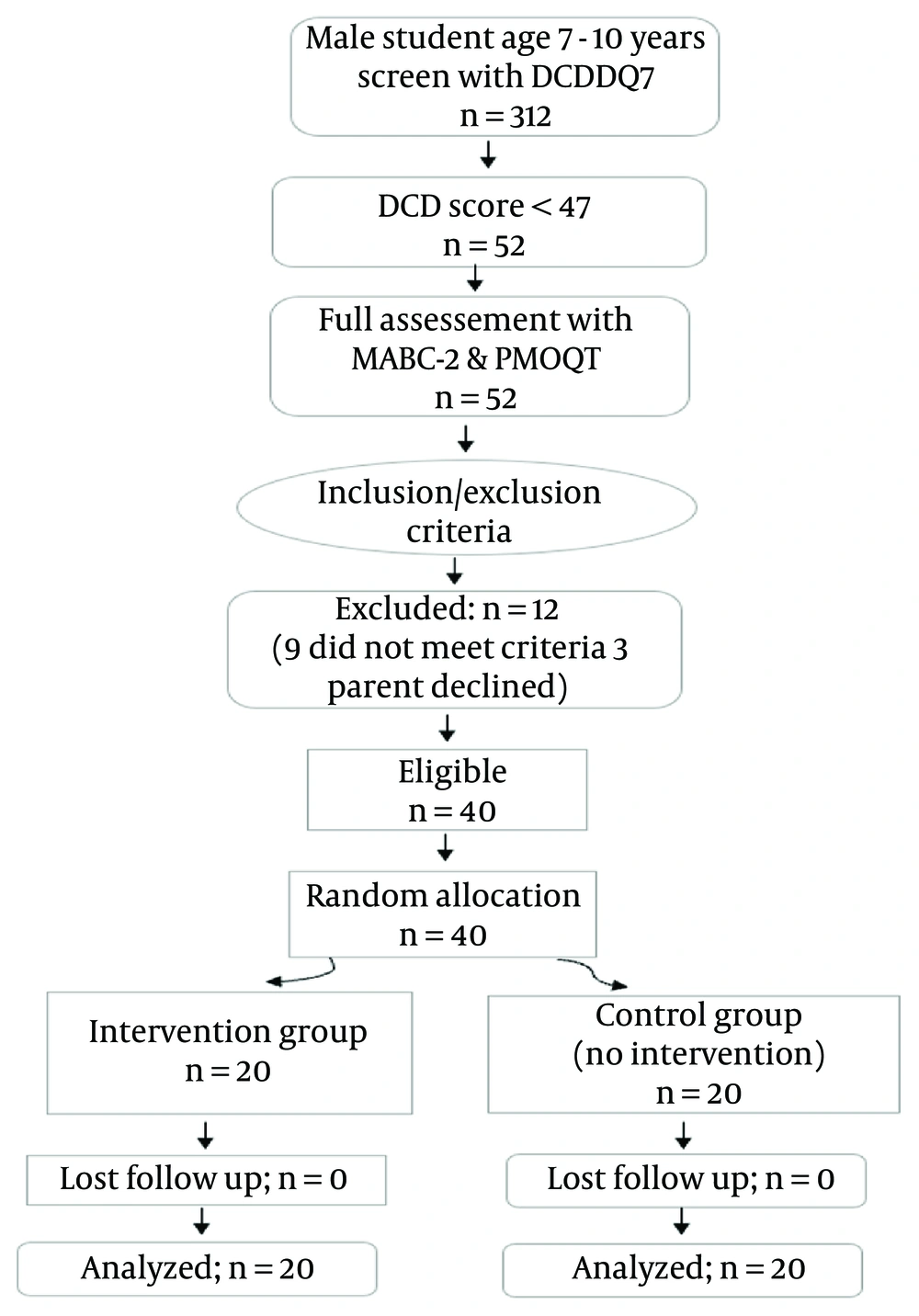
Figure 1.
Flow of participants through the study
Given the exploratory nature of this study and the absence of previous gamification-based FMS interventions for DCD, a formal power analysis was not feasible. The sample size (N = 40) was determined based on feasibility and precedent from comparable studies with 20 participants per group, which reported effect sizes ranging from η2 = 0.14 to 0.52 (23). This sample provides adequate precision for detecting large effects but has limited power for small-to-moderate effects.
3.2. Apparatus and Tasks
3.2.1. Screening and Diagnostic Tools
Three standardized assessment instruments were used to establish the diagnosis of DCD.
Developmental Coordination Disorder Questionnaire: Wilson et al. (22) developed the 15-item DCDQ, a parent-report tool designed for children aged 5 - 15 years. The revised instrument had a Cronbach's alpha of 0.89, compared with 0.88 for the previous version (22). The DCDQ assesses four domains: handwriting, general coordination, fine motor skills, and motor control during movement.
Movement Assessment Battery for Children, Second Edition: The MABC-2, revised by Henderson, Sugden, and Barnett (24), is a standardized instrument for diagnosing DCD. It includes a performance component with three subscales (manual dexterity, ball skills, and balance) for children aged 3 - 16 years. A standard score of 5, corresponding to the 5th percentile or lower, indicates significant motor impairment (red zone); scores of 6 - 7, corresponding to the 6th - 15th percentiles, indicate risk (yellow zone); and scores above the 15th percentile suggest the absence of motor difficulties (green zone). The validity and reliability of the MABC-2 have been confirmed in international research (25).
Persian Motor Observation Questionnaire for Teachers: The PMOQ-T is an 18-item teacher-report instrument used to evaluate gross and fine motor skills in children aged 5 - 11 years. Scores below the 16th percentile indicate risk of DCD, whereas scores between the 16th and 100th percentiles reflect typical motor development. Raw scores are converted into percentile ranks. The Persian version demonstrates acceptable test-retest reliability, satisfactory diagnostic validity, and high internal consistency (α = 0.91).
Raven Intelligence Test: Raven's Progressive Matrices were used to assess IQ and exclude intellectual disability. This test consists of 36 questions designed for children aged 5 - 12 years. Children with an IQ below 70 were excluded from the study. As shown in Table 2, the mean IQ in both groups was in the average range (intervention: 84.43 ± 3.9; control: 85.68 ± 3.5), confirming the absence of intellectual disability in the sample. The correlation coefficient of this test with the Stanford-Binet and Wechsler intelligence tests has been reported to range from 40% to 75%. Furthermore, its reliability at older ages has been reported to range from 70% to 90% (26).
Table 2.Baseline Characteristics of Participants in the Intervention and Control Groups (N = 20) a
| Characteristic | Intervention Group | Control Group | Test Statistic | P-Value |
|---|---|---|---|---|
| Age (y) | 8.7 ± 1.11 | 8.6 ± 1.02 | t (38) = 0.64 | 0.530 |
| Height (cm) | 133.41 ± 6.23 | 133.54 ± 5.10 | t (38) = 0.37 | 0.721 |
| Weight (kg) | 32.73 ± 4.87 | 32.80 ± 4.20 | t (38) = 0.39 | 0.706 |
| Body Mass Index (kg/m2) | 17.9 ± 2.1 | 18.1 ± 2.3 | t (38) = 0.29 | 0.775 |
| IQ | 84.43 ± 3.9 | 85.68 ± 3.5 | t (38) = 0.15 | 0.948 |
a Values are expressed as mean ± SD.
3.2.2. Primary Outcome Measurement Tool
Test of Gross Motor Development, Second Edition: The TGMD-2 is a standardized instrument used to assess children's FMS qualitatively. It includes two subtests: the Locomotor subtest, which assesses six skills (running, galloping, hopping, leaping, horizontal jump, and sliding), and the Object Control subtest, which evaluates six skills (striking a stationary ball, stationary dribbling, catching, kicking a stationary ball, overhand throw, and underhand roll). Ulrich reported overall validity of 96%, with subtest reliability coefficients of 85% for locomotor skills and 78% for object control skills (27). Farrokhi et al. (28) reported internal consistency coefficients of 0.87 for the Locomotor subtest, 0.74 for the Object Control subtest, and 0.80 for the overall composite score in the Iranian context.
3.3. Intervention: Gamification Program
The gamified intervention was delivered in three 45-minute sessions per week for 8 weeks. Each session followed a standard format consisting of a 10-minute active warm-up, a 30-minute core activity period, and a 5-minute closing segment for feedback, symbolic awards, and updating group rankings (23). Gagné's Nine Events of Instruction and Keller's ARCS model of motivation provided the theoretical framework. To enhance motivation and engagement, gamification components were incorporated, including explicit challenges, point-based prizes, and immediate performance feedback (23, 30). The intervention was delivered by two trained physical education instructors, each holding a bachelor's degree in physical education and certification in adapted physical activity. Before the intervention, they received 6 hours of training on the gamification protocol, including session structure, progression rules, and feedback delivery.
3.3.1. Program Phases
The program was designed in two sequential phases.
Phase 1, Explorers in Action (weeks 1 - 4), focused on foundational motor skills and cooperative play through an exploratory narrative. Activities included Conquering Territories, Bridges and Rivers, Explorer's Trail, Tower Builders, Treasure Cave, and Explorer's Race. This phase culminated in integrated challenges such as The Explorer's Labyrinth and Recovery of Lost Artefacts.
Phase 2, Movement Heroes (weeks 5 - 8), emphasized advanced motor proficiency, strategic gameplay, and team dynamics. Activities included The Hero's Odyssey, Castle Defence, Quest for the Crown Jewels, Path to the Kingdom, Resource Reconnaissance, and Fortress Guardians. This phase ended with culminating events: The Final Campaign and Dragon Grand Prix. The final session was structured as an integrated skills carnival featuring a circuit of activity stations (34). Through its progressive and sequential design, the curriculum ensured that all participants experienced structured, quantifiable growth in motor, cognitive, and socioemotional functioning. A weekly summary of the intervention is presented in Table 1. A full session-by-session description of the 24 sessions is provided Table S1 in Supplementary File.
Table 1.Weekly Summary of the Gamification-Based Intervention a
| Week | Phase/Theme | Targeted FMS | Example Activities | Progression Criteria | Materials |
|---|---|---|---|---|---|
| 1 | Explorers in Action | Locomotor (running, sliding, hopping) | Conquering Territories; Bridges and Rivers | Complete 3 successful runs without stopping | Cones, mats, hoops |
| 2 | Explorers in Action | Locomotor (galloping, leaping, horizontal jump) | Explorer's Trail; Tower Builders | Leap over 4 obstacles in a row | Low hurdles, foam blocks |
| 3 | Explorers in Action | Object control (throwing, catching) | Treasure Cave; Explorer's Race | Catch 3 out of 5 throws from 3 m | Soft balls, buckets |
| 4 | Explorers in Action | Integrated (locomotor + object control) | Explorer's Labyrinth; Recovery of Lost Artefacts | Complete the obstacle course in < 5 min | Combined equipment |
| 5 | Movement Heroes | Locomotor (agility, balance, running) | The Hero's Odyssey; Castle Defence | Maintain balance on beam for 10 s | Balance beam, cones |
| 6 | Movement Heroes | Object control (striking, kicking, dribbling) | Quest for Crown Jewels; Path to the Kingdom | Dribble ball between cones without losing control | Balls, cones, goals |
| 7 | Movement Heroes | Integrated (advanced) | Resource Reconnaissance; Fortress Guardians | Throw and catch while moving | All previous materials |
| 8 | Movement Heroes | Culmination/skills carnival | Final Campaign; Dragon Grand Prix; circuit stations | - | - |
a Abbreviation: FMS, fundamental motor skills.
To monitor fidelity, an independent observer (research assistant) attended 20% of sessions (5 of 24 sessions, randomly selected) and used a 10-item fidelity checklist covering adherence to session structure (warm-up, core activity, and cooldown), activity duration, use of rewards, and feedback delivery. The mean fidelity score was 96.5% (range, 94% - 100%). Safety was monitored by recording any adverse events, such as falls or injuries, during each session; no adverse events were reported.
3.4. Procedure
After ethical approval was obtained from the Institutional Review Board of Shahrood University of Technology (approval code: IR.SHAHROODUT.REC.1404.029), the screening procedure was initiated. The DCDQ-7 was first administered to the parents of 312 students. Of these students, 52 who scored below 47 were invited for further assessment using the MABC-2 and PMOQ-T (22, 29). Ultimately, 40 children who met the inclusion criteria were randomly assigned to two equal groups (n = 20 each): An intervention group and a control group. Randomization was performed using a computer-generated random number sequence by an independent researcher who was not involved in assessments or intervention delivery.
All diagnostic assessments, including the MABC-2, DCDQ-7, PMOQ-T, and Raven's matrices, were conducted by a licensed clinical psychologist with 5 years of experience in pediatric neurodevelopmental disorders. This assessor was blinded to group allocation at both pretest and posttest. A pretest was then administered to both groups using the TGMD-2 by a trained assessor, with video recording for subsequent scoring.
The intervention group received an 8-week gamified program consisting of three 45-minute sessions per week, for a total of 24 sessions. Each session was structured as follows: A 10-minute dynamic warm-up using response-based games; a 30-minute core activity period with a gamified approach, including gross and fine motor challenges, point scoring, immediate feedback, and a displayed leaderboard; and a final 5-minute segment for feedback, awarding symbolic rewards, and updating group rankings. Session content was designed according to game design principles, including progressive challenges, staged missions, and diverse rewards, to enhance locomotor and object control skills.
During this period, the control group received no targeted intervention and participated only in the standard school curriculum. Parents and teachers in both groups were instructed to record any extracurricular physical activities undertaken by the children to control for potential confounding effects.
Postintervention assessment was conducted immediately after the final session using the same battery of instruments and the same blinded assessor, who had no knowledge of group allocation. However, neither the instructors delivering the program nor the participants could be blinded because of the intrinsic nature of the intervention.
3.5. Data Analysis
All statistical analyses were performed using SPSS version 26 (IBM Corp., Armonk, NY, USA), with the significance level set at α = 0.05. Three separate univariate analyses of covariance (ANCOVA) were conducted, one for each dependent variable: Posttest locomotor skills, posttest object control skills, and posttest total motor quotient. For each ANCOVA, the corresponding pretest score served as the covariate, and group (intervention vs control) was the fixed factor.
Before the main analyses, the following assumptions were tested: 1) normality of residuals using the Kolmogorov-Smirnov test; 2) homogeneity of variances using Levene's test; and 3) homogeneity of regression slopes by testing the group × pretest interaction. All assumptions were met.
4. Results
Attendance was recorded for each session. Mean attendance was 22.4 of 24 sessions (93.3%) in the intervention group. No participant missed more than 3 sessions. All 20 participants received the intended dose of three 45-minute sessions per week for 8 weeks. No sessions were canceled. The demographic characteristics of participants in the intervention and control groups are presented in Table 2, including the mean and standard deviation for each variable.
The independent t-test results in Table 2 indicate no statistically significant differences between the intervention and control groups for any demographic variable (P > 0.05). Descriptive statistics for the study variables, including means and standard deviations, are presented in Table 3.
Table 3.Descriptive Statistics for Fundamental Motor Skills at Pretest and Posttest by Group a
| Variables and Phase | Intervention | Control |
|---|---|---|
| Locomotor | ||
| Pretest | 15.35 ± 1.86 | 15.77 ± 1.43 |
| Posttest | 19.70 ± 2.22 | 15.81 ± 1.55 |
| Object control | ||
| Pretest | 14.75 ± 2.33 | 14.73 ± 2.10 |
| Posttest | 18.90 ± 2.77 | 14.97 ± 2.08 |
| Total motor quotient | ||
| Pretest | 29.98 ± 2.16 | 29.99 ± 2.02 |
| Posttest | 37.87 ± 2.43 | 30.05 ± 2.03 |
a Values are expressed as mean ± SD.
The Kolmogorov-Smirnov test was used to determine whether the distribution of FMS data was normal. The normality assumption was met because the test statistics for object control skills (P = 0.66) and locomotor skills (P = 0.93) were not significant at α = 0.05. Levene's test indicated homogeneity of variances for the locomotor (F = 0.42, P = 0.55) and object control (F = 0.23, P = 0.71) subtests. After these assumptions were verified, ANCOVA was used to compare the group means. Table 4 presents the adjusted posttest means with 95% confidence intervals (CIs), F values, P values, and partial eta squared (η2) for each ANCOVA model.
Table 4.Adjusted Posttest Means, 95% Confidence Intervals, and ANCOVA Results for Fundamental Motor Skill Scores
| Variables and Group | Adjusted Mean | 95% CI | F (1, 37) | P-Value | η2 |
|---|---|---|---|---|---|
| Locomotor skills | 421.60 | < 0.001 | 0.91 | ||
| Intervention | 19.68 | 18.92 - 20.44 | |||
| Control | 15.83 | 15.07 - 16.59 | |||
| Object control skills | 296.64 | < 0.001 | 0.89 | ||
| Intervention | 18.88 | 17.98 - 19.78 | |||
| Control | 14.99 | 14.09 - 15.89 | |||
| Total motor quotient | 466.32 | < 0.001 | 0.94 | ||
| Intervention | 37.85 | 36.75 - 38.95 | |||
| Control | 30.07 | 28.97 - 31.17 |
According to the results in Table 4, gamification training improved locomotor skills (F = 421.60, P < 0.001, η2 = 0.91), object control skills (F = 296.64, P < 0.001, η2 = 0.89), and total motor quotient (F = 466.32, P < 0.001, η2 = 0.94) at posttest. After controlling for pretest scores, participants in the gamification training condition achieved significantly higher posttest scores than those in the control group for locomotor skills, object control skills, and total motor quotient.
CI, confidence interval. Adjusted means are estimated from ANCOVA models controlling for pretest scores.
5. Discussion
The present study evaluated the effects of an 8-week gamification-based intervention on FMS in children with DCD. The findings indicated that the gamified program produced statistically significant improvements in locomotor skills, object control skills, and total motor quotient, each with large effect sizes. These results support gamification as an effective approach for improving FMS in this clinical population. However, the small sample size and exploratory design warrant cautious interpretation. In addition, because of the semi-experimental design, including nonrandom school selection despite random assignment of eligible participants, causal conclusions cannot be drawn with certainty. Therefore, the findings should be interpreted as associations rather than definitive causal effects.
5.1. Locomotor Skills
For locomotor skills, the ANCOVA results revealed a statistically significant between-group difference after controlling for pretest scores. The adjusted posttest mean in the intervention group was 19.68 (95% CI, 18.92 - 20.44) compared with 15.83 (95% CI, 15.07 - 16.59) in the control group, with a large effect size. This finding is consistent with previous meta-analyses. A meta-analysis of six RCTs showed that Wii Fit training improves motor abilities and balance in children with DCD (31). Another meta-analysis of nine RCTs found that nonimmersive virtual reality improves running and agility (16). The improvements in locomotor skills observed in the present study may be attributable to structured, progressive challenges aligned with the challenge point framework, which posits that optimal learning occurs when task difficulty is appropriately matched to the learner's current skill level (11, 13). Previous research has also shown that virtual reality training facilitates the development of predictive internal models in children with DCD, with improvements in continuous relative phase correlating with enhanced motor performance (16, 30).
5.2. Object Control Skills
For object control skills, after adjusting for pretest scores, the intervention group showed a significantly higher adjusted posttest mean than the control group, with a large effect size. This finding is important because most previous gamified interventions for DCD have primarily focused on balance and locomotor abilities, with limited evidence regarding manipulative skills (17). A recent virtual reality study reported that task-oriented training with Xbox Kinect substantially enhanced object control abilities in children with DCD, and this increase was attributed to the generalization of internal models to object manipulation tasks (32). Incorporating ball-related activities, such as throwing, catching, and striking, within a game narrative provided the repetitive, task-specific practice essential for motor learning and neural adaptation. Immediate feedback and point-based rewards likely contributed to the consolidation of internal motor plans.
5.3. Total Motor Quotient
For total motor quotient, the adjusted posttest mean was 37.85 (95% CI, 36.75 - 38.95) in the intervention group compared with 30.07 (95% CI, 28.97 - 31.17) in the control group, again showing a significant between-group difference. This increase reflects the cumulative benefit of integrated locomotor and object control training. This broad improvement is consistent with previous systematic evaluations showing the efficacy of digital motor therapies for people with developmental disabilities (3). In addition, previous studies have demonstrated that virtual reality-based multitask sensorimotor therapies can greatly enhance gross and fine motor skills in children with DCD (33).
It is important to distinguish between statistical significance and clinical significance. The very large effect sizes indicate that the observed improvements are unlikely to be due to chance and represent substantial magnitudes of change within the study context. However, clinical significance, defined as meaningful improvement in daily functioning, quality of life, or participation, was not directly measured in this study. Therefore, we refer to potential clinical relevance rather than established clinical significance. Future studies should incorporate minimal clinically important difference thresholds and functional outcome measures, such as performance in physical education and activities of daily living, to determine whether the observed gains translate into real-world benefits.
Several factors may explain the effectiveness of the intervention: 1) applying Keller's ARCS model alongside Gagné's Nine Events of Instruction helped maintain learners' attention, establish relevance, build confidence, and foster satisfaction at every stage of the program (34); 2) progressive challenges and staged missions created an optimal challenge point, thereby preventing boredom and frustration (2); 3) children with DCD often have poor self-concept and low motivation for physical activity (2, 5), and the enjoyable, low-pressure gamified environment may have reduced this barrier and promoted sustained participation; and 4) evidence suggests that active exergames positively influence physical literacy components, such as self-concept, motivation, and social interaction, all of which contribute to motor competence (35).
The present study provides compelling evidence that an 8-week gamification-based intervention significantly improves FMS, including both locomotor and object control skills, in boys aged 7 - 10 years with DCD. The large effect sizes observed (η2 = 0.89 - 0.94) exceed those reported in comparable studies (23). These findings offer several distinct contributions to the literature. Previous meta-analyses have shown that virtual reality training benefits running and balance but does not significantly improve general motor abilities (16). In contrast, the present FMS-specific gamification intervention led to gains across all measured domains. The superior effect sizes may be attributable to three key factors: an integrated theoretical framework, a high session frequency (three 45-minute sessions per week), and game elements, including badges, leaderboards, and story-based challenges, that enhance intrinsic motivation.
Despite these promising results, several limitations warrant consideration. The semi-experimental design, with cluster sampling for school selection followed by individual randomization, limits causal inference and generalizability. The small sample size (N = 40), single-city sampling in Yasouj, Iran, and a male-only sample due to gender-segregated schooling restrict applicability to girls and broader populations. Consequently, the very large effect sizes should be interpreted cautiously, as small samples may overestimate true effect magnitudes because of sampling variability. Furthermore, although DCD diagnosis followed DSM-5 criteria using validated tools, the absence of an objective assessment by an occupational therapist or physiotherapist is a limitation. Comorbidity screening relied on parent and teacher reports without a structured diagnostic interview. In addition, neither instructors nor participants could be blinded because of the nature of the intervention, potentially introducing bias. The absence of follow-up data also precludes assessment of the retention of treatment gains.
5.4. Conclusions
Pending replication, these findings suggest that gamification is a promising motivational approach for improving FMS in children with DCD; however, we caution against immediate clinical or educational implementation. Confirmatory studies with stronger designs, including RCTs, larger samples, sex-balanced cohorts, diverse populations, and extended follow-up, are necessary to establish efficacy, generalizability, and sustainability. Future research should also include female participants, examine dose-response relationships, and determine minimal clinically important difference values using functional outcome measures.


