1. Background
"Research" is one of the most important factors in the growth and development of human societies (1). Research careers are often described in terms of outcomes (i.e., publications) (2). In the complex process of science, research activities can be considered as parts of activities receiving much attention in recent decades and as the basis for innovations. Research also improves education and training systems and is one of the most attractive and important factors in this field. Such activities have been started in different countries of the world to study the processes of education in various dimensions and have engaged many researchers. As a result, a significant body of research methods and information has been collected and used in many situations (3). Research and relevant findings, as a thoughtful and capable brain, help educational centers and universities in decision-making and planning. The main purpose of conducting research in universities and spending research budgets and manpower is to improve quality, help make good decisions, increase organizational productivity and efficiency, adopt appropriate strategies, and finally solve problems and promote entrepreneurship (4-6). Research; however, cannot advance science without having an effective connection with the findings (7). In this regard, medical universities play an essential role in the development of science by conducting basic and applied research, an important part of which is related to the reporting of research activities and especially the number of articles published by them. Student dissertations are also considered as parts of the research works of universities. Dissertation, as a research tool, motivates the student's initiative and scientific creativity to take steps to scientifically solve the therapeutic and health problems of society. Perhaps that is why in most developed countries, it is critical to write a dissertation and choose practical topics (8). Thesis development can also increase a person's knowledge, experience, and personal ability in research (9, 10). Because using their results can be the solution to many problems, the importance of dissertations, as the most important information sources, is not hidden from anyone (11).
2. Objectives
As a result, a step should be taken in careful planning of future research topics and deepening student dissertations, and making them more practical. By formulating newer topics, a platform can be developed to warrant scientific promotion in academic fields. Due to the fact that there is no report on dissertations’ titles and topics and their research methods and other general specifications in the field of medical education, our aim was to illustrate research trends and paths to assess the thematic scope of the research conducted in the field of medical education.
3. Methods
This descriptive cross-sectional study was performed retrospectively. We thematically analyzed master's dissertations in the field of medical education in the virtual faculty of medical education and management in Shahid Beheshti University of Medical Sciences from 2011 to 2016. The research was conducted using the field branch. Sampling was done by census. The study sample included the dissertations of the MSc. students graduated from the Virtual Faculty of Medical Education and Management of Shahid Beheshti University of Medical Sciences during 2011 and 2016. After obtaining the opinions of supervisors, the relevant data collection checklist (Table 1) was completed.
Table 1.
The Data Collection Checklist Used in This Study
| Data | |
|---|---|
| Dissertation title | |
| Year | |
| Researcher group | |
| Study tools | |
| Thesis type (research, review study, educational scholarship, educational design, evaluation, and assessment) | |
| The published article | |
| The journal’s name | |
| Keywords |
Checklists were collected to gather subject areas, research methods, study tools, keywords, published articles and relevant journals’ names, researcher groups, and the year of dissertation registration, all of which were independent variables. Thematic topics (category content) were determined by reviewing the titles and abstracts of the dissertations and based on the opinion of the supervisor. The topics were provided to two expert faculty members to give their comments and suggestions on the selected items. Then necessary corrections were made based on the experts’ opinions. Finally, nine thematic axes were identified including studies on objectives, effectiveness, comparative effectiveness, analysis and review of basic principles and evidence, perception, interpersonal and group communications, ethics, research synthesis, and status reporting.
The first group of studies was related to objectives, investigating the goals that have been set as education’s targets. Survey and needs assessment are some of the common research works in this group.
The second group evaluated the effectiveness of educational processes and programs. This group investigated the achievement of goals or the effectiveness of training programs. Survey research, controlled interventional research with a before-after design, and analysis of test data and competency data are among the common research fields in this group.
The third group was comparative effectiveness studies that examined the superiority of educational processes and programs in achieving goals. Experimental or quasi-experimental studies were widely used in this group of studies.
The fourth group was related to the studies analyzing and reviewing basic principles and evidence. This group was more complex and engaged in discussing why and how we should process and analyze the communications between criteria. Here, we were mainly faced with qualitative research.
The fifth group included perceptual studies that examined the experiences, perceptions, or opinions of students or teachers on various issues.
The sixth group of studies mainly focused on interpersonal communications and analyzed the relationship between the teacher and the student.
The seventh group of studies involved research synthesis. These studies investigated the methods of evidence synthesis used in education. Systematic reviews and meta-analysis were commonly used in this group.
The eighth group of studies was related to ethical principles and the matters related to ethics in education.
The ninth group included status report studies. The dissertations that reported processes and did not fall into other categories were classified under this group.
The keywords were first reviewed, and then according to their content, ten different groups of keywords were extracted. These keyword categories included education (i.e., all keywords with the words education, lesson, learning, grade point average, curriculum, club journal, morning report), groups (i.e., leaders, staff, managers, customers, students, faculty members, assistants, doctors, etc.), specialized fields (i.e., non-medical education specific terms and titles such as antibiotics, emotional intelligence, sonography, etc.), ability (such as knowledge, attitude, self-efficacy, skill, communication, experience, etc.), process (such as strategy, prioritization, needs assessment, analysis, etc.), test (including all keywords with the words test, evaluation, grade, and rank), environment (including all the keywords related to the environment, such as community, university, hospital, and ward), specialized education (including all the keywords related to education such as Delphi technique, Portfolio, etc.), evidence-based (including all evidence-based keywords), and general keywords (including unclassifiable ones such as health, gender, factors, etc.).
The types of studies included "descriptive", "original research", "needs assessment", "review", "evaluation", "educational design", and "educational research".
It is noteworthy that due to the high number of descriptive studies, it was decided to consider them in a separate group from other research fields.
The instruments used for data collection included checklists, tests, questionnaires, and interviews.
In the present study, collected variables were analyzed using SPSS v.16 software. For quantitative analysis, according to the research questions, relevant statistical methods including descriptive and inferential statistics, were used to analyze the data. Finally, a dissertation database could be accessed
4. Results
We analyzed the thematic distribution of master's dissertations in medical education from the students graduated during 2011 and 2016 from the Virtual Faculty of Medical Education and Management of Shahid Beheshti University of Medical Sciences. Overall, 144 dissertations were evaluated, and their subject areas were classified into nine general categories. The thematic distribution of these dissertations has been presented in Figure 1.
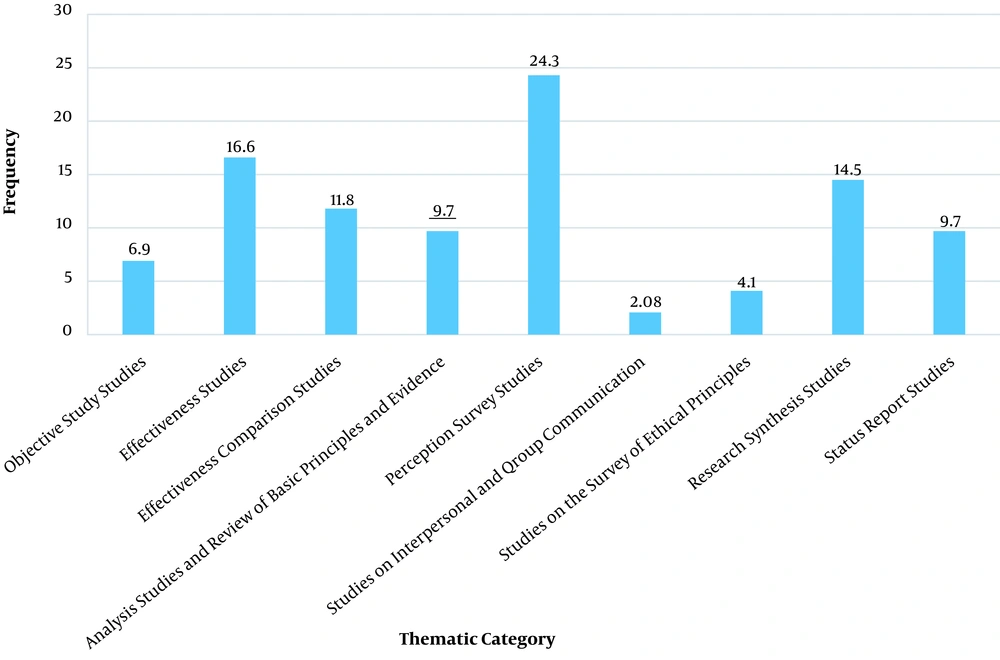
Figure 1.
The thematic distribution of master's dissertations in the field of medical education
The distribution of the keywords used in 144 master's dissertations in medical education was evaluated, and according to an overview on the content of these keywords, 10 different groups were identified. Most of the keywords were related to the dissertations conducted in the field of "education", and in this group, the keyword "education" had the highest frequency followed by the keywords of medical education, clinical education, and educational design. Only 23.3% of the keywords were single words, and the rest included combinations of two (65.5%), three (8.2%), and four (3%) words. The distribution of the keywords used in these dissertations has been presented in Figure 2.
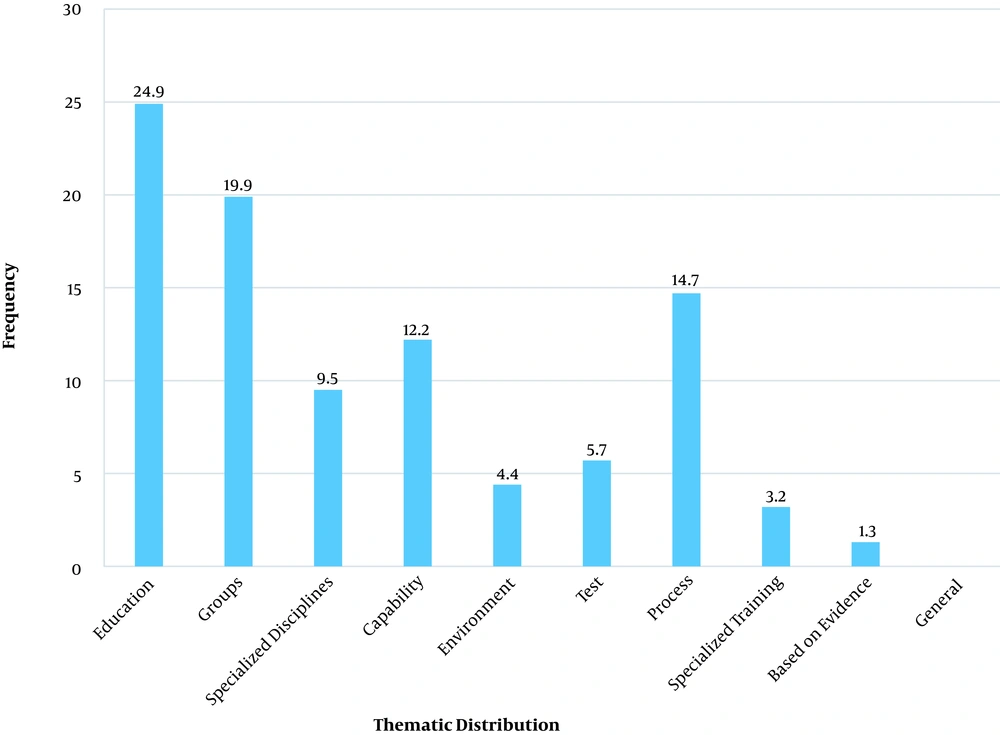
Figure 2.
The thematic distribution of master's dissertations in medical education based on the used keywords’ contents
Regarding the distribution of the types of master's dissertations, seven types of studies were identified (Figure 3).
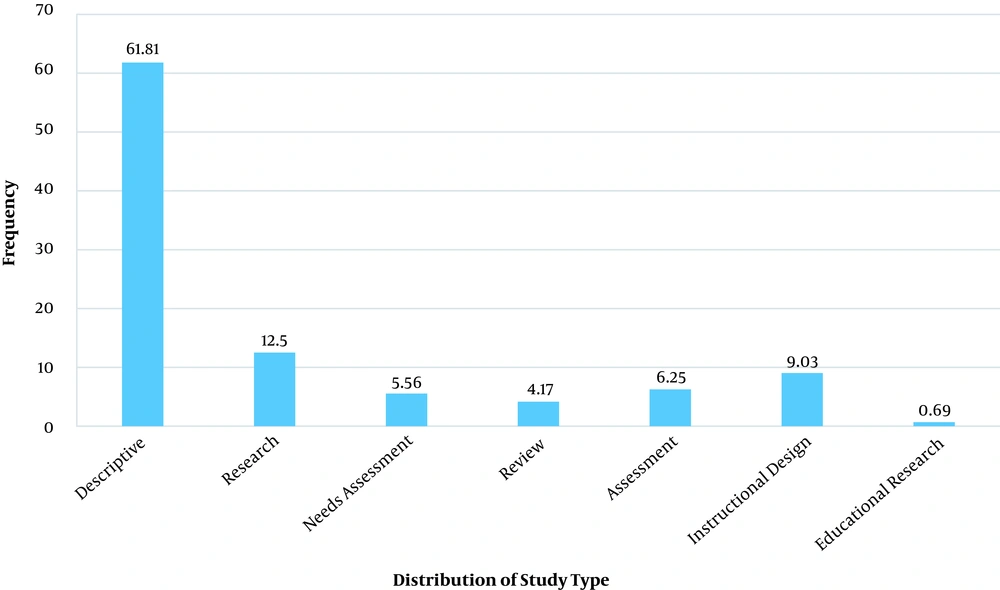
Figure 3.
The types of studies in the dissertations of postgraduate students in the field of medical education
Regarding the data collection tools used in master's dissertations in the field of medical education, four types of tools (questionnaire, checklist, interview, and tests) were identified in this study, as shown in Figure 4.
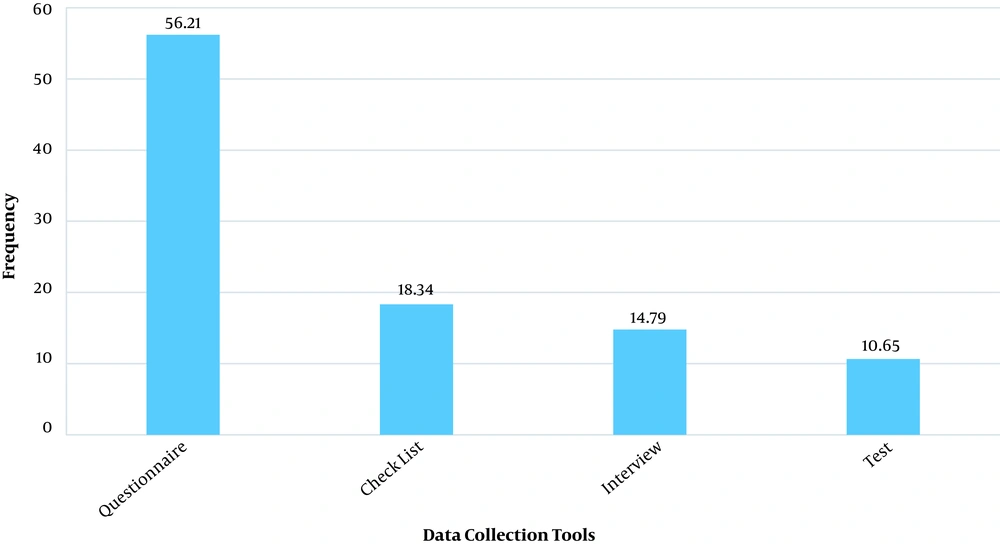
Figure 4.
The data collection tools used in master's dissertations in the field of medical education
Among the 144 dissertations studied, those from which an article was published were extracted. Overall, 51.4% of the dissertations resulted in a publication. Of these, 59.5% published in an English language journal (Figure 5).
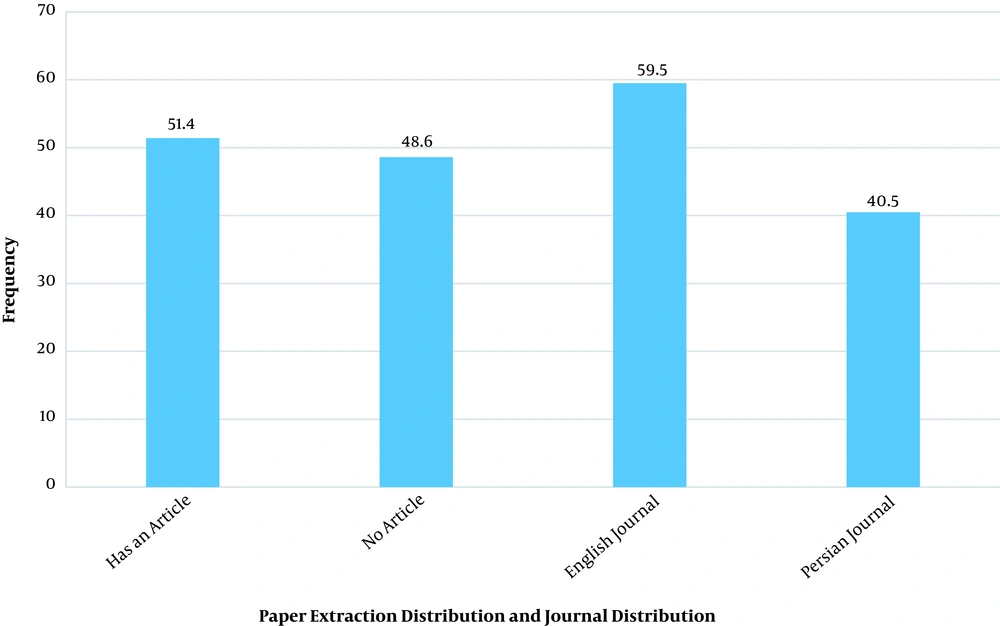
Figure 5.
Paper extraction from the dissertations of postgraduate students in the field of medical education and the language of the journals in which the papers were published.
5. Discussion
In this study, we investigated the thematic distribution of master's dissertations of medical education students graduated during 2011 and 2016 from the Virtual Faculty of Medical Education and Management of Shahid Beheshti University of Medical Sciences. As we observed, there was no balance in the frequencies of dissertations in different subject areas. In this regard, issues such as assessing goals, needs assessment, examining the relationship between individuals, and ethical issues had been less addressed in comparison with other subject areas. Studying perceptions and views has received more attention. This may be due to the lack of a subject area database to provide a basis for prioritizing dissertation topics. By categorizing dissertations thematically, it is possible to identify and consciously compensate for thematic gaps through research assistant planning and guiding students towards choosing appropriate topics for their dissertations.
In this study, to understand the distribution of the keywords used in the master's dissertations of medical education students, we initially reviewed the keywords, and according to their content, identified 10 different groups of keywords. According to the results, the most frequent keywords used in the dissertations evaluated were "education" and then "medical education", "clinical education", and "educational design". Due to the fact that after repeated searches in various databases, we could not find a similar study classifying the keywords, it was not possible to compare our results with those of other studies. However, it seemed logical that the keyword education had the highest frequency. It is recommended to assess the compliance of indexing descriptors and dissertation keywords with the MESH amendment.
Regarding the distribution of the study types of 144 master's dissertations in medical education, seven types of studies were recognized. According to the results, a "descriptive" design was the most popular type. On the other hand, among the four data collection tools used in the dissertations (i.e., questionnaires, checklist, interview, and test), most of the dissertations used questionnaires for this purpose. This finding was consistent with previous studies, including the study of Mansourian and Alipour, who conducted a thematic and methodological analysis on master's theses in social sciences at the University of Guilan (11), the study of Durak et al. (2017) in Turkey that analyzed the content of postgraduate dissertations (between 1986 and 2015) in distance learning at higher education (12), and also a 2010 study by Davis et al. at Bringham University in the United States, who evaluated master's dissertations in distance learning between 1998 and 2007 (13). In the above-mentioned studies, questionnaires were also the most widely used tools for data collection.
To review the articles published from the dissertations of the medical education field, among 144 master's dissertations evaluated, those from which an article was published were extracted. According to the results, it could be seen that an article was extracted from most of the evaluated dissertations. Due to the fact that the extracted articles were not registered in any database in the faculty and the university, it was somehow difficult to find these articles, and there may have been a possibility of error. Overall, it seems that most of the students have tried to publish an article. Among the types of studies resulting in a publication, the needs assessment, and evaluation studies performed better than others. Out of nine evaluation studies, six (66%) resulted in publishing an article while out of eight needs assessment studies, six (75%) published articles. On the other hand, out of 18 research studies, seven had articles, and among 89 descriptive studies, 48 were successful in publishing an article. Finally, three out of six review studies and four out of 13 educational design studies published articles.
Regarding the journal of publication, out of a total of 74 published articles, 59.5% of the articles had been accepted in non-Persian language journals, and 40.5% had been published in Persian journals, indicating a higher frequency of publishing in non-Persian journals