
1. Background
The swift growth of knowledge highlights the critical importance of lifelong learning in education (1). In recent years, there has been significant emphasis on enhancing university environments, mainly through strategies and factors for faculty development (2). University faculty members are at the forefront of social and educational advancement and play a pivotal role in empowerment (3). Specialized training courses are practical tools for faculty empowerment (4). Critical structural elements include establishing a unit for educational development, centers of excellence, and improving faculty members' readiness for e-learning. From a top-down approach, practical strategies for faculty development encompass regular discussions, workshops, financial support, incentives, social learning, mentorship, seminars, reflective practices, feedback mechanisms, and performance assessments (5). Given the global shift towards integrating technology in education, mobile phones have become critical due to their accessibility and the availability of user-friendly educational apps (6), highlighting the importance of mobile technology in new theoretical and academic research domains.
Mobile learning, a sophisticated subset of e-learning, provides learners with easy and unrestricted access to educational content (1, 7, 8). For the implementation of e-learning, establishing the necessary infrastructure, faculty members' mental preparedness, and developing valid instructional patterns are crucial. Various instructional design patterns, each with its unique impact and applications, have been developed to emphasize the creation of an appropriate learning environment (9). The Ashur instructional design pattern, which highlights the active involvement of learners in their education, is noted for its effectiveness (10).
Therefore, given the benefits of e-learning and its particular advantages in medical education, its integration into university educational programs is considered essential. Such integration proposes a blend of conventional and e-learning methods.
2. Objectives
This study aims to design a faculty empowerment application for e-learning at Shahid Beheshti University of Medical Sciences, marking a first in Iran. It underscores the necessity of e-learning in the third millennium, not just as an alternative but as a vital component of education. This research focuses on educational designers and planners, aiming to take a step towards establishing the necessary infrastructure and cultural framework for progressing towards virtual education.
3. Methods
This study marks a pioneering and practical research effort in the medical sciences field at Shahid Beheshti University of Medical Sciences, covering all university professors. The data collection process included a thorough review of scientific texts, extraction of articles from esteemed databases, and examination of course syllabi, workshop programs, and similar materials to identify internal and external study platforms. Furthermore, interviews were conducted with experts in electronic learning and medical education. A questionnaire developed by the researchers was used to evaluate faculty members' educational needs and identify preferences and features for the software environment.
The development of the educational course and the specification of software application features proceeded through the following distinct stages. During the initial literature review stage, eight relevant articles were examined from reputable databases, chosen based on keywords, journal names, publication years, and citation frequencies. These articles were then highlighted according to the study's objectives and organized by topic.
In evaluating workshops and empowerment courses, assessments were carried out on the electronic learning flash course at Shiraz University of Medical Sciences, the advanced empowerment course for professors at Tehran University of Medical Sciences, and the courses on essential teaching skills, memory, and teaching peers at Mah. These evaluations concentrated on educational sections, teaching-learning methods, instructional media, evaluation techniques, and electronic learning platform presence features. Additionally, platforms for educational and empowerment courses, educational management software, and human resources training and empowerment systems at universities in Mazandaran, Tabriz, Arak, and Mashhad were examined. International platforms such as Google Classroom, Blackboard Learn, and D2L Brightspace were also evaluated for graphical features, user experience, menus, modules, portals, interactive capabilities, accessibility, preferences, plug-in options, and support levels.
In the second phase, interviews and consultations with experts in electronic learning, medical education, and software development were carried out. Utilizing purposeful and snowball sampling methods, 7 individuals were chosen for interviews. These interviews included 2 in-person, 2 over the phone and 3 via email. In-person sessions varied from 35 to 60 minutes, while phone conversations were capped at 30 minutes, all conducted with the participant's consent for recording. The email interviews were analyzed and organized into themes covering multidisciplinary areas, electronic testing, electronic learning principles, and content and learning management systems. This process led to the creation of a checklist aimed at identifying users' educational needs, requirements, and preferences concerning software environment features. After receiving feedback and endorsements from consultants, a questionnaire was developed and reviewed for accuracy by 5 e-learning and medical education experts, and its reliability was confirmed with a Cronbach's alpha of 0.724.
This research involved creating a 51-item questionnaire that included demographic information (5 questions), needs assessment for course design (18 questions), and user preferences for platform design (UI/UX) and content (28 questions). Thirty faculty members from Shahid Beheshti University of Medical Sciences, chosen based on having at least 2 years of teaching experience and proficiency in educational technologies, completed the questionnaires online via the Porsline website. The analysis of the data was conducted using SPSS software, focusing on descriptive statistics such as mean, standard deviation, frequency, and percentage.
The design of the empowerment course, informed by the results of this study, adopts a multidisciplinary approach and is delivered through a web and mobile application. The course objectives are conveyed through narratives, textual PDFs, and multimedia content. The learning methods are in line with the needs assessment and principles of electronic learning. Moreover, the software environment, including the graphical user interface, is designed to reflect faculty preferences and the findings of this research.
4. Results
Based on the findings from a final checklist comprising 44 items, a needs assessment questionnaire was developed. Following approval from the supervisory team, this questionnaire was utilized in the design of the educational application (Table 1). The analysis of the responses revealed that out of 30 academic board members, 26 fully completed the researcher-designed questionnaire. Of these respondents, 14 (53.8%) were male, and 12 (46.2%) were female. In terms of academic ranks, 11 (42.3%) were associate professors, 7 (26.9%) were assistant professors, 7 (26.9%) were lecturers, and 1 (3.8%) was an instructor. The range of faculty members' work experience spanned from 3 to 33 years, with an average of 13.2 years.
Table 1.
Final Checklist of Educational and Software Features, Needs, Preferences, and Priorities
| Educational Needs | Software Requirements |
|---|---|
| Explore diverse e-learning methods. | Notifying the news in the specialized field as notification. |
| Familiarity with e-learning theories | Viewing the course calendar |
| Getting to know the principles of e-learning | Access to the digital library |
| Familiarity with e-learning standards | Providing feedback from the course or program |
| Familiarity with content management systems and learning management systems | Connecting cultural-educational centers to the navigation system |
| Familiarity with multimedia and their production | Publication of educational content as a link |
| Familiarity with content authoring software and tools | Access to your emails from within the application and website |
| Familiarity with tools and technologies in e-learning | Receiving educational announcements as notifications |
| Getting to know the evaluation process and its methods in e-learning | Filtered display of educational content (based on criteria such as the newest, most visited, most relevant, etc.) |
| Familiarity with electronic tests (design, execution, and analysis) | Ability to download and save educational files as PDF or PowerPoint |
| Familiarity with the process of designing an electronic learning environment | Displaying professors' information (name, education, resume, photo, contact information) |
| Getting to know the models and design patterns of electronic learning environments | Notifying you of the nearest eLearning training courses or conferences related to this field |
| Familiarity with individual differences and adaptive learning in electronic learning | Giving a pre-test before starting each course |
| Getting to know the types of interactions in e-learning | Having your favorite list and saving your favorite contents and courses in it |
| Getting to know the skills needed by professors and students | Note-taking through the application |
| Getting to know the principles of professional ethics in e-learning | Displaying frequently asked questions (FAQ) as a searchable (search bar) |
| Getting to know how to support the teacher and the learner in e-learning | Displaying programs related to each day as notifications on the home page of the app |
| Familiarity with teaching methods and techniques in electronic learning | Displaying information related to the educational goals of the courses |
| Providing content in the form of written texts, audio files, short clips, working games, simulations | |
| Communicate with your classmates through text messages, voice messages, and video messages. | |
| Having these items in your personal profile: first and last name, educational qualifications, position, work history, and photo. Displaying your university profile information as QR. |
Table 2 showcases the educational needs of faculty members, emphasizing their familiarity with the principles and foundations of electronic learning. The highest level of familiarity was observed with models and design patterns in electronic learning environments, methods and techniques of teaching in electronic learning, and electronic testing. On the contrary, the least familiarity was noted with software and content development tools, as well as with multidisciplinary areas, their production, and content and learning management systems.
Table 2.
The Level of Familiarity of Professors with the Principles and Basics, Concepts, and other Features of E-Learning a
| High Familiarity | Medium Familiarity | Low Familiarity | Very little Familiarity | No Need | Total | Average | |
|---|---|---|---|---|---|---|---|
| The principles of e-learning | 8 | 60 | 16 | 16 | 0 | 25 (100) | 2.4 ± 0.85 |
| Various electronic learning methods | 8.7 | 31.9 | 31.9 | 16 | 0 | 23 (100) | 2.57 ± 0.82 |
| Various e-learning theories | 8.7% | 56.5 | 21.6 | 4.3 | 0 | 23 (100) | 2.39 ± 0.87 |
| E-learning standards | 8.7 | 34.8 | 52.2 | 4.3 | 0 | 23 (100) | 2.52 ± 0.71 |
| Content management system and learning management system | 8.7 | 34.8 | 43.5 | 8.7 | 4.3 | 23 (100) | 0.91 ± 2.65 |
| Multimedia and its production | 4.3 | 31.9 | 30.4 | 21.7 | 4.3 | 23 (100) | 2.83 ± 0.96 |
| Content creation software and tools | 4.3 | 30.4 | 43.5 | 16 | 8.7 | 23 (100) | 2.91 ± 0.97 |
| Tools and technologies in e-learning | 8.7 | 48.7 | 30.4 | 8.7 | 4.3 | 23 (100) | 2.52 ± 0.93 |
| The evaluation process and its methods in e-learning | 17.4 | 34.8 | 31.9 | 4.3 | 4.3 | 23 (100) | 2.43 ± 0.97 |
| Electronic tests | 27.3 | 36.3 | 36.3 | 9.1 | 0 | 22 (100) | 2.18 ± 0.94 |
| The level of familiarity with the design process of the e-learning environment | 16 | 52 | 20 | 12 | 0 | 25 (100) | 2.28 ± 0.87 |
| The level of familiarity with models and patterns of designing electronic learning environments | 16 | 56 | 28 | 0 | 0 | 25 (100) | 2.12 ± 0.65 |
| Individual differences and flexible learning | 13 | 43.5 | 34.8 | 4.3 | 4.3 | 23 (100) | 2.43 ± 0.92 |
| The types of interactions in e-learning | 16.7 | 45.8 | 29.2 | 4.2 | 4.2 | 24 (100) | 2.33 ± 0.94 |
| The level of familiarity with the skills needed by professors and students for optimal use of electronic education | 11.5 | 42.3 | 42.3 | 3.8 | 0 | 26 (100) | 2.38 ± 0.74 |
| The principles of professional ethics in e-learning | 12 | 44 | 40 | 4 | 0 | 25 (100) | 2.36 ± 0.74 |
| The level of familiarity with how to support the teacher the learner in electronic learning | 16 | 36 | 48 | 0 | 0 | 25 (100) | 2.32 ± 0.73 |
| Teaching methods and techniques in electronic learning | 20 | 48 | 28 | 4 | 0 | 25 (100) | 2.16 ± 0.78 |
a Values are expressed as No. (%) or mean ± SD.
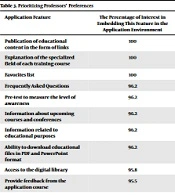
The results of the study highlight the preferences of educators regarding the application environment, as demonstrated through their yes-or-no responses about UI/UX design. The preferences, in order of priority, include the dissemination of educational content links, clarification of the course's specialized field, creation of a wishlist, notification of conferences, pre-course awareness assessment, storage of content in PDF or PowerPoint format, display of course objectives, access to a digital library, educational announcements, an FAQ section, feedback on the course and app, display of personal information, notifications for daily programs, a navigation system for access to cultural-educational centers, content filtering (most viewed, newest, most relevant), and access to a personal website and email within the application.
The findings reveal that respondents display a strong preference for consultation and support through the application, favoring text messages (31%), social networks (15%), phone calls (12%), and email (4%) for communication. Additionally, half of the faculty members express a preference for addressing their inquiries personally or via email, while the other half prefer using discussion forums in courses to post their questions. In terms of course evaluation, a majority of 65.4% opt for "all options," indicating a preference for a combination of online and offline exams and class activities, whereas 15.4% specifically choose online and offline exams.
When considering the mode of teaching delivery, 65% of respondents show a preference for asynchronous teaching methods, in contrast to the 35% who favor synchronous teaching. The analysis indicates that written text (PDF) is the most preferred type of educational content, with an average ranking of 1.96, whereas gamification ranks lowest with an average ranking of 4.42.
Furthermore, a significant 88.5% of respondents (23 individuals) express an interest in having their academic degrees displayed in their profile. Conversely, the least interest is shown in displaying profile photos, with only 46.2% indicating such a preference.
Table 3 shows the professors' priorities regarding the essential features that should be considered in the design of the application environment.
Table 3.
Prioritizing Professors’ Preferences
| Application Feature | The Percentage of Interest in Embedding This Feature in the Application Environment |
|---|---|
| Publication of educational content in the form of links | 100 |
| Explanation of the specialized field of each training course | 100 |
| Favorites list | 100 |
| Frequently Asked Questions | 96.2 |
| Pre-test to measure the level of awareness | 96.2 |
| Information about upcoming courses and conferences | 96.2 |
| Information related to educational purposes | 96.2 |
| Ability to download educational files in PDF and PowerPoint format | 96.2 |
| Access to the digital library | 95.8 |
| Provide feedback from the application course | 95.5 |
| Notification of educational announcements | 95.5 |
| Ability to take notes | 92 |
| Calendar of daily programs | 91.3 |
| Announcement of daily plans | 88.5 |
| Display personal information | 87.5 |
| navigation | 87 |
| Educational content filtering | 84 |
| Ability to access personal email and website | 82.6 |
| News | 69.2 |
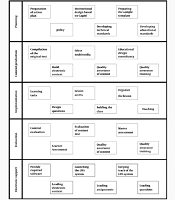
The design of an e-learning course application is divided into two principal components: Instructional design and user interface design. In this context, the instructional design phase, guided by the Ashur model, encompasses several steps: Identifying needs, defining educational objectives, selecting course topics and content, determining required media, choosing teaching-learning methods, strategizing for learner participation, and implementing formative and summative assessments.
The identified needs encompass topics such as the principles and concepts of e-learning, familiarity with standards and learning tools, and recognizing individual differences in e-learning. Based on these needs, educational objectives are established, and course topics and content are developed around principles of e-learning, contemporary technologies, and professional ethics in online education.
Various teaching and learning methods, including assignments, discussions, final exams, and addressing issues through online classes, are incorporated. Additionally, student participation engagement programs have been devised.
In the user interface section of the application, features like sharing educational links, providing information on courses and conferences, downloading educational materials, educational notification alerts, and content filtering are highlighted.
Overall, this application is designed to be a comprehensive and dynamic e-learning tool, utilizing the Ashur model as the foundational guide for instructional design.
5. Discussion
The survey results analysis concerning educational needs shows that faculty members at Shahid Beheshti University of Medical Sciences have the greatest familiarity with models and design patterns in e-learning environments. They are also well-acquainted with e-learning teaching methods and techniques, as well as with the design, implementation, and analysis of electronic testing. The least familiarity was noted with software and content development tools, underscoring the necessity for specialized e-learning courses that focus on these areas.
Reviewing the survey results for application design priorities, faculty members highlight the importance of publishing educational content through links, clarifying the specialized area of each course, and listing favorite topics. Conversely, features such as newsletters, access to email and personal websites, and filtering educational content rank lower in priority.
With an anticipation of future access through web browsers, the application will be developed using server-side coding architecture as a web service. By employing technologies such as Adobe Flash, HTML, JavaScript, CSS, jQuery, Ajax, PHP, and MySQL, the application seeks to align with prior studies in e-learning that demonstrate positive impacts on enhancing the quality of higher education.
The findings of this study align with those of Sarafrazi et al., who explored the role of e-learning in enhancing the quality of higher education. Their research indicated that e-learning contributes to the improvement of higher education quality (11). Similarly, Naderi et al., in their study titled "The impact of mobile-based learning on time and place management, resource management (search and planning), and student opinions on this learning method," found that mobile phone-based course content delivery positively affects time and place management, as well as resource management (search and planning) among students (12). Furthermore, Alami and Pashmforoush, in their research on "Investigating the use of computers, mobile phones, and culture in learning English vocabulary," demonstrated that language learners who underwent online training via computers and mobile phones exhibited a superior ability to recall vocabulary over extended periods (13). Chase et al., in their study "Mobile learning in medicine: Assessing student attitudes and behaviors," concluded that mobile-based learning significantly influences student behaviors and learning outcomes (14), a conclusion that is consistent with the results of our study.
5.1. Research Limitations
The lack of cooperation from some professors in completing the questionnaires due to time constraints was one of the study's limitations.
5.2. Conclusions
The study's findings highlight the increasing and evolving use of technology in education, introducing innovative concepts and methods poised to significantly boost the education sector. This research, which pioneers the design of an educational application for faculty members in medical sciences at a university, represents the first initiative of its kind in the country. It aims to emphasize the critical importance of continual technology integration to enhance the teaching and learning process, thereby laying the foundation for a virtual culture. Positioned as a cultural platform, the application equips academic members with user-friendly and academically relevant features, ensuring swift and easy access. It is recommended that the application design be based on a credible e-learning model, identifying and specifying the user interface features accordingly. Collaborating with e-learning experts and academic members is advisable for content development to boost the effectiveness of empowerment programs. After a pilot implementation, the final version of the application should undergo evaluation, with necessary adjustments made prior to a broader course integration.
5.3. Highlights
- The necessity of designing and implementing university professors' empowerment courses on electronic and user-friendly platforms such as mobile application.
- The necessity of allocating part of the empowerment courses to improve the ability of professors to use new educational technologies.
- The necessity of using valid models of educational design to design empowerment courses and to pay attention to the needs, interests and preferences of users for the design of a software platform.
5.4. Lay Summary
The use of technology and electronic educational platforms such as applications due to their high flexibility, user-friendliness and availability for holding university professors' empowerment courses is inevitable and increasing, and for this purpose it is necessary to rely on the model Valid educational design suitable for such learning environments, the needs, interests and preferences of users, both in terms of the design of the course itself and the features of the software platform for its implementation, should be given serious attention.