
1. Background
Promoting the quality of rehabilitation services is one of the major objectives in the rehabilitation service delivery system in various countries due to its important role in the health and satisfaction of society and the consequences of its deficiencies in different aspects. The rapid population aging will create many challenges for governments and communities as the number of older adults is expected to increase significantly globally due to the aging of the baby boomers (those born between 1946 and 1964) and declining birth rates. One consequence of this demographic shift is a further increase in the demand for long-term rehabilitation care. Between 2006 and 2016, the number of elderly care facilities in China increased from 308,000 to 1.16 million, and elderly beds increased from 1.533 million to 6.272 million (1). The growing number of older adults poses new challenges to satisfaction with rehabilitation services in nursing homes. Service capacity has certain distinctive characteristics: These services must be delivered through highly structured volunteers or stipend roles in "named" programs with an ongoing commitment. Rehabilitation includes various methods rehabilitation professionals can use to improve functions (2). It aims to optimize the functional rehabilitation of individuals in activities that can promote the participation of older people in social activities, promote healthy aging, and improve the quality of life in China. The World Health Group has emphasized the integration of rehabilitation into the health service systems at different levels, the establishment of a special government financial budget system, and the improvement of the capacity and level of rehabilitation services in nursing homes by multi-sectoral cooperation among public organizations, enterprises or non-profit organizations in families, communities and nursing homes, which affects the daily life of older people (3). Promoting the overall care levels of nursing homes is crucial, and those with better service capacity can better meet customers’ needs for various services (4). In the literature, the need for rehabilitation services for older adults in nursing homes has been discussed extensively. Still, no indicative evaluation of rehabilitation services in nursing homes has been conducted. In this context, this thesis assesses the ability of rehabilitation services for older people with mild disabilities in nursing homes. To our knowledge, no researcher in the field has conducted similar studies in the country. This research can contribute to the establishment of a basis for providing better rehabilitation services in nursing homes in the Region.
2. Objectives
This study aimed to derive the capacity of rehabilitation services for older people with mild disabilities in nursing homes.
3. Methods
3.1. Research Design
This study used a quantitative analysis of 120 older adults with mild disabilities. Using MATLAB software to analyze the data hierarchically and assign entropy values, the rehabilitation service capacity of the mildly disabled elderly in the nursing homes was finally extracted. The combined use of hierarchical analysis and entropy method can, on the one hand, weaken the effects of the subjectivity of hierarchical analysis on the results. On the other hand, it can decrease the possibility of the entropy method deviating from reality and provide a more scientific method for evaluating rehabilitation service levels in nursing homes.
3.2. Participants
The participants were selected among older people with mild disabilities in nursing homes. These mildly disabled older adults were studied using the activities of daily living (ADL) scale questionnaire. A non-probability sampling method was also used to select the patients (5). A total of 120 patients (47 males and 73 females) with a mean age of 69 years were enrolled.
3.3. Construction of Evaluation Index System
Analytical hierarchical analysis (AHP) was first introduced in the early 1970s by Professor T.L. Saaty, an American operations researcher. It divides the elements related to the problem into objective, criterion, and solution levels and analyzes the data according to this model.
The application of hierarchical analysis is divided into four steps: The first step is to investigate and study the decision object (6) and divide the factors in the relevant target system into different levels and establish a hierarchical structure model; the second step is to construct a judgment matrix from top to bottom according to the constructed hierarchical structure model by comparing two by two on a scale of 1 - 10; the third step is to solve the maximum eigenvalue of the judgment matrix (7) and pass consistency check; the fourth step is to rank the hierarchy from top to bottom.
The selection of indicators for the evaluation of the quality of rehabilitation services for older people with mild disabilities in urban nursing homes should follow the following principles: (A) functional principle, the selected indicators need to have descriptive, evaluative, and explanatory functions; (B) accessibility principle, the data of relevant indicators can be obtained from authoritative publications and media; (C) comparability principle, the indicators are comparable in terms of meaning, time and space (8) and statistical caliber; (D) completeness principle; (E) non-overlapping principle; (F) combination of quantitative and qualitative indicators (9). Based on the above principles, 30 sub-indicators in 3 categories were selected for the questionnaire.
3.4. Constructing the Judgment Matrix
The judgment matrix was constructed using the 1 - 9 scale method quoted by Saaty and Tavana to represent the two levels of importance (10). Taking the "rehabilitation environment" criterion layer as an example (11). The eight indicators in this layer are compared and ranked according to their importance. Cij is the ratio of the importance of the i-th indicator to the j-th indicator; the judgment matrix A = (Cij) n × n contains nine scales (Table 1).
Table 1.
Importance Levels and Their Assigned Values
| Scale | Meaning |
|---|---|
| 1 | Ci element and Cj element have the same effect |
| 3 | Element Ci has a slightly stronger effect than element Cj |
| 5 | The effect of element Ci is stronger than that of element Cj |
| 7 | The influence of element Ci is significantly stronger than that of element Cj |
| 9 | Ci elements are stronger than Cj elements |
| 2, 4, 6, 8 | The ratio of the influence of Ci elements over Cj elements is between the two adjacent classes mentioned above |
| 1, 1/2,…, 1/9 | The ratio of the influence of element Ci over element Cj is the reciprocal of Cij above |
The RI of the judgment matrix of order 1 - 10 is shown in the following table (Table 2):
Table 2.
RI Values for Matrices of Order 1 - 10
| Order Number | 1 | 2 | 3 | 4 | 5 | 6 | 7 | 8 | 9 | 10 |
|---|---|---|---|---|---|---|---|---|---|---|
| RI | 0.00 | 0.00 | 0.52 | 0.89 | 1.12 | 1.26 | 1.36 | 1.41 | 1.46 | 1.49 |
RI = 0 for n = 1, 2 in the table because the positive reciprocal inverse matrix of order 1, 2 always passes consistency.
3.5. Discriminant Matrix Construction and Solution of the Weights
The importance of the indicators was scored according to the index system. Then the scoring results were discussed and summarized internally to obtain a two-by-two discriminant matrix as follows (Table 3):
Table 3.
Importance of Indicators and Experts' Scores
| Indicators | Rehabilitation Environment | Quality of Rehabilitation Services | Rehabilitation Results |
|---|---|---|---|
| Rehabilitation environment | 1 | 1/3 | 1/3 |
| Quality of rehabilitation services | 3 | 1 | 2 |
| Rehabilitation results | 3 | 1/2 | 1 |
The maximum characteristic roots of the judgment matrix were calculated using MATLAB software. The consistency test of the judgment matrix is performed
Average random consistency index RI = 0.52. Stochastic consistency ratio:
Therefore, the results of the hierarchical analysis are considered to have satisfactory consistency, i.e., the distribution of the weight coefficients is very reasonable. The results of the weights are as follows (Table 4):
Table 4.
Indicator Layers and Weights Calculation Results
| Indicators | Weights |
|---|---|
| Rehabilitation environment | 0.1416 |
| Quality of rehabilitation services | 0.5247 |
| Rehabilitation results | 0.3338 |
3.6. Entropy Method Correction
The calculation principle is:
Step 1: The scale and unit of each indicator are different and cannot be compared and calculated directly; before calculation of each indicator weight, it needs to be standardized:
Step 2: To eliminate negative values for panning, some index values may have small or negative values after standardization. Therefore, for the unity and convenience of calculation, the standardized values are planned to eliminate the above situation (12):
Where H is the magnitude of the indicator panning, generally taken as 1.
Step 3: Dimensionless data reduction using the specific gravity method:
Step 4: Calculate the entropy value of the first indicator:
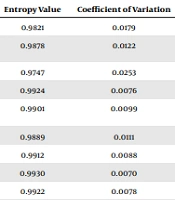
Step 5: The coefficient of variation of the first indicator is:
Among them, j = 1, 2, ….p
Step 6: The j weights of the first indicator are:
Among them, find the combination weights:
(Where wj is the weight of the hierarchical analysis method, and vj is the weight of the entropy value method) (Table 5).
Table 5.
Combined Weights of Each Indicator Under the Entropy Weighting Method Correction
| Indicator Layer | AHP Analysis Weights | Entropy Value | Coefficient of Variation | Entropy Method Weights | Combined Weights |
|---|---|---|---|---|---|
| Rehabilitation environment | 0.1416 | 0.9821 | 0.0179 | 0.3224 | 0.1454 |
| Quality of rehabilitation services | 0.5247 | 0.9878 | 0.0122 | 0.2206 | 0.3687 |
| Rehabilitation results | 0.3338 | 0.9747 | 0.0253 | 0.4569 | 0.4859 |
| Rehabilitation room design | 0.0351 | 0.9924 | 0.0076 | 0.1103 | 0.0320 |
| Ventilation, lighting, and air conditioning facilities | 0.1072 | 0.9901 | 0.0099 | 0.1432 | 0.1270 |
| Health status | 0.0822 | 0.9889 | 0.0111 | 0.1614 | 0.1098 |
| Seat comfort | 0.1243 | 0.9912 | 0.0088 | 0.1277 | 0.1313 |
| Anti-slip facilities | 0.2225 | 0.9930 | 0.0070 | 0.1018 | 0.1875 |
| Privacy | 0.2466 | 0.9922 | 0.0078 | 0.1134 | 0.2315 |
| Quiet level | 0.1223 | 0.9919 | 0.0081 | 0.1181 | 0.1195 |
| Dress code | 0.0597 | 0.9914 | 0.0086 | 0.1241 | 0.0613 |
| Financial input | 0.0168 | 0.9925 | 0.0075 | 0.0872 | 0.0149 |
| Rehabilitator level | 0.1767 | 0.9901 | 0.0099 | 0.1153 | 0.2076 |
| Treatment time | 0.0568 | 0.9900 | 0.0100 | 0.1165 | 0.0675 |
| Respectful treatment | 0.1901 | 0.9917 | 0.0083 | 0.0972 | 0.1883 |
| Treatment | 0.0636 | 0.9903 | 0.0097 | 0.1130 | 0.0732 |
| Human care | 0.2255 | 0.9931 | 0.0069 | 0.0810 | 0.1861 |
| Rehabilitation normalization | 0.1038 | 0.9924 | 0.0076 | 0.0884 | 0.0935 |
| Work system | 0.0375 | 0.9911 | 0.0089 | 0.1034 | 0.0395 |
| Employee input | 0.0394 | 0.9914 | 0.0086 | 0.1009 | 0.0405 |
| Management level | 0.0897 | 0.9917 | 0.0083 | 0.0972 | 0.0888 |
| Blood pressure indicators | 0.1015 | 0.9886 | 0.0114 | 0.0941 | 0.1166 |
| Muscle strength | 0.0257 | 0.9903 | 0.0097 | 0.0796 | 0.0250 |
| Coordination ability | 0.0158 | 0.9934 | 0.0066 | 0.0543 | 0.0105 |
| Body mass index | 0.0184 | 0.9919 | 0.0081 | 0.0667 | 0.0150 |
| Body weight | 0.0995 | 0.9890 | 0.0110 | 0.0904 | 0.1098 |
| Self-washing | 0.1939 | 0.9915 | 0.0085 | 0.0702 | 0.1663 |
| Self-directed toileting and bathing | 0.1958 | 0.9909 | 0.0091 | 0.0747 | 0.1787 |
| Outbound activities | 0.0582 | 0.9879 | 0.0121 | 0.0996 | 0.0708 |
| Self-dressing | 0.1676 | 0.9907 | 0.0093 | 0.0765 | 0.1566 |
| Bed and chair mobility | 0.0296 | 0.9897 | 0.0103 | 0.0847 | 0.0306 |
| Flatland movement | 0.0316 | 0.9874 | 0.0126 | 0.1038 | 0.0401 |
| Solitude relief | 0.0622 | 0.9872 | 0.0128 | 0.1053 | 0.0800 |
Abbreviation: AHP, analytical hierarchical analysis.
4. Results
Based on the weight calculation results above (Table 5), the weight of the primary risk indicators was 0.1454 for the indicator of rehabilitation environment (13), 0.3687 for the indicator of rehabilitation service quality, and 0.4859 for the indicator of rehabilitation effect.
Analyzing and comparing the weighting results of the primary risk indicators demonstrated that the weighting results, in descending order, were: Rehabilitation effect, rehabilitation service quality, and rehabilitation environment. Among them, the rehabilitation effect had the largest weight.
Analysis and comparison of the results of the weights of the secondary indicators revealed that the highest privacy weight in the rehabilitation environment was 0.2315, followed by anti-slip facilities, with a weight of 0.1875. The third was seating comfort, with a weight of 0.1313, and the least was related to rehabilitation room design, with a weight of 0.032. The highest weight of rehabilitation service quality was the level of rehabilitation teachers, with a weight of 0.2076, followed by respectful treatment, with a weight of 0.1883. The third was humanistic care, with a weight of 0.1861, and the least was the health work system, with a weight of 0.0395. The highest weight of rehabilitation service quality was rehabilitation teacher level, with a weight of 0.2076, followed by respectful treatment, with a weight of 0.1883. The third was humanistic care, with a weight of 0.1861, and the least was regarding the wellness work system, with a weight of 0.0395.
5. Discussion
This paper proposes a model for evaluating the level of rehabilitation services for mildly disabled older adults in nursing homes based on an AHP and entropy power method. In this research, the following results were obtained. On the one hand, the target level weights were ranked as rehabilitation quality, rehabilitation effect, and rehabilitation environment according to the expert scoring. On the other hand, the overall satisfaction index of the rehabilitation service of the nursing homes based on 30 indicators was not quite satisfactory. For improvement and enhancement of the service levels, the conclusions of the analysis are discussed as follows.
In the analysis of rehabilitation environment indicators (Table 5), the eight indicators of rehabilitation environment, privacy, and anti-slip design were ranked first. This can be because older people are more concerned about privacy and safety. Moreover, older adults had the lowest requirement coefficients for the rehabilitation room design and the rehabilitation teachers’ dress code, indicating that older people with mild disabilities did not care about the outside environment and paid more attention to their own needs.
The analysis of rehabilitation service quality indicators (Table 5) demonstrated that among the ten indicators of rehabilitation service quality, the level of three indicators of rehabilitation teachers, respectful treatment, and humanistic care had the highest weight. This indicates that the physical and psychological aspects of these older adults are more important. Moreover, the older adults paid more attention to their needs and received respectful services. In the overall service system evaluation, for the mildly disabled elderly in the provision of rehabilitation services, the most important element was humanistic care, which includes communication and conversation with the rehabilitators during the service project. This can be attributed to the fact that the disabled elderly living in nursing homes tend to be more depressed and have a lower quality of life than those living at home, and they need a companion. Existing quality indicators emphasize physical and psychological care, environmental safety, and administration. However, these issues are demonstrated to be insufficient to meet the requirements and expectations of older adults in nursing homes. Research on how to change long-term care has demonstrated that nursing homes may provide person-centered care (such as creating a home-like environment, encouraging older adults to participate, and providing more alternative options), and the concept of emphasizing the humanistic aspects of the care delivery process could complement existing quality indicators for rehabilitation services (14).
In Table 5, among the 12 rehabilitation effectiveness indicators, the four indicators of independent laundry, independent toileting, bathing, and independent dressing are important, with "dressing" and "bathing" in the instrumental activities of daily living scale (IADL) domain, which seems to be due to the relatively low physical demands of the tasks associated with these activities. Similarly, three of the six programs identified as IADL domains - "caring for family members," "participating in community activities," and "doing light housework" - cross-loaded on the mobility domain, as the decision to place any individual program in a particular domain was based on empirical and conceptual theoretical foundations. This suggests that older adults prefer rehabilitation services that can lead to tangible changes assisting them in coping with their life difficulties and yield practical rehabilitation outcomes (15).
5.1. Limitations
Based on the quantitative studies, it may be argued that the major limitation of this study was related to cognitive bias due to sedative medication in mildly disabled older adults, and this needs to be studied in more depth.
5.2. Conclusions
The findings suggest that older adults with mild disabilities are less concerned with the outside world and more focused on their own needs. Focusing on their emotional adjustment and psychological behavior can effectively improve interpersonal problems in nursing home residents. The perceived importance of humanistic care in the care process suggests that older adults prefer rehabilitation services that can significantly affect their life difficulties and actual rehabilitation outcomes.