
1. Context
Mass-gathering events (MGEs) are planned or spontaneous occasions in which large numbers of people assemble at a specific location within a defined period, often exceeding the routine capacity of local health systems and infrastructure (1, 2). These events include international sporting competitions, religious pilgrimages such as Hajj, cultural festivals, political gatherings, and other large-scale social occasions (1). Their risk profile is multifactorial and dynamic, encompassing physical hazards such as crowd-crush incidents, communicable disease outbreaks facilitated by close human contact, environmental stressors, and psychological consequences that affect both participants and responders (1, 3, 4). Effective risk mitigation requires public health planning, surveillance, and coordinated emergency response mechanisms.
Beyond the absolute number of attendees, health systems are increasingly challenged by unpredictable emergencies that may emerge rapidly during MGEs, including infectious disease threats, security incidents, and environmental extremes (5, 6). Conventional health care delivery models, designed primarily for routine and predictable demand, often struggle to manage the sudden surge in service needs associated with these events (2, 7, 8). Consequently, MGEs require highly coordinated, multiagency responses involving health care providers, public health authorities, emergency medical services (EMS), security forces, and psychosocial support teams (6). Despite growing recognition of these complexities, important gaps persist in education, preparedness, and operational integration across professional disciplines, exposing health systems to avoidable vulnerabilities during MGEs (9, 10, 11).
2. Evidence Acquisition
This study used a structured narrative review approach to ensure a comprehensive analysis. The search strategy targeted peer-reviewed journal articles, international health reports, and retrospective case studies of major MGEs.
Search terms included “mass gatherings,” “interprofessional education,” “health system resilience,” “disaster preparedness,” and “collaborative practice.”
The selection criteria focused on literature addressing the intersection between educational frameworks and emergency response in large-scale congregations.
Data were synthesized using a thematic analysis approach, focusing on three dimensions: 1) historical failures due to fragmentation, 2) the theoretical benefits of IPE, and 3) practical barriers to implementation.
3. Results
3.1. Challenges of Health Systems in Mass-Gathering Contexts
Conventional health care systems are primarily designed to operate under relatively stable demand conditions, with predictable patient flows and episodic care-delivery patterns (8, 9). In contrast, MGEs generate rapid and often nonlinear increases in health care demand, commonly conceptualized as surge-capacity requirements, which challenge the structural, operational, and human resource limits of health systems (7, 8). Surge capacity extends beyond physical assets such as hospital beds, ambulances, and equipment and includes the availability of skilled personnel trained in emergency care, trauma management, infectious disease control, mental health support, and large-scale coordination (6, 8).
Frontline responders, including physicians, nurses, emergency medical technicians, paramedics, security personnel, and incident managers, often operate under extreme constraints. Time pressure, prolonged working hours, communication barriers, fatigue, and adverse environmental conditions, such as heat, noise, and overcrowding, are common features of MGE settings (4, 8). These stressors heighten situational uncertainty and increase the likelihood of breakdowns in patient triage, transportation logistics, and continuity of care (4, 12). Evidence indicates that fragmented, discipline-bound responses limit system efficiency and compromise patient safety, underscoring the need for integrated, team-based approaches (13, 14, 15).
Another challenge is the dynamic evolution of risk during MGEs. Events initially considered well managed may escalate rapidly because of unforeseen triggers, such as abrupt weather changes, public health threats, or security incidents (16). Managing such complexity requires flexible, multidimensional response mechanisms supported by strong coordination, adaptive leadership, and shared situational awareness across professional and organizational boundaries (13).
3.2. Critical Incidents Highlighting the Consequences of Fragmentation
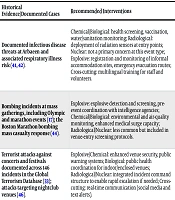
Historical analyses of MGEs demonstrate that insufficient coordination and fragmented response structures can exacerbate morbidity and mortality. The 2015 Mina stampede during the Hajj pilgrimage resulted in thousands of fatalities and injuries and revealed serious deficits in communication, situational awareness, and coordination among medical, emergency, and security services. Investigations highlighted the absence of a shared operational picture, unclear role delineation, and limited interoperability between responding agencies as key contributors to the scale of the disaster.
Similarly, the Kiss nightclub fire in Brazil in 2013 illustrated the devastating effects of siloed emergency responses. Failures in coordination among firefighters, EMS, and crowd-management teams delayed rescue operations and increased casualties (16). These incidents underscore a recurrent pattern in MGE-related emergencies: The absence of integrated training and collaborative operational frameworks can translate directly into preventable losses.
In contrast, responses to the COVID-19 pandemic, although not involving a traditional MGE, demonstrated the potential benefits of interdisciplinary collaboration. Coordinated efforts involving health care providers, public health authorities, and emergency planners enabled more effective surveillance, communication, and service delivery (14). This experience reinforced the value of cross-disciplinary education and integrated decision-making in managing large-scale health crises.
3.3. Deficiencies in Conventional Education and Training
Despite the complex demands of MGEs, health professional education remains predominantly discipline-specific, with limited emphasis on collaborative competencies (9, 10, 11). Undergraduate and postgraduate curricula in medicine, nursing, public health, and emergency management frequently prioritize technical skills while neglecting structured training in interprofessional communication, teamwork, and shared leadership (10, 11).
Disaster-preparedness training, when available, is often delivered through isolated workshops or short courses rather than as a longitudinal, integrated component of formal education (9). Such episodic approaches fail to cultivate deeply embedded collaborative skills that are essential for high-stress and rapidly evolving environments (4). The absence of shared terminology, mutual understanding of roles, and common goals among professional groups perpetuates operational silos and reduces system readiness during MGEs (13, 17).
3.4. Interprofessional Education as a Core Enabler
Interprofessional education is a learning process in which students or practitioners from different professional backgrounds learn together to improve collaboration and health outcomes (18, 19). By learning with, from, and about one another, health professionals develop a more holistic understanding of patient care and crisis management (20, 21).
Within the context of MGEs, IPE plays a pivotal role in strengthening shared situational awareness, clarifying professional boundaries, building mutual trust, and fostering distributed leadership capacity. Evidence indicates that IPE enhances teamwork, reduces errors, and improves operational efficiency during emergencies (18, 19, 20, 21). Simulation-based IPE approaches, including tabletop exercises and scenario-based training, allow interprofessional teams to rehearse realistic MGE situations in safe, controlled environments (17).
To achieve sustained impact, IPE must be embedded within formal educational systems and linked to continuous professional development rather than implemented as an isolated intervention.
3.5. Building Health System Resilience and Sustainability Through Interprofessional Education
Health system resilience refers to the capacity to absorb shocks, adapt to changing circumstances, and maintain essential functions during crises (13). Mass-gathering events act as acute stress tests, exposing vulnerabilities in governance, communication, workforce capacity, and coordination mechanisms (6, 8, 22).
Interprofessional education contributes directly to resilience by enhancing adaptive capacity, facilitating rapid information exchange, and strengthening coordination across professional and organizational boundaries (13). Interprofessional teams are better equipped to recognize emerging risks, adjust response strategies, and deploy resources dynamically. Embedding IPE into core curricula and professional standards supports long-term sustainability by ensuring a workforce that is inherently prepared for collaborative crisis response (17).
3.6. Complex Systems Perspective: Beyond Traditional Training
Mass-gathering events function as complex adaptive systems characterized by nonlinearity, feedback loops, and emergent behaviors (1). Reductionist training models that focus solely on protocols and isolated competencies are insufficient for managing such environments.
Educational strategies must therefore promote systems thinking, enabling professionals to recognize interdependencies, anticipate cascading effects, and operate flexibly under uncertainty. Leadership training should emphasize coordination, negotiation, and conflict management across multiple stakeholders, including health care, security, emergency management, and community organizations (13).
3.7. Leveraging Educational Infrastructure and Workforce Development
Formal disaster-medicine and emergency-preparedness programs, such as postgraduate degrees and national curricula, provide important platforms for institutionalizing IPE (23). Integrating interprofessional competencies into accreditation standards and workforce-development policies reinforces consistency and scalability.
Emergency medical services play a critical role in MGEs, and targeted interprofessional training for EMS personnel, hospital teams, and public health authorities strengthens continuity of care across the response spectrum (12).
4. Discussion
Mass-gathering events function as complex adaptive systems in which health risks evolve dynamically through nonlinear interactions among environmental, behavioral, infrastructural, and organizational factors (1). Evidence synthesized in this review indicates that the predominant challenge in MGE health management is not merely resource scarcity but fragmented professional roles and the absence of shared operational frameworks. Traditional education models, which are deeply siloed, discipline-specific, and protocol-centered, fail to prepare health personnel for the relational, cognitive, and coordination competencies required in these high-density, time-compressed environments (10, 11).
Historical analyses of critical incidents, including the 2015 Mina tragedy, consistently demonstrate that delays in situational awareness, incompatible communication systems, and unclear interprofessional responsibilities can substantially exacerbate morbidity and mortality. Investigations following such events highlight the absence of a shared operational picture and limited interoperability among responding agencies as key contributors to the scale of the disaster. These recurring patterns underscore that operational failures are often systemic rather than individual, arising from weak interprofessional linkages rather than deficits in technical skills (13).
The findings of this review reaffirm that IPE provides a crucial mechanism for addressing these systemic vulnerabilities. Interprofessional education strengthens shared mental models, improves distributed leadership, enhances trust, and fosters real-time coordination, all of which disaster medicine and resilience science identify as foundational for effective response in rapidly evolving scenarios (20, 21). Importantly, IPE extends beyond joint learning; it represents a paradigm shift toward systems-based thinking in which responders perceive themselves as interconnected nodes within an integrated emergency ecosystem (13).
Furthermore, aligning IPE with emerging digital platforms and workforce-development policies can substantially accelerate readiness across all levels of the health system (23). Integrating IPE into organizational doctrine, from academic curricula to emergency operations policies, builds long-term institutional memory and enhances adaptability during MGEs. Thus, the challenge is no longer the conceptual recognition of IPE’s importance but its systematic implementation through structured educational pathways, accreditation requirements, and multiagency exercises.
4. Conclusions
Mass-gathering events pose escalating, multidimensional challenges for health systems worldwide. As demonstrated in this review, fragmented professional silos and discipline-specific training models are inadequate for managing the dynamic, nonlinear pressures inherent in MGEs. Interprofessional education emerges as the critical missing link for building health systems that are integrated, adaptive, and resilient (12).
By embedding IPE across educational structures, organizational policies, and operational practices, and by reinforcing it through systems thinking, simulation-based training, and workforce development, health systems can achieve a more coherent, coordinated, and anticipatory response capacity. As MGEs continue to expand in scale and complexity, strengthening interprofessional collaboration is not merely an enhancement but an essential pillar of global health security and sustainable preparedness.
4.1. Practical Recommendations for Policy and Practice
To operationalize IPE in the context of MGEs, the following actions are proposed:
1. Institutionalize multiagency simulation: Health ministries should mandate joint simulation-based training, including tabletop and field exercises, involving EMS, hospital staff, security forces, and nongovernmental organizations at least 6 months before scheduled MGEs.
2. Develop unified communication protocols: A common-language framework should be developed and taught in IPE modules to prevent terminology-related delays during triage and surge transitions.
3. Integrate longitudinal curricula: MGE-specific IPE competencies should be embedded into undergraduate and postgraduate curricula in medicine, nursing, and public health, rather than delivered only through short-term workshops.
4. Use digital collaboration platforms: Virtual reality and artificial intelligence-driven platforms may be used for interprofessional team training, enabling responders from different geographic locations to synchronize their roles in simulated high-pressure MGE environments.