
1. Background
Multiple sclerosis (MS) is an autoimmune disease of the central nervous system characterized by focal areas of demyelination in the white matter of the cerebral and spinal nerves. The loss of myelin hinders the transmission of nerve impulses. While the damage to neuron axons can sometimes be mild and reversible, in most cases, these injuries are progressive, resulting in permanent loss of nerve cell function (1). Multiple sclerosis affects 2 to 5 million people worldwide (2). In Iran, there is an estimated average of 80 000 MS patients (3). According to the 2013 disease atlas, Iran falls within the medium prevalence range, with 20 to 60 cases per hundred thousand people (1). The increasing prevalence of MS in recent years underscores its significance in our country (4). Multiple sclerosis not only poses a significant health challenge but also imposes an economic burden in terms of patient care costs and treatments, as well as the reduced economic productivity of affected individuals (5). The onset of this disease typically occurs between the ages of 20 to 40 years, with women being 2 - 3 times more likely to be affected than men. This age range coincides with important family and social responsibilities (6-8).
Fatigue is a primary symptom of MS, experienced by 76 to 97% of patients (9). Fatigue is described as a mental or physical lack of energy perceived by the individual or caregiver, interfering with normal and desired activities (10, 11). The nature of fatigue associated with MS is more profound than fatigue in healthy people or fatigue in other diseases. So that in people with MS, it causes early retirement, reduced working hours and insurance (9, 12-14). According to the National Multiple Sclerosis Association (2021), the top ten causes of fatigue in these patients include mood disorders (such as depression, stress, and anxiety), poor diet, sleep disturbances, bladder problems, pain and muscle spasms, decreased physical activity/muscle weakness, environmental factors, and drug-related side effects (15). Fatigue disrupts the daily lives and personal independence of individuals with MS, causing numerous challenges in areas such as employment, education, finances, leisure activities, and family life, and, ultimately, negative impacts on social and personal relationships, quality of life, and mental well-being (16-19).
Nurses can empower patients to enhance their daily functioning by recognizing their crucial role in caring for chronic patients and helping them manage their symptoms, such as fatigue, stress, anxiety, and overall well-being (20, 21). While various educational methods are available, traditional approaches may not adequately address the rapidly evolving information and educational needs of individuals with chronic conditions (22). Additionally, ongoing monitoring of chronic disease patients has become a significant challenge for healthcare systems aiming to deliver prompt and effective services (23). Therefore, exploring the impact of innovative communication methods on these patients is recommended. One of the important methods in teaching self-care programs is telenursing (3), which is a vital component of modern nursing care and offers a solution to improve the quality of care and provide efficient access to nursing services, overcoming geographical barriers that affect long-term health. It empowers patients and supports their families through various communication technologies, including telephone, computer, SMS, electronic learning tools, internet, email, websites, and smartphone applications. Telephones are widely used in developed countries due to their affordability and accessibility (5, 24-26). According to Khazaeili et al., there has been a rapid increase in the use of digital and remote communication technologies for MS patients, driven by factors such as mobility limitations, travel expenses, time constraints for consultations and treatments, and the shortage of specialized services available (27).
Patient education is a time-consuming aspect of healthcare services, prompting a need to explore the effectiveness of different educational strategies in this domain (28). Bektas et al. reported that web-based education can enhance disease management and reduce symptom burdens (29).
However, despite the profound impact of patient education, various obstacles hinder its implementation, such as patient anxiety, physical limitations, and nurses’ lack of knowledge and skills regarding educational procedures (30). Given the importance of implementing educational programs to enhance the health and quality of life of chronic patients, especially those with MS who may experience fatigue and have difficulty attending face-to-face sessions, remote nursing offers increased flexibility (31). This approach offers several advantages, including time savings, remote education, and follow-up, and the elimination of the need for physical presence during training sessions for both patients and nurses. Today, there is still less attention given to the issue of providing self care programs based on accompanying health, especially in the common problems of MS patients (3). Nevertheless, further investigation is necessary to assess the advantages and disadvantages of this method compared to traditional face-to-face training methods.
2. Objectives
This study aimed to examine the impact of mobile health self-care training on fatigue in MS patients in Zahedan in 2023.
3. Methods
This quasi-experimental study involved two groups and was conducted with the research population consisting of all MS patients referred to the Zahedan Multiple Sclerosis Association in 2023. Inclusion criteria were literacy in reading and writing, having a record at the Multiple Sclerosis Association, access to a mobile phone and the Internet, a minimum disease history of 1 year, an Expanded Disability Status Scale (EDSS) score ≤ 4 (indicating sufficient self-care ability), and not being part of the treatment staff. Exclusion criteria included a person’s refusal to participate further in the research and the occurrence of a severe stressful event during the study.
The sample size for each group was determined to be 8 based on the mean fatigue score from a similar study involving MS patients. The calculation considered a 95% confidence interval and 95% test power using the following formula (32):
Where Z1 - α/2 = 1.96; Z1 - β = 1.64; S1 = 1.96; S2 = 1.70;
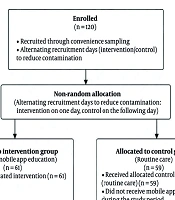
To ensure an adequate sample size, accounting for possible dropouts, 40 individuals were included in each group, resulting in a total of 80 participants. Simple random assignment was employed to allocate selected patients to either the control or intervention groups. In this method, the first sample was assigned to the intervention or control group through a lottery process, followed by alternately placing the subsequent research units into each group.
Subsequently, the researcher collected data on patient characteristics and fatigue through patient interviews. A demographic information form was utilized to record patient characteristics, encompassing sex, age, employment status, education level, marital status, ethnicity, duration of MS, number of hospitalizations in the past year, number of disease attacks, changes in the dosage of disease-modifying drugs, and management of disease complications. The EDSS was administered to assess the participants’ level of disability. Scores on this scale range from 0 (normal neurological examination) to 10 (MS-related death). Lower scores indicate less severe disability, while higher scores indicate greater disability. A neurologist conducted the grading, and the questionnaire’s validity and reliability were previously confirmed. Cronbach's alpha of 0.82 is mentioned in the instrument manual for reliability, and in this study, reliability was not measured again for this tool (33).
The Fatigue Severity Scale (FSS), developed by Krupp et al., measured fatigue in MS patients. This tool consists of 9 items, with 5 items assessing the quality of fatigue, including physical and mental fatigue, and the impact of fatigue on the individual’s social status. Additionally, 1 item compares the intensity of fatigue with other symptoms experienced by MS patients. Each question is scored on a scale from 1 to 7, with the fatigue score ranging from 9 to 63. Higher scores indicate more significant fatigue. Responses are scored on a 5-point Likert scale, where a score of 1 indicates complete disagreement with the statement, and a score of 7 indicates complete agreement (34). The validity of the questionnaire has been confirmed and its reliability has been confirmed with Cronbach's alpha coefficient of about 96% (35). In the current study, the tool’s reliability was further confirmed with a Cronbach’s alpha value of 0.85.
First, the neurologist completed the EDSS by conducting a face-to-face interview with the patient at their bedside. Patients who scored higher than 4 were not included in the study. Then, participants in both the intervention and control groups completed the demographic information form and FSS through face-to-face interviews.
In the intervention group, patients participated in a mobile health training program via a website created by the researcher. Patients in this group received fatigue self-care training through podcasts and videos, and they were provided with information about the website’s address and how to use it. Each patient was assigned a unique ID and password. The training content was uploaded to the site every week for 6 weeks on Saturdays, and patients could ask the researcher questions at any time by leaving a text or voice message. The researcher responded to their queries through podcasts or text messages. The implementation of the program was also followed up with weekly phone calls on Wednesdays for 6 weeks, with one call each week.
Two months after the initial measurement, the researcher conducted face-to-face interviews with patients at the Multiple Sclerosis Association to complete the FSS once again. Patients in the control group received the usual training provided by the staff of the Association. Two months after the initial assessment, the control group patients were interviewed in person to complete the FSS questionnaire.
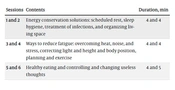
As presented in Table 1, the mobile health training program primarily focused on strategies to reduce and manage the causes of fatigue, along with energy conservation methods. All sessions were conducted through the researcher’s video clips and podcasts, using simple and understandable language without any medical jargon.
Table 1.
The Content of the Mobile Health Training Program
| Sessions | Contents | Duration, min |
|---|---|---|
| 1 and 2 | Energy conservation solutions: Scheduled rest, sleep hygiene, treatment of infections, and organizing living space | 4 and 4 |
| 3 and 4 | Ways to reduce fatigue: Overcoming heat, noise, and stress, correcting light and height and body position, planning and exercise | 4 and 4 |
| 5 and 6 | Healthy eating and controlling and changing useless thoughts | 4 and 5 |
The collected data were analyzed using SPSS 26 software. Firstly, the normality of the data was assessed using the Shapiro-Wilk test. Descriptive statistics were used to calculate the frequency, percentage, mean, standard deviation, minimum, and maximum. The paired-sample t-test was employed to compare the mean scores for each group before and after the intervention. Additionally, the independent-samples t-test was used to compare the mean scores between the two groups before and after the intervention. The chi-square test was utilized to determine the frequency of qualitative variables in both groups. Furthermore, ANCOVA was conducted to evaluate the effectiveness of the intervention while controlling for the pretest and the potential effects of some confounding variables. The significance level for the study was set at less than 0.05 (P < 0.05).
4. Results
Based on the analysis of the participants’ demographic data, patients in both the control and intervention groups exhibited homogeneity in terms of demographic and clinical characteristics. This indicates that there was no significant difference between the two groups regarding factors such as age, gender, education, marital status, occupation, and ethnicity (P > 0.05). Additional demographic findings can be seen in Table 2.
Table 2.
Comparison of Demographic Characteristics between the Two Groups a
| Variables and Categories | Intervention Group | Control Group | P-Value |
|---|---|---|---|
| Age | 35.15 ± 8.15 | 34.17 ± 6.56 | 0.55 b |
| Gender | 0.74 c | ||
| Male | 6 (15) | 5 (12.5) | |
| Female | 34 (85) | 35 (87.5) | |
| Education | 0.78 c | ||
| Primary school | 4 (10) | 6 (15) | |
| Diploma | 13 (32.5) | 13 (32.5) | |
| Higher education | 23 (57.5) | 21 (52.5) | |
| Job | 0.96 c | ||
| Unemployed | 9 (22.5) | 9 (22.5) | |
| Housewife | 16 (40) | 15 (37.5) | |
| Employed | 15 (37.5) | 16 (40) | |
| Ethnicity | 0.8 c | ||
| Baluch | 12 (30) | 11 (27.5) | |
| Fars | 28 (70) | 29 (72.5) | |
| Marital status | 0.81 c | ||
| Single | 15 (37.5) | 14 (35) | |
| Married | 25 (62.5) | 26 (65) | |
| Disease duration | 1.87 ± 0.75 | 1.77 ± 0.73 | 0.55 b |
| Number of hospitalizations in the past year | 2.20 ± 0.88 | 2.30 ± 0.91 | 1 b |
| Number of disease attacks | 1.02 ± 0.15 | 1.02 ± 0.15 | 1 b |
| Change in the dose of drugs | |||
| Changed | 0 (0) | 0 (0) | |
| Did not change | 40 (100) | 40 (100) |
a Values are expressed as mean ± SD or No. (%).
b Independent-samples t-test.
c Chi-square test.
According to the study’s data, the average fatigue score of MS patients in the intervention group significantly decreased from 43.47 ± 8.15 before mobile health training to 30.10 ± 8.28 after the training. This reduction was confirmed by the paired-sample t-test (P = 0.001), demonstrating the effectiveness of mobile health training in improving fatigue. In contrast, in the control group, the mean fatigue score of patients increased from 43.72 ± 9.04 to 44.07 ± 9.13. However, this change was not statistically significant (P = 0.69).
The independent t-test revealed that although the average fatigue score of patients in both study groups did not significantly differ before the training (P = 0.89), a significant difference emerged between them after the implementation of mobile health training (P = 0.001) (Table 3). Levene’s test confirmed the assumptions of approximate normality and variance homogeneity, as well as the homogeneity assumption of the regression, based on the non-significant interaction between the independent and dependent variables. Therefore, the prerequisites for conducting the ANCOVA were met (P = 0.001).
Table 3.
Comparing the Mean Fatigue Scores in the Two Groups Before and After the Intervention a
| Group | Pre-intervention | Post-intervention | P-Value (Paired t-Test) |
|---|---|---|---|
| Control | 43.72 ± 9.04 | 44.07 ± 9.13 | 0.69 |
| Intervention | 43.47 ± 8.15 | 30.10 ± 8.28 | 0.001 |
| P-value (independent t-test) | 0.89 | 0.001 |
a Values are expressed as mean ± SD.
The results of the ANCOVA, controlling for the significant effect of pre-test scores, demonstrated that the average fatigue score of MS patients in both groups after mobile health training had a statistically significant difference (P = 0.0001) (Table 4).
Table 4.
ANCOVA Results for the Mean Fatigue Scores
| Source of Changes | Sum of Squares | df | Mean Squares | F | P-Value | Effect Size | Test Power |
|---|---|---|---|---|---|---|---|
| Pretest | 3404.55 | 1 | 3404.55 | 103/78 | 0.0001 | 0.57 | 1 |
| Group | 3798.11 | 1 | 3798.11 | 115/87 | 0.0001 | 0.60 | 1 |
| Error | 2525.8 | 77 | 32.80 | ||||
| Total | 119875 | 80 |
5. Discussion
The present study showed that mobile health training can effectively decreases the fatigue of MS patient. Also, the post-test revealed a significant difference in fatigue scores between the intervention and control groups. In alignment with the findings of this study, D’Hooghe et al. showed that the use of an application with tele-coaching and tele-monitoring capabilities through a smartphone reduces fatigue in patients with MS (9). However, their study focused more on increasing the physical activity of patients through motivational messages and teaching energy conservation methods. In the present study, the intervention sessions included not only energy conservation methods but also strategies to reduce and manage the causes of physical and mental fatigue.
Furthermore, Pottgen et al. demonstrated that telenursing methods (transmitting content based on cognitive behavioral therapy strategies via email) not only reduce fatigue in MS patients but also have a positive effect on their daily life activities and overall quality of life (36). In line with this study’s suggestion, the current study investigated changes and additions to drug treatments after patients entered the study. Connelly et al. also found that educational programs delivered through mobile phones not only improved the treatment process and adherence to dietary requirements among patients but also encouraged innovative approaches to providing better healthcare services to individuals with chronic disorders (37).
Consistent with the current study, Finlayson et al. demonstrated that website-based training significantly reduces fatigue in the intervention group of MS patients compared to the control group (15). Similarly, Kazemi et al. indicated that the use of mobile phone software enhances self-efficacy and treatment adherence in patients with MS (2). In addition to saving nurses time, creating electronic platforms for patients can empower them to manage their disease regardless of time or location. These platforms also serve as valuable resources to keep patients well-informed about their condition.
In contrast to the findings of the present study, Saadatifar et al. revealed that mobile health education, compared to routine education, did not significantly impact treatment adherence in hemodialysis patients (38). Several factors, including differences in society, working methods, the criterion of average media literacy for study entry, and the absence of telephone follow-ups after interventions, could account for this discrepancy. In the current study, telephone follow-ups were conducted, and continuous monitoring of patient performance is expected to contribute to better outcomes. Notably, the positive effect of telephone training and follow-up in reducing fatigue intensity in the intervention group can be attributed to improved communication between nurses and patients, the sense of support provided to patients, and encouragement for effective communication with healthcare providers.
Contrary to the results of the present study, Rietberg et al. suggested that rehabilitation programs do not significantly affect the fatigue of MS patients. These researchers proposed that chronic fatigue in MS patients may remain relatively stable over time, regardless of interventions (39). However, this finding contradicts the outcomes of the present study, which could be attributed to differences in the types of interventions.
Based on the findings of these studies, it is evident that the use of communication technologies allows nurses to deliver high-quality care and education to MS patients, particularly those with limited mobility or living in underserved areas where access to nursing services is challenging. Furthermore, effective management of symptoms associated with this chronic disease enables continuous support and follow-up for patients, regardless of their location. The memory problem of the patients was not solved, but they tired to compensate it by teleplone follow-up.
5.1. Conclusions
The results of this study highlight the positive impact of mobile health training on reducing fatigue in patients with MS. To diversify training methods, enhance patient motivation, save nurses’ time, and reduce costs; it is recommended to incorporate mobile health training into the treatment programs for this patient group to alleviate their fatigue symptoms.